Tag: Doosan Bobcat

  • (034020) DOOSAN ENERBILITY 2025 Outlook: In-Depth Analysis of Stock Forecast & Investment Strategy

    (034020) DOOSAN ENERBILITY 2025 Outlook: In-Depth Analysis of Stock Forecast & Investment Strategy

    The latest DOOSAN ENERBILITY 2025 outlook has sent ripples through the investment community, signaling a significant shift in financial performance for the South Korean industrial giant (KRX: 034020). The company’s projection of a full-year shift to operating and net losses raises critical questions for current and potential investors. What are the underlying factors driving this downturn? How will this forecast impact DOOSAN ENERBILITY stock in the short and long term? This comprehensive analysis will delve into the official disclosures, dissect the market headwinds, and provide actionable investment strategies to navigate the challenges ahead.

    The 2025 Forecast: A Shift into the Red

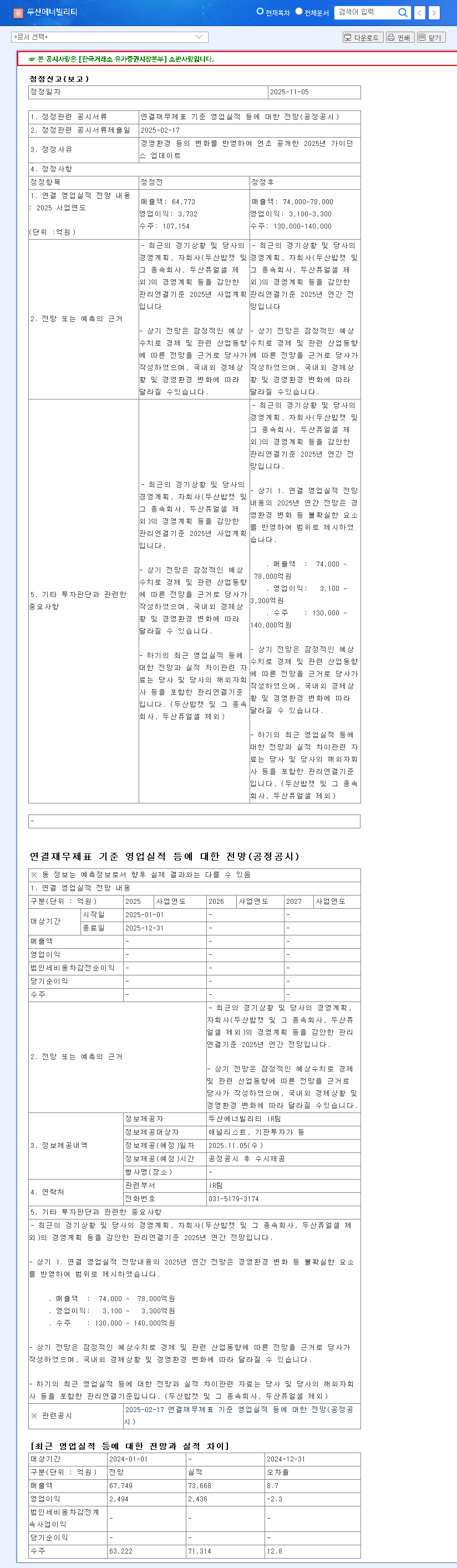
    According to the company’s public filing, the Doosan Enerbility earnings forecast for the full year 2025 points to a stark reversal of fortune compared to the first half of the year. The official numbers, detailed in the Official Disclosure, are projected as follows:

    • Consolidated Revenue: KRW 469.4 billion
    • Operating Profit: KRW -30.8 billion (Shift to loss)
    • Net Profit: KRW -77.1 billion (Shift to loss)

    This forecast confirms earlier warnings of a “significant decrease in sales in the Doosan Enerbility segment” and indicates a challenging second half of 2025, leading to an overall annual deficit. The market’s reaction will hinge on understanding the complex factors contributing to this downturn.

    While the headline numbers are concerning, the underlying story is one of strategic investment amid macroeconomic pressure. The key for investors is to differentiate between cyclical downturns and long-term structural issues.

    Unpacking the Headwinds: Factors Behind the Forecast

    Several converging factors are contributing to the challenging DOOSAN ENERBILITY 2025 outlook. A thorough Doosan Enerbility analysis reveals both external market pressures and internal strategic decisions.

    Macroeconomic and Market Pressures

    • Global Economic Slowdown: Persistent inflation and higher interest rates are dampening global demand. This directly impacts key business units like Doosan Bobcat, which is sensitive to volatility in the global construction market. For more context, see analysis from authoritative sources like Reuters on the global economy.
    • Supply Chain Volatility: Fluctuations in raw material prices, particularly steel and copper, combined with rising global logistics costs, are eroding profit margins on large-scale energy and construction projects.
    • Exchange Rate Fluctuations: As a major exporter and importer, Doosan Enerbility is exposed to currency risks. An unfavorable KRW/USD exchange rate can significantly impact both revenue reporting and import costs.

    Internal Strategic Factors

    • Aggressive R&D Investment: The company is making substantial investments in future growth engines. While critical for long-term value, the high costs of developing SMRs, hydrogen fuel cells, and next-gen gas turbines exert significant short-term pressure on profitability.
    • Doosan Fuel Cell Segment: This division continues to face profitability challenges due to intense market competition and evolving government policies in the renewable energy sector.

    Impact on DOOSAN ENERBILITY Stock (034020)

    The earnings revision is expected to have a dual-phased impact on the DOOSAN ENERBILITY stock price.

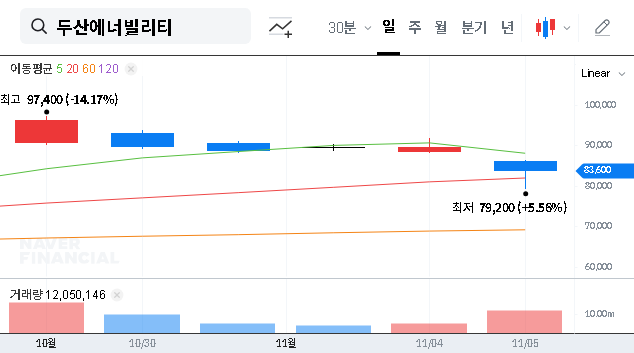
    Short-Term Impact: In the immediate term, the market is likely to react negatively. The shift to a loss is well below prior consensus estimates, which will almost certainly trigger downward pressure on the stock price and a sharp deterioration in investor sentiment. A price correction is highly probable as the market digests this new information.

    Mid-to-Long Term Impact: The long-term trajectory depends entirely on the company’s ability to convert its investments into tangible results. The market will be closely watching for key milestones, such as securing new contracts for Small Modular Reactors (SMRs), commercializing their hydrogen technology, or winning major gas turbine orders. Success in these areas could lead to a significant re-evaluation of the company’s worth, independent of the 2025 results.

    Investment Strategy: Navigating the Volatility

    Given the negative DOOSAN ENERBILITY 2025 outlook, investors should adopt a cautious and strategic approach tailored to their time horizon.

    For the Short-Term Investor

    A defensive stance is recommended. The risk of further downside is high following the announcement. It is prudent to wait for the stock price to stabilize and show signs of a bottom before considering entry. Monitor trading volumes and technical support levels closely.

    For the Long-Term Investor

    The short-term price dip could present a buying opportunity for those who believe in the company’s long-term vision. The focus should be on the fundamental value of its future growth engines:

    • Monitor Progress: Closely track the tangible outcomes from investments in nuclear, SMR, and hydrogen technologies. Look for press releases on new partnerships, orders, and technological milestones.
    • Diversification Value: Acknowledge the role of stable cash cows like Doosan Bobcat, which can provide a financial cushion during this transitional period.
    • Conservative Valuation: Evaluate the company’s potential for profitability improvement from a long-term, conservative perspective. Dollar-cost averaging on significant dips may be a viable strategy to build a position over time.

    Disclaimer: These forecasts are projections and subject to change based on market conditions and company performance. Investors should conduct their own due diligence before making any investment decisions.
    (034020) DOOSAN ENERBILITY 2025 Outlook: In-Depth Analysis of Stock Forecast & Investment Strategy 관련 이미지
  • Doosan Enerbility’s Overseas IR: A Potential Investment Opportunity? Key Analysis and Outlook


    Doosan Enerbility's Overseas IR: A Potential Investment Opportunity? Key Analysis and Outlook 대표 차트 이미지


    1. What’s Doosan Enerbility’s Overseas IR About?

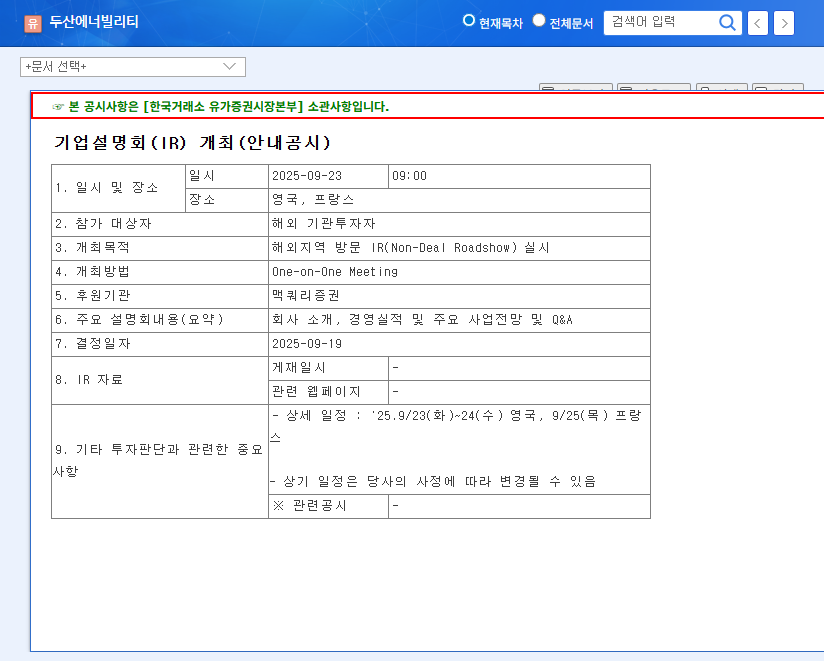
    Doosan Enerbility will hold an IR for overseas investors on September 23rd. The company will present its overview, business performance, future business strategies, and hold a Q&A session. This IR presents a crucial opportunity to showcase the company’s growth potential and build investor confidence.

    2. A Deep Dive into Corporate Fundamentals

    2.1 Core Business Segments: Doosan Enerbility balances stable growth in traditional businesses like nuclear power and gas turbines with investments in new businesses like hydrogen fuel cells. The recent nuclear power plant contract and successful commercial operation of gas turbines are positive signals. However, the decline in operating profit of the Doosan Bobcat segment warrants attention.

    2.2 Financial Health: While the debt ratio remains stable, the decline in consolidated net profit might raise concerns among investors. The planned investment of KRW 2.5 trillion over the next three years is interpreted as a strategic move to secure future growth engines.

    2.3 Market Expectations: The market expects a clear picture of the company’s growth strategy and future vision from this IR. Specifically, clarifying the decline in net profit and presenting concrete plans for new business investments will be crucial.

    3. What Impact Will the IR Have?

    3.1 Positive Impact: The IR allows Doosan Enerbility to actively communicate its vision and growth potential to overseas investors. Emphasizing its competitiveness in the eco-friendly energy sector could attract investment and boost corporate value.

    3.2 Negative Impact: If the IR results fall short of market expectations, it could lead to a decline in stock prices and investor sentiment. Fluctuations in exchange rates and raw material prices are also risk factors.

    4. Action Plan for Investors

    Doosan Enerbility’s overseas IR is considered a positive event from an investment perspective. However, given the recent decline in net profit and market uncertainties, it’s advisable to monitor the IR results and subsequent market reactions before making investment decisions. If the IR provides clear guidelines on the business outlook, active investment can be considered.


    FAQ

    What are Doosan Enerbility’s main businesses?

    Doosan Enerbility operates various businesses including power generation equipment, water treatment facilities, compact construction equipment, and hydrogen fuel cells.

    What are the key topics of this IR?

    Presentations and Q&A sessions will cover company overview, business performance, key business outlook, and investment plans.

    How can I participate in the IR?

    This IR is a private event for institutional investors.

    What should I be aware of when investing?

    It is important to make investment decisions considering the recent decline in consolidated net profit, and fluctuations in exchange rates and raw material prices.


    Doosan Enerbility's Overseas IR: A Potential Investment Opportunity? Key Analysis and Outlook 관련 이미지


  • Doosan Bobcat Investment Strategy After Corporate Briefing: Analyzing Short-Term Uncertainty and Long-Term Growth Potential

    Doosan Bobcat Investment Strategy After Corporate Briefing: Analyzing Short-Term Uncertainty and Long-Term Growth Potential 대표 차트 이미지

    What Happened?: Doosan Bobcat Holds Corporate Briefing

    Doosan Bobcat held a corporate briefing at Korea Investment Week 2025 on September 15, 2025. The company presented its recent performance results and future growth strategies, followed by a Q&A session with investors.

    Why It Matters: Balancing Short-Term Uncertainty with Long-Term Growth

    Doosan Bobcat experienced a decline in performance in the first half of 2025 due to factors such as the global construction slowdown. However, the company maintains long-term growth potential thanks to its strong brand recognition, new technology development, and business diversification. This corporate briefing was a crucial opportunity to accurately diagnose the current situation and assess future strategies.

    Fundamental Analysis: Short-Term Challenges vs. Long-Term Opportunities

    • Short-term threats: Global economic slowdown, raw material price volatility
    • Long-term opportunities: Strong brand power, new technology development (electrification, autonomous driving), hydraulic equipment business acquisition, shareholder return policy

    Investor Action Plan: “Wait and See” Strategy

    • Short-term: Analyze corporate briefing results and monitor macroeconomic indicators
    • Long-term: Make investment decisions after confirming construction market recovery, new business performance, and synergy effects

    It is crucial to carefully review the contents of the corporate briefing and management’s response strategies, and to continuously monitor macroeconomic variables when making investment decisions.

    How was Doosan Bobcat’s performance in the first half of 2025?

    Revenue in the first half of 2025 was USD 3.01102 billion, down 12.26% year-on-year, and operating profit was USD 283.09 million, down 32.19% year-on-year. The deteriorating global macroeconomic environment, including the global construction slowdown, was the main cause.

    What are Doosan Bobcat’s future growth drivers?

    Doosan Bobcat’s future growth drivers include strong brand recognition, development of electrification and autonomous driving technologies, business diversification through the acquisition of the hydraulic equipment business, and an active shareholder return policy.

    What should investors consider when investing in Doosan Bobcat?

    Investors should consider the corporate briefing content, management’s commitment to improving performance and future growth strategies, and macroeconomic variables when making investment decisions.

    Doosan Bobcat Investment Strategy After Corporate Briefing: Analyzing Short-Term Uncertainty and Long-Term Growth Potential 관련 이미지
  • Doosan Bobcat at KB Korea Conference 2025: A Turnaround Opportunity?

    Doosan Bobcat at KB Korea Conference 2025: A Turnaround Opportunity? 대표 차트 이미지

    1. Doosan Bobcat IR Event: What Happened?

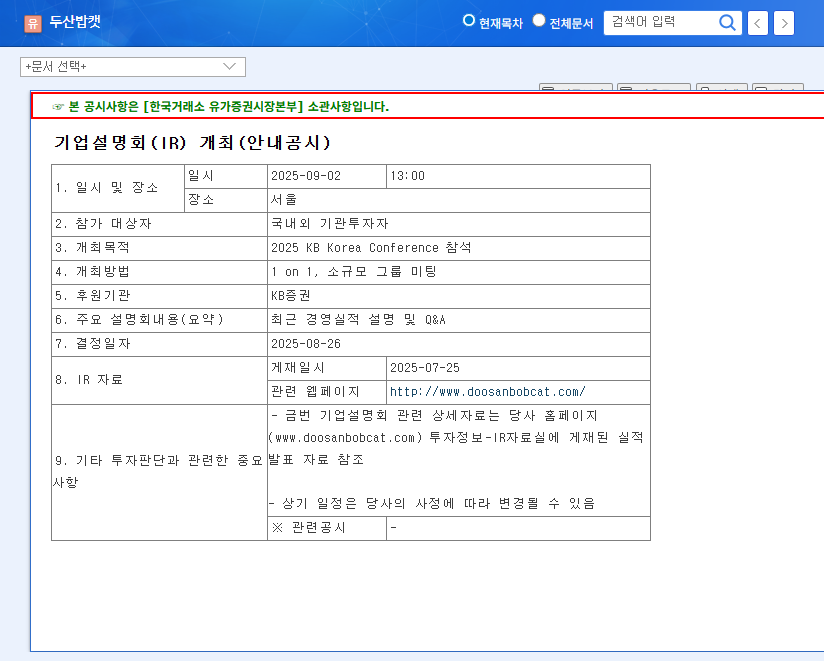
    Doosan Bobcat held an investor relations (IR) presentation at the 2025 KB Korea Conference on September 2nd. The company presented its recent performance results and future business strategies, followed by a Q&A session with investors.

    2. Key Analysis: Why is it Important?

    Doosan Bobcat has experienced a performance slump in recent years. This IR was a crucial opportunity to assess the company’s potential for a turnaround. Investors were particularly interested in the synergy effects following the Doosan Mottrol acquisition and the company’s strategy for securing future growth engines. The company’s response to external factors such as the global economic slowdown and raw material price volatility was also a key concern.

    3. Key Takeaways and Outlook: What’s Next?

    The core messages of this IR were the earnings improvement outlook, the strategy to maximize synergy effects from the Doosan Mottrol acquisition, and the company’s vision for future growth. The stock’s direction will likely depend on whether the company delivered positive messages that met market expectations. Management’s firm commitment to growth and presentation of a concrete action plan will play a crucial role in improving investor sentiment.

    • Positive Scenario: A positive earnings outlook and the presentation of a concrete growth strategy could improve investor sentiment, leading to a potential stock price increase.
    • Negative Scenario: If performance falls short of market expectations or the future outlook is uncertain, the stock price could decline.

    4. Action Plan for Investors

    Investors should thoroughly review the IR materials and related analysis reports, carefully evaluating the company’s medium to long-term growth potential. An investment strategy focused on the company’s fundamentals and future value, rather than short-term stock price fluctuations, is recommended.

    Frequently Asked Questions

    What are Doosan Bobcat’s main businesses?

    Doosan Bobcat’s primary businesses are construction equipment and hydraulics. They recently strengthened their hydraulics business segment through the acquisition of Doosan Mottrol.

    What were the key takeaways from this IR?

    Key takeaways include the outlook for earnings improvement, synergy effects from the Doosan Mottrol acquisition, and strategies for securing future growth engines.

    What should investors be aware of?

    Investors should consider external risk factors such as the global economic slowdown and raw material price volatility. They should also carefully analyze the speed and sustainability of the company’s earnings improvement.

    Doosan Bobcat at KB Korea Conference 2025: A Turnaround Opportunity? 관련 이미지
  • Doosan Enerbility Holds IR: Q2 Earnings and Future Stock Outlook

    1. What Happened?

    Doosan Enerbility participated in the UBS Korea Summit 2025 and held an Investor Relations (IR) meeting on August 25, 2025. The company announced its Q2 2025 earnings and key management updates, followed by a Q&A session with investors.

    2. Why is it Important?

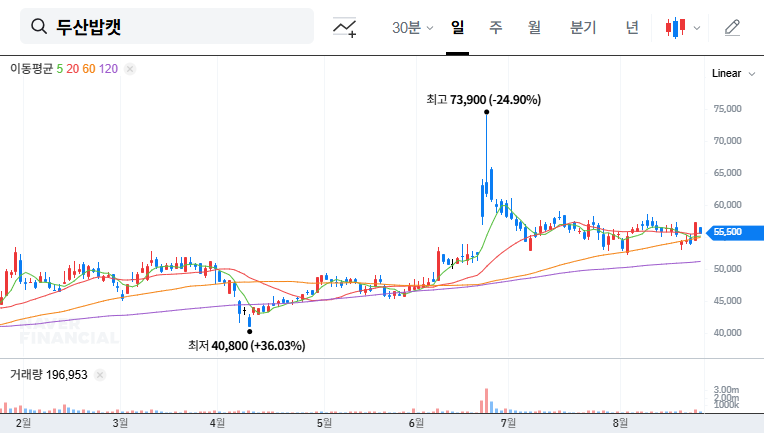
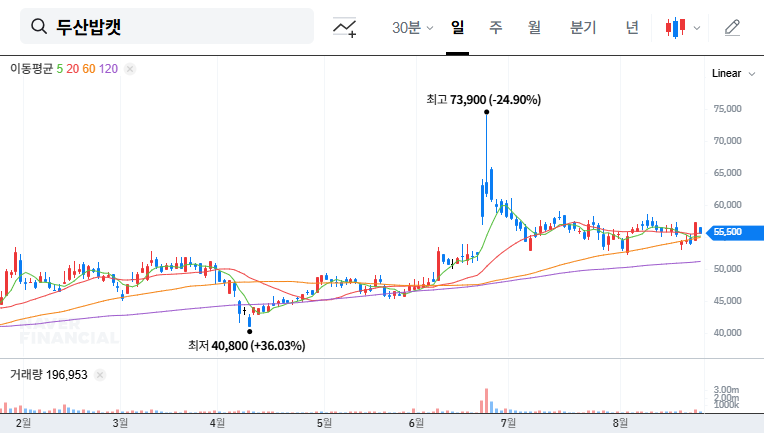
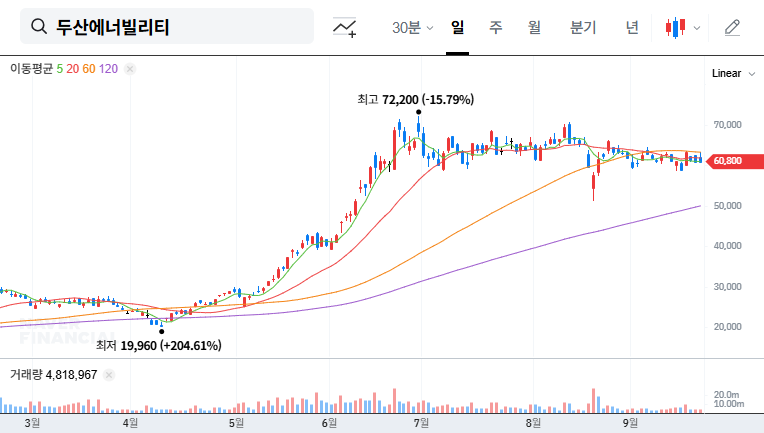
    Doosan Enerbility’s stock price has recently experienced a sharp increase, rising from 37,200 KRW on May 20, 2025, to over 100,000 KRW by August 20, 2025. The Q2 earnings and future business outlook presented at this IR are expected to significantly influence the stock’s future direction. Key areas of interest include the performance of Doosan Bobcat and Doosan Fuel Cell, securing new orders in nuclear and gas turbines, and the outcome of investments in new businesses.

    3. Key Takeaways and Outlook

    3.1 Q2 Earnings Analysis

    Doosan Enerbility’s first-half 2025 earnings showed a significant decline compared to the same period last year. Revenue decreased by 48.7% to 8.3175 trillion KRW, operating profit fell by 59.4% to 413.5 billion KRW, and net income dropped by 63.3% to 176.6 billion KRW. The slowdown in Doosan Bobcat’s performance and declining profitability of Doosan Fuel Cell were cited as primary factors. However, new orders in nuclear and gas turbine sectors are viewed as a positive sign.

    3.2 Investment Highlights

    • Positive Factors: Increased orders for nuclear/gas turbines, investments in new businesses like aircraft engines, and easing of interest rate hikes.
    • Negative Factors: Potential underperformance in Q2 results, continued high interest rates, exchange rate volatility, and increased competition.

    3.3 Future Outlook

    Experts acknowledge Doosan Enerbility’s growth potential, but maintain a cautious stance regarding its short-term stock performance. They recommend a comprehensive evaluation of the Q2 earnings announcement, future business strategies, and macroeconomic factors before making investment decisions.

    4. What Should Investors Do?

    Investors should consider the following factors when developing their investment strategies:

    • Carefully review the IR results, future order outlook, and new business plans.
    • Monitor macroeconomic variables such as interest rates, exchange rates, and commodity prices.
    • Analyze the performance of each business segment: Doosan Enerbility, Doosan Bobcat, and Doosan Fuel Cell.
    • Assess the company’s technological development and ESG management efforts to secure future growth drivers like aircraft engines and SMRs.

    FAQ

    What are Doosan Enerbility’s main businesses?

    Doosan Enerbility operates various businesses including power generation, water, construction, nuclear power, gas turbines, and renewable energy. Its subsidiaries include Doosan Bobcat and Doosan Fuel Cell.

    Why did Doosan Enerbility’s stock price surge recently?

    The surge is attributed to expectations for future growth drivers such as securing large-scale orders in nuclear and gas turbine sectors and entering the SMR (Small Modular Reactor) business.

    What are the key considerations when investing in Doosan Enerbility?

    Investors should consider factors like the performance volatility of Doosan Bobcat and Doosan Fuel Cell, the potential for global economic slowdown, and increased competition. They should also pay close attention to the impact of macroeconomic variables such as commodity prices and exchange rate fluctuations.

  • Doosan Bobcat Q2 2025 Earnings Analysis: Unveiling Opportunities Amidst Construction Downturn

    1. Doosan Bobcat Q2 2025 Performance: What Happened?

    Doosan Bobcat reported a 12.2% YoY decline in revenue to $3.01 billion in Q2 2025. Declining sales in both the Compact Equipment and Material Handling segments due to the construction downturn were the primary factors. Operating profit and net income also decreased by 32.2% and 40.7%, respectively.

    2. Reasons for the Decline: Why Did This Happen?

    External factors such as the global construction slowdown, high interest rates, and rising raw material prices significantly impacted profitability. However, the acquisition of Doosan Mottrol and the subsequent integration of the hydraulics business offer a positive sign.

    3. Positive & Negative Factors: Interpreting the Results

    • Positive Factors:
      • Business diversification through the hydraulics business acquisition
      • Resilient demand in compact construction equipment and agriculture/landscaping markets
      • Investment in future technologies (electrification, automation)
      • Stable financial structure and enhanced shareholder return policy
    • Negative Factors:
      • Declining sales due to the construction downturn
      • Cost pressures from high interest rates and rising raw material/logistics costs
      • Increased exchange rate volatility

    4. Investment Strategy: What Should Investors Do?

    A conservative investment approach is recommended in the short term, closely monitoring macroeconomic indicators and construction market trends. In the medium to long term, investors can consider a dollar-cost averaging strategy, taking into account the synergy effects of the hydraulics business, the growth potential of future businesses, and the sustainability of shareholder return policies.

    Frequently Asked Questions

    What are Doosan Bobcat’s main businesses?

    Doosan Bobcat’s main businesses are Compact Equipment, Material Handling, and Hydraulics.

    What were the main reasons for the decline in Q2 2025 earnings?

    The global construction market slowdown, high interest rates, and rising raw material prices were the primary factors.

    What is the outlook for Doosan Bobcat?

    While there are uncertainties in the short term, Doosan Bobcat is expected to grow in the long term through synergies from the hydraulics business and investments in future technologies.

  • Doosan Q2 2025 Earnings: A Deep Dive into the Results and Future Outlook

    1. Doosan Q2 2025 Earnings Analysis: Below Expectations

    Doosan reported its Q2 2025 earnings on July 25, 2025. While revenue exceeded expectations, operating profit and net profit fell short. Net profit, in particular, saw a significant decline compared to the same period last year.

    • Revenue: KRW 53.464 billion (Consensus +13%)
    • Operating Profit: KRW 3.578 billion (Consensus -24%)
    • Net Profit: KRW 0.786 billion (Consensus -69%)

    2. Factors Behind the Underperformance: Doosan Enerbility and High Debt

    The main reason for the disappointing results was the decline in operating profit at Doosan Enerbility. Despite strong performance from Doosan Bobcat, it was not enough to offset the negative impact from Doosan Enerbility. The company’s high debt level also remains a concern.

    3. Key Takeaways for Investors and Action Plan

    Increased short-term volatility is possible, calling for cautious investment strategies. In the mid-to-long term, investors should focus on Doosan Bobcat’s growth trajectory, Doosan Enerbility’s new business performance, and macroeconomic factors. Key considerations include:

    • Doosan Bobcat growth potential: Monitor the possibility of a slowdown in the North American construction market.
    • Doosan Enerbility’s SMR and hydrogen business performance: The success of these new ventures will significantly influence long-term growth.
    • Macroeconomic factors: Be aware of the potential impact of fluctuations in interest rates, exchange rates, and raw material prices.

    Investor Action Plan:

    • Short-term investors: Exercise caution and consider a wait-and-see approach due to increased volatility.
    • Long-term investors: Monitor macroeconomic conditions and subsidiary performance.

    Frequently Asked Questions

    What are the main reasons for Doosan’s weak Q2 performance?

    The decline in Doosan Enerbility’s operating profit and high debt levels are considered the main factors.

    What is the outlook for Doosan’s stock price?

    Downward pressure is possible in the short term, but the mid-to-long-term trajectory will depend on factors such as Doosan Bobcat’s growth and the success of Doosan Enerbility’s new businesses.

    What should investors be aware of?

    Investors should be mindful of macroeconomic factors and the performance volatility of subsidiaries. In particular, pay attention to the growth potential of Doosan Bobcat and the success of Doosan Enerbility’s new ventures.

  • Doosan Bobcat Aims for $12B Revenue by 2030: Analyzing Opportunities and Risks

    1. What is Doosan Bobcat’s Plan?

    Doosan Bobcat announced its ‘Value-up Program’ targeting $12 billion in revenue by 2030. Key elements include 1) a growth strategy through investment in adjacent businesses and technology companies, 2) enhanced shareholder return policies such as share buybacks and quarterly dividends, and 3) efficient capital allocation for financial soundness.

    2. What are the Positive and Negative Factors?

    Positive Factors:

    • • Shareholder return policies (share buybacks, quarterly dividends, minimum dividend guarantee) can act as momentum for stock price increase.
    • • The credit rating upgrade (AA-) will contribute to reduced financing costs and improved financial stability.
    • • Potential for securing new growth engines through M&A and collaboration with tech companies.

    Negative Factors:

    • • Weak Q1 results and macroeconomic uncertainties (raw material prices, exchange rates, interest rate volatility, global economic slowdown) could dampen investor sentiment.
    • • High dividend payout plans could act as a financial burden.

    3. What Should Investors Focus On?

    Doosan Bobcat’s future stock price will depend heavily on the success of its growth strategy, changes in the macroeconomic environment, and the actual impact of its shareholder return policies. Investors should closely monitor the following:

    • • M&A and technology development performance
    • • Changes in macroeconomic indicators (raw material prices, exchange rates, interest rates, etc.)
    • • Competitiveness compared to competitors

    4. Investment Action Plan

    Short-term investors should be mindful of market volatility, while long-term investors should develop investment strategies focusing on the success of the growth strategy and changes in the macroeconomic environment. Consulting additional analytical data and expert opinions will also be beneficial.

    Frequently Asked Questions

    What is Doosan Bobcat’s 2030 revenue target?

    $12 billion.

    What are the key shareholder return policies?

    Share buybacks, introduction of quarterly dividends, and a minimum dividend guarantee (KRW 1,600 per share).

    What are the key investment risks?

    Weak Q1 performance, macroeconomic uncertainty, and high dividend payout plan.

  • Doosan Bobcat Q2 2025 Earnings: A Deep Dive into the Underperformance and Future Outlook

    1. Doosan Bobcat’s Q2 Performance: What Happened?

    Doosan Bobcat’s Q2 revenue reached ₩22.014 trillion, slightly exceeding expectations. However, operating income and net income declined by 4.1% and 12.9% respectively, falling short of market forecasts. Operating profit margin also saw a slight decrease, indicating weakening profitability.

    2. Why the Underperformance?

    The disappointing results can be attributed to a combination of macroeconomic factors and increased market competition. The continued rise in US interest rates, potential global economic slowdown, and increasing raw material and logistics costs have all put pressure on profitability. Fluctuations in exchange rates and rising interest rates further contributed to the decline by increasing interest expenses.

    3. What’s Next for Doosan Bobcat?

    Despite the Q2 setback, Doosan Bobcat maintains a healthy financial structure and continues to invest in long-term growth, which are positive signs. However, given the ongoing global economic uncertainty, strategic responses such as market diversification, enhanced cost management, product innovation, risk management, and performance monitoring are crucial.

    4. Action Plan for Investors

    • Avoid overreacting to short-term stock price fluctuations and focus on a long-term investment strategy.
    • Closely monitor macroeconomic indicators and market conditions, adjusting your investment portfolio accordingly.
    • Pay close attention to Doosan Bobcat’s future earnings announcements and management commentary to inform investment decisions.
    Q: What were the main reasons for Doosan Bobcat’s Q2 earnings miss?

    A: A combination of macroeconomic factors (rising interest rates, economic slowdown, rising raw material prices, etc.), exchange rate fluctuations, rising interest rates, and increased market competition.

    Q: What is the outlook for Doosan Bobcat?

    A: While uncertainty persists, the company’s healthy financial structure and growth potential, combined with strategic responses, suggest it can continue to grow.

    Q: What should investors keep in mind?

    A: Focus on a long-term investment strategy rather than short-term price fluctuations and closely monitor macroeconomic indicators and market conditions.

  • Doosan Bobcat Announces Dividend: What Does it Mean for Investors? (July 2025 Analysis)

    1. What Happened?: Doosan Bobcat Announces Cash Dividend

    Doosan Bobcat announced a cash dividend of KRW 400 per share (0.7% yield) on July 25, 2025. This decision, made despite a decline in Q1 sales, has caught the market’s attention.

    2. Why?: Background and Implications of the Dividend Decision

    The dividend decision is interpreted as a sign of confidence in improved profitability through price increases and cost management, and a robust financial structure. It also suggests a willingness to enhance shareholder value by providing cash flow to investors. However, there is also the possibility of weakened growth potential due to reduced reinvestment capacity.

    3. So What?: Analyzing the Impact of the Dividend

    • Positive Impact: Potential for improved investor sentiment and short-term stock price increase.
    • Negative Impact: Constraints on growth strategies such as R&D investment, potential weakening of long-term growth potential.
    • Stock Price Impact: Potential for short-term increase, followed by long-term movement dependent on earnings and macroeconomic factors. Volatility expected after ex-dividend date (August 9th).

    4. Investor Action Plan: Future Outlook and Investment Strategies

    Investing in Doosan Bobcat requires a cautious approach. Both the potential for short-term stock price gains and long-term uncertainties should be considered. Continuous monitoring of future earnings announcements, changes in macroeconomic indicators (commodity prices, interest rates, exchange rates), and competitor trends is crucial. In particular, risk management strategies should be developed through sensitivity analysis of commodity price and exchange rate fluctuations.

    How was Doosan Bobcat’s Q1 2025 performance?

    While sales decreased, operating profit margin improved due to price increases and cost management. The Compact Equipment segment accounted for the majority of sales, and the effects of the Doosan Mottrol acquisition are becoming apparent.

    How will this dividend decision affect Doosan Bobcat’s stock price?

    In the short term, it can act as a factor driving up the stock price, but long-term stock price movements will depend on the effects of reduced reinvestment after the dividend, macroeconomic factors, and future earnings announcements.

    What should investors be aware of when investing in Doosan Bobcat?

    Investors should carefully monitor macroeconomic factors such as rising commodity prices, interest rate hikes, and exchange rate fluctuations, as well as competitor trends.