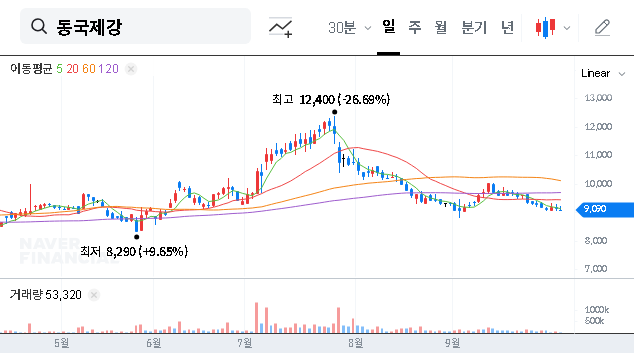
Tag: Dongkuk Steel

  • (460860) Dongkuk Steel Stock Analysis: Is the NPS Stake Sale a Warning Sign?

    (460860) Dongkuk Steel Stock Analysis: Is the NPS Stake Sale a Warning Sign?

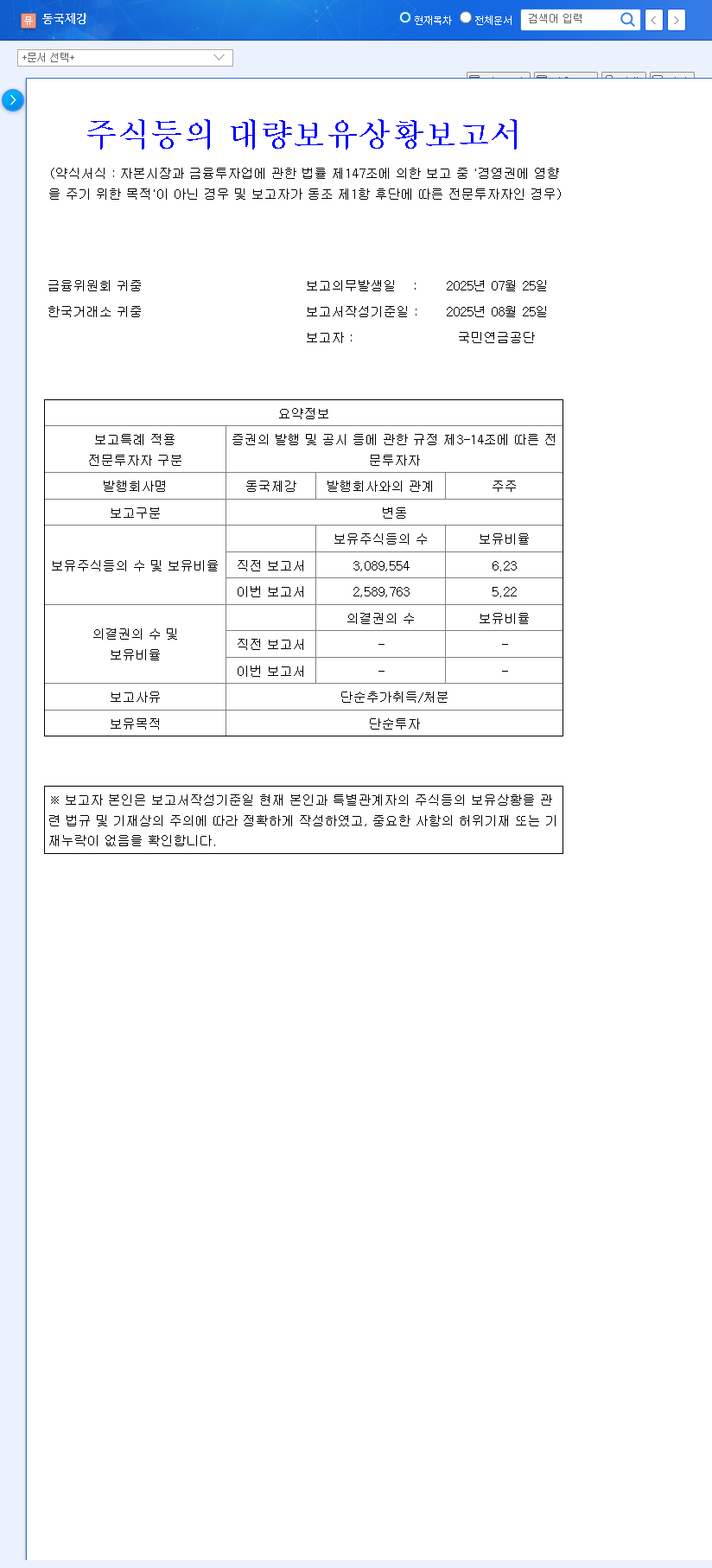
    The recent disclosure from South Korea’s National Pension Service (NPS) announcing a reduction in its ownership of Dongkuk Steel stock has sent ripples through the investment community. When one of the country’s largest institutional investors adjusts its position, the market takes notice. The NPS reduced its stake from 6.23% to 5.22%, a move that raises critical questions for current and potential investors.

    What does this stake reduction truly signify for the future of Dongkuk Steel? Is this a signal of underlying weakness, or merely a portfolio rebalancing? This in-depth analysis will explore the full implications of this event on the Dongkuk Steel stock price, its core fundamentals, and provide actionable strategies for your investment decisions.

    The Disclosure: What Exactly Happened?

    On October 1, 2025, the National Pension Service (NPS) filed an official ‘Report on Major Shareholdings’ concerning Dongkuk Steel (Market Cap: KRW 450.9 billion). The report, available on the public DART system (Official Disclosure), confirmed the key detail: the NPS’s stake in Dongkuk Steel decreased from 6.23% to 5.22%. This 1.01 percentage point reduction was categorized as a result of a ‘simple additional acquisition/disposal’, but the reasons behind such a move warrant a closer look.

    A Deep Dive into Dongkuk Steel Stock Fundamentals

    To understand the NPS’s decision, we must analyze the fundamental health of Dongkuk Steel. The company faces a mix of significant headwinds and promising strategic initiatives.

    1. Challenging Market and Underperforming Earnings

    The first half of 2025 was tough for Dongkuk Steel, primarily due to a broad downturn in the global steel market and a slowdown in the domestic construction sector. Financial results reflected this pressure:

    • Revenue: KRW 1.6192 trillion, showing a notable decline year-over-year.
    • Operating Profit: KRW 34.2 billion, also significantly lower than the same period last year.
    • Key Detractor: Falling export prices for the company’s long and heavy steel products severely impacted profitability.

    2. Future-Oriented Growth Strategies

    Despite the challenging environment, Dongkuk Steel is not standing still. The company is actively pursuing several initiatives aimed at sustainable growth and shareholder value:

    • ‘Steel for Green’ Strategy: A commitment to investing in eco-friendly processes to ensure long-term sustainability and meet ESG demands.
    • GFRP Business Diversification: The company is entering the Glass Fiber Reinforced Plastic (GFRP) market, a high-growth sector. This move diversifies its portfolio away from traditional steel, with sales expected to commence in late 2025.
    • Enhanced Shareholder Returns: Management has raised the minimum dividend to KRW 400 per share for three years and already declared an interim dividend of KRW 200, signaling confidence to the market.

    3. Complex Macroeconomic Factors

    No Dongkuk Steel investment can be evaluated in a vacuum. Broader economic trends play a crucial role. For an in-depth look at market trends, investors often consult resources like the World Steel Association. Key factors include:

    • Exchange Rate: A rising KRW/USD exchange rate (KRW 1,400.50) can be a double-edged sword. While it benefits exporters, it increases the cost burden for companies like Dongkuk Steel that rely heavily on imported raw materials.
    • Interest Rates: Sustained high interest rates increase borrowing costs and can dampen construction activity, a key demand driver for steel.

    Impact of the NPS Sale on Dongkuk Steel Stock

    The sale by a major institutional investor like the NPS sends a powerful short-term negative signal. However, long-term value will ultimately be dictated by the company’s ability to execute its growth strategy and navigate the market recovery.

    Short-Term: Negative Sentiment and Volatility

    The immediate impact is likely negative. The NPS is a market bellwether, and its selling can trigger a decline in investor confidence, putting downward pressure on the Dongkuk Steel stock price. Investors should anticipate increased trading volume and heightened price volatility as the market digests this news. Learning to interpret moves by institutional investors is a key skill.

    Mid- to Long-Term: Fundamentals are Key

    The long-term outlook depends heavily on why the NPS sold. If it was a simple portfolio rebalancing, the impact may be fleeting. If it was based on deep concerns about Dongkuk Steel’s fundamentals, it could signal a prolonged period of weakness. The market will now watch to see if other investors absorb this selling pressure and if the company’s strategic initiatives, like the GFRP business, begin to bear fruit.

    Investor Action Plan: Should You Buy Dongkuk Steel Stock Now?

    Given the disappointing first-half earnings and a high PER of around 40x (as of June 30, 2025), the stock carries a valuation burden. The NPS Dongkuk Steel sale adds another layer of uncertainty.

    • Short-Term (1-3 Months): Caution. It is prudent to wait and observe the market’s reaction. A premature purchase could lead to catching a falling knife. Monitor support levels and wait for signs of stabilization.
    • Mid- to Long-Term (6-12+ Months): Observe and Approach. A successful Dongkuk Steel investment from here hinges on tangible improvements in fundamentals. If the GFRP business shows strong performance and the steel market begins a cyclical recovery, the current price could represent an attractive entry point, especially if the NPS sale proves to be purely strategic.

    Frequently Asked Questions (FAQ)

    What does the NPS’s reduction in Dongkuk Steel stake mean?

    It means the National Pension Service sold a portion of its shares, decreasing its holding from 6.23% to 5.22%. As a major institutional investor, this action is seen as a negative short-term signal that can pressure the stock price.

    What is Dongkuk Steel’s recent financial performance?

    For the first half of 2025, both revenue and operating profit declined compared to the previous year. This was caused by a slowdown in the construction and steel markets and falling export prices.

    What is Dongkuk Steel’s GFRP business?

    GFRP (Glass Fiber Reinforced Plastic) is a new business venture for Dongkuk Steel. It represents a key part of their strategy to diversify and find new growth engines outside the traditional steel sector, with sales planned for late 2025.

    What are the key factors to monitor for Dongkuk Steel stock?

    Investors should closely watch any further selling by the NPS, the actual sales performance of the new GFRP business, the pace of the global steel market recovery, outcomes of any major legal issues, and the company’s overall ESG compliance.
    (460860) Dongkuk Steel Stock Analysis: Is the NPS Stake Sale a Warning Sign? 관련 이미지
  • Dongkuk Steel Cancels Hyundai IFC Acquisition: Analyzing the Impact and Investment Strategy

    1. What Happened? : Hyundai IFC Acquisition Cancelled

    Dongkuk Steel has officially announced its withdrawal from the acquisition of Hyundai IFC. This decision was made after a strategic review focused on strengthening its core steel business.

    2. Why? : Reasons for Withdrawal and Market Reaction

    While market expectations were high for this large-scale M&A, Dongkuk Steel’s weak performance in the first half of the year and concerns about its financial stability likely influenced the decision to withdraw.

    3. What’s Next? : Pros, Cons, and Future Outlook

    Positive Impacts:

    • • Reduced financial burden and increased focus on existing and new businesses (GFRP)
    • • Prevention of increased debt and deterioration of financial health

    Negative Impacts:

    • • Lost opportunity for business diversification and synergy creation through the acquisition of Hyundai IFC
    • • Potential slowdown in short-term growth momentum

    Dongkuk Steel’s stock price is expected to be influenced by its eco-friendly strategies, GFRP business performance, and the recovery of the steel market.

    4. Investor Action Plan

    Investors should pay attention to the following:

    • • Q3 earnings announcement
    • • GFRP business performance and market response
    • • Global steel market conditions and construction industry trends
    • • Updates on ongoing lawsuits and contingent liabilities

    Frequently Asked Questions

    Why did Dongkuk Steel cancel the acquisition of Hyundai IFC?

    Dongkuk Steel withdrew from the acquisition to focus on strengthening its core steel business. The company’s weak first-half performance and potential increase in financial burden were likely factors in the decision.

    How will this decision affect Dongkuk Steel’s stock price?

    In the short term, the stock price is likely to remain stable without significant fluctuations. The mid-to-long-term impact will depend on the company’s eco-friendly strategies, GFRP business performance, and the recovery of the steel market.

    What should investors pay attention to?

    Investors should monitor the upcoming Q3 earnings announcement, GFRP business performance, global steel market conditions, and updates on ongoing lawsuits and contingent liabilities.

  • Hyundai Steel: Decoding the IFC Divestment Rumors and Dongkuk Steel Acquisition

    1. Hyundai Steel’s IFC Divestment: What Happened?

    On April 16, 2025, Seoul Economic Daily reported that Hyundai Steel was considering divesting its IFC, with Dongkuk Steel as a potential buyer. Hyundai Steel officially stated it is ‘reviewing various options to strengthen its business structure and enhance management efficiency,’ with no confirmed decisions. A further announcement is expected by November 13, 2025.

    2. Why Pursue M&A?

    Hyundai Steel faces challenges including a global steel market slowdown, volatile raw material prices, and substantial investment burdens. Divesting IFC could improve its financial structure, while acquiring Dongkuk Steel could streamline its business and boost efficiency.

    3. M&A Impact on Corporate Value

    • Positive Aspects: Enhanced business structure, strengthened ESG management, and maintained financial stability.
    • Negative Aspects: Declining sales and profitability, high investment burden, raw material price and exchange rate volatility, global economic downturn, and M&A uncertainty.

    The impact of the M&A on corporate value depends heavily on whether the deal goes through and its specific terms. Successful M&A could improve business structure and create synergy, but failure could exacerbate existing challenges.

    4. Investor Action Plan

    Investors should carefully consider the M&A uncertainties, the progress of the US electric arc furnace construction, the expansion of eco-friendly steel products, and global economic and raw material price fluctuations. Monitoring the November 13, 2025 announcement for further clarity is crucial.

    Frequently Asked Questions

    Why is Hyundai Steel divesting IFC?

    Hyundai Steel is exploring various options to strengthen its business structure and improve management efficiency, and the divestment of IFC is being considered as one such option. However, nothing has been finalized yet.

    Is the acquisition of Dongkuk Steel confirmed?

    No, the acquisition is not yet confirmed. Hyundai Steel officially stated it is reviewing various options.

    How will the M&A rumors affect Hyundai Steel’s stock price?

    M&A rumors can increase market attention and volatility. Investors should proceed with caution.

  • Dongkuk Steel Exploring Hyundai IFC Acquisition: Opportunities, Risks, and Investment Strategies

    1. Why is Dongkuk Steel Considering Acquiring Hyundai IFC?

    Dongkuk Steel is exploring the acquisition of Hyundai IFC to strengthen its core steel business. Facing declining profitability due to the global economic slowdown and the downturn in the steel market, Dongkuk seeks new growth engines through business diversification. The acquisition is interpreted as a strategy to achieve economies of scale, strengthen market dominance, and secure future competitiveness. For Dongkuk Steel, which has already been pursuing business portfolio diversification through ventures like Glass Fiber Reinforced Plastic (GFRP) business, the potential acquisition of Hyundai IFC is seen as a potential stepping stone for further growth.

    2. What Synergies Can Be Expected from the Acquisition?

    The acquisition of Hyundai IFC is expected to allow Dongkuk Steel to expand its business portfolio and secure new growth engines. It also presents the possibility of improving cost competitiveness and expanding market influence by realizing economies of scale. The positive M&A news could improve investor sentiment and drive up the company’s value.

    3. What Risks Should Investors Consider?

    However, the outlook isn’t entirely rosy. The acquisition is expected to require substantial funds, which could strain the company’s financial structure. There’s also the potential for friction and inefficiencies during the integration of corporate cultures, systems, and organizations. If the acquisition falls through, it could damage the company’s image and credibility and lead to a weakening of focus on its core business. Investors should pay close attention to the ongoing lawsuit regarding rebar bid rigging, as the outcome could exacerbate the financial burden.

    4. Action Plan for Investors

    • • Carefully review the details of Hyundai IFC’s business and financial status as they are disclosed.
    • • Analyze Dongkuk Steel’s financing plans for the acquisition and the projected financial impact, and monitor management’s strategy and communication regarding the acquisition.
    • • Continuously monitor the impact of changes in the steel industry and macroeconomic indicators.

    FAQ

    Q: Is Dongkuk Steel’s acquisition of Hyundai IFC confirmed?

    A: No, it’s not yet finalized. Dongkuk Steel is currently reviewing the acquisition jointly with a financial investor and will make an announcement once details are confirmed.

    Q: How will Dongkuk Steel’s business portfolio change with the acquisition of Hyundai IFC?

    A: The acquisition will allow Dongkuk Steel to expand beyond its existing steel business into new areas. This diversification is expected to contribute to a more stable revenue structure and provide future growth momentum.

    Q: What are the risks associated with the acquisition?

    A: Key risks include the financial burden of financing the acquisition, potential friction during the integration of corporate cultures and systems, and the possibility that the deal may fall through. The outcome of an ongoing lawsuit could also add to the financial strain.

  • Dongkuk Steel’s Q1 Earnings Disappoint Despite Interim Dividend Announcement – What’s Next for the Stock?

    1. What Happened? Dongkuk Steel’s Interim Dividend and Q1 Earnings

    Dongkuk Steel announced an interim dividend of KRW 200 per share. However, the company reported weak Q1 2025 earnings, with sales down 21.75% year-on-year to KRW 725.5 billion and operating profit plummeting 91.4% to KRW 4.255 billion. The decline in H-beam market share is cited as a key factor in the earnings decline.

    2. Why Did This Happen? Analyzing the Reasons Behind the Weak Performance

    Increased competition in the H-beam market, falling sales prices, and a general slowdown in steel demand are the main reasons for Dongkuk Steel’s weak Q1 performance. The global economic slowdown and the downturn in the construction sector also contributed negatively.

    3. What’s Next? Stock Outlook and Investment Strategies

    While the interim dividend announcement could positively impact the stock price in the short term, significant gains are unlikely given the weak Q1 results and market conditions. The future stock price is expected to depend on the recovery of competitiveness in the H-beam sector and the recovery of the construction market.

    4. What Should Investors Do? Key Investment Points

    • Focus on fundamental changes in the company rather than short-term stock price fluctuations.
    • Continuously monitor the recovery of H-beam market share and profitability.
    • It is important to evaluate management’s business strategies and risk management capabilities.

    Frequently Asked Questions

    What is Dongkuk Steel’s interim dividend amount?

    KRW 200 per share.

    What are the main reasons for Dongkuk Steel’s weak Q1 performance?

    Declining H-beam market share, falling sales prices, and an overall slowdown in steel demand.

    What is the outlook for Dongkuk Steel’s stock price?

    While the interim dividend announcement could be positive in the short term, significant gains are unlikely given the weak earnings and market conditions. The recovery of the H-beam sector and the construction market will heavily influence the stock price.

  • Dongkuk Holdings Acquires Ferrum Tower: Impact on Stock Price and Financials

    1. The Ferrum Tower Acquisition: What Happened?

    On July 25, 2025, Dongkuk Holdings announced the acquisition of Ferrum Tower from Samsung Life Insurance for 645.1 billion won. The acquisition, funded by a combination of internal funds and loans, aims to secure office space for its subsidiary, Dongkuk Steel, and enhance operational efficiency.

    2. Why Acquire Ferrum Tower?

    Dongkuk Steel has expressed a need for dedicated office space for some time. The acquisition of Ferrum Tower addresses this need, providing a stable workspace and potential long-term cost savings through reduced rent. The potential for asset value appreciation is another positive factor.

    3. The Future of Dongkuk Holdings Post-Acquisition

    The acquisition will significantly impact Dongkuk Holdings’ financial structure. While the increase in assets is positive, the increased debt and associated interest expenses must be considered. While the short-term impact may include increased financial burden, long-term benefits such as rental income or improved operational efficiency are expected. However, the high-interest rate environment and macroeconomic uncertainties pose risks.

    • Positive Factors: Asset value appreciation, long-term rent reduction, improved operational efficiency.
    • Negative Factors: Increased interest expenses due to higher debt, high-interest rates and macroeconomic uncertainties.

    4. Investor Action Plan

    Investors should closely monitor Dongkuk Holdings’ financial performance post-acquisition, focusing on changes in its debt structure, financing methods, and the impact of macroeconomic factors. The performance of Dongkuk Steel and the continued growth of Intergis are also critical indicators to watch. A long-term investment strategy is recommended, rather than reacting to short-term stock price fluctuations.

    How will the Ferrum Tower acquisition affect Dongkuk Holdings’ stock price?

    Short-term volatility is possible due to concerns about increased debt, but the long-term impact could be positive due to asset appreciation and improved operational efficiency.

    What are Dongkuk Holdings’ main subsidiaries?

    Dongkuk Steel, Intergis, DKI, and DKC are the main subsidiaries.

    How is the acquisition being financed?

    The acquisition is being financed through internal funds and bank loans.