Tag: Distressed Company

  • (082660) Cosnine (082660) Delisting Decision: A Complete Guide for Investors

    (082660) Cosnine (082660) Delisting Decision: A Complete Guide for Investors

    The situation surrounding Cosnine (082660) has reached a critical boiling point for investors. With its 8-month improvement period concluding on October 10, 2025, the potential for a Cosnine delisting from the KOSDAQ market is no longer a distant threat but an imminent reality. The company is burdened by a history of severe management risks, including embezzlement allegations and auditors’ qualified opinions, making any investment exceptionally precarious. This comprehensive guide will dissect the timeline, analyze the dire corporate fundamentals, and provide a clear action plan for investors caught in this high-stakes scenario.

    Understanding the factors leading to this KOSDAQ delisting risk is paramount. We will explore the financial instability, the uncertain future of its business segments, and the potential outcomes of the KOSDAQ Market Committee’s upcoming decision. For anyone holding or considering Cosnine stock, this analysis is essential for navigating the weeks ahead.

    The Critical Timeline: The Path to the Cosnine Delisting Decision

    The clock is ticking for Cosnine. The end of the improvement period has triggered a formal review process by the Korea Exchange (KRX). Here are the key dates and steps that will determine the company’s fate:

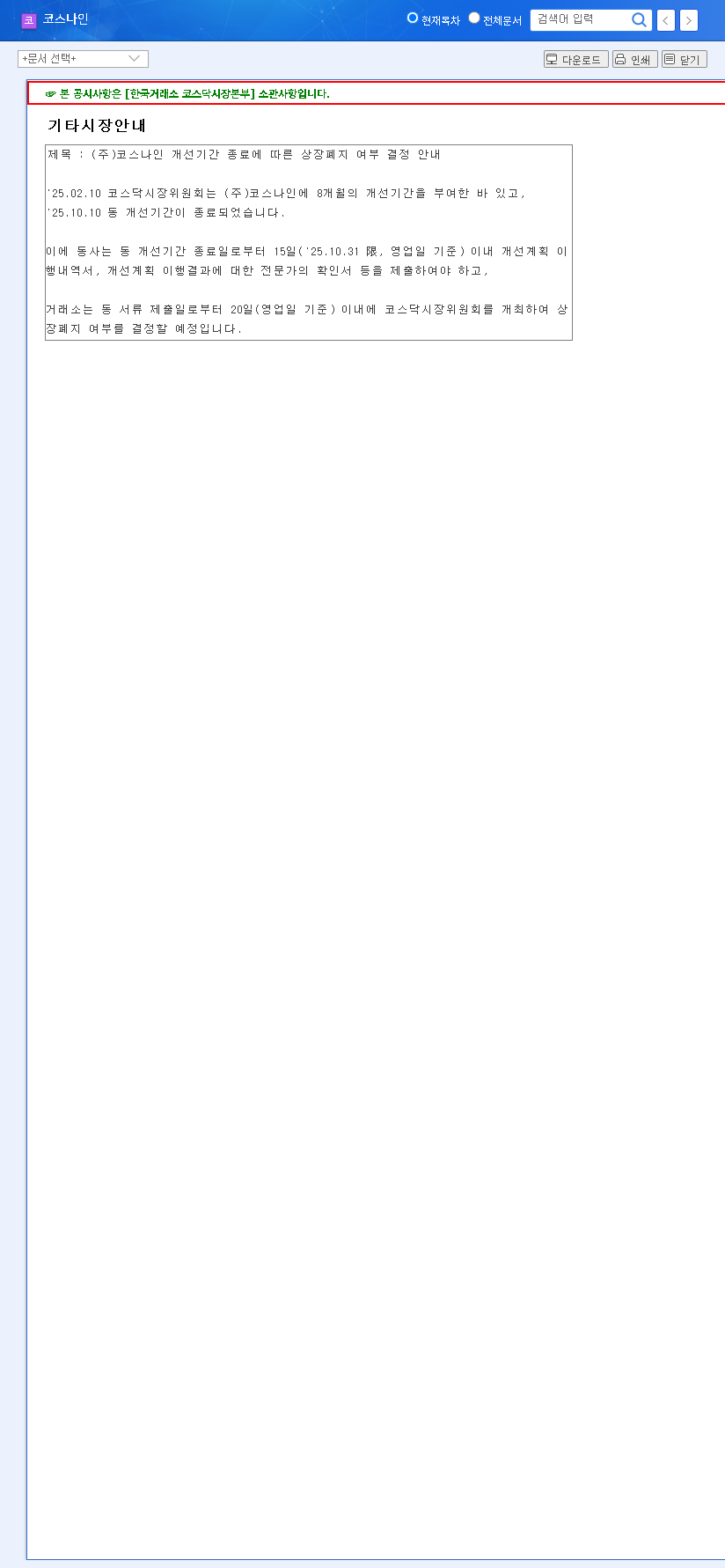
    • Improvement Period Ends: October 10, 2025. This was the final deadline for Cosnine to demonstrate significant operational and financial recovery.
    • Report Submission: By October 31, 2025. The company must submit a detailed performance report and a confirmation letter from an external expert verifying its improvements.
    • KOSDAQ Market Committee Review: Within 20 business days of the report submission (typically by mid-to-late November). The committee will convene to review the evidence and make the final ruling on whether to maintain the listing or proceed with the Cosnine delisting.

    Analysis of Severe Corporate Fundamentals

    Cosnine’s predicament is not a sudden development but the culmination of long-standing issues that have eroded its financial health and investor trust. The risk of delisting is rooted in these deep-seated problems.

    A History of Management Red Flags

    The company’s past is littered with events that signal high investor risk. These historical issues include allegations of embezzlement and breach of trust, a history of entering rehabilitation procedures due to financial collapse, and multiple instances of being flagged for delisting review. These are not minor infractions; they point to a systemic failure in corporate governance and transparency.

    Dire Financial Health: A Look at the Numbers

    An analysis of Cosnine’s 25th half-year report reveals a company on the brink. The numbers paint a grim picture of its operational and financial viability. You can review the Official Disclosure (DART) for more details. Key concerns include:

    • Collapsing Revenue & Soaring Losses: Revenue has continued to decline while net loss expanded to a staggering KRW 15.9 billion.
    • Equity Erosion: Total equity has plummeted to just KRW 6.16 billion, signaling a severe risk of complete capital impairment.
    • Negative Cash Flow: The company is burning through cash from its core operations, making it difficult to fund day-to-day activities, let alone growth initiatives.
    • Auditor’s Qualified Opinion: This is a major red flag. It means the auditor could not confidently verify the accuracy of the company’s financial statements, fundamentally undermining their reliability. To learn more about such warnings, you can read about how to interpret auditor opinions in our guide.

    Given these catastrophic financial indicators, the path to proving sustainable recovery to the KOSDAQ committee is incredibly narrow. The risk of a Cosnine delisting is substantiated by its own financial reports.

    Potential Scenarios and Investor Impact

    Investors should brace for extreme volatility. The outcome of the committee’s decision will have a binary and dramatic effect on the stock’s value.

    • Scenario 1: Listing is Maintained. In this unlikely event, there could be a short-term, speculative price surge. However, the underlying weak fundamentals remain. Without a concrete, executed turnaround plan, the company will likely face similar challenges in the future, making long-term investment risky.
    • Scenario 2: Delisting is Decided. This is the more probable outcome. The stock price would collapse, trading would be halted, and the stock would eventually be removed from the exchange. For investors, this almost certainly means a total loss of their investment, as recovering capital from a delisted, financially insolvent company is nearly impossible. More information on such procedures can be found on the Financial Supervisory Service (FSS) website.

    Investor Action Plan: Navigating the Cosnine (082660) Crisis

    In this critical period, emotional decision-making is the enemy. A disciplined, cautious approach is required.

    • Avoid New Investments: Initiating a new position in Cosnine (082660) at this juncture is pure speculation with an overwhelmingly negative risk/reward profile. The potential for total loss is too high.
    • Existing Holders – Assess Your Risk: Investors currently holding shares must be prepared for the worst-case scenario. Any capital in this stock should be considered ‘at risk’ and not be money you cannot afford to lose entirely.
    • Stay Informed: Closely monitor official disclosures from the Korea Exchange (KRX) and news reports. Do not rely on rumors or message boards. The final decision will be formally announced.
    • Focus on Fundamentals: Ultimately, the decision comes down to whether the company has fundamentally improved. Based on the available data, the evidence for a sustainable turnaround is exceptionally weak.

    In conclusion, the probability of a Cosnine delisting is extremely high due to its catastrophic financial state and history of poor governance. We strongly advise extreme caution and recommend that investors avoid this stock until there is absolute clarity from the KOSDAQ Market Committee.
    (082660) Cosnine (082660) Delisting Decision: A Complete Guide for Investors 관련 이미지
  • (057880) Pureunsunamu (057880) Delisting Crisis: Rehabilitation Halted – A Critical Investor Warning

    (057880) Pureunsunamu (057880) Delisting Crisis: Rehabilitation Halted – A Critical Investor Warning

    The looming threat of a Pureunsunamu delisting has become a stark reality for investors. Following the company’s recent, alarming disclosure, the path forward for Pureunsunamu (057880) is fraught with peril. This analysis breaks down the critical news of its ‘Rehabilitation Process Discontinuation,’ explains the severe underlying financial weaknesses, and provides a clear, actionable plan for shareholders navigating this crisis. In a situation where every decision counts, this guide offers the essential insights needed to protect your capital from irreversible loss.

    The Decisive Blow: Rehabilitation Process Discontinued

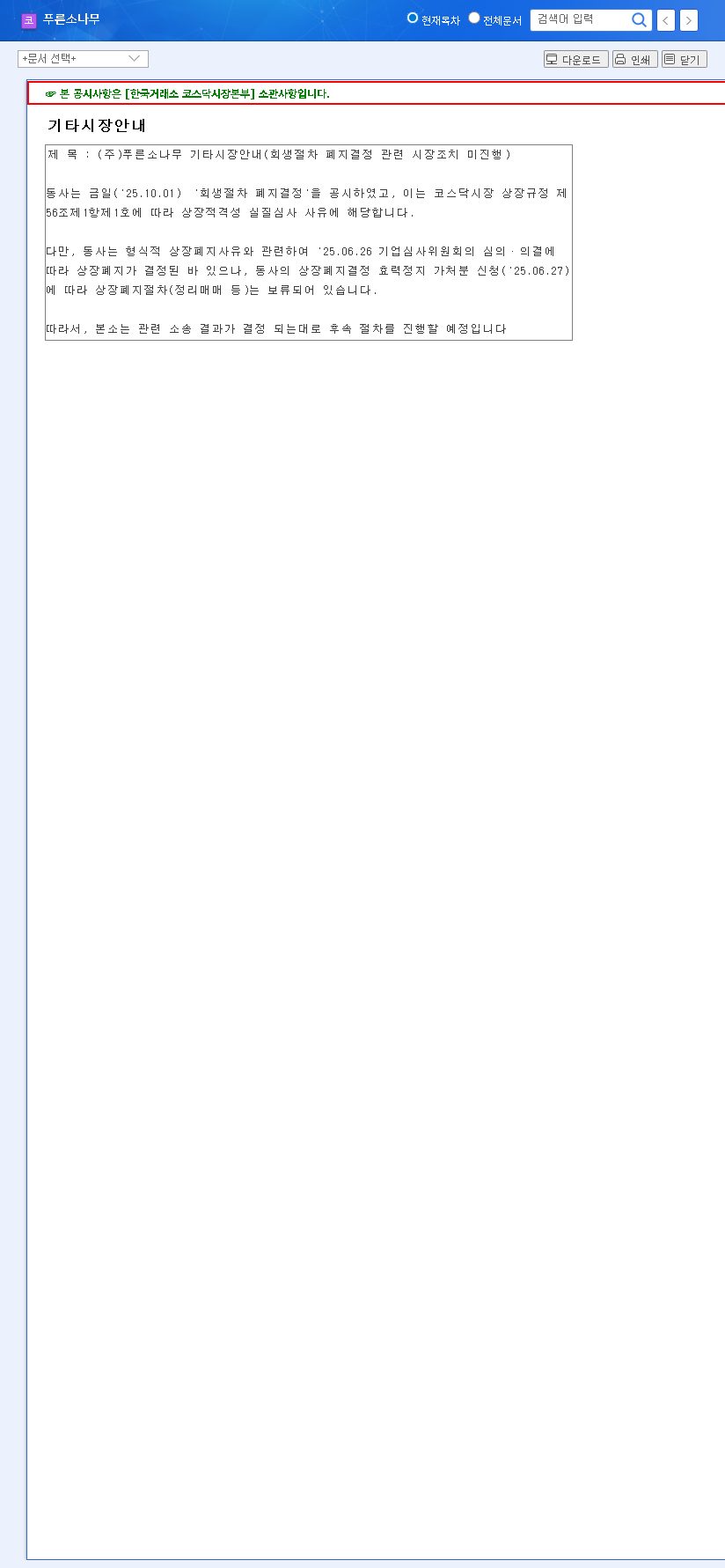
    On October 1, 2025, a critical announcement sent shockwaves through the market: KOSDAQ-listed Pureunsunamu (057880) officially disclosed the ‘Discontinuation of Rehabilitation Proceedings.’ This event is not a minor setback; it’s a formal trigger for a substantive eligibility review for delisting under KOSDAQ Market Listing Regulations. The official disclosure, available on DART, confirms the gravity of the situation (Official Disclosure). This effectively extinguishes the company’s last hope for a structured recovery, dramatically increasing the likelihood of a permanent KOSDAQ delisting.

    While an existing injunction has temporarily paused the delisting procedures that were initiated on June 26, 2025, this new development serves as a fatal blow to the company’s case. The courts and the Korea Exchange will now weigh this failure heavily in their final decisions, making a positive outcome for shareholders highly improbable.

    Anatomy of a Collapse: Why Pureunsunamu Is Failing

    The discontinuation of the company rehabilitation process was not a sudden event but the culmination of deep-seated, structural problems that have plagued Pureunsunamu for years.

    1. The Financial Abyss

    The company’s financial health is in critical condition. The semi-annual report for 2025 paints a grim picture of a business on the edge of insolvency:

    • Capital Impairment: A staggering debt-to-equity ratio of -565% indicates that liabilities far exceed assets, a classic sign of bankruptcy.
    • Massive Losses: An operating loss of 875 million KRW and a net loss of 5,016 million KRW show a complete inability to generate profit from its operations.
    • History of Red Flags: A disclaimer of audit opinion for the 2023 fiscal year had already triggered a delisting event, highlighting persistent and unresolved accounting and operational issues. For more information on such risks, investors can consult authoritative sources like global market regulators.

    2. Flawed Business Strategy and Risky Ventures

    Pureunsunamu’s core business in senior care has consistently failed to be profitable. In a desperate attempt to find a growth engine, the company has pivoted to high-risk ventures like proximity radiation therapy software and overseas anti-cancer technology. While ambitious, these projects require significant capital and a stable operational foundation—two things Pureunsunamu critically lacks. Given the ongoing Pureunsunamu delisting crisis, the probability of these ventures securing funding and reaching successful commercialization is virtually zero.

    Any financial forecasts projecting a turnaround for Pureunsunamu in late 2025 should be viewed with extreme skepticism. The H1 2025 report directly contradicts these optimistic claims, revealing a company in deeper distress than some analysts suggest.

    The Inevitable Aftermath: What Delisting Means for You

    With the collapse of the rehabilitation plan, the future for Pureunsunamu (057880) shareholders is bleak. The short-term and long-term consequences will be severe.

    Short-Term: Liquidation Trading and Extreme Volatility

    Once the injunction is lifted and the delisting process resumes, the stock will likely enter a phase of ‘liquidation trading.’ During this period, the stock price is expected to plummet uncontrollably as investors rush to exit a failing asset. The recovery of any significant portion of one’s investment becomes nearly impossible at this stage.

    Long-Term: Total Loss of Investment

    Should the delisting be finalized, shares of Pureunsunamu will become essentially worthless. Minority shareholders will be left with an un-tradable asset, leading to a complete and irrecoverable loss of their investment. The company, cut off from public funding, will face an insurmountable challenge in continuing its operations, likely leading to its eventual dissolution.

    Investor Action Plan: An Urgent Investor Warning

    Given the overwhelming evidence, the investment outlook for Pureunsunamu (057880) is unequivocally negative. Here are the recommended actions:

    • For Existing Investors: The most prudent course of action is to sell your holdings immediately. Attempting to wait for a miraculous recovery is a high-risk gamble against overwhelming odds. Exiting now is the best strategy to mitigate further losses.
    • For Potential Investors: Do not initiate any new positions. The company’s survival is in serious doubt, and any new capital invested faces an extremely high probability of being lost entirely.
    • Stay Informed: Continue to monitor official news regarding the final delisting decision, but do so for risk management, not to look for a buying opportunity. To learn more about navigating such situations, you can read our guide on handling delisted stocks in your portfolio.

    (057880) Pureunsunamu (057880) Delisting Crisis: Rehabilitation Halted – A Critical Investor Warning 관련 이미지