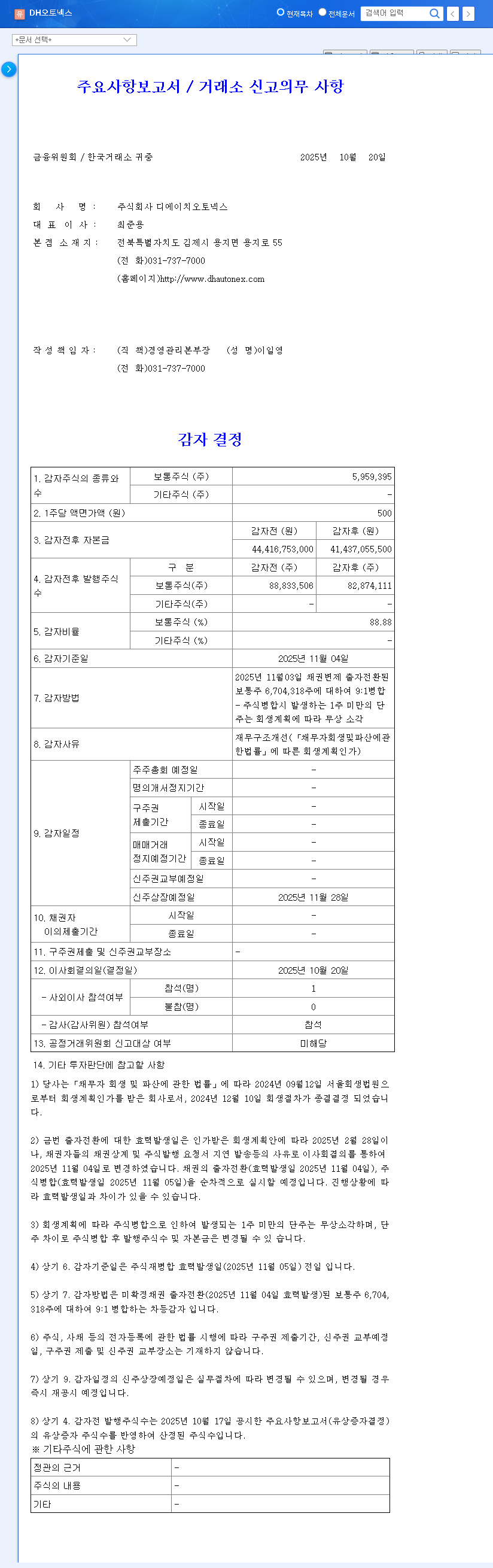
The recent announcement of the DHAUTONEX capital reduction has sent ripples through the investment community. On October 20, 2025, DHAUTONEX CO.,LTD (Korean: DH오토넥스) revealed a drastic plan for an 88.9% stock merger as a cornerstone of its court-approved rehabilitation. This is not just a standard corporate action; it’s a critical maneuver aimed at financial survival and future recovery. For shareholders and potential investors, this event presents a complex mix of high risk and potential long-term opportunity. This comprehensive analysis will deconstruct the capital reduction, explore its immediate and future impacts, and outline a strategic approach for navigating this pivotal moment.
A capital reduction of this magnitude is a clear signal of severe financial distress, but it is also a necessary step in a company’s journey back to stability. The key for investors is understanding the details of the accompanying rehabilitation plan.
Deconstructing the 88.9% Stock Merger
The core of the DHAUTONEX capital reduction is a significant stock merger designed to improve the company’s precarious financial structure. This action falls under the legal framework of the ‘Debtor Rehabilitation and Bankruptcy Act’, indicating it’s a court-sanctioned effort to restructure and stabilize the company. Here are the critical details every investor must know:
- •Reduction Method: A 9-for-1 stock merger. For every nine common shares an investor holds, they will be merged into a single share.
- •Shares Affected: 5,959,395 existing common shares, plus 6,704,318 common shares converted from debt repayment.
- •Fractional Shares: Any odd lot shares (less than one full share after the merger) will be retired without compensation, which can be a disadvantage for smaller retail investors.
- •Record Date: November 4, 2025.
- •Expected Trading Resumption: November 28, 2025.
Immediate Fallout & Long-Term Outlook
The impact of this financial restructuring will be felt in two distinct phases: the volatile short-term and the uncertain but potentially promising long-term.
Short-Term: Navigating Market Volatility
In the immediate aftermath, investors should brace for significant downward pressure on the stock price. The high reduction ratio of 88.9% drastically reduces the number of outstanding shares, which raises alarms about:
- •Share Dilution Concerns: Although the number of shares decreases, the context of a rehabilitation plan can spook the market.
- •Weakened Investor Sentiment: A capital reduction of this nature confirms the company’s severe financial difficulties, leading to a loss of confidence.
- •High Volatility: When trading resumes on November 28, 2025, the new share price will reflect the merger. Expect extreme price swings as the market digests the news and the company’s future prospects.
Mid-to-Long-Term: The Path to Recovery
The ultimate goal of the DHAUTONEX capital reduction is to lay a foundation for future viability. Success hinges entirely on the execution of the broader rehabilitation plan. If successful, the company could see a significant reduction in its debt-to-equity ratio and a healthier balance sheet. Key factors to monitor include the company’s ability to streamline operations, focus on core profitable business segments, and regain market trust through transparent management. A successful turnaround could lead to substantial value recovery, but the path is fraught with risk.
Investor Strategy: A Cautious & Informed Approach
Given the high degree of uncertainty, a prudent investment strategy is essential. Rushing into a decision is ill-advised. Instead, investors should adopt a wait-and-see approach while conducting thorough due diligence. Focus on continuous monitoring and deep research into the following areas:
- •The Official Disclosure: The most crucial first step is to analyze the primary source. The full details are available in the Official Disclosure (DART Report).
- •Rehabilitation Plan Specifics: Look for detailed documents outlining creditor agreements, debt-to-equity conversion ratios, and future business plans. This is the roadmap to recovery.
- •Financial Health: Scrutinize the latest financial statements and cash flow reports to understand the company’s liquidity and operational status post-restructuring. For more context, you can learn about analyzing companies in financial distress.
- •Industry Benchmarking: Compare DHAUTONEX’s position against healthy competitors to gauge its chances of regaining market share and competitiveness. For a general overview, resources like Investopedia provide excellent definitions of financial restructuring.
Frequently Asked Questions
What is the main reason for the DHAUTONEX capital reduction?
The primary reason is to execute a critical financial restructuring as part of a court-approved rehabilitation plan. It aims to significantly reduce debt and repair the company’s balance sheet to ensure its survival and long-term viability.
How will the 88.9% stock merger affect my shareholding?
Your shares will be merged at a 9-to-1 ratio. For every nine shares you own, you will receive one new share. This will dramatically reduce the number of shares you hold, and the stock price will adjust upwards accordingly upon resumption of trading, though market sentiment will ultimately determine its value.
When can I trade DHAUTONEX shares again?
Trading is expected to resume on November 28, 2025. Be prepared for high volatility on and after this date as the market reacts to the newly structured company and its perceived future prospects.