Tag: Defense Industry

  • (079550) LIG Nex1 Stock Analysis (079550): Q3 Earnings & Future Outlook

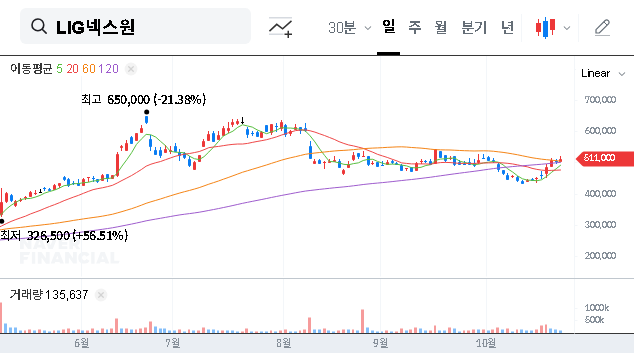
    (079550) LIG Nex1 Stock Analysis (079550): Q3 Earnings & Future Outlook

    In a world of escalating geopolitical tensions, the defense sector is under an intense spotlight. This comprehensive LIG Nex1 stock analysis delves into the prospects of South Korea’s leading defense contractor, LIG Nex1 Co., Ltd. (079550), as it approaches a pivotal Investor Relations (IR) event on November 18, 2025. Following a surprising revenue decline in the first half of the year, all eyes are on the upcoming Q3 earnings report and the company’s strategic vision for the future.

    This article provides an expert breakdown of LIG Nex1’s current financial standing, its promising growth catalysts, and the critical factors investors must monitor during the IR event. We will dissect the numbers, evaluate the strategies, and offer a clear framework for making informed investment decisions.

    The Q3 2025 IR Event: A Moment of Truth

    LIG Nex1’s scheduled IR event is more than a routine update; it’s a critical platform to address investor concerns and chart a course for future growth. The primary agenda includes the announcement of preliminary LIG Nex1 earnings for Q3 2025 and a detailed presentation on the company’s operational status. The market is eager for clarity on the H1 revenue dip and reassurance about the company’s long-term trajectory.

    In-Depth LIG Nex1 Stock Analysis: Financial Health & Performance

    The Paradox: Declining Revenue vs. a Massive Order Backlog

    According to its H1 2025 report, LIG Nex1 posted revenue of KRW 1,852.97 billion, marking a 35.6% decrease year-on-year. This naturally raised concerns. However, the headline number doesn’t tell the whole story. The company boasts an incredibly robust order backlog of KRW 23,466.5 billion. This massive backlog provides a stable and predictable foundation for revenue streams for years to come, suggesting the H1 decline may be a matter of project timing rather than a fundamental business weakness. You can review the Official Disclosure (Source: DART) for more details.

    An order backlog of over KRW 23 trillion acts as a powerful buffer against short-term revenue fluctuations, securing the company’s financial stability and offering significant long-term visibility for investors.

    Core Business Segments and Export Outlook

    The PGM (Precision Guided Munitions) segment remains the company’s revenue cornerstone, accounting for 47.8% of the total. The observed decline in other areas like ISR (Intelligence, Surveillance, Reconnaissance) and C4I (Command, Control, Communications, Computers, and Intelligence) is largely attributed to the cyclical nature of large-scale government contracts. The export share, which stood at 17.3%, also saw a temporary decrease. A key focus of the upcoming LIG Nex1 IR event will be the strategy to re-accelerate international sales and secure new overseas contracts.

    Future Growth Engines: Robotics and Geopolitical Tailwinds

    The Strategic Acquisition of Ghost Robotics

    LIG Nex1’s forward-looking strategy is highlighted by its significant acquisition of Ghost Robotics Corporation. This move is not merely a diversification play; it’s a strategic pivot to secure a foothold in the future of defense technology. This acquisition establishes a powerful robotics platform, opens a direct channel into the lucrative U.S. defense market, and positions LIG Nex1 at the forefront of autonomous warfare systems. This investment signals a strong commitment to becoming a global, tech-driven defense powerhouse.

    Macroeconomic and Geopolitical Opportunities

    The global landscape presents significant opportunities for the Korean defense industry. Rising global defense budgets, driven by heightened security concerns, create a fertile ground for companies like LIG Nex1. According to reports from leading defense analysts, global military expenditure continues to climb. Additionally, the weaker Korean Won against the US Dollar provides a competitive pricing advantage for LIG Nex1’s exports, potentially boosting profitability on international contracts.

    Investor Action Plan: What to Watch in the IR Briefing

    For investors conducting a thorough LIG Nex1 stock analysis, the IR event will provide crucial data points. Pay close attention to the management’s commentary on the following key areas:

    • Q3 Performance: Is there a clear reversal or stabilization of the revenue decline? Listen for a detailed analysis of the causes and the outlook for Q4 and beyond.
    • Robotics Synergy: Demand concrete plans on how Ghost Robotics will be integrated and the timeline for realizing synergies and penetrating the U.S. market.
    • Export Strategy: What is the specific plan to regain momentum in overseas markets? Look for announcements of new contracts or progress in key international negotiations.
    • Financial Management: How is the company managing its balance sheet and cash flow amidst large R&D investments and acquisitions?

    For more insights, you can compare this with our Deep Dive into the Korean Defense Sector.

    Frequently Asked Questions (FAQ)

    Q1: When is the LIG Nex1 IR event?

    A1: The Investor Relations (IR) event is scheduled for November 18, 2025. It will feature the announcement of preliminary Q3 2025 operating results and a detailed corporate briefing.

    Q2: What is the significance of LIG Nex1’s order backlog?

    A2: Despite an H1 2025 revenue dip, the company holds a massive order backlog of over KRW 23 trillion. This provides a very stable and predictable foundation for future revenues, mitigating short-term performance concerns.

    Q3: What are LIG Nex1’s key future growth drivers?

    A3: Key growth drivers include strengthening its core domestic business and expanding into future technologies through strategic moves like the acquisition of Ghost Robotics, which is aimed at securing a leading position in defense robotics and entering the U.S. market.

    Q4: What are the primary risks for the 079550 stock?

    A4: Key risks include potential delays in converting the order backlog to revenue, increased competition in the global defense market, the efficiency of R&D spending, and the impact of currency fluctuations on profitability.

    (079550) LIG Nex1 Stock Analysis (079550): Q3 Earnings & Future Outlook 관련 이미지
  • (005810) Poongsan Holdings Q3 2025 IR: In-Depth Stock Analysis & Investment Strategy

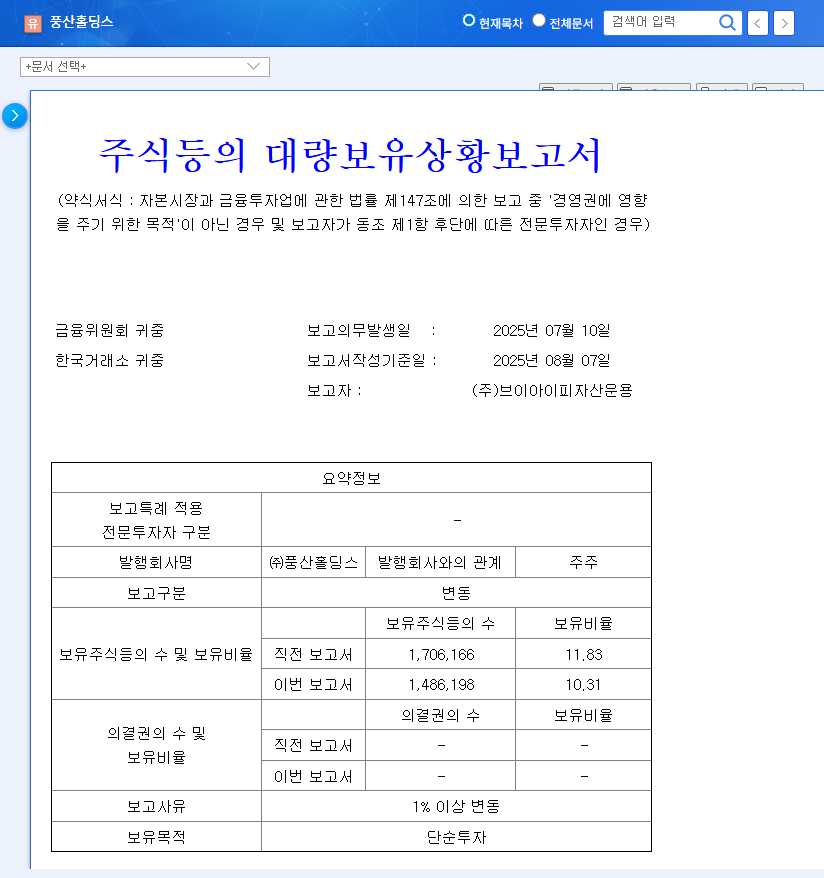
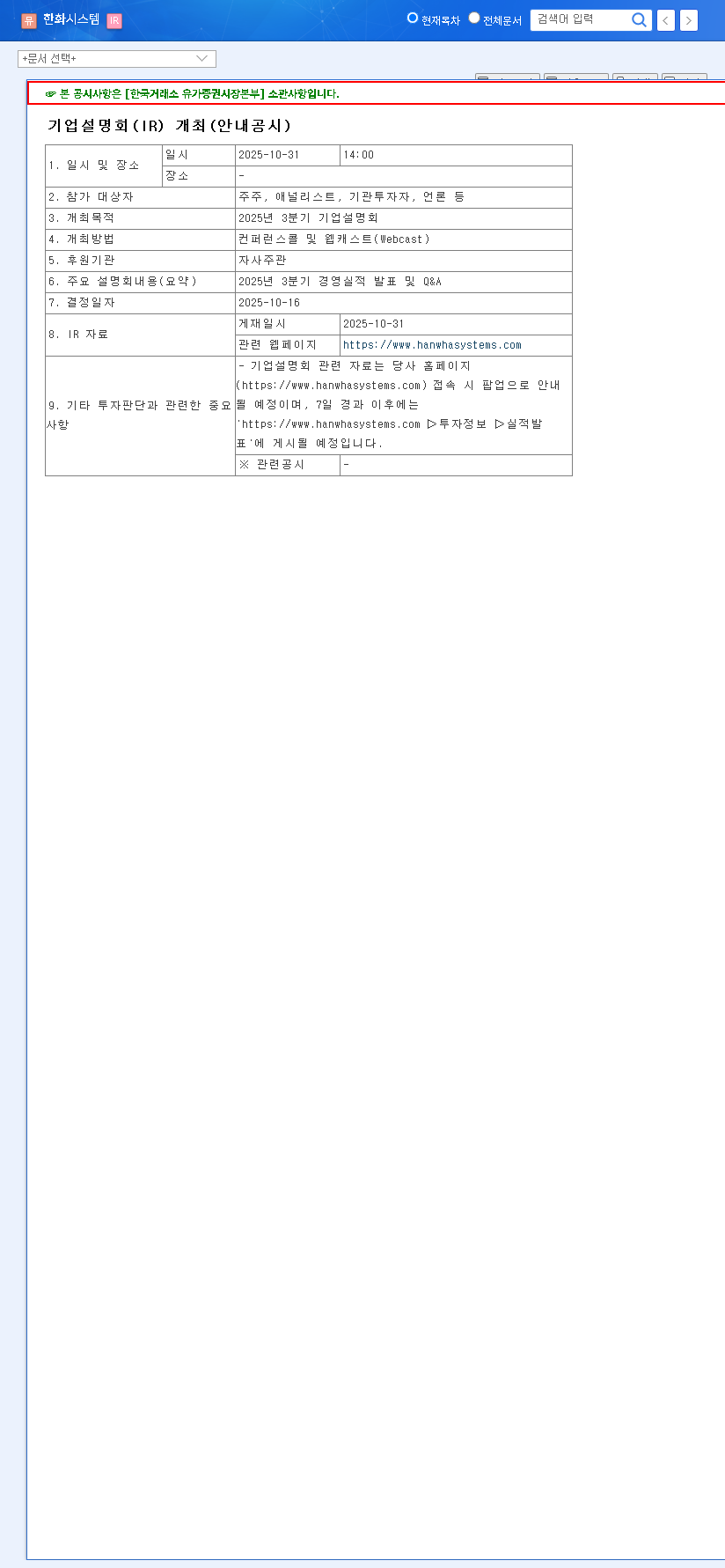
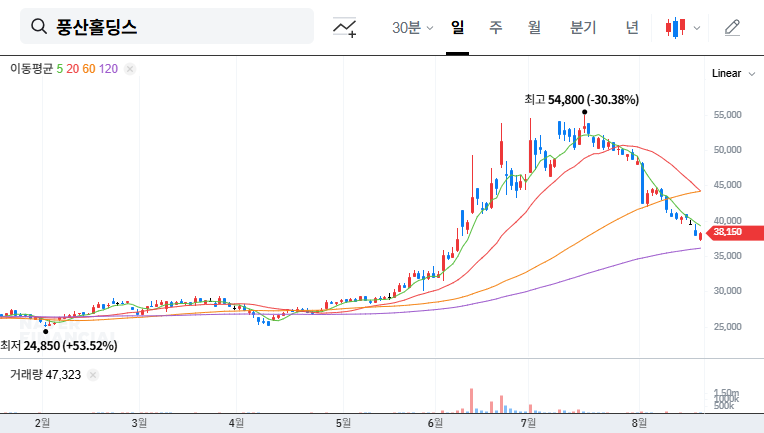
    (005810) Poongsan Holdings Q3 2025 IR: In-Depth Stock Analysis & Investment Strategy

    The upcoming POONGSAN HOLDINGS CORPORATION IR for Q3 2025 is more than just a routine financial update; it’s a critical inflection point for investors. Scheduled for October 31, 2025, this event will see the company address its performance amidst a challenging global economic climate. For shareholders and potential investors, this is the moment to gauge whether the company’s foundational strengths can overcome significant macroeconomic headwinds. The messages delivered could set the stock’s trajectory for months to come.

    This analysis provides a deep dive into the factors that will shape the Poongsan Holdings stock narrative, offering a clear framework for interpreting the IR event and making informed investment decisions.

    Event Overview: Q3 2025 IR Details

    Poongsan Holdings has formally announced its investor relations event, where it will present its third-quarter performance and engage with the market in a Q&A session. The market anticipates this will bring much-needed clarity on the company’s strategy and financial health.

    • Purpose: Q3 2025 Management Performance Announcement and Q&A Session.
    • Date & Time: October 31, 2025, at 14:00 (KST).
    • Official Source: Details are confirmed in the company’s Official Disclosure on DART.

    Fundamental Analysis: A Company of Contrasts

    Poongsan Holdings operates on a dual foundation: a stable, cash-generating core business and a high-growth defense segment. However, recent financial reports reveal emerging pressures that this IR event must address.

    Core Strengths and Growth Catalysts

    • Robust Order Backlog: The company’s fabricated metals and defense divisions boast a strong and stable order book, providing excellent revenue visibility for the coming quarters.
    • K-Defense Expansion: As a key player in South Korea’s burgeoning defense export market (‘K-Defense’), Poongsan is well-positioned to capitalize on global geopolitical trends. This segment represents a significant engine for future growth. Learn more about our guide to investing in the defense industry.
    • Shareholder Value Initiatives: Recent treasury stock acquisitions signal a commitment from management to support the stock price and enhance shareholder returns.

    Headwinds and Investor Concerns

    • Profitability Squeeze: The first half of 2025 saw a decline in operating profit and net income. This is largely attributed to rising raw material costs (like copper) and increased capital expenditures, which are compressing margins.
    • Increased Financial Leverage: An uptick in the net debt and debt-to-equity ratio makes the company more vulnerable to interest rate hikes. Investors will be keen to hear about the company’s debt management strategy.
    • Macroeconomic Volatility: The business is directly exposed to fluctuations in commodity prices and foreign exchange rates. A weak Korean Won helps exports but increases the cost of imported raw materials, creating a complex challenge.

    Stock Impact: Bull vs. Bear Scenarios

    The outcome of the POONGSAN HOLDINGS CORPORATION IR will likely push the stock towards one of two distinct paths.

    The Bull Case (Positive Outlook)

    A positive reaction would be fueled by Q3 earnings that exceed market expectations, particularly a rebound in operating margins. If management presents a detailed, credible strategy for expanding the defense business with specific contract targets and provides a confident outlook for managing costs, investor sentiment could turn decisively positive. Clear and transparent answers during the Q&A that address debt concerns would further bolster the stock.

    The Bear Case (Negative Outlook)

    Conversely, the stock could face downward pressure if Q3 results miss consensus estimates or if profitability continues to decline. Vague commentary on future growth, a downgraded outlook for the year, or evasive answers regarding financial leverage would be significant red flags. Any unexpected negative disclosures during the Q&A could trigger an immediate sell-off.

    Actionable Investment Strategy Post-IR

    Prudent investors should prepare a checklist to analyze the IR announcement objectively. Look beyond the headlines and focus on the underlying data and management’s tone. Global macroeconomic trends, as reported by leading financial news outlets, will continue to be a factor, but company-specific performance is key.

    Investor Checklist:

    • Analyze Q3 Profitability: Did the operating profit margin show a sequential improvement from Q2? This is the most critical indicator of a turnaround.
    • Scrutinize Future Guidance: Did management provide specific, quantitative growth targets for the defense and new materials sectors?
    • Evaluate Risk Management: How did the company address the risks of raw material costs and currency fluctuations? Was their strategy convincing?
    • Investment Action: Consider a phased buying approach if the Bull Case materializes. If the Bear Case unfolds, maintaining a cautious stance or reducing exposure may be prudent until a clearer positive catalyst emerges.

    In conclusion, the Poongsan Holdings Q3 2025 IR is a pivotal event. While the company possesses a solid business foundation with promising growth avenues, its vulnerability to financial and economic pressures is undeniable. This IR will provide the crucial data points needed to determine whether the company is successfully navigating these challenges or if further turbulence lies ahead.

    (005810) Poongsan Holdings Q3 2025 IR: In-Depth Stock Analysis & Investment Strategy 관련 이미지
    (005810) Poongsan Holdings Q3 2025 IR: In-Depth Stock Analysis & Investment Strategy 관련 이미지
  • (272210) Hanwha Systems’ ₩859.3B Defense Contract: A 2025 Stock & Investment Analysis

    (272210) Hanwha Systems’ ₩859.3B Defense Contract: A 2025 Stock & Investment Analysis

    The recent announcement of a massive Hanwha Systems defense contract has sent ripples through the investment community. Valued at a staggering ₩859.3 billion, this agreement with LIG Nex1 for IM3 multi-function radar production is a significant indicator of the company’s trajectory. For investors evaluating the Hanwha Systems investment outlook, this deal is more than just a headline—it’s a testament to the company’s technological prowess and a cornerstone for future revenue stability. This analysis will dissect the contract’s implications, its impact on Hanwha Systems stock, and the strategic considerations for your portfolio.

    Deconstructing the Landmark ₩859.3 Billion Deal

    Hanwha Systems has solidified its position as a key player in the South Korean defense industry by securing this major production contract with fellow defense giant, LIG Nex1. The deal, officially logged and disclosed, confirms the production of the advanced IM3 multi-function radar system. The official details of this agreement can be reviewed in the public filing (Source: DART Official Disclosure).

    Key Contract Specifications

    • Contract Value: ₩859.3 billion, representing a significant 30.65% of the company’s estimated 2025 revenue.
    • Contract Partner: LIG Nex1, a leading South Korean aerospace and defense company.
    • Scope: Production of the IM3 Project Multi-function Radar (MFR) system.
    • Duration: A long-term project spanning 7 years and 3 months, from October 2025 to January 2033, ensuring a stable revenue stream.

    Strategic Importance & Market Impact

    This contract is a major strategic win. Multi-function radars are the ‘eyes and ears’ of modern defense platforms, capable of simultaneous surveillance, tracking, and missile guidance. Securing this contract not only provides a financial boost but also enhances Hanwha Systems’ reputation as a world-class provider of high-tech defense electronics, which can lead to further opportunities in both domestic and international markets. For a deeper understanding of market dynamics, you can explore our analysis of South Korea’s defense export strategy.

    “This long-term, high-value contract significantly de-risks Hanwha’s revenue forecast for its core defense segment. It provides a stable foundation that allows the company to invest more aggressively in next-generation growth areas like satellite communications and AI-driven defense solutions.”

    Analyzing Hanwha Systems’ Financial Fundamentals

    While this defense contract is a clear positive, a comprehensive investment decision requires looking at the entire company. Hanwha Systems operates across multiple segments, each with its own set of opportunities and challenges.

    Defense Sector: The Engine of Growth

    The defense division remains the company’s bedrock. With steady growth in revenue and operating profit, driven by projects like the KF-21 AESA radar, the division is capitalizing on favorable global defense spending trends. The increasing geopolitical tensions worldwide have created a robust demand for advanced military hardware, a trend from which Hanwha is well-positioned to benefit.

    ICT Sector: A Turnaround Story in the Making?

    The ICT sector has faced headwinds from market competition and heavy investment in new technologies. While this has impacted short-term profitability, these investments in AI, cloud, and digital platforms are crucial for long-term relevance. A key area to watch is the company’s venture into low-orbit satellite communication services, a potential high-growth engine for the future.

    Investor Action Plan: What Does This Mean for Hanwha Systems Stock?

    This Hanwha Systems defense contract is a significant catalyst. It secures a substantial portion of future revenue, improves financial stability, and reinforces the company’s core strengths. This allows management to better navigate the challenges in the ICT sector and invest in new growth opportunities like the Philly Shipyard venture.

    Positive Factors for Investment

    • Long-Term Revenue Visibility: The 7-year contract duration provides exceptional stability.
    • Strengthened Market Position: Reinforces technological leadership and opens doors for future export contracts.
    • Improved Financials: Expected to boost profitability and support a healthier balance sheet, with an improving debt-to-equity ratio.

    Potential Risks to Monitor

    • Execution Risk: Large-scale, complex projects carry inherent risks related to production timelines and cost management.
    • Macroeconomic Headwinds: Currency fluctuations could impact profitability, especially on the components sourced internationally.
    • ICT Sector Performance: The speed of the turnaround in the ICT division remains a key variable for overall corporate valuation.

    Overall Investment Opinion: Positive with Upside Potential. The stability provided by this monumental defense contract provides a strong buffer and a platform for growth. Investors should view Hanwha Systems as a core defense play with significant, albeit longer-term, upside from its technology and shipbuilding ventures. The current positive momentum in the defense sector, underpinned by this contract, presents a compelling case for the future of Hanwha Systems stock.

    (272210) Hanwha Systems' ₩859.3B Defense Contract: A 2025 Stock & Investment Analysis 관련 이미지
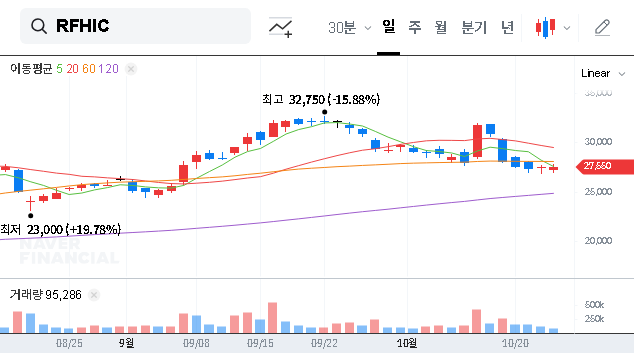
  • (218410) RFHIC CORPORATION (218410) Stock: Deep Dive into Q3 2025 Earnings Surprise & Future Outlook

    (218410) RFHIC CORPORATION (218410) Stock: Deep Dive into Q3 2025 Earnings Surprise & Future Outlook

    The latest Q3 2025 earnings report from RFHIC CORPORATION (218410) has sent ripples through the market, presenting investors with a complex but intriguing picture. While top-line revenue slightly missed consensus, a significant ‘earnings surprise’ in operating profit has captured attention. However, this was contrasted by a shortfall in net income, raising important questions about the company’s underlying financial health and future trajectory.

    This comprehensive analysis unpacks the RFHIC earnings for Q3 2025, exploring the fundamental drivers, technological advantages in GaN semiconductor technology, and the strategic risks that lie ahead. For current and prospective investors, understanding these nuances is critical to navigating the future of RFHIC stock.

    Dissecting the RFHIC CORPORATION Q3 2025 Earnings Report

    The preliminary Q3 2025 figures reveal a multi-faceted performance. The headline news was the impressive beat on operating profit, suggesting strong core operational efficiency or a favorable product mix. Let’s examine the key metrics against market forecasts:

    Key Performance Indicators (vs. Forecast)

    • Revenue: KRW 40.5 billion (1% below forecast of KRW 40.8 billion)
    • Operating Profit: KRW 7.4 billion (23% ABOVE forecast of KRW 6.0 billion) – A significant earnings surprise.
    • Net Income: KRW 5.7 billion (24% BELOW forecast of KRW 7.5 billion)

    The divergence between operating and net income suggests that while the company’s core business operations were more profitable than expected, non-operating factors likely weighed on the bottom line. This could include foreign exchange losses, higher interest expenses on debt, or other one-off financial costs. The full preliminary report can be accessed via this Official Disclosure from DART for further detail.

    The Engine Room: Core Strengths & GaN Technology Edge

    RFHIC CORPORATION’s ability to generate strong operating profit is rooted in its deep technological expertise, particularly in Gallium Nitride (GaN) semiconductors. GaN technology offers superior efficiency, power density, and frequency performance compared to traditional silicon-based chips, making it essential for next-generation applications.

    RFHIC’s unique position as the only domestic Korean company with end-to-end GaN transistor capabilities—from design to mass production—forms a powerful competitive moat in high-growth global markets.

    Primary Growth Pillars

    • Defense & Radar: A robust order backlog of KRW 148.2 billion for GaN power amplifiers in radar systems provides excellent revenue visibility and stability.
    • Wireless Communication: The ongoing global rollout of 5G infrastructure continues to demand high-performance GaN components, a core market for RFHIC.
    • New Frontiers: Strategic expansion into the burgeoning satellite communication and spacecraft sectors secures long-term growth drivers, tapping into a market projected to reach USD 580 billion by 2040. You can read more about the future of the satellite communications industry in our related analysis.

    Navigating Headwinds: Challenges on the Horizon

    Despite its strengths, RFHIC CORPORATION faces several challenges that investors must monitor closely. These risks could impact future profitability and stock performance if not managed effectively.

    Key Risks for RFHIC Stock

    • Revenue Concentration & Decline: A recent decline in the core ‘GaN Power Amplifiers’ segment is a concern. Reversing this trend is critical for sustained growth.
    • Reduced R&D Investment: The R&D expense ratio dropped significantly from 15.61% in 2023 to 6.49% in H1 2025. In a fast-evolving tech industry, sustained innovation is non-negotiable, and this trend could threaten long-term competitiveness. Discover more about the power of next-generation GaN semiconductors from authoritative sources like IEEE.
    • Inventory Management: A rising inventory level (from KRW 78.8 billion to KRW 88.9 billion) needs careful management to avoid potential write-downs and cash flow constraints.
    • Macroeconomic Pressures: While a weaker Korean Won helps export competitiveness, it also increases the cost of imported raw materials. Persistent high interest rates globally add to the company’s financial burden.

    Investment Outlook: What’s Next for RFHIC CORPORATION?

    The Q3 earnings report offers both catalysts and cautions. The operating profit beat provides a potential short-term boost to stock momentum, validating the company’s core operational strength. However, the market will be looking for confirmation that this is a sustainable trend and not a one-off event driven by cost-cutting.

    Key Investor Checklist

    Moving forward, investors should focus on these critical points in upcoming reports and company communications:

    • Q4 2025 Performance: Look for continued strength in operating profit and, crucially, a recovery in revenue from the GaN Power Amplifier segment.
    • New Business Monetization: Track progress on when new ventures in satellite and space will begin contributing meaningfully to the top and bottom lines.
    • Commitment to Innovation: Monitor R&D spending in future quarters. A return to higher investment levels would be a positive signal for long-term technological leadership.

    Disclaimer: This analysis is for informational purposes only and is based on publicly available data. It does not constitute investment advice. All investment decisions should be made based on your own research and judgment.

    (218410) RFHIC CORPORATION (218410) Stock: Deep Dive into Q3 2025 Earnings Surprise & Future Outlook 관련 이미지
  • (474610) RF Systems Co., Ltd. Analysis: Q3 2025 Earnings, Stock & Investment Outlook

    (474610) RF Systems Co., Ltd. Analysis: Q3 2025 Earnings, Stock & Investment Outlook

    The latest announcement of provisional Q3 2025 earnings from RF Systems Co., Ltd. has sparked considerable debate among investors. While the figures suggest a minor slowdown from a strong second quarter, they also highlight impressive year-over-year growth, creating a complex picture for market watchers. This comprehensive investment analysis delves into the nuances of the Q3 results, examines the company’s core fundamentals, and explores the external factors shaping its future. We aim to provide a clear perspective on whether RF Systems stock represents a compelling opportunity or a risk to be managed.

    Unpacking the Q3 2025 Earnings Report

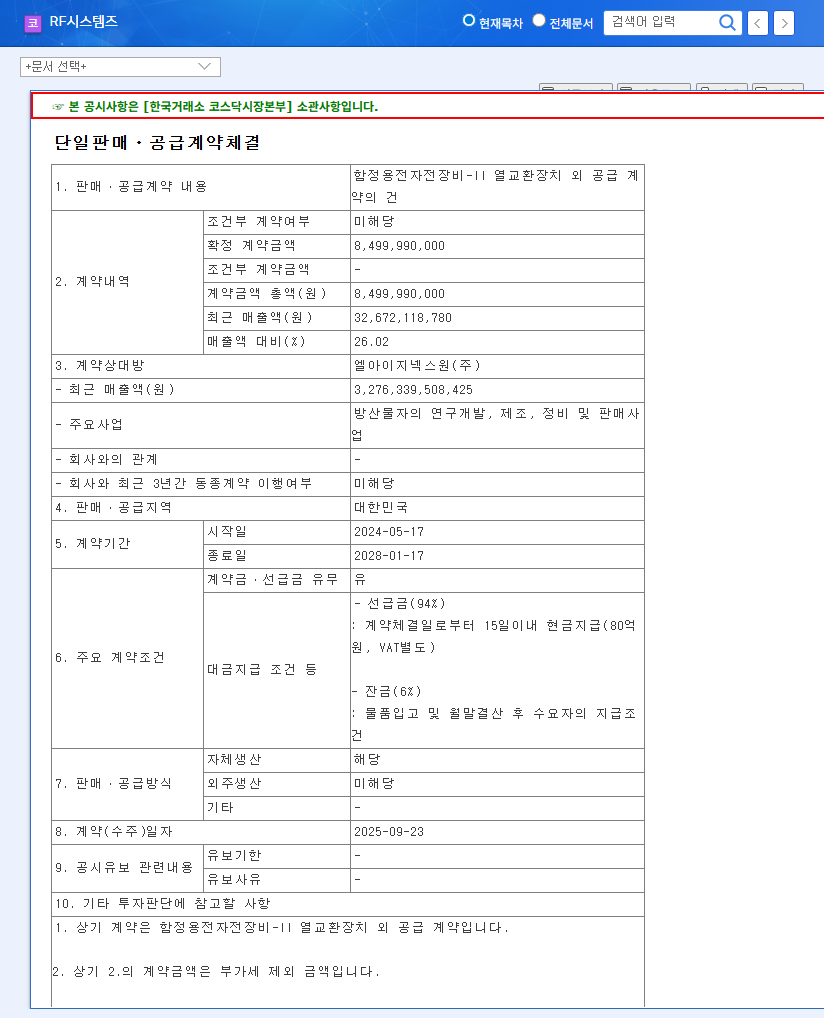
    On October 27, RF Systems Co., Ltd. released its provisional operating results for the third quarter of 2025. The official disclosure can be viewed directly on the DART portal (Source). The key financial metrics reported were:

    • Revenue: KRW 7.6 billion
    • Operating Profit: KRW 0.6 billion
    • Net Profit: KRW 0.9 billion

    While these figures show a sequential decrease from Q2, they paint a much brighter picture when viewed through a wider lens. Both revenue and profitability demonstrate a substantial improvement over the same period in 2024 and the first quarter of 2025. This suggests that despite short-term fluctuations, the company’s underlying operational efficiency and profitability management remain robust, a positive signal for anyone conducting an RF Systems Co., Ltd. investment analysis.

    The Q3 slowdown appears to be a minor blip in a larger story of year-over-year growth and strengthening fundamentals. The key for investors is to distinguish between short-term noise and long-term trends.

    Core Fundamentals and Key Growth Drivers

    A look at the H1 2025 report reveals the solid foundation upon which RF Systems is built. The company isn’t just surviving; it’s strategically investing in its future. Understanding these growth drivers is essential for assessing its long-term stock potential.

    Strengthened Financial Health

    The first half of 2025 saw revenue climb to KRW 17,054 million, propelled by consistent orders from the defense sector and promising expansion in civilian markets. More impressively, operating and net profits surged, showcasing excellent cost control. The company’s financial structure has also improved, with the debt-to-equity ratio falling to a healthy 54.56%. While rising inventory levels warrant monitoring, the overall financial picture is one of stability and intelligent management.

    Strategic Investments in Future Technologies

    RF Systems is actively leveraging its core defense technology to penetrate high-growth adjacent markets. Key areas of expansion include:

    • Satellite Communications: A rapidly growing industry with significant government and commercial demand.
    • Maintenance, Repair, and Overhaul (MRO): Providing long-term service revenue streams.
    • Microwave Generators: Applications in various industrial and scientific fields.

    This diversification is backed by a substantial commitment to R&D, which stands at 9.56% of revenue. Such investment is crucial for maintaining a competitive edge in the tech sector. For more on evaluating tech companies, review our guide on analyzing technology stocks.

    Navigating the Market: External Factors at Play

    No company operates in a vacuum. The performance of RF Systems stock is also influenced by macroeconomic trends. The late-Q3 decline in the KRW/USD exchange rate could squeeze margins for an export-focused company like RF Systems. Conversely, stabilizing interest rates and falling commodity prices provide a favorable tailwind by reducing financing costs and input materials. According to market analysis from leading financial experts, these global trends are expected to continue into the next quarter.

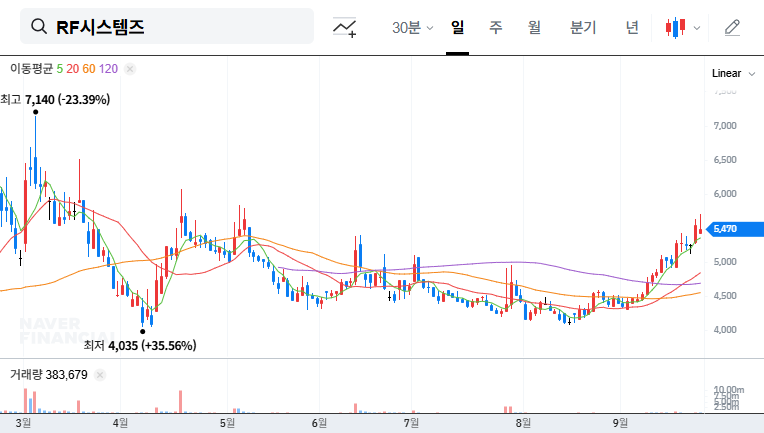
    Despite a downward trend in stock price since late 2024, a notable recent uptick in foreign ownership to 8.68% suggests that international investors are seeing long-term value, a bullish signal that shouldn’t be overlooked.

    Investment Outlook: A Balanced View

    The latest Q3 2025 earnings present a classic case for both optimistic and cautious investors.

    The Bull Case (Long-Term Potential)

    Investors with a long-term horizon have reason for optimism. The company’s proven ability to improve profitability, coupled with its strategic expansion into high-growth sectors and heavy R&D spending, positions it well for future success. The rising foreign ownership indicates that smart money sees this underlying value.

    The Bear Case (Short-Term Caution)

    Short-term traders should proceed with caution. The sequential slowdown, persistent stock price downtrend, and exchange rate volatility are significant headwinds. The lack of market consensus on earnings also makes the stock susceptible to sharp movements based on sentiment.

    Final Recommendation

    RF Systems Co., Ltd. is a fundamentally strong company on a positive long-term trajectory. For investors willing to look past short-term volatility, the current price may present an attractive entry point. However, it is crucial to monitor key indicators like exchange rate trends and the revenue growth from new business ventures. A cautious, long-term approach appears to be the most prudent strategy. Always conduct your own thorough research before making any investment decisions.

    (474610) RF Systems Co., Ltd. Analysis: Q3 2025 Earnings, Stock & Investment Outlook 관련 이미지
    (474610) RF Systems Co., Ltd. Analysis: Q3 2025 Earnings, Stock & Investment Outlook 관련 이미지
  • (218410) RFHIC Corporation Inks $6.5M LIG Nex1 Contract for Cheollian Satellite No. 5

    (218410) RFHIC Corporation Inks $6.5M LIG Nex1 Contract for Cheollian Satellite No. 5

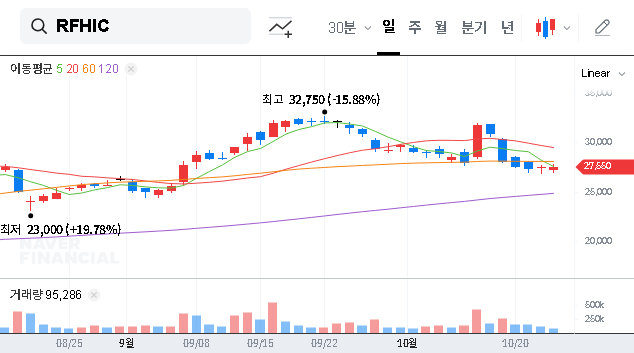
    In a significant development for the aerospace and defense sectors, RFHIC Corporation has officially announced a landmark supply contract with LIG Nex1, a premier name in South Korea’s defense industry. This pivotal agreement, centered on the upcoming Cheollian Satellite No. 5 project, not only represents a substantial financial injection but also solidifies RFHIC’s position as a leader in advanced satellite communication technology. The deal underscores the company’s unique technological prowess and marks a strategic deepening of its role in high-stakes national infrastructure projects.

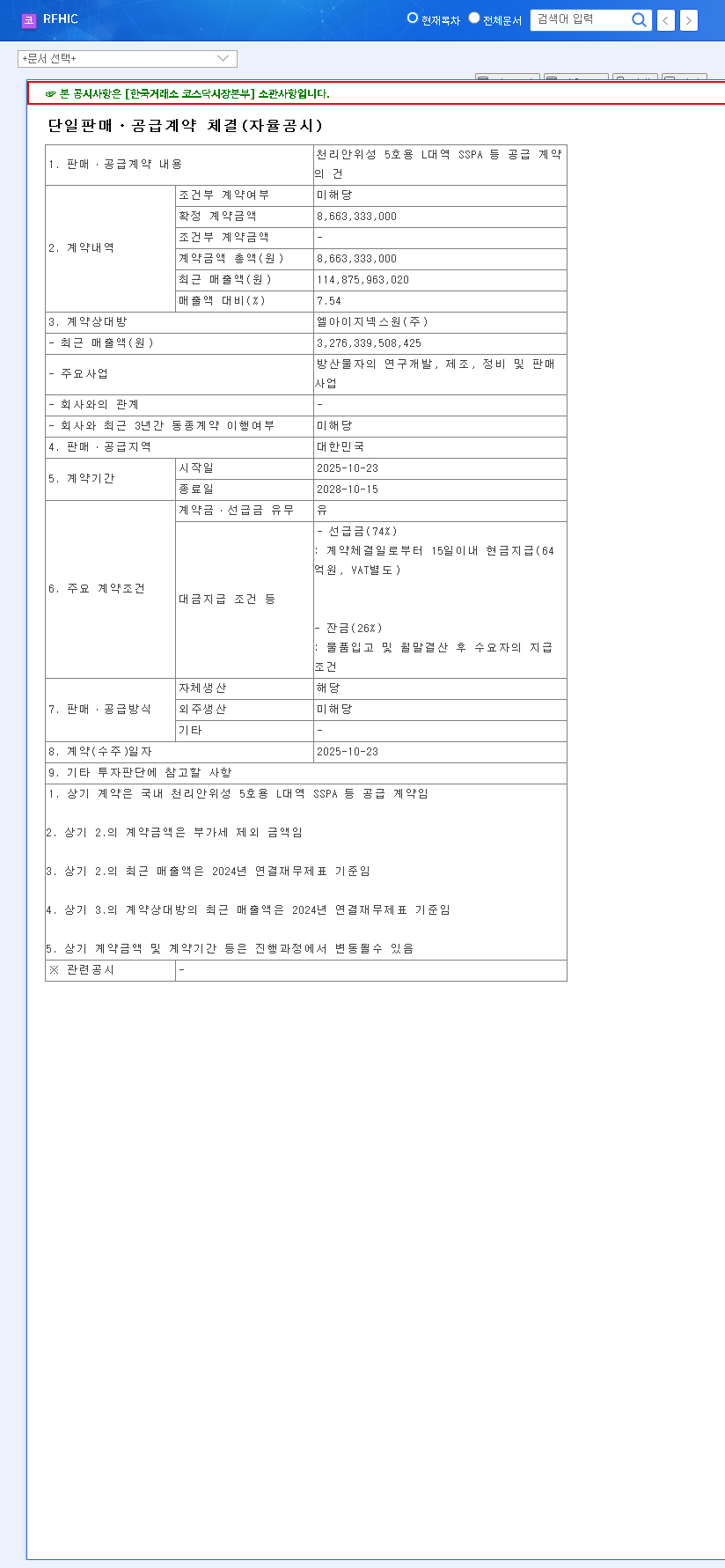
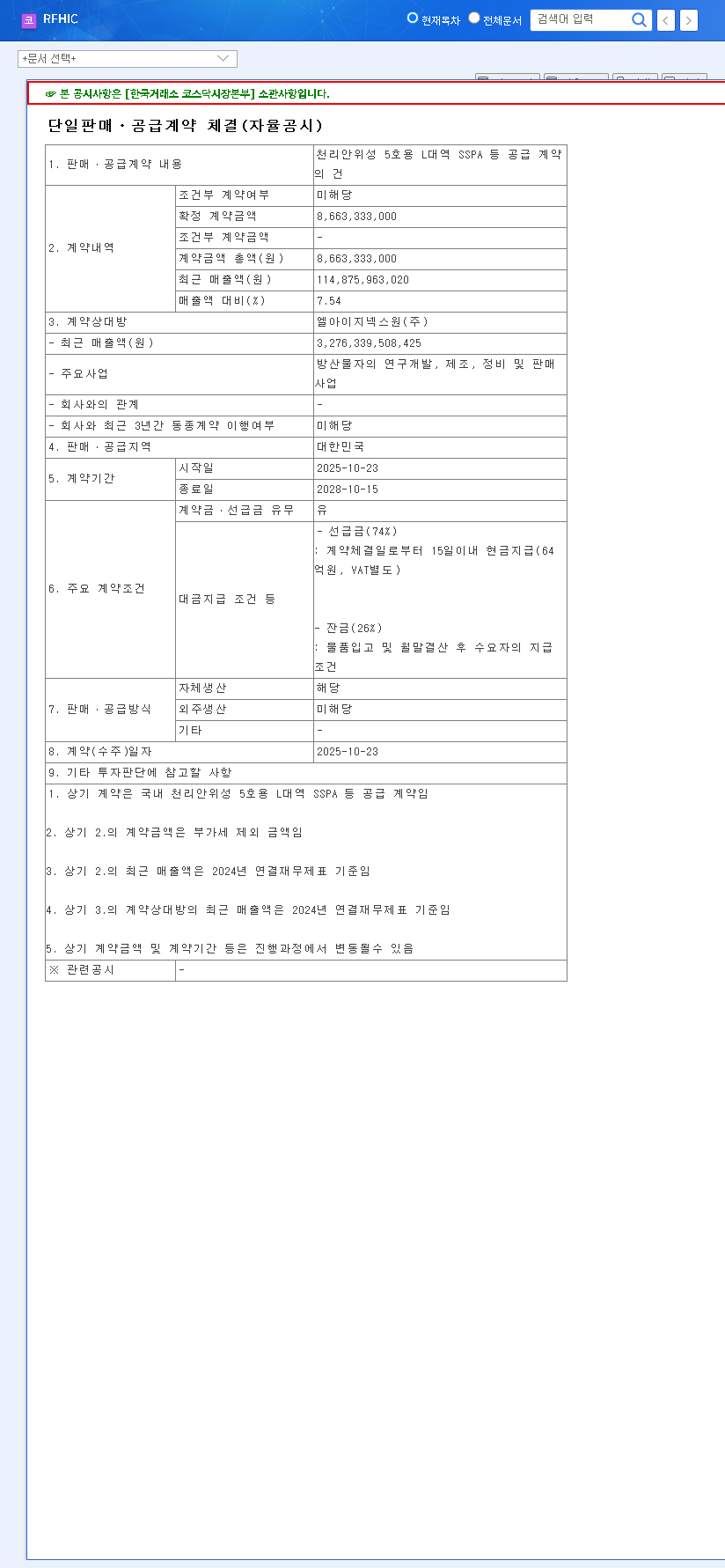
    On October 23, 2025, RFHIC Corporation disclosed the signing of a ‘Supply Contract for L-band SSPA, etc., for Cheollian Satellite No. 5’ with LIG Nex1 Co., Ltd. The official filing provides complete transparency on this major development. (Source: Official DART Disclosure).

    Contract Details: A Landmark Agreement

    This LIG Nex1 contract is a testament to the trust placed in RFHIC Corporation’s capabilities. The specifics of the agreement paint a clear picture of its importance:

    • Contract Value: 8.7 billion KRW (approximately $6.5 million USD), providing a significant and predictable revenue stream.
    • Contract Period: A three-year term from October 23, 2025, to October 15, 2028, ensuring long-term project stability.
    • Financial Scale: The contract is equivalent to 7.54% of RFHIC’s most recent annual revenue, marking a substantial contribution to its top line.

    Decoding the Technology: The Critical Role of the L-band SSPA

    At the heart of this contract is the L-band SSPA (Solid State Power Amplifier), a mission-critical component for modern satellite communication. An SSPA is responsible for amplifying the radio frequency signals that a satellite transmits back to Earth, ensuring clear and reliable communication. The ‘L-band’ refers to a specific frequency range (1-2 GHz) prized for its reliability in various weather conditions, making it ideal for essential services like GPS, mobile satellite phones, and surveillance.

    Developing and manufacturing these components requires immense technological expertise, precision engineering, and robust quality control. By securing this contract, RFHIC Corporation publicly validates its leadership in this high-value, high-barrier-to-entry market segment. For more on satellite technology, authoritative sources like the European Space Agency provide excellent background information.

    This contract is more than a financial win; it’s a strategic validation of RFHIC Corporation’s technological dominance in the competitive satellite communication landscape and a cornerstone for future growth with LIG Nex1.

    Strategic Implications and Future Outlook

    The ripple effects of this deal extend far beyond the immediate revenue boost. The collaboration on the Cheollian Satellite No. 5 project creates a powerful synergy and opens doors for future opportunities.

    Strengthening a Key Partnership

    LIG Nex1 is a titan in South Korea’s defense industry, involved in everything from guided missiles to radar and avionics. A successful, long-term collaboration with such a partner enhances RFHIC’s business stability and positions it favorably for future defense and space-related government contracts. This partnership is a key growth driver that investors should watch closely.

    Market Validation and Enhanced Corporate Image

    Participation in a critical national project like a geostationary satellite enhances technological credibility and public recognition. It solidifies RFHIC Corporation’s image as a cutting-edge technology provider, capable of meeting the most stringent quality and performance standards. This can be a major advantage when competing for international contracts. To learn more about RFHIC’s core technologies, you can read our guide on GaN-on-SiC technology in RF applications.

    Potential Risks and Considerations

    While overwhelmingly positive, it is prudent to consider potential challenges:

    • Supply Chain Stability: Fluctuations in the price or availability of raw materials for components could impact profitability.
    • Execution Excellence: Satellite projects demand absolute adherence to strict delivery schedules and flawless quality control.
    • Competitive Landscape: The advanced technology sector is dynamic; continuous innovation is necessary to stay ahead of competitors.

    Investor Takeaway

    This LIG Nex1 contract is a clear positive catalyst for RFHIC Corporation. It provides short-term financial stability while laying the groundwork for long-term dominance in the advanced satellite communication market. Investors should monitor the smooth execution of this contract and look for signs of further collaboration between RFHIC and LIG Nex1 as key indicators of future performance.

    Disclaimer: This content is based on publicly available report information and is for informational purposes only. It does not constitute investment advice. Investment decisions should be made based on independent research and professional judgment.

    (218410) RFHIC Corporation Inks $6.5M LIG Nex1 Contract for Cheollian Satellite No. 5 관련 이미지
  • (079550) LIG Nex1’s KRW 2 Trillion Bid: Unconfirmed Disclosure & Stock Analysis for Investors

    (079550) LIG Nex1’s KRW 2 Trillion Bid: Unconfirmed Disclosure & Stock Analysis for Investors

    The recent news surrounding the potential LIG Nex1 KRW 2 trillion bid has sent shockwaves through the investment community, creating a climate of both immense opportunity and significant uncertainty. While initial reports suggested a monumental contract win for the Korean defense giant, a subsequent ‘unconfirmed’ disclosure has left investors carefully weighing their next move. This analysis unpacks the situation, providing a detailed look at the implications for LIG Nex1 stock and a strategic roadmap for investors.

    Deconstructing the LIG Nex1 Unconfirmed Disclosure

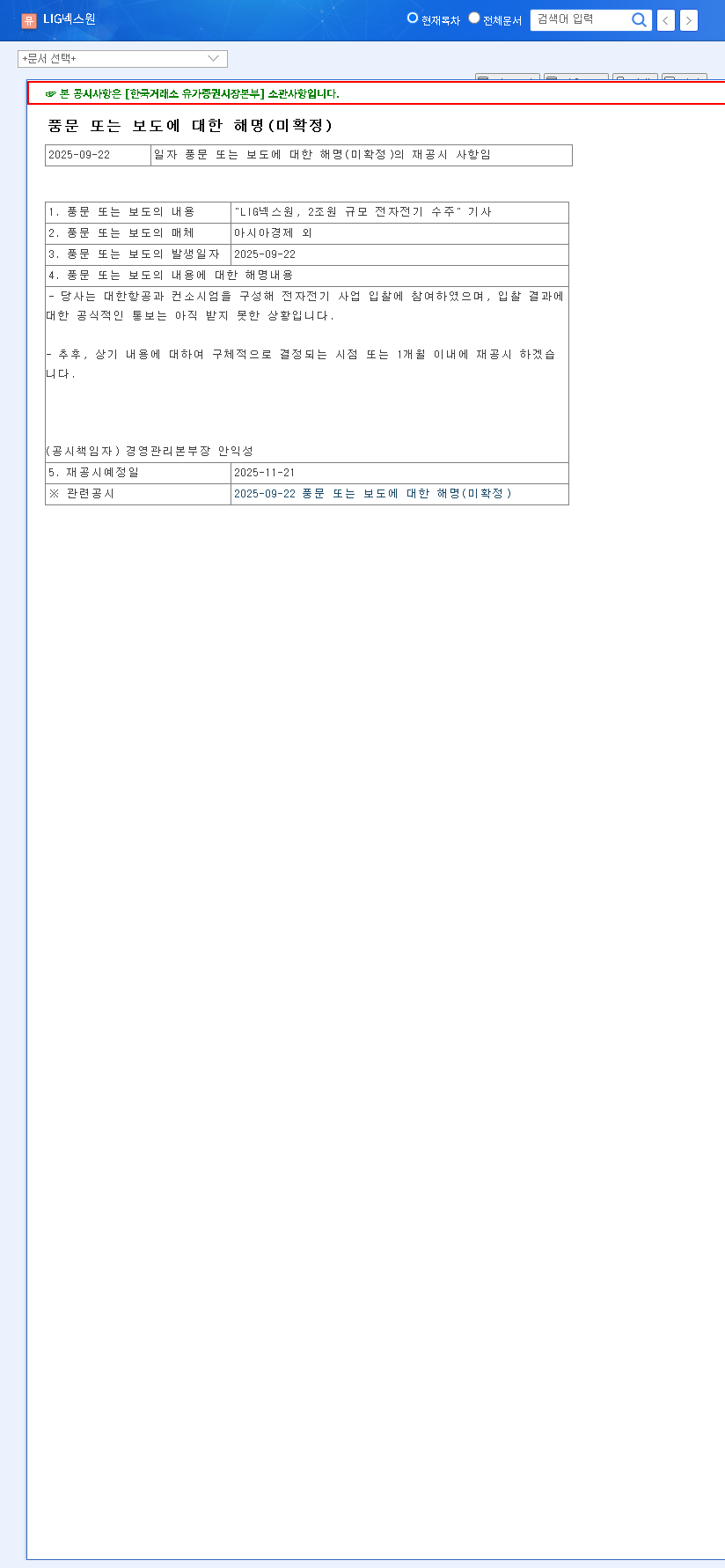
    On September 22, 2025, media outlets reported that LIG Nex1 Co., Ltd. had potentially secured a landmark KRW 2 trillion electronic warfare project. A contract of this magnitude—representing a substantial portion of the company’s market capitalization—naturally captured significant market attention. However, the narrative shifted a month later. On October 22, 2025, LIG Nex1 officially addressed these reports in an ‘unconfirmed’ disclosure filed with the Financial Supervisory Service (Source: Official DART Report).

    The key takeaways from the clarification are:

    • LIG Nex1 participated in the bid as part of a consortium with Korean Air.
    • The company has not yet received official notification regarding the bid’s outcome.
    • A follow-up disclosure is scheduled at the time of the final decision or by November 21, 2025.

    In essence, while LIG Nex1’s participation is confirmed, the contract award itself hangs in the balance, creating the current state of market anticipation.

    For investors, this ‘unconfirmed’ status is a critical juncture where high expectations and palpable risk coexist. The final outcome will undoubtedly serve as a major catalyst for LIG Nex1 stock, in one direction or the other.

    Why This Bid Matters: Market Context and Impact

    The Booming Korean Defense Industry

    This event isn’t happening in a vacuum. The Korean defense industry is experiencing a golden age, with exports surging due to its reputation for high-tech, cost-effective solutions. As global geopolitical tensions rise, nations are increasing their defense budgets, creating unprecedented demand. A win like the LIG Nex1 KRW 2 trillion bid would not only be a victory for the company but also a further validation of South Korea’s growing dominance in the global arms market, as noted in reports by major outlets like Reuters on global defense spending.

    Scenario Analysis: The Bull vs. The Bear Case

    Investors must prepare for both potential outcomes once the final announcement is made.

    • The Bull Case (Successful Bid): A confirmed KRW 2 trillion contract would be a massive catalyst. It would dramatically boost LIG Nex1’s revenue and order backlog for years, provide stable profitability, and solidify its leadership in the advanced electronic warfare sector. Investor sentiment would likely surge, pushing LIG Nex1 stock to new highs.
    • The Bear Case (Failed Bid): Failure to secure the contract would likely trigger a sharp, negative reaction. The high expectations currently priced into the stock could unwind, leading to significant selling pressure. It would also represent a lost opportunity to a competitor, potentially impacting long-term strategic positioning in this key defense segment.

    A Strategic Action Plan for Investors

    Navigating this period of uncertainty requires a proactive and informed strategy. Here’s how to prepare for the upcoming announcement.

    1. Monitor Official Channels Diligently

    The most critical date is November 21, 2025. Set an alert for LIG Nex1’s official disclosures. Be prepared to act on confirmed news, not on rumors. The details of the contract (if won), such as payment schedules and margins, will be just as important as the headline number.

    2. Deepen Your Fundamental Research

    Beyond this single bid, assess the company’s core strength. Analyze LIG Nex1’s existing order backlog, financial health (debt levels, cash flow), and its project pipeline. Understanding the synergy with its consortium partner, Korean Air, can also provide insight into the bid’s strength. Compare its valuation and growth prospects with others in the sector by reviewing our in-depth analysis of the Korean defense sector.

    3. Implement Risk Management

    Given the binary nature of the upcoming announcement, volatility is almost guaranteed. Consider your position size carefully. Avoid making an oversized bet based purely on speculation. Prudent investors may set pre-determined entry or exit points (e.g., stop-loss orders) to manage potential downside risk if the bid fails.

    The outcome of the LIG Nex1 KRW 2 trillion bid is undoubtedly a pivotal event. By staying informed, conducting thorough due diligence, and preparing for multiple scenarios, investors can navigate this period of uncertainty and make decisions grounded in strategy, not speculation.

    (079550) LIG Nex1's KRW 2 Trillion Bid: Unconfirmed Disclosure & Stock Analysis for Investors 관련 이미지
  • (003490) KOREAN AIR LINES Stock: Analysis of ₩3 Trillion Airborne Control Aircraft Project

    (003490) KOREAN AIR LINES Stock: Analysis of ₩3 Trillion Airborne Control Aircraft Project

    A major development is casting a new light on KOREAN AIR LINES stock as reports surface about its potential involvement in a massive ₩3 trillion national defense initiative. The project in question involves sophisticated airborne control aircraft, a move that could signal a significant strategic shift for the aviation giant. This analysis delves into the official company disclosure, the potential financial upside, and the inherent risks for investors eyeing this new chapter for Korean Air.

    We will break down what this airborne control aircraft project entails, evaluate the short and long-term implications for the company’s valuation, and outline a prudent investment strategy based on the available information. Is this a catalyst for sustained growth or a speculative venture still shrouded in uncertainty?

    The Disclosure: Unpacking the ₩3 Trillion Opportunity

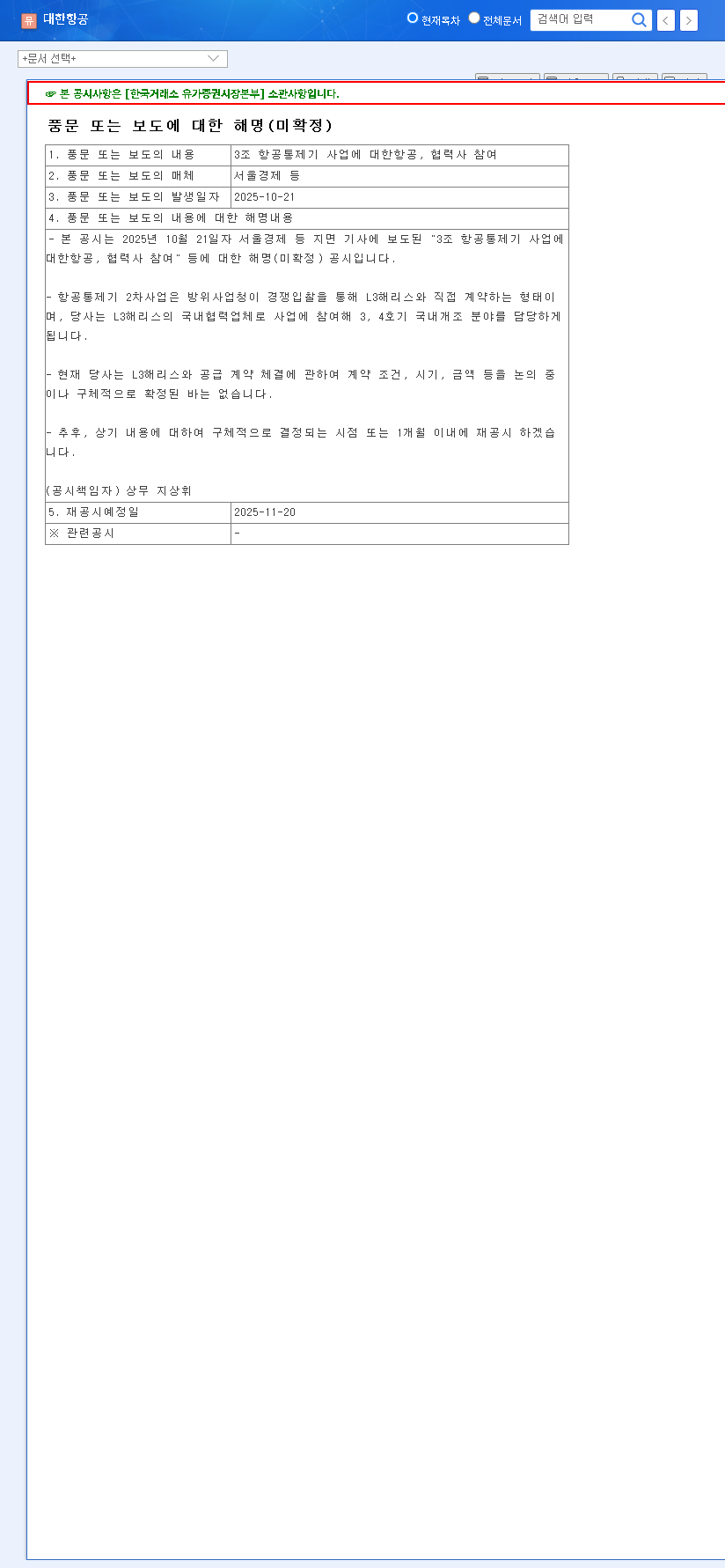
    On October 21, 2025, news outlets began reporting that KOREAN AIR LINES was poised to partner in the second phase of a major defense acquisition. In response, the company issued a clarification to address the speculation. The core of the announcement reveals a potential partnership with a global defense technology leader, L3Harris, for the domestic modification of the 3rd and 4th airborne control aircraft for the Defense Acquisition Program Administration (DAPA).

    KOREAN AIR LINES has officially stated that while a supply contract with L3Harris is under discussion, crucial details such as contract terms, timing, and financial scope are not yet confirmed. The company has committed to a re-disclosure by November 20, 2025.

    This ‘unconfirmed’ status is critical. While the news validates a new business opportunity, it also introduces a layer of uncertainty that investors must navigate carefully. The company’s clarification can be viewed in full via its Official Disclosure (DART).

    Analyzing the Impact on KOREAN AIR LINES Stock

    Prior to these reports, market expectations for KOREAN AIR LINES’ involvement in a project of this nature were minimal. Therefore, this development should be analyzed as a new, potential catalyst rather than an impact on existing business fundamentals. We can assess the potential effects from both short-term and long-term perspectives.

    Short-Term: A Mix of Opportunity and Caution

    In the immediate term, the news flow is a net positive for investor sentiment. It highlights the company’s technical capabilities and opens the door to a lucrative new sector. However, the unconfirmed nature of the deal will likely temper any significant, sustained rally in KOREAN AIR LINES stock until concrete details emerge.

    • Positive Catalyst: The prospect of a large-scale, multi-trillion Won KAL defense contract can generate excitement and attract speculative interest.
    • Credibility Boost: Being considered for such a high-tech project validates KOREAN AIR LINES’ aerospace engineering and maintenance (MRO) divisions.
    • Key Risk: The ‘unconfirmed’ status is the primary headwind. A failure to secure the contract or unfavorable terms could lead to investor disappointment.

    Mid- to Long-Term: The Path to Business Diversification

    The most compelling aspect of this KOREAN AIR LINES investment thesis is the potential for strategic diversification. The commercial airline industry is notoriously cyclical and sensitive to economic shocks, fuel prices, and global events. Securing a significant role in the defense sector would provide a stable, long-term revenue stream insulated from these pressures.

    Successful execution of this L3Harris partnership could establish KOREAN AIR LINES as a key player in South Korea’s defense-industrial ecosystem. This opens doors to future projects, from aircraft maintenance to advanced modifications and systems integration. For more context on the industry, see our guide to investing in aerospace and defense stocks.

    Investment Strategy: Key Points to Watch

    Given the current information, a ‘watchful waiting’ approach is the most prudent strategy. The potential upside is clear, but the risks of premature investment are tangible. Investors should focus on the following key points leading up to the November 20, 2025 re-disclosure date.

    • Contract Confirmation: The binary outcome of whether the contract is signed is the most critical factor.
    • Financial Details: Once confirmed, the contract’s total value for KOREAN AIR LINES, its duration, and expected profit margins will determine the actual financial impact.
    • Scope of Work: Understanding the company’s precise role—whether it involves complex systems integration or more basic airframe modification—will be key to assessing its long-term value creation. Defense contractors like L3Harris Technologies have extensive global supply chains, and KOREAN AIR’s role within it matters.

    In conclusion, the potential entry into the airborne control aircraft project is a genuinely exciting development for KOREAN AIR LINES. It represents a tangible step toward becoming a more resilient and diversified aerospace leader. While short-term volatility in KOREAN AIR LINES stock is expected, the long-term strategic merit is undeniable. The upcoming disclosure will be the true determinant, and investors should remain vigilant for the confirmed details.

    (003490) KOREAN AIR LINES Stock: Analysis of ₩3 Trillion Airborne Control Aircraft Project 관련 이미지
  • (012450) Hanwha Aerospace IR: Ultimate Guide to Q3 2025 Earnings & Stock Impact

    (012450) Hanwha Aerospace IR: Ultimate Guide to Q3 2025 Earnings & Stock Impact

    The global investment community is closely watching HANWHA AEROSPACE CO., LTD. as it prepares for its pivotal Q3 2025 Investor Relations (IR) event on November 4, 2025. This upcoming Hanwha Aerospace IR is more than a standard financial report; it’s a critical moment for investors to gauge the company’s trajectory, understand its strategic initiatives, and assess its future growth potential. This comprehensive guide will delve into what to expect, analyze potential impacts on the Hanwha Aerospace stock, and provide a strategic action plan for investors.

    Understanding the nuances of this event is crucial for anyone considering a Hanwha Aerospace investment. We will break down the key business segments, potential market-moving announcements, and how you can prepare to make informed decisions.

    What to Expect from the Hanwha Aerospace Q3 2025 IR

    The primary purpose of the IR event is to present the Hanwha Aerospace Q3 2025 earnings and provide a forward-looking outlook. However, seasoned investors know the real value lies in the details beyond the headline numbers. The session will feature a management presentation followed by a Q&A, offering direct insights into the executive team’s confidence and strategic priorities.

    Key Business Segments in Focus

    Hanwha Aerospace operates across several high-tech domains. The performance of these divisions will be central to the IR discussion:

    • Defense Division: This segment is the company’s powerhouse, known for products like the K9 Thunder self-propelled howitzer and the Redback Infantry Fighting Vehicle. Investors will be keen on updates regarding international contracts, production schedules, and margin performance amidst global geopolitical tensions.
    • Aerospace Division: Focusing on aircraft engines and space launch vehicles, this division represents the company’s long-term, high-growth potential. Look for commentary on the Nuri rocket’s progress, satellite business development, and partnerships within the global aviation industry.
    • Technology Solutions: This includes precision machinery and security solutions. While smaller, its profitability and technological synergies with the core divisions are important indicators of operational excellence.

    Investor sentiment for Hanwha Aerospace stock will be shaped not just by past performance, but by the credibility and ambition of its future outlook. The management’s tone during the Q&A will be as telling as the numbers themselves.

    Potential Scenarios & Stock Price Impact

    The market’s reaction will hinge on whether the results and guidance meet, beat, or miss analyst expectations. Here are plausible scenarios:

    Positive Impact (Bullish Scenario)

    A surge in the Hanwha Aerospace stock price could be triggered by:

    • Earnings Beat: Q3 revenue and profit figures that significantly exceed market consensus.
    • Upgraded Guidance: A confident and upwardly revised forecast for Q4 2025 or the full year 2026.
    • Major Contract Announcements: Confirmation of new, large-scale defense or aerospace contracts.

    Negative Impact (Bearish Scenario)

    Conversely, downward pressure on the stock could result from:

    • Earnings Miss: Performance that falls short of analyst expectations, particularly in the high-margin defense sector.
    • Cautious Outlook: Management expressing concerns about supply chains, project delays, or a softening order book.
    • Evasive Q&A: Failure to provide clear answers to critical investor questions, which can erode confidence.

    Investor Action Plan for the Hanwha Aerospace IR

    Proactive research is key. Don’t just wait for the announcement; prepare for it. For broader context, you can read our deep dive on global defense market trends to understand the industry landscape.

    • Review Analyst Reports: Gather consensus estimates for revenue, operating profit, and EPS before the call. This provides a benchmark for the actual results.
    • Analyze Past Performance: Examine trends from previous quarters to identify patterns and understand management’s track record of forecasting.
    • Monitor the Official Disclosure: The most credible information comes directly from the source. The company’s filing can be found in the Official Disclosure on DART.
    • Assess the Market Reaction: After the IR, compare the company’s report with independent analysis from reputable financial news sources like Bloomberg to get a balanced view.

    Ultimately, the Hanwha Aerospace future outlook depends on its ability to execute on its massive order backlog and innovate in the aerospace sector. Investors should focus on the long-term fundamentals revealed during the IR, rather than just the immediate, short-term stock price volatility. A successful Hanwha Aerospace investment strategy is built on thorough due diligence and a multi-year perspective.

    (012450) Hanwha Aerospace IR: Ultimate Guide to Q3 2025 Earnings & Stock Impact 관련 이미지
  • (047810) KOREA AEROSPACE INDUSTRIES (KAI) Secures ₩448.6B Contract: An In-Depth Investor Analysis

    (047810) KOREA AEROSPACE INDUSTRIES (KAI) Secures ₩448.6B Contract: An In-Depth Investor Analysis

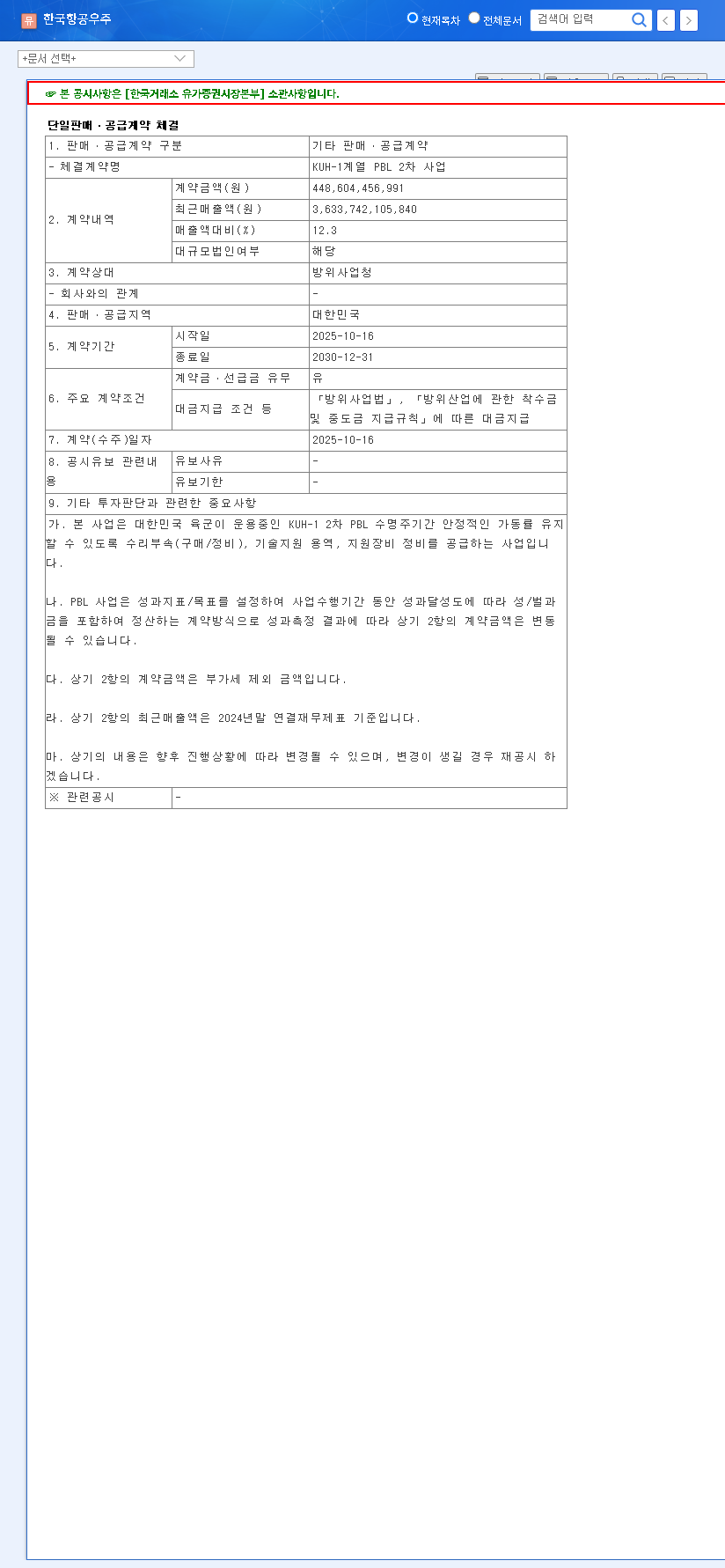
    KOREA AEROSPACE INDUSTRIES, LTD. (KAI), a titan in South Korea’s aerospace and defense sector, has made a significant move that has captured the attention of the investment community. The company recently announced a massive supply contract for the KUH-1 Series Performance-Based Logistics (PBL) Phase 2 Project with the Defense Acquisition Program Administration (DAPA). Valued at an astounding ₩448.6 billion, this agreement represents a major financial injection and a powerful vote of confidence in KAI’s capabilities. This article provides a comprehensive analysis of the KAI contract, its implications for corporate value, and the strategic considerations for current and potential investors.

    Unpacking the Landmark ₩448.6 Billion KAI Contract

    On October 16, 2025, KOREA AEROSPACE INDUSTRIES officially entered into this long-term agreement with DAPA. The contract is not just substantial in value—accounting for 12.3% of KAI’s recent annual revenue—but also in duration, spanning over five years until December 31, 2030. This secures a predictable and significant revenue stream, a highly desirable trait in the often-cyclical defense industry.

    The core of the deal revolves around providing comprehensive logistics, maintenance, and operational support for the KUH-1 ‘Surion’ utility helicopter fleet. For full transparency and verification, the details of this agreement can be reviewed in the Official Disclosure (Source: DART).

    What is Performance-Based Logistics (PBL)?

    Understanding the PBL model is crucial to grasping the value of this KAI contract. Unlike traditional contracts that focus on selling parts and performing repairs as needed, a PBL model is a strategic partnership. KAI is not just a supplier; it’s a service provider responsible for ensuring the Surion fleet meets specific performance and readiness targets. This involves inventory management, technical support, and proactive maintenance to maximize aircraft availability. This high-value service model fosters a deeper relationship with the client (DAPA) and generates more stable, recurring revenue compared to one-off hardware sales.

    This five-year, ₩448.6 billion PBL contract significantly de-risks KAI’s revenue forecast, providing a stable foundation for growth and solidifying its role as a key national defense partner.

    The Bull Case: Positive Impacts for KOREA AEROSPACE INDUSTRIES

    This contract is poised to deliver multiple strategic benefits that could positively influence KAI stock and its long-term valuation.

    • Enhanced Revenue Stability: The most immediate impact is the secured ₩448.6 billion revenue stream over five years. National defense projects offer unparalleled stability, shielding KAI from commercial market volatility and providing a solid financial footing.
    • Strengthened Defense Position: This large-scale contract with DAPA reinforces KAI’s indispensable role in South Korea’s defense infrastructure. It validates the performance of the Surion helicopter platform and enhances trust, which can lead to preferential consideration for future government projects.
    • Validation and Export Potential: A successful, long-term domestic support contract serves as a powerful testament to the reliability of the KUH-1 platform. This can be leveraged as a crucial selling point in international markets, potentially boosting KAI’s export sales for both the helicopter and its associated support services.

    Navigating Potential Headwinds: Risks Investors Must Consider

    Despite the overwhelmingly positive outlook, a prudent investment strategy requires acknowledging potential risks associated with this long-term endeavor.

    • Project Execution Risk: Long-term projects can encounter unforeseen challenges, such as technical issues, supply chain disruptions, or cost overruns. As a PBL contract, failure to meet performance metrics could result in financial penalties, impacting profitability.
    • Government Policy and Budget Shifts: The defense industry is intrinsically linked to government policy. Future changes in administration, defense priorities, or budget allocations could potentially alter the scope or funding of ongoing projects.
    • Competitive Landscape: While KAI is dominant domestically, the global aerospace market is fiercely competitive. Investors should monitor how KAI’s technology and cost-effectiveness stack up against international rivals, which could affect future export opportunities.

    Strategic Action Plan for KAI Investors

    This initial analysis provides a strong foundation, but thorough due diligence is essential. Investors should consider the following steps:

    1. Review Financial Health: Analyze KAI’s recent financial statements to assess its balance sheet strength, debt levels, and cash flow. This will help quantify the exact impact of the new contract on its overall financial stability.
    2. Consult Market Analysis: Gain a wider perspective by reviewing analyst reports and market consensus from reputable financial news sources like Bloomberg or Reuters to understand target stock prices and broader market sentiment.
    3. Understand the Sector: Contextualize KAI’s performance by exploring the wider trends in the global defense industry. For more information, read our Guide to Investing in the Aerospace & Defense Sector.

    Conclusion: A Stable Trajectory for Growth

    The KUH-1 PBL Phase 2 contract is unequivocally a major victory for KOREA AEROSPACE INDUSTRIES. It provides a robust, multi-year revenue stream, deepens a critical government partnership, and validates its flagship helicopter program. While investors must remain mindful of execution and policy risks, this deal marks a significant milestone that enhances KAI’s business stability and growth prospects for the foreseeable future.

    (047810) KOREA AEROSPACE INDUSTRIES (KAI) Secures ₩448.6B Contract: An In-Depth Investor Analysis 관련 이미지