Tag: CRO Business

  • (187660) Hyundai ADM Bio Inc. Convertible Bond: A Guide to Share Dilution vs. Liquidity

    (187660) Hyundai ADM Bio Inc. Convertible Bond: A Guide to Share Dilution vs. Liquidity

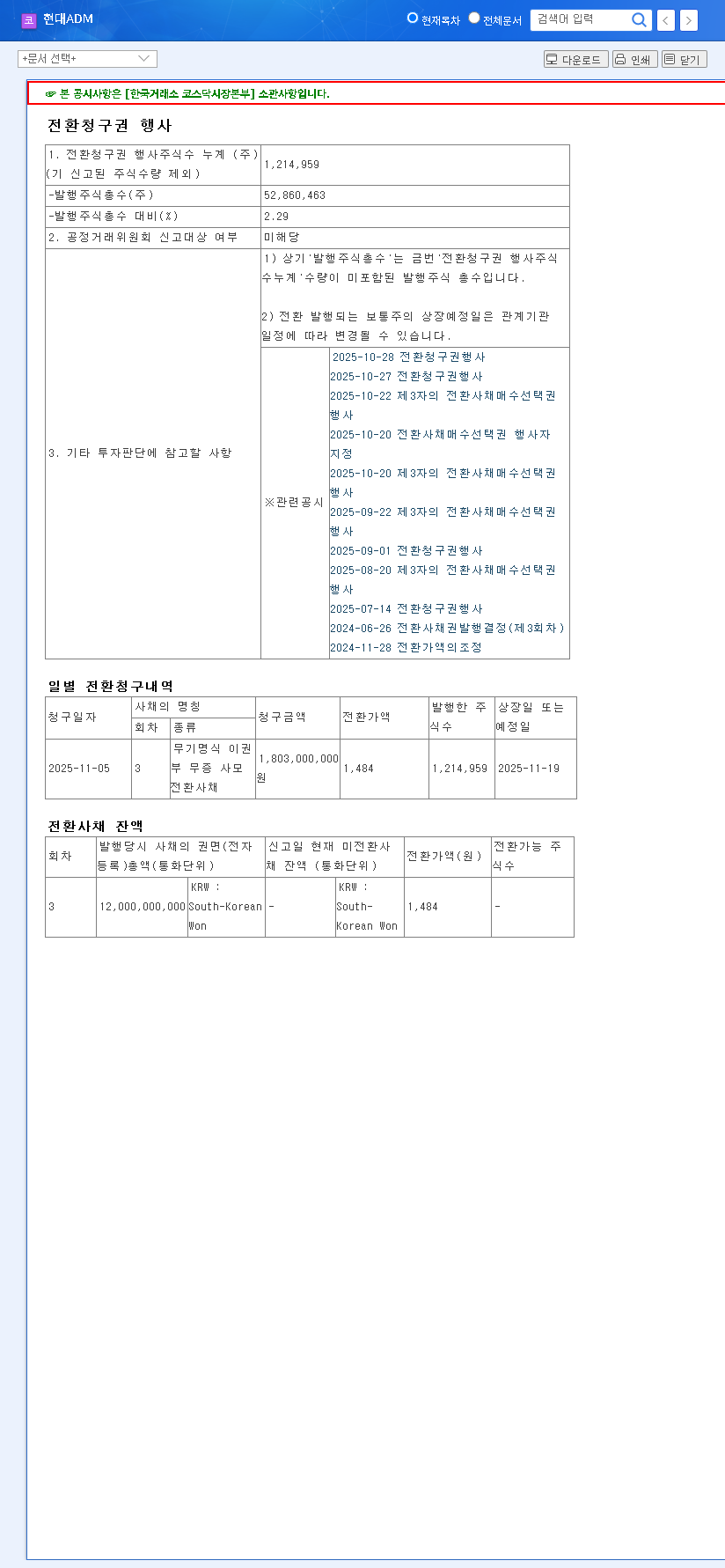
    Hyundai ADM Bio Inc. has just executed a significant financial maneuver by exercising its convertible bond rights, a move that injects fresh capital but also introduces over a million new shares to the market. For investors, this creates a critical dilemma: is this a strategic cash infusion that will fuel growth, or a desperate measure that will lead to significant share dilution? This comprehensive analysis will dissect the Hyundai ADM Bio Inc. convertible bond event, examine the company’s precarious financial health, and provide actionable strategies for investors navigating this pivotal moment.

    The Core Event: A Closer Look at the Convertible Bond Exercise

    On November 5, 2025, Hyundai ADM Bio Inc. confirmed the exercise of conversion rights for its outstanding convertible bonds. In simple terms, bondholders are choosing to swap their debt for equity, betting on the future value of the company’s stock. This move has immediate and tangible consequences for the company’s capital structure and stock market dynamics.

    The core conflict for investors is weighing the short-term benefit of ₩1.8 billion in liquidity against the long-term risk of share value erosion from 1.2 million new shares flooding the market.

    Key Details of the Issuance

    Understanding the specifics is crucial for any investor strategy. Here are the official details from the company’s disclosure:

    • Company: Hyundai ADM Bio Inc.
    • New Shares Issued: 1,214,959 (representing 2.29% of market cap)
    • Conversion Price: ₩1,484 per share
    • Total Capital Raised: Approx. ₩1.8 billion
    • Expected Listing Date: November 19, 2025
    • Source: Official Disclosure (DART Report)

    Analyzing Hyundai ADM’s Shaky Fundamentals

    The impact of a financing event like this cannot be judged in a vacuum. The company’s underlying health is the most critical factor. Unfortunately, Hyundai ADM Bio Inc.’s fundamentals are showing signs of significant strain, which magnifies the risks associated with this share issuance.

    Struggling Business Segments

    The company’s core operations are facing headwinds. The CRO (Contract Research Organization) business is experiencing a revenue decline of 14.4% year-over-year amid fierce competition. Meanwhile, its future growth engine—the anti-cancer drug development in its Bio Business—is still pre-revenue and fraught with uncertainty, including recent clinical trial setbacks. This paints a picture of a company whose primary revenue stream is shrinking while its future prospects remain speculative.

    Deteriorating Financial Health

    A look at the financial statements reveals a worrying trend that makes this Hyundai ADM Bio Inc. convertible bond exercise look more like a necessity than a strategic choice.

    • Expanding Losses: Operating losses have widened to ₩-4.37 billion, signaling deep profitability issues.
    • High Debt: The debt-to-equity ratio stands at a concerning 178.73%, and this bond conversion only addresses a fraction of its total debt.
    • Negative Cash Flow: With an operating cash flow of ₩-2.856 billion, the company is burning through cash, raising serious liquidity concerns.

    Investor Playbook: Navigating the Aftermath

    Given the weak fundamentals, investors must approach this situation with extreme caution. The short-term influx of shares will likely create downward pressure on the stock price around the November 19th listing date.

    Short-Term Strategy (High Risk)

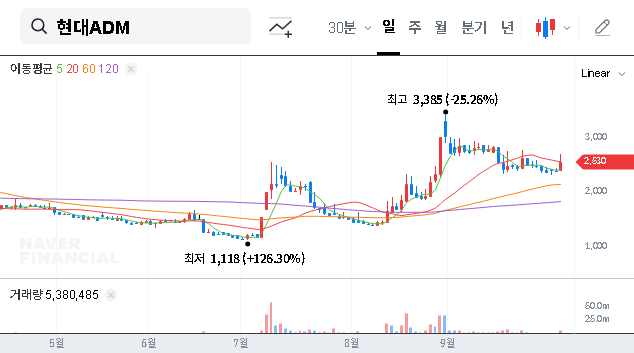
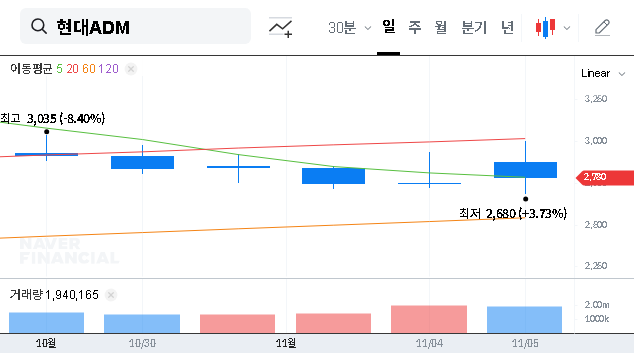
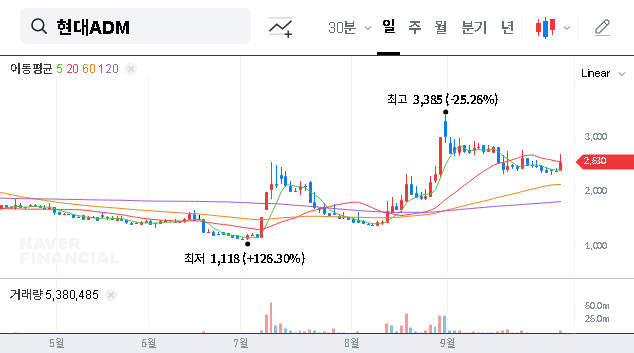
    Traders should be wary of the supply overhang. The arbitrage opportunity—with the current stock price (₩2,780) well above the conversion price (₩1,484)—means bondholders have a strong incentive to sell their newly acquired shares for a quick profit. This could trigger a sell-off. Monitoring trading volume and price action closely on and after the listing date is paramount for anyone considering a short-term position.

    Long-Term Investment Outlook

    Long-term investors should disregard the noise of the bond conversion and focus entirely on fundamental improvements. Before considering an investment, look for tangible evidence of a turnaround. For more information on what makes these instruments tick, you can review this comprehensive guide to convertible bonds from a reputable financial source. Key milestones to watch for include:

    • Positive clinical trial data or partnerships in the bio-business.
    • A stabilization or return to growth in the CRO segment.
    • A clear plan for debt reduction and a path to positive cash flow.

    Without these fundamental shifts, the company’s long-term prospects remain dim. Investors interested in this sector should also read our internal guide on How to Analyze Biotech Stocks for broader context.

    Final Verdict: A Warning Sign for Investors

    The Hyundai ADM Bio Inc. convertible bond exercise is not a signal of strength. While it provides a temporary liquidity patch, it fails to address the deep-seated problems within the company’s business model and financial structure. The immediate risk of share dilution and supply pressure outweighs the modest benefit of the capital injection. Until Hyundai ADM Bio Inc. demonstrates a credible and sustained operational turnaround, this event should be viewed as a warning sign rather than a catalyst for growth. The company’s future stock performance will be dictated by fundamental execution, not financial engineering.
    (187660) Hyundai ADM Bio Inc. Convertible Bond: A Guide to Share Dilution vs. Liquidity 관련 이미지
  • (187660) Hyundai ADM Bio Conversion Right Exercise: A 2025 Investor’s Deep Dive (187660)

    (187660) Hyundai ADM Bio Conversion Right Exercise: A 2025 Investor’s Deep Dive (187660)

    Investors in Hyundai ADM Bio lnc. (187660) are closely watching the latest corporate action: a significant Hyundai ADM Bio conversion right exercise involving its convertible bonds (CBs). This event, while common in corporate finance, often raises critical questions about its impact on stock price, shareholder value, and the company’s long-term strategy. Is this a sign of strength and investor confidence, or a warning of potential stock dilution ahead?

    This comprehensive analysis will dissect the recent announcement, evaluate the company’s core fundamentals—including its recovering Contract Research Organization (CRO) business and promising new drug pipeline—and provide a clear-eyed view for investors. We will explore the immediate effects and what this means for your investment strategy in 2025 and beyond.

    Breaking Down the Conversion Right Exercise

    What Exactly Happened?

    On October 27, 2025, Hyundai ADM Bio officially announced that holders of its convertible bonds chose to exercise their right to convert that debt into company stock. A convertible bond is a type of hybrid security that starts as a loan to the company but can be converted into a predetermined number of common shares. This is often used by growth-stage companies to raise capital at a lower interest rate than traditional loans.

    According to the Official Disclosure filed with DART, the key details of this exercise are:

    • Shares Issued: A total of 1,037,060 new shares will be created.
    • Market Impact: This represents approximately 2.04% of the current market capitalization.
    • Conversion Price: The price was set at a low KRW 1,484 per share.
    • Listing Date: These new shares are expected to begin trading on November 11, 2025.

    The most striking detail is the conversion price of KRW 1,484, which is significantly below the recent trading price of around KRW 3,100. This created a substantial, low-risk profit opportunity for bondholders, making the conversion a logical financial move for them.

    Hyundai ADM’s Business Fundamentals

    Core Engine: The CRO Business

    Hyundai ADM Bio’s primary revenue stream is its Contract Research Organization (CRO) services. As a CRO, it partners with pharmaceutical and biotech firms to manage and execute clinical trials, from initial Phase 1 studies to post-market Phase 4 analysis. While the 2025 semi-annual report indicated a temporary dip in CRO revenue, the company has made strides in improving operational efficiency, leading to a significant reduction in net loss. This suggests a strengthening foundation for its core business, a crucial factor for long-term Hyundai ADM Bio stock price performance.

    Future Growth: Anticancer Drug Pipeline

    Beyond its CRO services, the company’s future value is tied to its development of a niclosamide-based anticancer drug. Progress in this area, including the production of investigational drugs and preparations for clinical trial approval, is a key catalyst. The success of this pipeline could transform Hyundai ADM Bio from a service provider into a high-growth biopharmaceutical company, representing a massive potential upside for investors who are willing to take on the associated clinical trial risks. Interested investors can learn more about how to analyze biotech stocks on our blog.

    While the CRO business provides stability, the anticancer drug development holds the key to exponential growth. The successful execution of both is paramount for sustained investor confidence.

    The Double-Edged Sword: Impact of the Conversion

    Negative: Stock Dilution and Price Pressure

    The most immediate consequence of the Hyundai ADM Bio conversion right exercise is stock dilution. With over one million new shares entering the market, the ownership stake of each existing shareholder is slightly reduced. This increase in supply can create short-term downward pressure on the stock price, especially as the original bondholders may look to sell their newly acquired shares to lock in profits. This is a critical risk for current investors to monitor around the November 11th listing date.

    Positive: A Stronger Balance Sheet

    On the other hand, converting debt to equity has a significant positive impact on the company’s financial health. By extinguishing a portion of its debt obligations, Hyundai ADM Bio reduces its liabilities and increases its shareholder equity. This de-risks the balance sheet, lowers interest expenses, and improves key financial ratios. For a company in the capital-intensive biotech sector, a stronger financial foundation is a major advantage for funding future research and operations. This can be seen as a bullish long-term signal.

    Investment Outlook: A Neutral but Watchful Stance

    Given the competing factors, a “Neutral” investment opinion is warranted at this time. The long-term growth story, driven by the CRO business recovery and drug development potential, remains intact. However, the short-term headwinds from stock dilution and market volatility cannot be ignored.

    Prudent investors should focus on monitoring several key developments in the coming months:

    • Share Price Absorption: How well does the market absorb the new shares after November 11th? Heavy selling pressure could create a better entry point.
    • Clinical Trial News: Any positive announcements regarding the niclosamide-based anticancer drug could easily outweigh dilution concerns.
    • Quarterly Earnings: The next financial report will be crucial to confirm the sustained recovery and profitability of the core CRO business.

    In conclusion, the Hyundai ADM Bio conversion right exercise is a complex event with both benefits and drawbacks. While it introduces short-term risk, it also strengthens the company’s financial standing for its long-term growth ambitions. Careful monitoring is the most sensible strategy for now.

    (187660) Hyundai ADM Bio Conversion Right Exercise: A 2025 Investor's Deep Dive (187660) 관련 이미지
  • (187660) Hyundai ADM Bio Stake Sale: An In-Depth Analysis for Investors

    (187660) Hyundai ADM Bio Stake Sale: An In-Depth Analysis for Investors

    The recent Hyundai ADM Bio stake sale has sent significant shockwaves through the investment community, raising critical questions about the company’s future. When a major shareholder like Sangsangin Savings Bank significantly reduces its position, it’s more than a simple transaction; it’s a signal that demands careful analysis. This move is expected to create short-term volatility for Hyundai ADM Bio stock and highlights underlying challenges within its core operations, from its struggling CRO business to the high-stakes world of new drug development.

    For investors, this development is a pivotal moment. Is this a temporary downturn or a sign of deeper fundamental issues? This guide provides a comprehensive breakdown of the stake sale, its potential repercussions, and a strategic checklist for navigating the uncertainty surrounding Hyundai ADM Bio.

    Unpacking the Hyundai ADM Bio Stake Sale Event

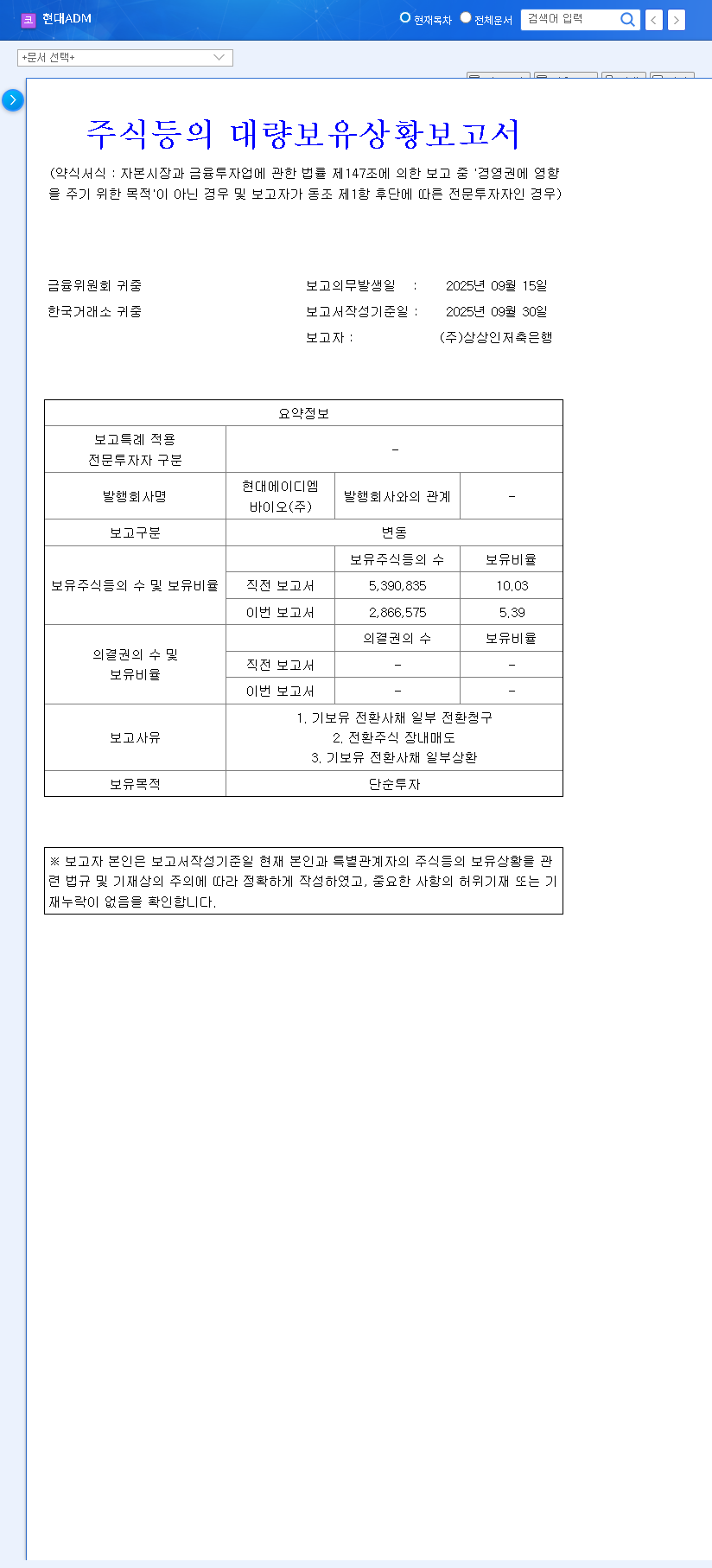
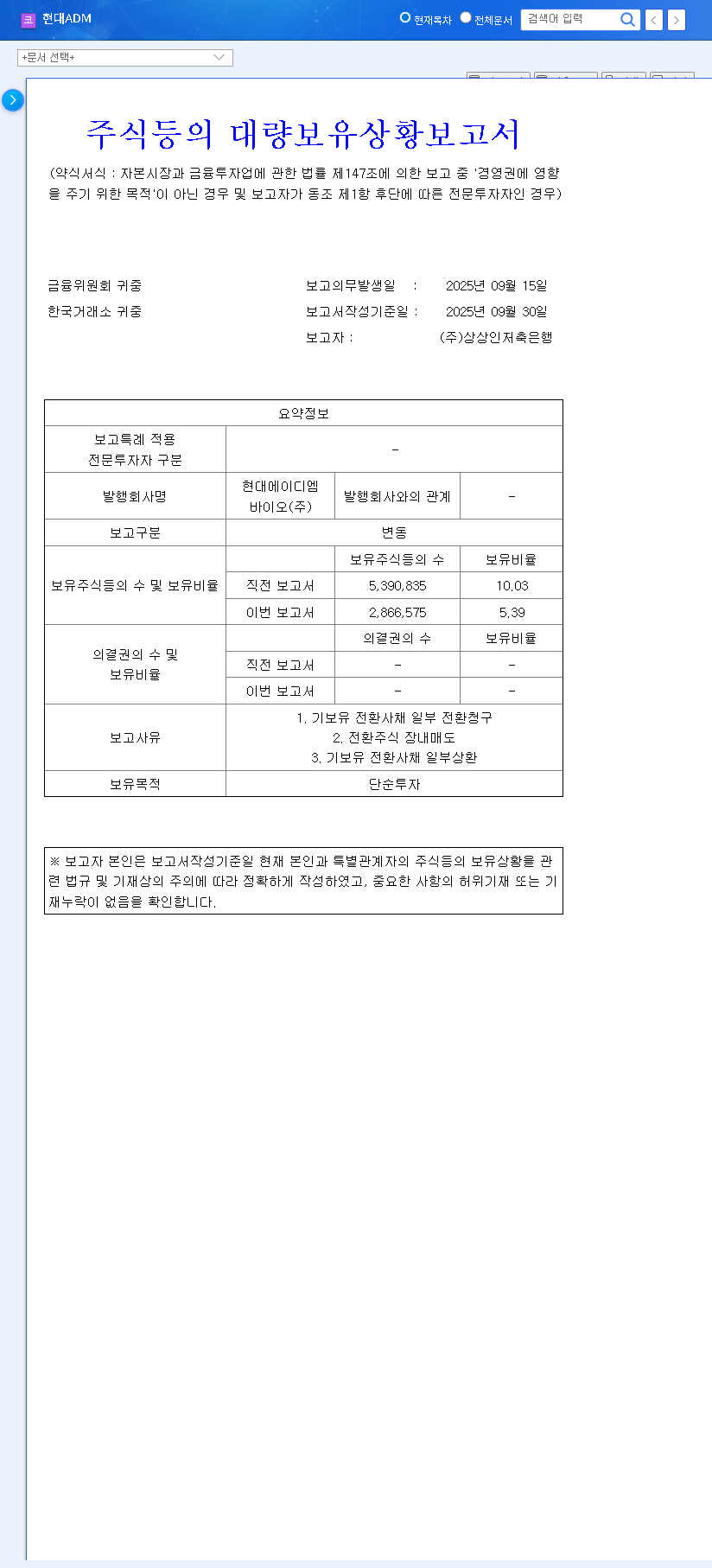
    According to an official disclosure filed on October 2, 2025, Sangsangin Savings Bank and two of its affiliates—Sangsangin Securities and Sangsangin Plus Savings Bank—executed a substantial sell-off of their shares in Hyundai ADM Bio. The group’s collective ownership plummeted from 10.03% down to 5.39%, a staggering reduction of 4.64 percentage points. This represents the sale of over 870,000 common shares on the open market.

    The official reason cited for the sale was a ‘simple investment’ adjustment, primarily involving the sale of shares obtained after exercising conversion rights on previously held convertible bonds (CBs). You can view the complete filing here: Official Disclosure (DART). This large volume of shares entering the market is a primary driver of the expected downward pressure on the stock price.

    Why Did Sangsangin Group Divest? The Underlying Risks

    While ‘simple investment’ is the public rationale, such a significant divestment is rarely without cause. The move likely reflects concerns over several fundamental risks embedded in Hyundai ADM Bio’s business model and financial health.

    Deterioration of the Core CRO Business

    The company’s core Contract Research Organization (CRO business) has been facing a significant slump. A CRO provides support to the pharmaceutical, biotechnology, and medical device industries in the form of research services. A decline in this revenue stream directly impacts profitability and cash flow, making it difficult to fund other, more speculative ventures. This shrinking business line is a major red flag for investors looking for stable growth.

    Uncertainty in New Drug Development

    Hyundai ADM Bio has pivoted its focus towards high-risk, high-reward oncology drug development. However, this area is fraught with peril. Recent setbacks, including subsidiary liquidations, looming patent expirations, and the voluntary withdrawal of clinical trial plans, cast a long shadow over the potential success of its pipeline. The long and expensive road to drug approval means that any uncertainty can spook investors.

    The divestment by a major institutional holder isn’t just a transaction; it’s often interpreted by the market as a vote of no confidence in a company’s ability to overcome its immediate fundamental challenges.

    Market Impact and Strategic Considerations for Investors

    The consequences of the Hyundai ADM Bio stake sale are multifaceted. In the short term, the introduction of nearly a million shares creates a supply-demand imbalance that will almost certainly pressure the stock price downwards. This is compounded by the share dilution effect from the conversion of bonds into equity.

    Beyond the technicals, the sale erodes market sentiment. When a knowledgeable insider sells, other investors question their own positions. This can trigger further selling and increase volatility. Therefore, a cautious and well-informed approach is paramount.

    Investor Checklist: Key Areas to Monitor

    Given the heightened uncertainty, investors should shift from passive holding to active monitoring. Focus on tangible evidence of progress and stability. For the latest financial news, it’s always wise to consult an authoritative source like Bloomberg.

    • Oncology Pipeline Progress: Look for concrete results. Are they publishing positive clinical trial data? Are new patents being filed? Tangible scientific progress is the only true long-term value driver.
    • CRO Business Turnaround: Monitor quarterly earnings for any signs of stabilization or recovery in the core CRO business. New contracts or strategic partnerships would be a positive signal.
    • Financial Health Improvement: Keep a close eye on the company’s balance sheet. Are they managing their debt effectively? Watch for further CB issuance or other dilutive financing measures. For more on this, see our guide on how to analyze a biotech company’s financials.
    • Ownership Structure Changes: With Sangsangin Group reducing its stake, who might step in? The emergence of a new strategic investor could be a powerful catalyst for the stock.
    • Management Communication: Pay close attention to official statements from Hyundai ADM Bio’s management. Their transparency and strategic vision in response to these challenges will be telling.

    In conclusion, investing in Hyundai ADM Bio at this juncture carries significant risk. The short-term outlook is bearish due to market pressures from the stake sale. A prudent strategy involves staying on the sidelines until the company demonstrates tangible progress in addressing its fundamental business and financial weaknesses. Careful, continuous monitoring is the best approach for any potential or current investor.

    (187660) Hyundai ADM Bio Stake Sale: An In-Depth Analysis for Investors 관련 이미지