Tag: Corporate Review

  • (020760) ILJIN DISPLAY Improvement Period: A Deep Dive into Delisting Risk & Investor Strategy

    (020760) ILJIN DISPLAY Improvement Period: A Deep Dive into Delisting Risk & Investor Strategy

    The recent decision to grant ILJIN DISPLAY CO.,LTD. an improvement period by the Korea Exchange Corporate Review Committee has placed the company at a critical crossroads. For investors, this news is a double-edged sword, representing both a sliver of hope for recovery and a stark reminder of the looming ILJIN DISPLAY delisting risk. With trading suspended and fundamentals deteriorating, navigating this uncertainty requires a clear-eyed analysis of the facts and a prudent action plan.

    This comprehensive guide will dissect the implications of the ILJIN DISPLAY improvement period, explore the severe financial challenges the company faces, and provide a strategic roadmap for current and potential investors. We will delve into the specific conditions of the trading suspension, the factors influencing its potential delisting, and what to monitor over the coming year.

    Understanding the ILJIN DISPLAY Improvement Period

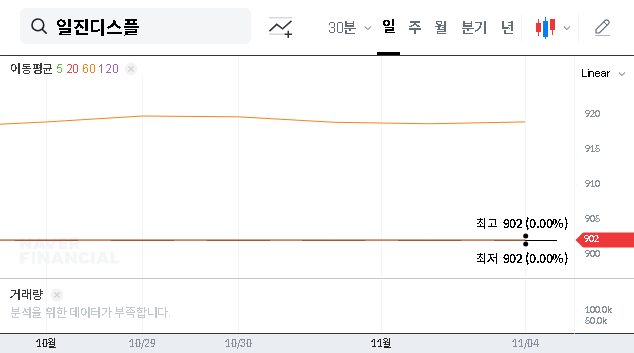
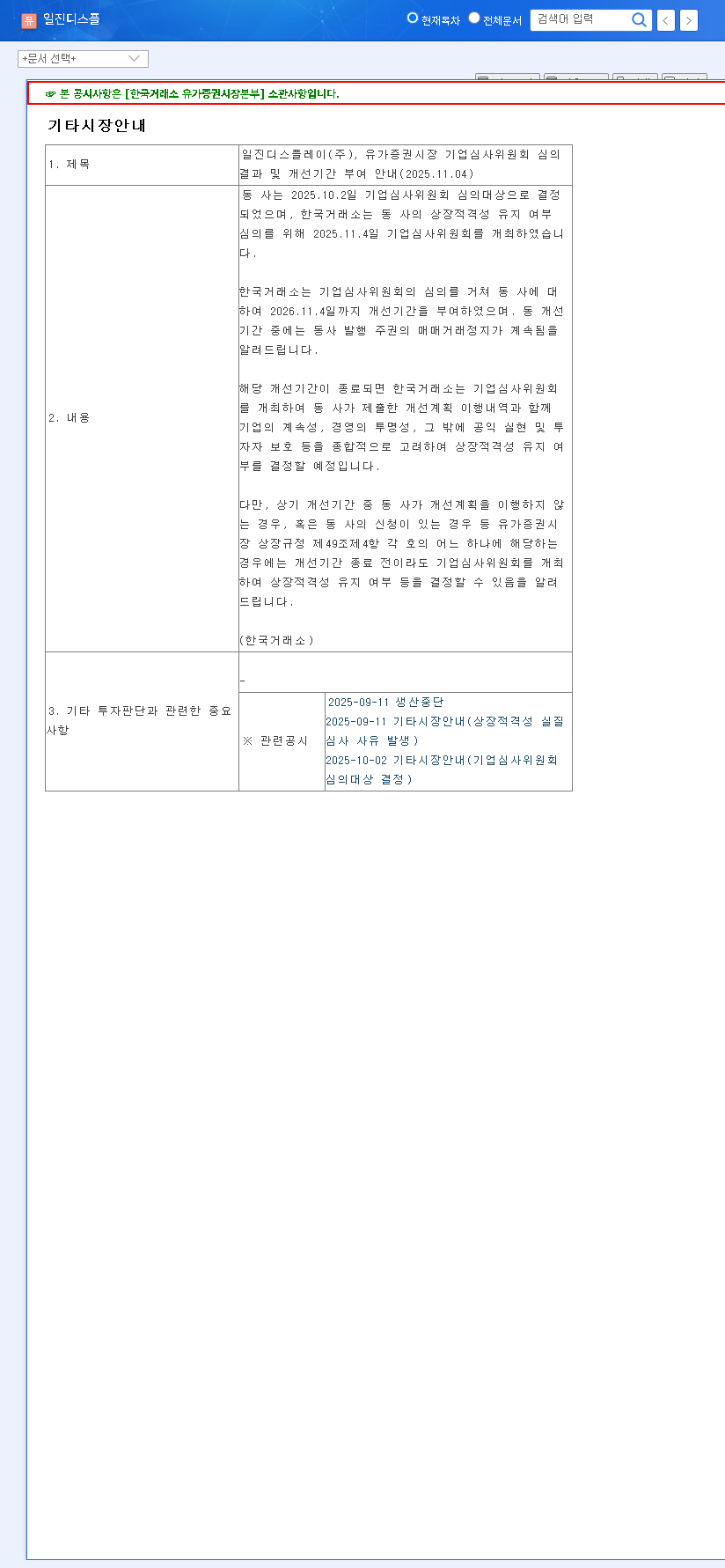
    On November 4, 2025, the Korea Exchange’s KOSPI Market Corporate Review Committee opted not to immediately delist ILJIN DISPLAY (Market Cap: KRW 46.5 billion). Instead, it granted the company a one-year grace period to address the issues threatening its listing eligibility. This is a critical lifeline, but one with strict conditions.

    • Improvement Period Duration: One full year, concluding on November 4, 2026.
    • Trading Status: The ILJIN DISPLAY trading suspension will remain in effect throughout this period.
    • Objective: The company must implement a comprehensive improvement plan to resolve concerns about its financial stability, going concern status, and management transparency.

    At the end of this period, the Exchange will re-evaluate the company. Success could lead to the resumption of trading; failure will almost certainly result in delisting. Investors can review the full details in the Official Disclosure on DART (Source).

    A Deep Dive into ILJIN DISPLAY’s Financial Crisis

    The decision to review ILJIN DISPLAY’s listing eligibility was not arbitrary. It stemmed from a profound and worsening deterioration of its core business fundamentals, raising significant doubts about its ability to continue as a going concern. A look at the H1 2025 financials paints a grim picture.

    Collapsing Revenue and Profitability

    Revenue in the first half of 2025 fell to KRW 40,256 million, with both the Touch Screen Panel (DS) and Sapphire Wafer (AD) divisions experiencing declines. More alarmingly, the company swung from a profit to an operating loss of KRW 1,791 million and a net loss of KRW 4,206 million, indicating that its core operations are no longer sustainable in their current form.

    Precarious Financial Health and High Delisting Risk

    The balance sheet reveals several red flags that directly contribute to the high ILJIN DISPLAY delisting risk:

    • High Leverage: The debt-to-equity ratio has climbed to 153.25%, a worrying figure that signifies a heavy reliance on borrowed funds.
    • Liquidity Squeeze: With a current ratio below 100%, the company’s short-term assets are insufficient to cover its short-term liabilities, posing an immediate cash flow risk.
    • Convertible Bond Overhang: Over KRW 10.1 billion in convertible bonds could lead to share dilution and further financial strain if converted.

    While the improvement period offers a chance for a structured turnaround, the underlying financial sickness is severe. Success is far from guaranteed and will require drastic operational and financial restructuring.

    Strategic Action Plan for Investors

    Given the high stakes and prolonged ILJIN DISPLAY trading suspension, investors must adopt a cautious and highly informed approach. Hope is not a strategy; diligence and realism are paramount.

    Key Monitoring Points During the Improvement Period

    Your focus should be on tangible evidence of a successful turnaround, not just promises. Monitor the following closely:

    • Improvement Plan Execution: Scrutinize the specifics of the company’s plan. Are they selling non-core assets? Are they securing new financing? Is management taking clear, decisive action?
    • Financial Filings: Pay close attention to quarterly reports for any signs of stabilizing revenue, margin improvement, or debt reduction.
    • Corporate Governance Changes: Look for efforts to enhance transparency and strengthen the management team, as this is a key part of the Exchange’s review. This is a common step in the corporate turnaround process.

    External macroeconomic pressures, such as sustained high interest rates and volatile shipping costs, as reported by leading financial analysts (Reuters), will only add to the company’s challenges.

    Investment Recommendation

    For Potential Investors: Entering a new position in ILJIN DISPLAY stock at this juncture is an extremely high-risk endeavor. The potential for a total loss of capital in a delisting scenario is significant. It is strongly advised to remain on the sidelines until there is concrete evidence of a sustainable recovery and trading has resumed.

    For Existing Shareholders: The capital is currently locked due to the trading suspension. The best course of action is to diligently follow the company’s progress. Avoid emotional decision-making and focus on the objective metrics outlined above. The fate of your investment rests entirely on the company’s ability to execute its improvement plan over the next year.

    In conclusion, the ILJIN DISPLAY improvement period is a final chance, not a guarantee. The path ahead is fraught with challenges, and investors must proceed with the utmost caution.
    (020760) ILJIN DISPLAY Improvement Period: A Deep Dive into Delisting Risk & Investor Strategy 관련 이미지
  • (234920) Zaigle Delisting Review (2025): Full Analysis, Stock Risks & Investor Guide

    (234920) Zaigle Delisting Review (2025): Full Analysis, Stock Risks & Investor Guide

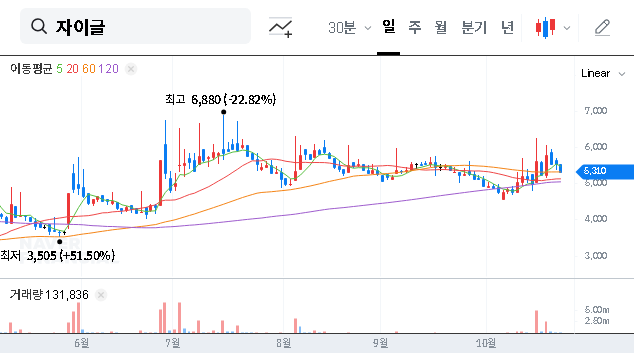
    Investors in Zaigle Co., Ltd. (KOSDAQ) are facing a period of critical uncertainty. The recent announcement of a pending Zaigle delisting review has sent shockwaves through the investment community, raising serious questions about the company’s future and the safety of shareholder capital. This comprehensive analysis will break down the situation, from the initial disclosure to the underlying financial weaknesses, helping you understand the immense risks and formulate a rational strategy in these turbulent times.

    We will explore the company’s precarious fundamentals, the external market pressures, and the potential scenarios that could unfold, providing you with the insights needed to navigate this high-stakes event.

    What Happened? The Official Zaigle Delisting Review Announcement

    On October 29, 2025, Zaigle Co., Ltd. filed a disclosure that triggered an alarm for every shareholder. The company officially announced the occurrence of a reason for a delisting eligibility substantial review. According to the filing, a decision on whether the company is subject to this formal review will be made by November 19, 2025. You can view the complete report directly from the source: Official Disclosure (DART).

    If the Korea Exchange (KRX) determines a formal review is unnecessary, the currently suspended trading of Zaigle stock will be lifted. However, if Zaigle is deemed subject to the review, it enters a high-risk deliberation process that could lead to severe consequences, including designation as an administrative issue or, in the worst-case scenario, complete delisting from the exchange.

    Why Is Zaigle Facing a Delisting Review? A Look at the Cracks

    This critical situation did not arise overnight. It is the culmination of deteriorating business fundamentals, questionable financial health, and a history of compliance issues that have eroded investor trust.

    Struggling Core Business & Uncertain New Ventures

    • Existing Business Slump: Sales of its flagship ‘Zaigle Grill’ and other well-being appliances have remained sluggish. The healthcare segment has also failed to gain traction, showing a decline in sales year-over-year.
    • Unproven New Ventures: While the company is pinning its hopes on new ventures like the ‘Zaigle On Simple’ medical device, their contribution to revenue is still negligible. More concerning is the collapse of its highly anticipated US secondary battery joint venture, which has amplified uncertainty. Plans for domestic LFP battery development remain on paper, with no clear path to production. For more information on market challenges, you can read about global supply chain disruptions.

    Alarming Financial Health Indicators

    • Deteriorating Profitability: With falling revenue and operating losses for two consecutive quarters in the first half of 2025, the company’s core profitability is in question.
    • Solvency Concerns: The debt-to-equity ratio climbed to a concerning 135.03% as of Q1 2025. This indicates the company is relying more on debt to finance its assets, which is a major red flag for financial stability.
    • Negative Cash Flow: Negative operating cash flow reveals that the company’s core business activities are not generating enough cash to sustain operations, forcing it to rely on financing or asset sales.
    • History of Sanctions: A past record of fines for dishonest disclosures has damaged corporate credibility, making investors wary of management’s transparency. If you want to learn more, check out our guide on how to analyze high-risk stocks.

    The combination of a failing core business, unproven ventures, and weak financials creates a perfect storm. The Zaigle delisting review is a direct consequence of these deep-seated issues.

    The Ripple Effect: Potential Impacts on Zaigle Stock and Business

    The outcome of this review will have profound and far-reaching consequences. Investors must prepare for significant volatility and potential downside.

    Direct Consequences

    • Stock Price Volatility: The uncertainty alone will likely lead to severe downward pressure on Zaigle’s stock price.
    • Trading Suspension: If subjected to the full review, a prolonged trading suspension is highly probable, locking up investor capital and creating immense liquidity risk.
    • Total Loss of Investment: In the worst-case scenario of delisting, the stock could become worthless, leading to a total loss for shareholders.

    Indirect Consequences

    • Credit Rating Downgrade: The situation could trigger a downgrade, making it harder and more expensive for Zaigle to raise capital.
    • Business Contraction: Partners, suppliers, and clients may become hesitant to do business with a company on the verge of being delisted, impacting contracts and revenue streams.

    Investor Playbook: Navigating the Uncertainty

    Given the high degree of investment risk, a cautious and defensive strategy is paramount.

    Potential Scenarios by November 19

    • Positive Scenario (Not Subject to Review): This would resolve immediate uncertainty and could cause a short-term relief rally. However, without a fundamental business turnaround, any gains may be short-lived.
    • Negative Scenario (Subject to Review): This is the worst outcome. It would trigger the formal Zaigle delisting review process, almost certainly leading to a trading suspension and a sharp drop in value if and when trading resumes.

    Recommendations for Investors

    For Potential Investors: Initiating a new position in Zaigle at this time carries an extremely high level of risk. It is strongly advised to stay on the sidelines until there is absolute clarity on the company’s listed status.

    For Existing Shareholders: The decision is more complex. You must assess your risk tolerance and be prepared for the possibility of a total loss. Monitoring the situation closely until the November 19 deadline is crucial. Any decision to sell or hold should be based on the understanding that the stock’s value is highly precarious.

    (234920) Zaigle Delisting Review (2025): Full Analysis, Stock Risks & Investor Guide 관련 이미지
  • STX Granted Improvement Period: Can it Avoid Delisting? Investor Analysis

    1. What Happened?

    STX was placed under review for delisting due to violations of accounting standards and was given an improvement period until June 21, 2026. Trading will be suspended during this period, and the delisting decision will depend on the improvement results.

    2. Why Did This Happen?

    STX is facing a serious financial crisis. A combination of negative factors such as capital impairment, continued operating losses, and lack of liquidity has put the company in a difficult position. In particular, losses related to the nickel mine development project have exacerbated the financial burden.

    3. What’s Next?

    STX’s future is uncertain. If the company succeeds in improving its financial structure and management transparency within the improvement period, it may be able to maintain its listing. However, if it fails, the likelihood of delisting is high.

    • Positive Scenario: Successful implementation of the improvement plan, success of new businesses, strengthening the competitiveness of main businesses.
    • Negative Scenario: Failure to implement the improvement plan, delisting, and existential crisis for the company.

    4. What Should Investors Do?

    Investors should closely monitor STX’s improvement plan, management activities, and information disclosure. It is important to make prudent investment decisions, keeping in mind the possibility of delisting.

    Frequently Asked Questions

    Why was STX granted an improvement period?

    Because it was placed under review for delisting due to violations of accounting standards.

    Can STX shares be traded during the improvement period?

    No, trading is suspended.

    What is the likelihood of STX being delisted?

    It depends on whether the improvement plan is implemented, but it is currently quite high.

    What should investors be aware of?

    Investors should closely monitor STX’s improvement plan, management activities, and information disclosure, and keep in mind the possibility of delisting.

  • Winia Aid Escapes Delisting Threat? Resuscitation Possibility Analysis and Investment Strategy

    1. What Happened to Winia Aid?

    Winia Aid faced delisting due to an ‘adverse’ audit opinion stemming from uncertainty about its ability to continue as a going concern. However, through restructuring and M&A (acquisition by the UAMCO-Hyundai Rental Care consortium), they improved their financial structure and finally received an ‘unqualified’ audit opinion, resolving the delisting issue. Now, only the Corporate Review Committee’s final decision remains.

    2. Why is it Important?

    The Corporate Review Committee’s decision is a key variable that will determine Winia Aid’s fate. If the listing is maintained, trading can resume, and stock prices may rise. However, if the decision is to delist, investors could face significant losses. Therefore, investors need thorough analysis of the Corporate Review Committee’s decision and careful investment judgment.

    3. So, What Will Happen?

    In the short term, stock price volatility is expected to increase depending on the Corporate Review Committee’s decision. In the medium to long term, if the listing is maintained, positive effects such as securing financial soundness, normalizing management, restoring business competitiveness, and regaining market trust can be expected. However, there are still challenges to overcome, such as declining sales and negative operating cash flow.

    4. What Should Investors Do?

    • Keep an eye on the Corporate Review Committee’s decision and the new management’s business plan.
    • Continuously monitor sales and profitability improvement, cash flow improvement, and financial soundness strengthening measures.
    • Carefully consider both potential risks and opportunities when making investment decisions.
    Q: Will Winia Aid be delisted?

    A: The reason for delisting has been resolved, but the final decision rests with the Corporate Review Committee. A decision is expected by September 12, 2025 (within 20 business days) or within 20 days of submitting the business improvement plan.

    Q: Is it okay to invest in Winia Aid?

    A: Investment decisions should be made carefully, considering the Corporate Review Committee’s decision, financial indicator improvement trends, and management’s business plan.

    Q: What are the future prospects for Winia Aid?

    A: If the listing is maintained, positive prospects such as secured financial soundness, normalized management, and restored business competitiveness can be expected. However, challenges remain, such as declining sales and negative operating cash flow.

  • Bucket Studio Faces Delisting Risk: 9-Month Grace Period Granted – Investor Alert

    Bucket Studio on the Brink: Granted 9-Month Period for Improvement Amid Delisting Fears

    On July 16, 2025, the Korea Exchange’s Corporate Review Committee officially granted Bucket Studio a nine-month grace period, citing grounds for delisting. This decision reflects serious concerns regarding Bucket Studio’s financial soundness and management transparency. The company is required to submit its improvement plan implementation status and an expert confirmation by April 16, 2026, after which the Exchange will make a final delisting determination.

    Bucket Studio’s Grim Reality: A Deep Dive into Q1 2025 Fundamentals

    Bucket Studio’s Q1 2025 report starkly illustrates the company’s deteriorating financial health. Key takeaways that investors must be aware of include:

    • Plummeting Revenue: Revenue significantly dropped by 77.8% year-over-year to 3.875 billion KRW. This decline is primarily attributed to the sluggish domestic market in content distribution and slower growth in the kiosk business.
    • Persistent and Widening Operating Losses: The company recorded an operating loss of 1.755 billion KRW in the first quarter, indicating a worsening profitability crisis.
    • Net Loss Conversion: Net income saw a sharp decline compared to the previous year, resulting in a net loss of 1.811 billion KRW.
    • High Debt Ratio: The debt-to-equity ratio rose to 41.47% compared to the previous quarter’s end. Rising interest rates could further exacerbate interest expenses.
    • Deteriorating Cash Flow: A decrease in cash flow from operating activities signals a weakening ability to generate cash internally.
    • Litigation and Management Risks: Ongoing lawsuits and issues related to management pose potential risks, which could lead to financial losses and damage the company’s reputation.

    While potential growth in the kiosk business and strategic targeting of the MZ generation in the F&B sector offer some positive aspects, it remains uncertain whether these factors can translate into a tangible improvement in financial performance in the short term, given the Q1 results.

    The Impact of Delisting Fears on Stock Price: An Event Analysis

    The granting of an improvement period by the Corporate Review Committee is expected to have an immediate and severe negative impact on Bucket Studio’s stock price. As the possibility of delisting becomes a reality, investor sentiment is likely to sour, leading to significant sell-offs.

    Short-Term Impacts

    • Stock Price Decline: A drop in stock price due to investor fear is inevitable. The extent of the decline will depend on the feasibility of the improvement plan and market reaction.
    • Difficulty in Attracting Investment: The delisting risk will make it extremely challenging to secure additional funding, further complicating efforts to improve the financial structure.
    • Business Operations Disruption: Failure to attract investment and an uncertain future outlook could disrupt business operations, potentially souring relationships with business partners.

    Long-Term Impacts

    • Actual Delisting: If the improvement plan is not successfully implemented, delisting will be confirmed, resulting in substantial losses for shareholders.
    • Erosion of Corporate Value: Delisting or a sustained stock price decline will severely damage the company’s credibility and overall corporate value.
    • Inevitable Business Restructuring: To maintain its listing, Bucket Studio will need to undertake significant business restructuring and financial health improvements, which may involve difficult decisions such as workforce reductions.

    External Environment Analysis and Risk Summary

    External factors such as exchange rates, interest rates, oil prices, and shipping costs have a limited direct impact on Bucket Studio’s business. However, for a company with a high debt ratio, the trend of rising interest rates is a significant factor that can exacerbate financial burdens through increased interest expenses. Furthermore, rising US 10-year Treasury yields can negatively affect overall investor sentiment.

    The most significant risk currently facing Bucket Studio is undoubtedly the possibility of delisting. In addition to this, existing litigation risks and management-related issues are likely to continue exerting negative pressure. Without actively addressing these risks during the improvement period, the likelihood of delisting will increase.

    Conclusion and Investor Implications

    Bucket Studio is facing severe financial difficulties and management risks. The grace period granted by the Korea Exchange represents a final opportunity to maintain its listing.

    Over the next nine months, Bucket Studio must formulate and diligently implement a concrete and actionable improvement plan to boost revenue, enhance profitability, reduce its debt ratio, and resolve litigation risks. Investors must exercise extreme caution in their investment decisions, fully aware of the delisting possibility, and closely monitor all future disclosures.

    Note: The provided stock price data is historical and may not accurately reflect the current situation. Additional financial statement and market analysis are essential for a more precise assessment.

    Why was Bucket Studio granted an improvement period?

    Bucket Studio was granted a nine-month grace period by the Korea Exchange’s Corporate Review Committee due to serious concerns about its financial soundness and management transparency, citing potential delisting reasons.

    What is Bucket Studio’s current financial status?

    According to the Q1 2025 report, revenue has plummeted by 77.8% year-over-year, operating losses have widened, and net income has turned into a loss, indicating an overall poor financial state. An increasing debt ratio and deteriorating cash flow are also significant concerns.

    What are the expected impacts on Bucket Studio going forward?

    The grace period could lead to short-term negative impacts such as stock price declines, difficulties in attracting investment, and disruptions to business operations. Failure to implement the improvement plan could result in the worst-case scenario of delisting, directly leading to a devaluation of corporate assets and shareholder losses.

    What should investors do now?

    Investors in Bucket Studio should make investment decisions with extreme caution, keeping the possibility of delisting in mind. It is crucial to closely monitor the improvement plans and implementation progress disclosed by Bucket Studio and strategize accordingly.

    By when must Bucket Studio submit its improvement plan?

    Bucket Studio must submit its improvement plan implementation status and an expert confirmation to the Korea Exchange by April 16, 2026. The Exchange will then make the final decision on whether to delist the company.