Tag: COPUS KOREA Co.

  • (322780) COPUS KOREA Major Shareholder Change: A 2024 Investor’s Guide to What’s Next

    (322780) COPUS KOREA Major Shareholder Change: A 2024 Investor’s Guide to What’s Next

    A significant development is unfolding for investors in COPUS KOREA Co., Ltd., as recent disclosures signal an imminent COPUS KOREA major shareholder change. The news, stemming from a ‘Report on Status of Large Shareholdings’, has sent ripples through the investment community, raising critical questions about the company’s future leadership, strategic direction, and ultimately, its stock valuation. This comprehensive analysis will break down the official disclosure, explore the potential market ramifications, and provide a clear, actionable roadmap for investors navigating this period of uncertainty.

    The report reveals that major shareholder Mr. Oh Young-seop has significantly reduced his stake, not as a simple stock sale, but as part of a stock transfer agreement explicitly designed to change the company’s largest shareholder. This isn’t just a portfolio adjustment; it’s a potential changing of the guard.

    Deconstructing the Disclosure: What Exactly Happened?

    The official filing, disclosed on May 15, 2024, provides the core facts of this transaction. Understanding these details is the first step in a thorough investment analysis. You can view the original document directly from the source: Official Disclosure (DART Report).

    Key Details from the Shareholding Report

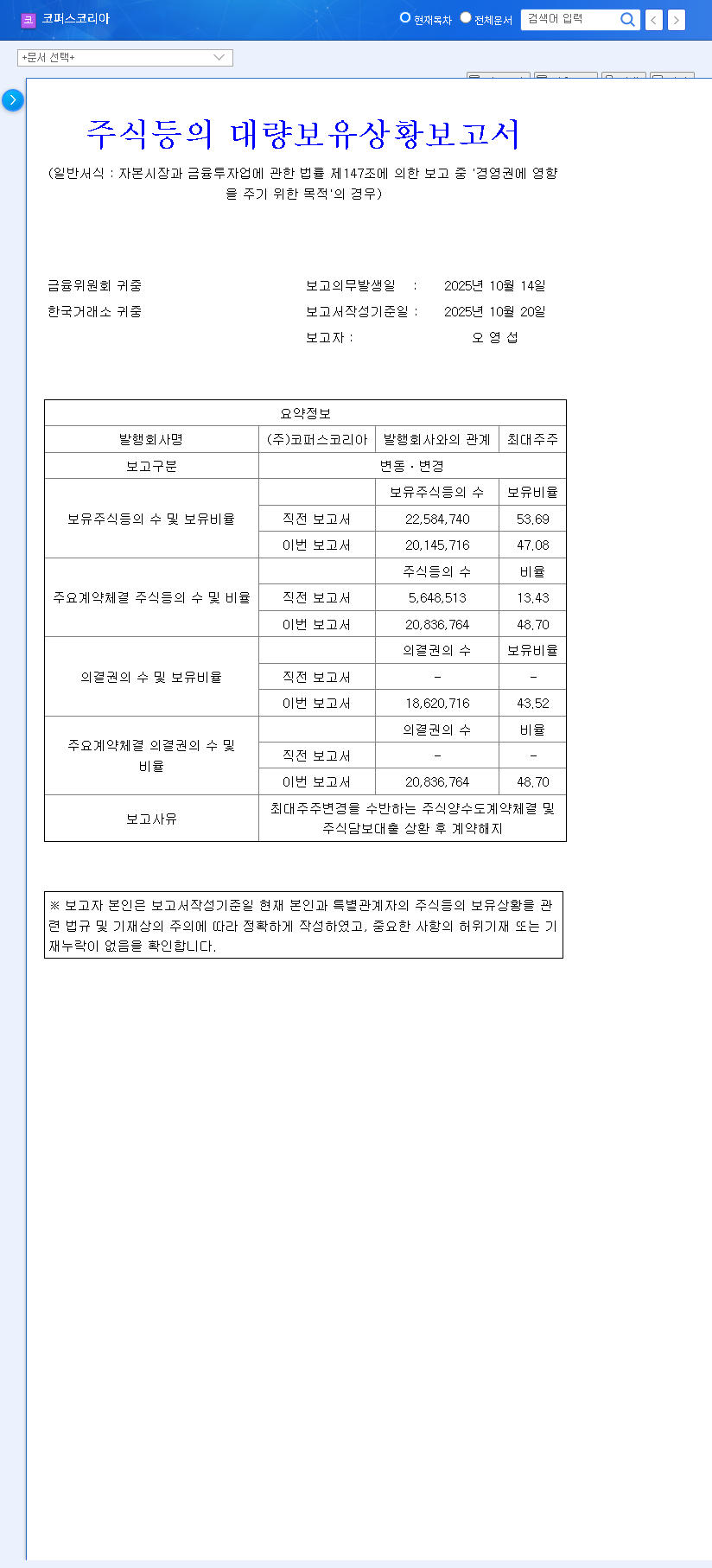
    • Significant Stake Reduction: The primary shareholder, Mr. Oh Young-seop, saw his stake decrease from 53.69% to 47.08%, a substantial reduction of 6.61 percentage points.
    • Explicit Purpose: The reason cited was the ‘Execution of stock transfer agreement entailing a change in the largest shareholder.’ This language removes ambiguity and confirms a transfer of management control is intended.
    • Transaction Specifics: A total of 2,439,024 common shares were sold by Mr. Oh Young-seop in an off-market transaction, indicating a pre-arranged deal with a specific buyer rather than a sale on the open stock exchange.

    The most critical phrase in the report is ‘entailing a change in the largest shareholder.’ This signals that the COPUS KOREA major shareholder change is not just a possibility, but a planned strategic event with a new controlling entity set to emerge.

    Impact Analysis: Volatility vs. Long-Term Value

    Any change in control introduces both risk and opportunity. For the COPUS KOREA stock, we can anticipate distinct short-term and long-term effects.

    Short-Term Market Reaction

    In the immediate future, uncertainty is the dominant force. The market dislikes ambiguity, and until the new major shareholder’s identity and plans are revealed, we can expect heightened stock price volatility. Speculative trading may increase as the market attempts to price in various potential outcomes. A sale by a founding or long-term major shareholder can sometimes be perceived negatively, but the context of a strategic transfer often mitigates this.

    Long-Term Corporate Revaluation

    The long-term trajectory depends entirely on the new leadership. The company’s corporate value could be significantly re-evaluated based on several factors: the new owner’s strategic vision, their capacity to inject new capital or technology, and the potential for synergy with COPUS KOREA’s existing media and content businesses. This is where diligent investors can find opportunity; for more on this, see our guide to analyzing M&A deals for value.

    An Investor’s Action Plan: Key Monitoring Points

    With information still emerging, a patient and watchful approach is paramount. Rather than making rash decisions, investors should focus their attention on the following key areas and await further disclosures.

    • The New Shareholder’s Profile: Who is the acquirer? Are they a strategic player in the media industry or a financial investor? Analyze their track record, financial health, and past acquisitions to predict their likely strategy for COPUS KOREA.
    • Details of the Transfer Agreement: Subsequent disclosures must be scrutinized for the acquisition price, payment terms, and any attached conditions. The price paid per share will be a key indicator of how the new owner values the company.
    • Future Strategic Announcements: Pay close attention to any announcements regarding changes in the management team, revised business plans, or a new corporate vision. These will be the clearest signals of the company’s future direction.
    • Fundamental Business Performance: Amidst the ownership news, don’t lose sight of COPUS KOREA’s underlying business fundamentals. Continue to monitor revenue growth, profitability, and industry trends.

    Conclusion: Finding Opportunity in Transition

    The pending COPUS KOREA major shareholder change represents a pivotal moment for the company and its investors. While the current lack of complete information creates short-term risk, it also sets the stage for a potential long-term re-rating of the company’s value. The capabilities, resources, and strategy of the incoming management will be the ultimate determinants of success. For now, the best strategy is not to react, but to prepare. By conducting thorough due diligence and closely monitoring new information as it is released, investors can position themselves to make well-informed decisions as this new chapter for COPUS KOREA unfolds.
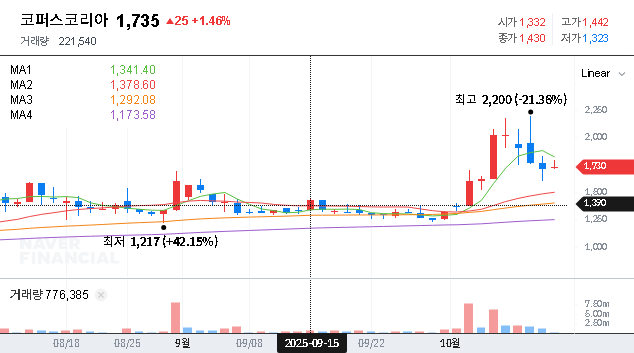
    (322780) COPUS KOREA Major Shareholder Change: A 2024 Investor's Guide to What's Next 관련 이미지
  • (322780) COPUS KOREA Stock (322780): Deep Dive Analysis of Innovation No. 1 Fund’s 23% Stake

    (322780) COPUS KOREA Stock (322780): Deep Dive Analysis of Innovation No. 1 Fund’s 23% Stake

    The COPUS KOREA stock (KOSDAQ: 322780) has been thrust into the spotlight following a significant disclosure that has captured the market’s attention. A relatively unknown entity, Innovation No. 1 Fund, has suddenly emerged as a major shareholder, acquiring a substantial 23.02% stake in the company. This move, while officially labeled as a ‘simple investment,’ raises critical questions for current and potential investors. What does this massive acquisition signal for the future of COPUS KOREA’s corporate value and its stock price? This comprehensive stock analysis will dissect the event, explore the potential impacts, and provide a strategic outlook for navigating this new development.

    The Event: Innovation No. 1 Fund’s Major Stake Acquisition

    On October 20, 2025, a mandatory disclosure revealed a pivotal shift in the shareholder structure of COPUS KOREA. This event is the primary catalyst for the renewed interest in the 322780 stock. The official filing, available on the DART electronic disclosure system (Official Disclosure), confirms the key details of the transaction.

    Key Details of the Transaction

    • Reporting Entity: Innovation No. 1 Fund
    • Acquired Company: COPUS KOREA Co., Ltd. (322780)
    • Acquired Stake: 23.02% (9,500,000 common shares)
    • Acquisition Method: Off-market purchase from a previous major shareholder.
    • Stated Holding Purpose: Simple Investment

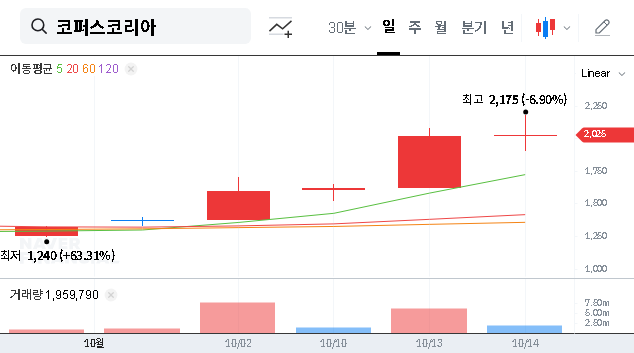
    This acquisition makes Innovation No. 1 Fund a commanding shareholder. For a company with a market capitalization of around 70.8 billion KRW, such a large block trade is a significant event that warrants a closer look.

    Market Impact Analysis for Your COPUS KOREA Investment

    Large shifts in ownership can send mixed signals. A thorough stock analysis requires us to consider the potential upsides and downsides for the COPUS KOREA stock.

    Potential Positive Factors

    • Vote of Confidence: A 23% stake is a massive capital commitment. This can be interpreted as a strong vote of confidence from the fund in COPUS KOREA’s underlying business and future growth prospects.
    • Increased Market Attention: Such a large transaction inevitably draws attention from retail and institutional investors, potentially increasing trading volume and liquidity.
    • Reduced Management Uncertainty: By declaring the purpose as ‘simple investment’, the fund signals it does not intend to pursue hostile M&A or management disputes, which can stabilize investor sentiment.

    Potential Negative Factors & Concerns

    • Information Asymmetry: Little is known about Innovation No. 1 Fund, its investment track record, or its ultimate exit strategy. This lack of transparency creates uncertainty.
    • Stock Overhang Risk: A large, concentrated holding creates a potential ‘overhang.’ If the fund decides to liquidate its position in the future, it could exert significant downward pressure on the stock price.
    • Increased Volatility: Major shareholder news often leads to heightened short-term price swings as the market digests the information and speculates on the fund’s next move.

    Investor Strategy: What to Do Now?

    Given the available information, a prudent and watchful approach is recommended for anyone considering a COPUS KOREA investment. Here are actionable steps to take:

    • Monitor Disclosures: Keep a close eye on the DART system for any follow-up filings. A change in holding purpose from ‘simple investment’ to ‘management participation’ would be a game-changing event.
    • Analyze Fundamentals: Look beyond the news. Dig into COPUS KOREA’s upcoming earnings reports and financial statements. Is the company’s core business strong enough to justify the fund’s investment?
    • Track Institutional Flow: Use financial data providers like Bloomberg or Reuters to see if other institutional investors are following suit or divesting.
    • Understand the Nuances: Such events can be complex. To better understand the implications, you can review our guide on analyzing large shareholder disclosures.

    Frequently Asked Questions

    Who is Innovation No. 1 Fund?

    Detailed public information on the fund is scarce. Based on its name and the nature of the transaction, it is likely a private equity or special situations fund. Its ‘simple investment’ declaration suggests a focus on capital gains rather than operational control, at least for now.

    Is a 23.02% stake enough to control COPUS KOREA?

    While not an absolute majority, a 23.02% stake makes them the most powerful shareholder. It allows for significant influence over major corporate decisions and the ability to appoint board members, especially if they align with other shareholders.

    What does the ‘simple investment’ purpose really mean for the stock?

    Legally, it means the fund does not intend to influence management. In practice, it’s a positive signal that reduces fears of a hostile takeover. However, this purpose can be changed with a subsequent filing. It also implies the fund’s primary goal is profit, which could mean a future sale of their stake once their price target is met.

    Disclaimer: This article is for informational purposes only and is based on publicly available data. It should not be construed as financial or investment advice. All investment decisions should be made based on your own research and judgment.

    (322780) COPUS KOREA Stock (322780): Deep Dive Analysis of Innovation No. 1 Fund's 23% Stake 관련 이미지
  • (322780) COPUS KOREA Stake Acquisition: A Deep Dive into Green Growth’s 27.47% Power Play

    (322780) COPUS KOREA Stake Acquisition: A Deep Dive into Green Growth’s 27.47% Power Play

    A significant corporate event is unfolding that demands investor attention: the recent COPUS KOREA stake acquisition by an entity named Green Growth. On October 20, 2025, public records revealed that Green Growth secured a massive 27.47% stake in COPUS KOREA Co., Ltd., with the explicit goal of influencing management. This move is far from a passive investment; it signals a potential paradigm shift in the company’s direction, strategy, and leadership. This comprehensive analysis will unpack the details of the deal, explore the potential ramifications for corporate governance, and provide a strategic guide for investors navigating this period of uncertainty and opportunity.

    The Landmark Deal: Unpacking the Green Growth Acquisition

    The transaction was officially solidified on October 14, 2025, when Green Growth agreed to an off-market purchase of 11,336,764 shares of COPUS KOREA. The subsequent disclosure confirmed the magnitude of this move, positioning Green Growth as a dominant shareholder with nearly a third of the company’s voting power. The stated purpose, to ‘influence management rights,’ is a clear and direct declaration of intent to be an active, and likely disruptive, force within the company. For a detailed verification of this event, investors can refer to the Official Disclosure (DART report).

    “A stake of this size is a game-changer. It’s not about suggesting changes from the sidelines; it’s about having the power to demand a seat at the table and fundamentally alter the company’s trajectory. The Green Growth COPUS KOREA dynamic will be the single most important factor for the company’s valuation in the coming year.”

    The Ripple Effect: Potential Scenarios for COPUS KOREA

    With such a substantial holding, Green Growth’s influence can manifest in several key areas. Understanding these potential outcomes is critical for any stock analysis of COPUS KOREA.

    1. A New Era of Corporate Governance or a Management Shake-up?

    A 27.47% stake provides the leverage to request board seats, challenge executive decisions, and even call for special shareholder meetings to vote on critical matters. This could lead to a productive overhaul of corporate governance, introducing new strategies and efficiencies. However, if the current management resists these changes, it could ignite a contentious management dispute. Such a conflict can create operational paralysis and negatively impact employee morale and stock performance, making this the most immediate risk factor to monitor.

    2. Unlocking Synergy: What ‘Green’ Means for Growth

    While details about Green Growth are scarce, its name suggests a focus on environmentally conscious or sustainable sectors. This could be a significant opportunity for COPUS KOREA. Green Growth might push for greater investment in sustainable technologies, improved ESG (Environmental, Social, and Governance) ratings, or entry into new, eco-friendly markets. A strong ESG profile is increasingly important for attracting institutional investment. For more on this trend, you can read about the fundamentals of ESG-focused corporate strategies. A successful synergy could unlock new revenue streams and position COPUS KOREA as a forward-thinking leader in its industry.

    3. Stock Price Volatility and Long-Term Value

    In the short term, the market’s reaction to the COPUS KOREA stake acquisition will likely be volatile. Speculators may drive the price up on takeover rumors, while uncertainty could cause sell-offs. The long-term stock price trajectory, however, will be determined by tangible results. If Green Growth’s involvement leads to better financial performance, clear strategic direction, and profitable growth, substantial long-term value can be created for all shareholders.

    A Strategic Checklist for Investors

    In this fluid situation, a cautious and informed approach is paramount. Investors should focus on gathering intelligence and monitoring key developments. Here are the critical points to watch:

    • Profile Green Growth: Who are the principals behind this entity? Investigate their track record with other investments. Are they known for hostile takeovers or for collaborative value creation?
    • Monitor Official Communications: Watch for any press releases, shareholder letters, or new regulatory filings from either COPUS KOREA or Green Growth that clarify their specific plans and intentions.
    • Analyze Existing Shareholder Base: How will other major shareholders react? The stance of the current largest shareholder and the board will be crucial in determining whether the transition is smooth or adversarial.
    • Re-evaluate COPUS KOREA’s Fundamentals: Conduct a fresh stock analysis. Assess the company’s core business strengths, weaknesses, and financial health to understand how Green Growth’s influence could either enhance or detract from its value. Authoritative platforms like Bloomberg offer extensive financial data for this purpose.

    In conclusion, Green Growth’s acquisition of a 27.47% stake in COPUS KOREA is a pivotal event that has moved the company from a predictable path to a crossroads. While the move introduces significant uncertainty and the risk of a management shake-up, it also presents the possibility of renewed vision and accelerated growth. The ultimate outcome for the company and its stock price hinges entirely on the forthcoming actions of Green Growth and the response of COPUS KOREA’s existing leadership. Vigilant monitoring and comprehensive due diligence are now more critical than ever for investors.

    (322780) COPUS KOREA Stake Acquisition: A Deep Dive into Green Growth's 27.47% Power Play 관련 이미지
  • (322780) COPUS KOREA Convertible Bond: In-Depth Analysis of Stock Outlook & Investment Strategy

    (322780) COPUS KOREA Convertible Bond: In-Depth Analysis of Stock Outlook & Investment Strategy

    COPUS KOREA Co., Ltd. has recently become a focal point for investors following its announcement of a 10 billion KRW COPUS KOREA convertible bond issuance. This strategic financial maneuver, designed to raise crucial capital, presents a classic dilemma: Is it a lifeline signaling a future turnaround, or a red flag indicating deeper financial distress? For shareholders and potential investors, this move raises critical questions about stock dilution, financial stability, and the long-term stock outlook.

    This comprehensive analysis will dissect the intricacies of the CB issuance, evaluate the company’s underlying fundamentals, and project the potential ramifications for its corporate value and stock price. We will provide a clear investment strategy to help you navigate the uncertainty and make a well-informed decision regarding COPUS KOREA stock.

    Unpacking the 10 Billion KRW CB Issuance

    On October 15, 2025, COPUS KOREA officially announced its decision to raise 10 billion KRW through a private placement of convertible bonds. Understanding the terms is the first step in assessing the potential impact. You can view the Official Disclosure on DART for complete details.

    Key Terms of the Bond:

    • Total Amount: 10 billion KRW
    • Investor: Green Innovation (via private placement)
    • Conversion Price: 1,914 KRW per share
    • Payment Date: November 13, 2025
    • Conversion Period: November 13, 2026, to October 13, 2028

    This structure gives the investor, Green Innovation, the right to convert their debt into COPUS KOREA stock within the specified period. This is a common financing tool, but the reasons behind it are what truly matter.

    The Financial Pressures Driving the Decision

    The issuance of a COPUS KOREA convertible bond was not a decision made in a vacuum. It is a direct response to significant financial and operational headwinds facing the company. A look at their fundamentals reveals a challenging picture:

    With declining revenue, widening losses, and a debt ratio soaring to 219.03%, securing fresh capital became a strategic imperative for survival and future growth.

    • Worsening Profitability: Revenue plummeted by 37.8% year-on-year to 6.48 billion KRW, largely due to the conclusion of the major drama production ‘Okssibu-in-jeon’. The company remains deep in an operating deficit of -4.18 billion KRW, compounded by valuation losses on existing financial instruments.
    • Deteriorating Financial Health: A shrinking asset base and rising liabilities have pushed the debt-to-equity ratio to a concerning 219.03%. This indicates a highly leveraged position that increases financial risk.
    • A Silver Lining: Despite the gloom, the content distribution business showed robust health, growing 23.3% to 4.84 billion KRW, thanks to a booming Japanese OTT market. This division remains a key pillar of strength. For more context, you can explore our guide on Analyzing Financial Statements for Tech Stocks.

    The capital injection from this CB issuance is intended to shore up working capital, pay down debt, and invest in new growth areas, such as its nascent short-form platform.

    Impact on COPUS KOREA Stock: A Double-Edged Sword

    For existing shareholders, a convertible bond issuance often brings mixed feelings. It can provide the fuel for a turnaround but also comes with significant risks.

    The Potential Upside (Opportunity)

    • Improved Liquidity: The immediate cash infusion provides financial breathing room, allowing the company to meet its obligations and operate more smoothly.
    • Fuel for Growth: These funds can be deployed to strengthen the high-performing content distribution arm and successfully launch new ventures, creating future revenue streams.

    The Inherent Downsides (Crisis)

    • Stock Value Dilution: This is the primary concern. If and when the bonds are converted, the total number of outstanding shares will increase, potentially decreasing the value and earnings per share for existing stockholders. Learn more about how this works from authoritative sources like Investopedia.
    • Increased Debt Burden: Until conversion, these bonds are debt. They add to the company’s liabilities and interest expenses, further straining a weak balance sheet.
    • Execution Risk: There’s no guarantee the funds will be used effectively. A failure to generate a return on this new capital could leave the company in an even worse position.

    Investment Strategy: A Prudent Path Forward

    Given the high stakes, a cautious and diligent investment strategy is paramount for anyone considering COPUS KOREA stock. Short-term volatility and downward pressure are likely as the market digests the risk of dilution.

    Actionable Checklist for Investors:

    • Adopt a Conservative Stance: The company’s fundamentals are weak. Avoid speculative buying until there are clear signs of a business turnaround.
    • Monitor Fund Utilization: Track company announcements to see precisely how the 10 billion KRW is being spent. Is it going toward high-growth projects or just covering operational shortfalls?
    • Watch Key Performance Indicators (KPIs): Pay close attention to the next few quarterly reports. Look for a recovery in the production business, sustained growth in distribution, and any improvements in the debt ratio and profit margins.
    • Understand the Bond Terms: Scrutinize the CB agreement for clauses like ‘re-pricing’, which could allow the conversion price to be lowered, increasing potential dilution.

    In conclusion, while the COPUS KOREA convertible bond issuance provides a necessary financial bridge, it places the burden of proof squarely on the company’s management. Long-term value creation will depend entirely on their ability to execute a successful turnaround. For now, diligent monitoring from the sidelines is the most prudent approach.

    (322780) COPUS KOREA Convertible Bond: In-Depth Analysis of Stock Outlook & Investment Strategy 관련 이미지
  • (322780) COPUS KOREA Convertible Bond: An In-Depth 2025 Investor Analysis

    (322780) COPUS KOREA Convertible Bond: An In-Depth 2025 Investor Analysis

    The recent announcement of the COPUS KOREA Convertible Bond issuance for 10 billion KRW has sent ripples through the investor community. For a company at the crossroads of expanding its K-content empire and navigating financial headwinds, this move is pivotal. This analysis unpacks the decision, examines the company’s fundamentals based on its 2025 semi-annual report, and provides a clear roadmap for investors wondering if this is a strategic masterstroke or a sign of underlying risk.

    We’ll explore the immediate and long-term consequences of this capital infusion, from potential stock dilution to the prospects for financial recovery, helping you make a more informed investment decision regarding COPUS KOREA’s stock.

    The 10 Billion KRW Convertible Bond: Key Details

    On October 15, 2025, COPUS KOREA officially disclosed its plan to issue 10 billion KRW in convertible bonds (CBs) through a private placement. A convertible bond is a hybrid financial instrument that begins as debt but can be converted into a predetermined number of the company’s common shares. This gives the company immediate capital while offering investors potential upside if the stock price increases. The full details can be found in the Official Disclosure (DART Report).

    • Issuance Amount: 10 billion KRW
    • Conversion Price: 1,914 KRW (a 5.48% discount from the reference price)
    • Coupon Rate: 2.0% (The annual interest paid to bondholders)
    • Yield to Maturity: 4.0% (The total return if held until maturity)
    • Conversion Period: November 13, 2026, to October 13, 2028

    Analyzing COPUS KOREA’s Financial Health

    To understand why this CB issuance is happening now, we must look at the company’s recent performance. The 2025 semi-annual report paints a picture of a company with significant growth potential but facing undeniable financial strains.

    Positive Catalysts: The Growth Engine

    Despite challenges, COPUS KOREA has strong drivers. Its acquisition of Kim Jonghak Productions has enabled it to co-produce Netflix Originals, boosting its global profile. The continued high demand for K-content provides a stable revenue stream from its Japanese distribution business. Furthermore, its ventures into new media like short-form content (Hyper Epic Co., Ltd.) and webtoons show a forward-thinking strategy to diversify. This aligns with broader market trends in media consumption, as noted by industry analysts like Bloomberg.

    Risk Factors: The Financial Pressures

    The financial report reveals a concerning trend. The company has shifted from profit to an operating loss, with a significant net loss exacerbated by derivatives valuation. This COPUS KOREA Convertible Bond issuance increases total debt, pushing the debt-to-equity ratio to a high 219.03%. This level of leverage can be risky, making the company vulnerable to interest rate changes and economic downturns. Underperforming subsidiaries and the potential for copyright impairment add further layers of risk that investors must not overlook.

    “For COPUS KOREA, this CB issuance is a double-edged sword. It provides critical fuel for growth projects but also increases the debt burden and introduces the risk of future share dilution. Success hinges entirely on execution.”

    Impact of the Convertible Bond on Investors

    The issuance will have distinct effects in both the short and long term.

    Short-Term (Next 12 Months)

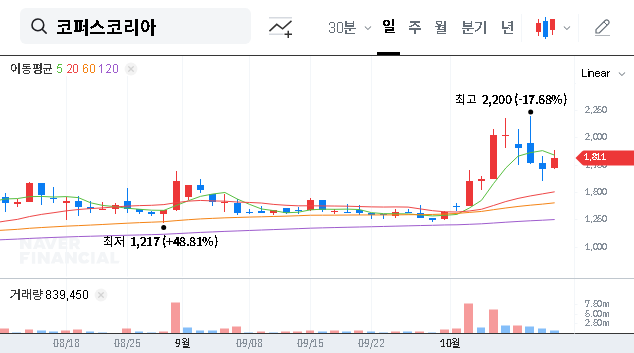
    Initially, the 10 billion KRW in funding is a positive, providing liquidity for operations and strategic investments. However, the market will likely react to the potential for future stock supply. The conversion price being lower than the market price creates an ‘overhang’—the possibility of new shares flooding the market if the stock price rallies, which can suppress upward momentum. Investor sentiment will be a key watchpoint; the market needs to see this as a strategic move for growth, not a desperate measure for survival.

    Mid-to-Long-Term (Post-Conversion Period)

    Once the conversion period begins in late 2026, the primary concern is share value dilution. If bondholders convert their debt into stock, the number of outstanding shares increases, which can decrease the earnings per share and the ownership percentage of existing shareholders. On the flip side, successful conversion transforms debt into equity on the balance sheet. This deleveraging effect would improve the company’s financial structure, lower its debt-to-equity ratio, and be viewed positively by the market.

    Investor Action Plan & Strategy

    Given the mix of high potential and high risk, a cautious and well-monitored approach is essential for anyone invested in or considering COPUS KOREA stock.

    • Monitor Key Performance Indicators: Look beyond headlines. Scrutinize quarterly earnings reports for real revenue growth and improved profit margins from the new content ventures.
    • Track Conversion Trends: Keep an eye on the stock price relative to the 1,914 KRW conversion price. As it rises above this level, the probability of conversion (and dilution) increases.
    • Assess Financial Health Improvements: Check for a decreasing debt-to-equity ratio and positive operating cash flow in future financial statements. This will be the ultimate proof of a successful turnaround.
    • Diversify Your Portfolio: Given the volatility, ensure your investment in COPUS KOREA is part of a diversified portfolio. For more on this, see our guide on Investing in the K-Content Industry.

    In conclusion, the COPUS KOREA Convertible Bond is a critical inflection point. Its success will be measured not by the funds raised today, but by the company’s ability to translate this capital into sustainable growth and improved financial stability tomorrow.

    (322780) COPUS KOREA Convertible Bond: An In-Depth 2025 Investor Analysis 관련 이미지
  • (322780) COPUS KOREA Rights Offering: A Deep Dive into the KRW 8 Billion Lifeline

    (322780) COPUS KOREA Rights Offering: A Deep Dive into the KRW 8 Billion Lifeline

    The recent announcement of the COPUS KOREA rights offering has sent ripples through the investment community. With a substantial KRW 8 billion at stake, the central question is whether this capital injection will be the catalyst for a much-needed turnaround or simply delay an inevitable decline. For investors, understanding the nuances of this move is critical, as it directly impacts share value, company stability, and long-term growth prospects.

    This comprehensive analysis dissects the offering’s details, examines the severe financial crisis prompting it, and weighs the potential positive and negative outcomes to provide a clear roadmap for stakeholders.

    Breaking Down the KRW 8 Billion Rights Offering

    On October 14, 2025, COPUS KOREA Co., Ltd. finalized its plan for a significant capital raise. The company will issue 4,990,642 new common shares at a price of KRW 1,603 per share. This third-party allotment rights offering is directed at a single investor, ‘GreenGrowth,’ and is designed to raise a total of KRW 8 billion. This issuance represents approximately 12% of the company’s existing shares, a figure that immediately raises questions about share dilution.

    The timeline is set with a payment date of January 30, 2026, and the new shares are scheduled for listing on the stock exchange on February 19, 2026. For complete transparency, the official filing can be reviewed directly. Official Disclosure: Click to view DART report.

    The Catalyst: A Deepening Financial Crisis

    The decision to pursue a rights offering was not a strategic choice for growth but a necessary move for survival. COPUS KOREA’s financials paint a grim picture. The 2025 half-year report revealed a catastrophic 73% year-on-year decrease in revenue, plummeting to just KRW 6.48 billion. This collapse was driven by poor performance in its core distribution and production segments. The bottom line is equally concerning, with operating losses ballooning to KRW 4.19 billion and net losses reaching KRW 6.97 billion.

    This isn’t just a temporary downturn; it’s a fundamental crisis. The rights offering is a critical lifeline, but investors must question whether it’s enough to repair a deeply damaged financial structure.

    Key Indicators of Financial Distress

    • Soaring Debt-to-Equity Ratio: The ratio has climbed to an alarming 219.03%, signaling high financial leverage and increased risk for creditors and shareholders. For more on this metric, see this guide on financial ratios.
    • Shrinking Capital & Cash: A decline in capital and available cash equivalents has created intense liquidity pressure, making it difficult to cover short-term obligations.
    • Diversification Struggles: Attempts to diversify, such as a joint venture for a short-form platform, have yet to bear fruit, while underperforming subsidiaries continue to drag down consolidated results.

    A Double-Edged Sword: The Impact on Investors

    The COPUS KOREA rights offering presents both a glimmer of hope and a significant risk. Investors must weigh these two sides carefully.

    The Bull Case: Potential Positives

    • Immediate Liquidity: The KRW 8 billion provides immediate cash to stabilize operations and improve the balance sheet.
    • Fuel for Growth: The funds can be allocated to new content investments and business expansion, potentially creating new revenue streams.
    • Vote of Confidence: Securing ‘GreenGrowth’ as a major investor provides management stability and could be a positive signal to the market.

    The Bear Case: Potential Negatives

    • Share Value Dilution: The issuance of nearly 5 million new shares will dilute the ownership stake and earnings per share for existing shareholders. This is a primary concern for any long-term stock analysis.
    • Unresolved Core Issues: The cash infusion is a treatment, not a cure. Without a fundamental recovery in revenue and profitability, the company’s long-term viability remains in question.
    • Downward Stock Price Pressure: The market may react negatively to the dilution and the low offering price of KRW 1,603, potentially driving the COPUS KOREA stock price down.

    Conclusion: A Cautious Path Forward for Investors

    The COPUS KOREA rights offering is a pivotal moment for the company. While the KRW 8 billion is essential for short-term survival, sustained success depends entirely on management’s ability to execute a turnaround strategy that revives its core business. The path ahead is fraught with uncertainty.

    Investors should proceed with extreme caution, closely monitoring the use of proceeds, any signs of revenue recovery, and the company’s progress toward profitability. This is a high-risk, high-stakes situation where diligent research and a clear understanding of the fundamentals are paramount before making any investment decision.

    (322780) COPUS KOREA Rights Offering: A Deep Dive into the KRW 8 Billion Lifeline 관련 이미지
  • (322780) COPUS KOREA Major Shareholder Change: A Deep-Dive Investment Analysis

    (322780) COPUS KOREA Major Shareholder Change: A Deep-Dive Investment Analysis

    The financial market is abuzz with the recent news surrounding COPUS KOREA Co., Ltd., which stands at a pivotal crossroads. A recently announced stock transfer agreement signals a significant COPUS KOREA major shareholder change, a transaction valued at approximately 25.6 billion KRW. This move raises a critical question for every investor: can a new controlling interest steer the company away from its struggling fundamentals, or does it introduce fresh uncertainty? With plummeting revenues and a strained balance sheet, this analysis will dissect the potential outcomes and outline a prudent investment strategy for navigating this volatile period.

    We will explore the details of the acquisition, the company’s pre-existing financial health, the potential for a turnaround, and the considerable risks involved. This comprehensive guide provides the clarity needed to make an informed decision.

    The Landmark Deal: Anatomy of the Shareholder Change

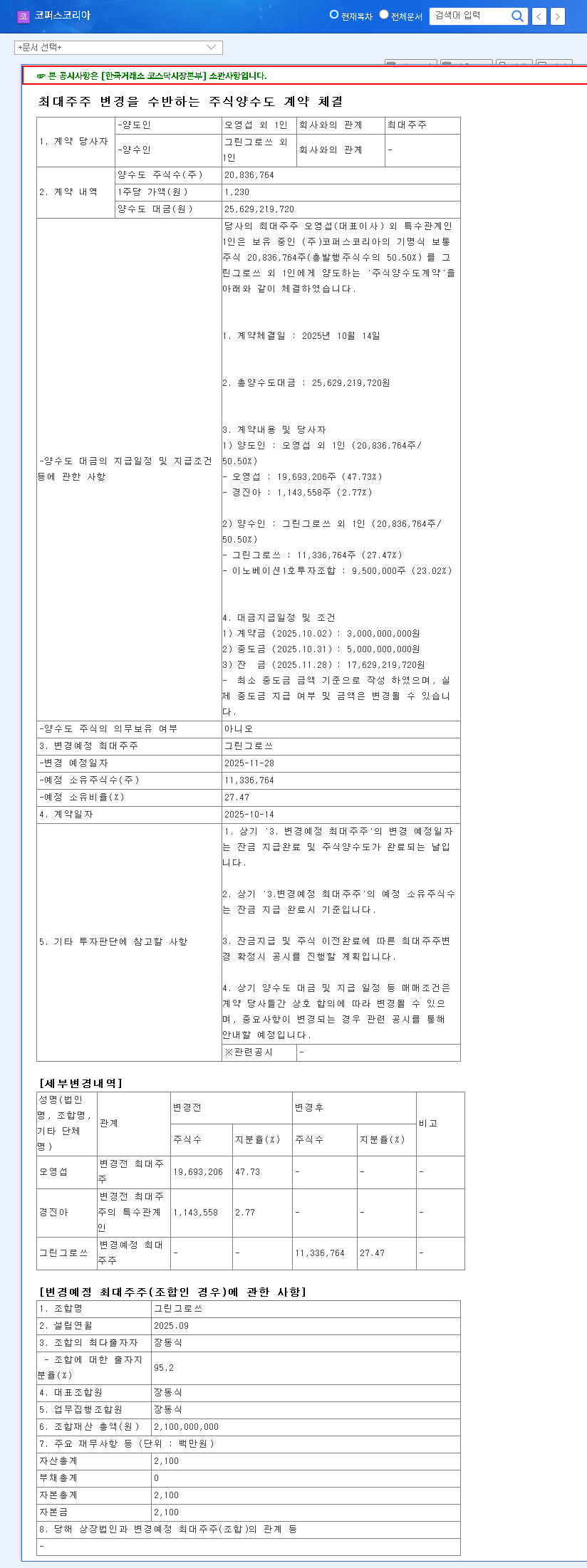
    On October 14, 2025, COPUS KOREA officially disclosed the signing of a stock transfer agreement that fundamentally alters its ownership structure. The transaction sees the existing largest shareholder, Oh Young-sup and one other, transferring a controlling stake to a new consortium. This is not merely a boardroom shuffle; it’s a seismic shift with profound financial implications. The official details of this COPUS KOREA major shareholder change can be verified in the Official Disclosure (DART).

    Key Transaction Details at a Glance

    • Seller: Oh Young-sup and one other (Outgoing largest shareholder)
    • Buyer: Greengrowth and one other (Innovation 1st Investment Association)
    • Total Transfer Price: Approximately 25.63 billion KRW
    • Shares Transferred: 20,836,764 shares (a controlling 50.50% stake)
    • New Largest Shareholder: Greengrowth, with an expected ownership of 27.47%

    Pre-Acquisition Financial Health: A Company in Crisis

    Before this acquisition, COPUS KOREA’s financial statements painted a grim picture. The 2025 semi-annual report revealed deep-seated issues that any new management team will need to confront immediately. Understanding these challenges is key to any credible COPUS KOREA stock analysis.

    The company faced a perfect storm of plummeting revenue, deteriorating core profitability, and a burdensome debt load. The shareholder change is not just an opportunity; it’s a necessity for survival.

    Core Business Deterioration

    Consolidated revenue had nosedived by a staggering 73% year-over-year, landing at just 6.48 billion KRW. This wasn’t a blip; it was a systemic failure across both content distribution and production—the company’s primary growth engines. While headline net profit showed improvement, this was misleadingly propped up by non-operating factors like valuation gains on financial instruments. The separate financial statements, which offer a clearer view of the core business, revealed a substantial operating loss, confirming the severe decay in operational profitability.

    Mounting Financial Burdens

    The company’s consolidated debt ratio escalated to 219.03%, a clear red flag for financial instability. The increase in convertible bonds and derivative liabilities added further pressure, creating a challenging environment for investment and growth. For a deeper understanding of these metrics, investors can review resources on Understanding Financial Ratios for Stock Analysis.

    Potential Impacts: Bull vs. Bear Case

    This change in ownership presents a classic fork in the road. The path forward depends entirely on the new management’s strategy and execution.

    The Bull Case (Positive Outlook)

    • Management and Financial Overhaul: The infusion of 25.6 billion KRW and a new leadership team from Greengrowth could be the catalyst for a complete operational and financial reset.
    • Strategic Investment: With fresh capital, COPUS KOREA could aggressively invest in high-growth areas like its short-form platform business, acquire new content IP, or expand its R&D efforts.
    • Market Re-evaluation: A clear, compelling vision from Greengrowth could lead to a re-rating of the company’s stock as the market prices in future growth instead of past failures. News of a solid plan could draw attention from major financial outlets like Bloomberg.

    The Bear Case (Negative Risks)

    • Execution Uncertainty: A new vision is one thing; executing it is another. A failure to create synergy between new management and the existing business could lead to more disruption.
    • Persistent Revenue Slump: The revenue decline may be structural. If the market has fundamentally shifted away from COPUS KOREA’s offerings, a turnaround could be prolonged and costly.
    • Acquisition Debt Burden: The substantial acquisition cost, combined with the company’s existing debt, could constrain the new owners’ ability to invest freely in the business.

    Investment Strategy: A Time for Diligent Observation

    Given the high degree of uncertainty, the most prudent COPUS KOREA investment strategy at this juncture is a ‘Watch’ or ‘Hold’ recommendation. The potential for a turnaround is real, but so are the risks of further decline. Before committing capital, investors should wait for concrete evidence of a new strategic direction and initial signs of its success.

    Key Metrics to Monitor Post-Acquisition:

    • New Management’s 100-Day Plan: Look for a clear, publicly communicated business plan from Greengrowth.
    • Quarterly Revenue Trends: Is the revenue decline stabilizing or, ideally, reversing?
    • Debt Reduction Efforts: Are there tangible steps being taken to de-leverage the balance sheet?
    • Operating Margin Improvement: Monitor profitability from core business operations, ignoring one-off financial gains.

    The Greengrowth acquisition is a high-stakes gamble. For investors on the sidelines, the best move is to watch closely as the new owners play their hand.

    (322780) COPUS KOREA Major Shareholder Change: A Deep-Dive Investment Analysis 관련 이미지