Tag: Construction

  • SeoHan’s Major Shareholder Increases Stake: A Sign of Turnaround or a Temporary Boost?

    SeoHan's Major Shareholder Increases Stake: A Sign of Turnaround or a Temporary Boost? 대표 차트 이미지

    1. What Happened? Background of the Stake Increase

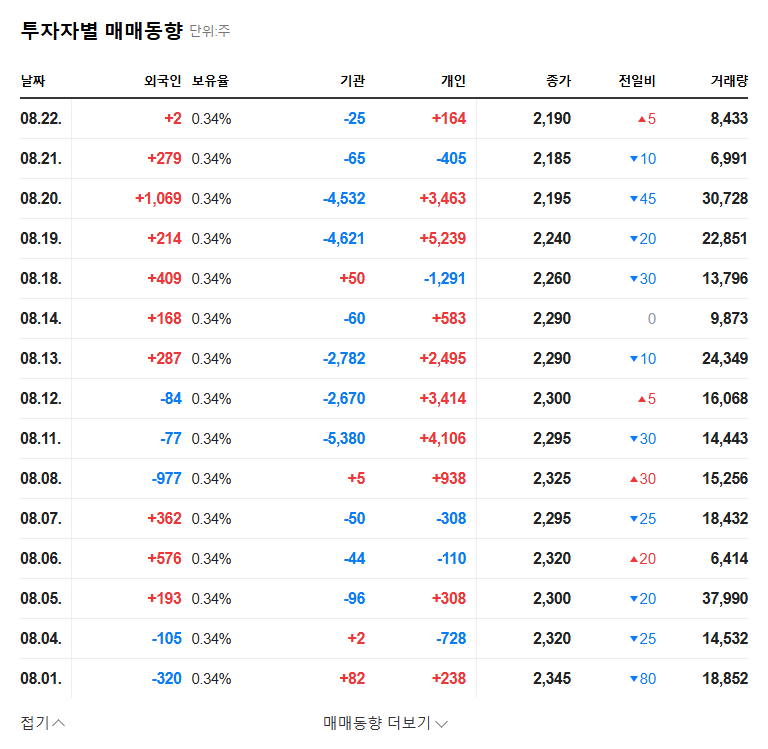
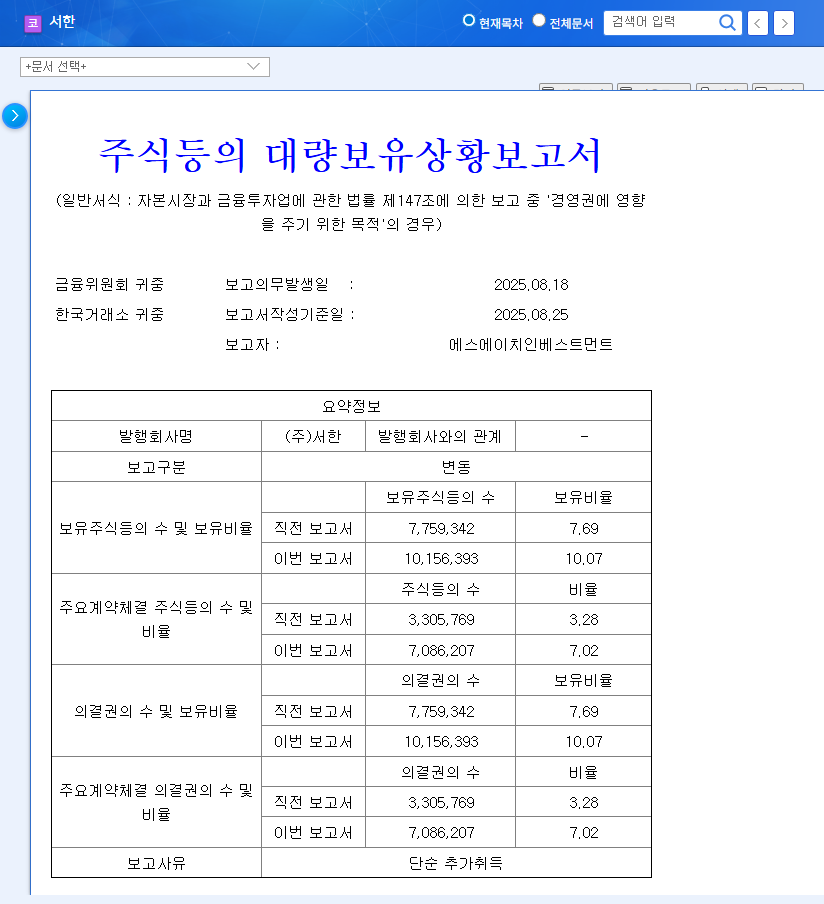
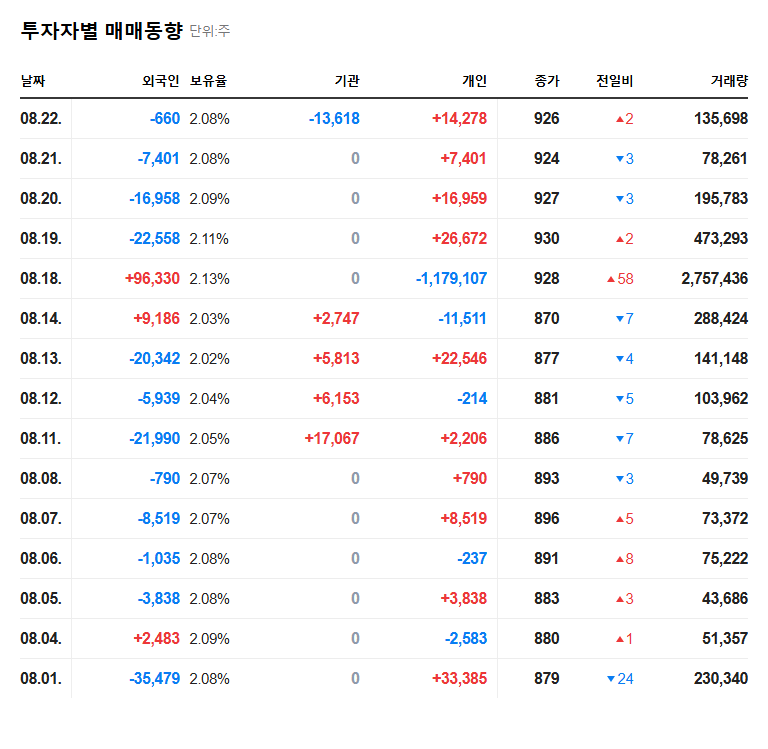
    On August 25, 2025, SeoHan’s major shareholders, SH Investment and Mr. Kim Byung-jun, acquired additional shares through after-hours trading, reaching a total ownership of 10.07%. This was disclosed as a simple additional acquisition for the purpose of influencing management rights.

    2. Why Does it Matter? Implications of the Stake Increase

    The increase in stake by major shareholders can be interpreted as a move to strengthen management control or demonstrate active participation in management. In an unstable business environment, this can be seen as a signal of commitment to the company’s operations. It’s particularly noteworthy as a potential indication of their willingness to tackle the challenges SeoHan currently faces.

    3. What’s Next? Short-term and Long-term Impact Analysis

    • Short-Term Impact: Increased stock price volatility and heightened market attention. The after-hours acquisition may lead to short-term stock price gains.
    • Long-Term Impact: Enhanced management stability and potential improvement in fundamentals. However, addressing existing financial risks like declining sales, high inventory levels, and contingent liabilities is crucial.

    4. What Should Investors Do? Investment Strategy

    While short-term stock price momentum can be anticipated, a neutral stance and cautious approach are recommended, considering the fundamental issues. Investors should closely monitor the major shareholder’s plans for business normalization, the real estate market recovery, and efforts to mitigate financial risks.

    FAQ

    Does an increase in major shareholder stake always positively affect the stock price?

    Not necessarily. Various factors, such as the purpose of the stake increase, the company’s fundamentals, and market conditions, influence stock prices.

    What are the main financial risks for SeoHan?

    Declining sales, high inventory levels, and substantial contingent liabilities are key risk factors.

    What should investors be aware of?

    Carefully monitor the major shareholder’s business normalization plans, efforts to mitigate financial risks, and be mindful of changes in the real estate market.
    SeoHan's Major Shareholder Increases Stake: A Sign of Turnaround or a Temporary Boost? 관련 이미지
    SeoHan's Major Shareholder Increases Stake: A Sign of Turnaround or a Temporary Boost? 관련 이미지
  • NRB (475230) Stock Outlook: Investment Fund Sells Stake, Opportunity or Crisis?

    NRB (475230) Stock Outlook: Investment Fund Sells Stake, Opportunity or Crisis? 대표 차트 이미지

    What Happened?

    An investment fund sold 250,000 shares of NRB through after-hours trading, reducing its stake from 10.88% to 8.55%. This event, occurring at a time of heightened market attention following the company’s IPO, could negatively impact investor sentiment.

    Behind the Sale and Fundamental Analysis

    NRB possesses growth potential based on its modular construction technology and strong presence in the B2G market. However, high debt ratios and recent net losses pose ongoing financial risks. The investment fund’s stake sale could amplify concerns about these financial vulnerabilities.

    Investment Strategy: Navigating Risk and Opportunity

    In the short term, a cautious approach is warranted, closely monitoring the absorption of the sold shares and overall market reaction. A mid-to-long-term perspective should focus on NRB’s technology and growth potential while carefully monitoring improvements in financial health and profitability. Continuous review of quarterly earnings, new business performance, and changes in financial indicators is crucial for adjusting investment strategies.

    Key Monitoring Points

    • Further stake changes by the investment fund
    • Quarterly earnings improvement trends (revenue growth, net income turning positive)
    • Modular production capacity utilization rate
    • New business performance (orders and revenue contribution)
    • Efforts to improve financial soundness (debt repayment, capital structure improvement)
    • Changes in the competitive landscape

    Frequently Asked Questions

    How will the investment fund’s stake sale impact NRB’s future?

    While it may exert downward pressure on the stock price in the short term, it doesn’t necessarily pose a fundamental threat to NRB’s long-term growth potential. The company’s efforts to improve its financial health and achieve earnings growth will be key factors.

    What should investors check before investing in NRB?

    Investors should continuously monitor financial soundness indicators (debt ratio, net income), modular production capacity utilization rate, and new business performance. Changes in the competitive landscape and further stake changes by the investment fund are also important checkpoints.

    NRB (475230) Stock Outlook: Investment Fund Sells Stake, Opportunity or Crisis? 관련 이미지
    NRB (475230) Stock Outlook: Investment Fund Sells Stake, Opportunity or Crisis? 관련 이미지
  • Kolon Global Hit with ₩44.2 Billion Lawsuit: What’s the Impact on Kolon Stock?

    Kolon Global Hit with ₩44.2 Billion Lawsuit: What's the Impact on Kolon Stock? 대표 차트 이미지

    Kolon Global’s ₩44.2 Billion Lawsuit: The Details

    Kolon Global has been sued by the Deokhyeon District Housing Redevelopment Association for ₩44.2 billion in unjust enrichment. This is a significant amount, representing 7.41% of Kolon Global’s assets.

    Ripple Effects: Impact on Kolon

    Financial Impact

    If Kolon Global loses the lawsuit, it could face financial instability, additional costs, and a decline in asset value. As Kolon Global is a key affiliate of the group, this financial burden could indirectly affect the entire group.

    Business Impact

    The lawsuit could negatively impact Kolon Global’s construction business, affecting new orders and ongoing projects. Furthermore, strained relations with the association could create difficulties in similar future projects. A decline in investor confidence in the management environment is also a concern.

    Stock Price and Investor Sentiment

    The lawsuit announcement could lead to a short-term decline in stock price and dampen investor sentiment. The outcome of the lawsuit and the company’s response strategy will determine the medium- to long-term stock price trend.

    Action Plan for Investors

    Investors should closely monitor the progress of the lawsuit and the company’s response strategy. It’s also crucial to consider existing fundamental factors such as construction market conditions, interest rate/exchange rate fluctuations, and bio-business development risks when making investment decisions.

    What is the amount of the lawsuit against Kolon Global?

    ₩44.2 billion (₩44,217,588,450).

    How will the lawsuit affect the Kolon Group as a whole?

    As Kolon Global is a key affiliate, the financial burden could indirectly affect the entire group. However, considering the group’s diversified business portfolio, the impact on the overall corporate value may be limited.

    What should investors do?

    Investors should closely monitor the progress of the lawsuit and the company’s response strategy, and consider existing fundamental factors when making investment decisions.

    Kolon Global Hit with ₩44.2 Billion Lawsuit: What's the Impact on Kolon Stock? 관련 이미지
    Kolon Global Hit with ₩44.2 Billion Lawsuit: What's the Impact on Kolon Stock? 관련 이미지
  • Korea Refractories Divests Ilkwang E&C: What’s Next for the Stock?

    Korea Refractories Divests Ilkwang E&C: What's Next for the Stock? 대표 차트 이미지

    1. What Happened? : Divestiture of Ilkwang E&C

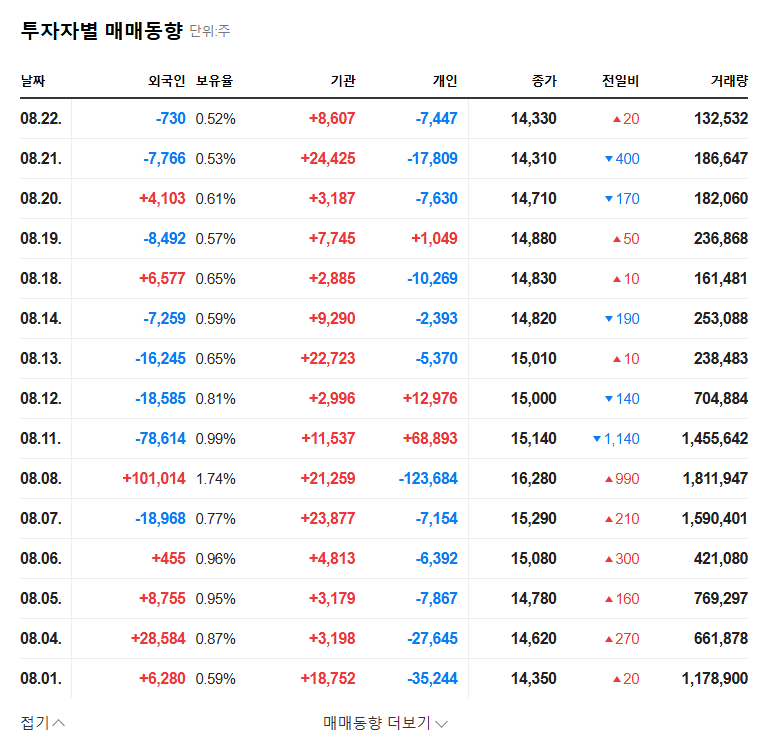
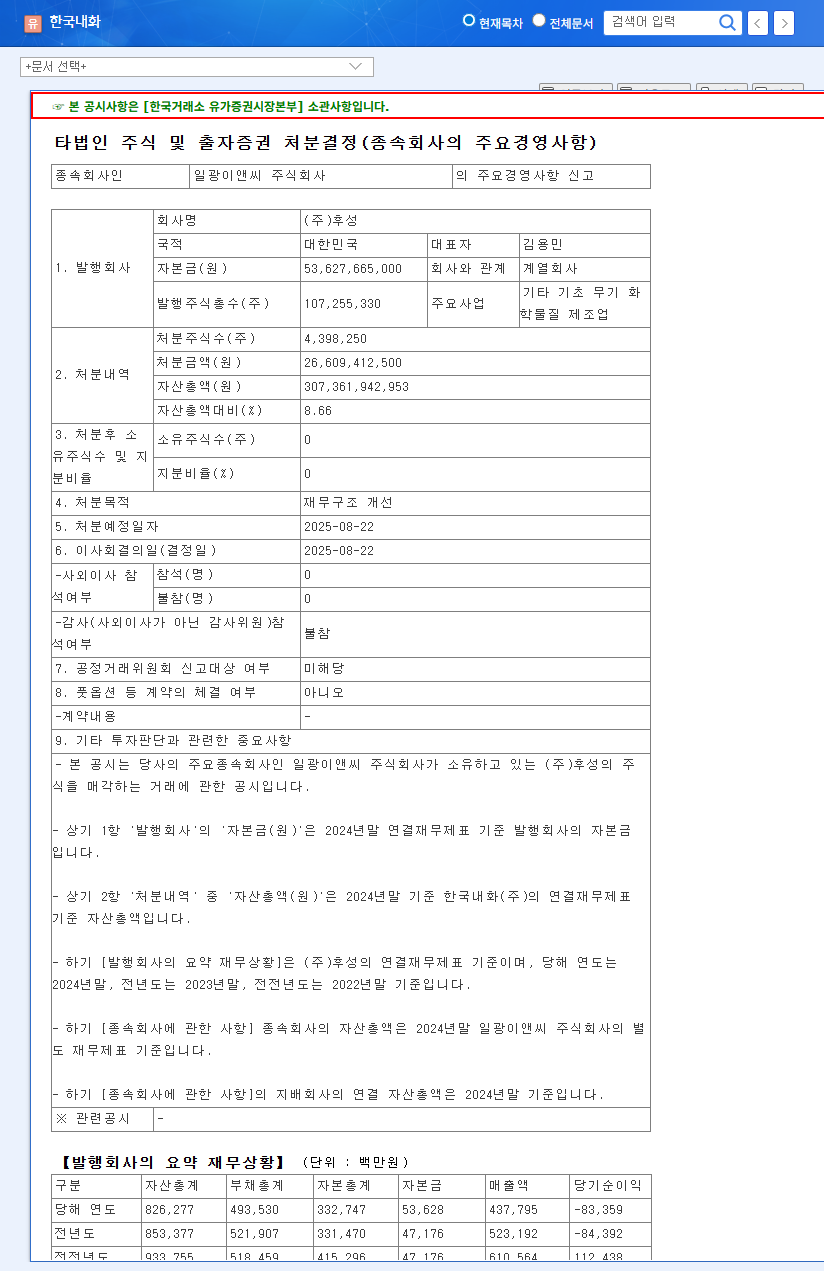
    On August 25, 2025, Korea Refractories announced the sale of its 100% stake in Ilkwang E&C to Hoosung for 26.6 billion KRW. Consequently, Ilkwang E&C will be removed from Korea Refractories’ consolidated financial statements.

    2. Why the Divestiture? : Strengthening Financials and Mitigating Risk

    Korea Refractories has been facing financial challenges due to recent underperformance and lawsuits. Ilkwang E&C, in particular, has been a burden due to increasing losses stemming from the construction industry downturn and ongoing litigation. This divestiture is expected to improve Korea Refractories’ debt-to-equity ratio and boost liquidity. It also allows the company to shed the financial risks associated with the underperforming subsidiary and focus on its core refractories business.

    3. What’s Next? : Analyzing Stock Price Implications

    The divestiture could have both positive and negative short-term impacts on the stock price. While the anticipated financial improvements could drive the price up, concerns about revenue decline due to the loss of Ilkwang E&C’s contributions could put downward pressure on the stock. The mid-to-long-term impact will depend on how Korea Refractories utilizes the proceeds from the sale and whether its core refractories business improves. The success of its new ventures in IT and big data will also be a key factor.

    4. What Should Investors Do? : Action Plan

    • Short-term Investors: Can consider short-term trading strategies during periods of increased stock volatility. However, proceed with caution due to the high risk involved.
    • Mid-to-Long-term Investors: Carefully monitor Korea Refractories’ performance post-divestiture, the use of proceeds, and the performance of the core refractories business and new ventures before making investment decisions.
    • All Investors: Keep a close eye on macroeconomic indicators such as raw material prices and exchange rate fluctuations.

    Frequently Asked Questions

    Is the divestiture of Ilkwang E&C positive for Korea Refractories’ stock price?

    In the short term, it could be positive due to anticipated financial improvements. However, in the long term, it could be negative due to potential revenue decline. The use of the proceeds and the performance of the core business are crucial factors.

    What is the outlook for Korea Refractories?

    The future of Korea Refractories hinges on strengthening its competitiveness in the refractories business and the success of its new ventures. Currently, the outlook is uncertain.

    What should investors be cautious about?

    Investors should consider the post-divestiture performance, the use of proceeds, and macroeconomic conditions. A cautious approach to investment is recommended.

    Korea Refractories Divests Ilkwang E&C: What's Next for the Stock? 관련 이미지
    Korea Refractories Divests Ilkwang E&C: What's Next for the Stock? 관련 이미지
  • Doosan Enerbility Wins $330M LNG Plant Contract: Investment Implications

    1. What Does the $330 Million Contract Mean?

    Doosan Enerbility has signed a contract with Korea Gas Corporation to build the second phase of LNG storage tanks and auxiliary facilities at the Dangjin LNG terminal for $330 million. This is a long-term project expected to last approximately four years and four months.

    2. Why Is This Important?

    This contract win is more than just a deal; it holds significant implications for the future of Doosan Enerbility.

    • Revenue Growth and Stability: The long-term contract secures a stable revenue stream and lays the foundation for future sales growth.
    • Strengthened Business Competitiveness: It demonstrates Doosan’s expertise in LNG storage tank construction, giving them a competitive edge in future similar projects.
    • Expansion of Eco-Friendly Energy Business: Reinforces the company’s ESG commitment and secures future growth engines by strengthening their LNG business portfolio, aligning with the global shift towards carbon neutrality.

    3. What Are the Implications for Investors?

    Alongside the positives, investors should also be aware of potential risks.

    • Positive Impacts: Increased revenue, enhanced business stability, strengthened ESG management
    • Potential Risks: Fluctuations in raw material prices, construction delays, intensified competition

    Therefore, investors should consider these factors comprehensively when making investment decisions.

    4. What’s the Investment Strategy?

    This contract win is a positive sign, showcasing Doosan Enerbility’s long-term growth potential. However, instead of being swayed by short-term stock price fluctuations, investors should focus on the company’s fundamentals, future order outlook, and changes in the competitive landscape, adopting a long-term perspective when developing their investment strategy.

    Will this contract have a positive impact on Doosan Enerbility’s stock price?

    A positive impact can be expected in the long run, but short-term stock price volatility can be influenced by various factors.

    What is Doosan Enerbility’s main business?

    It is an energy and heavy industry company that manufactures power generation equipment, desalination plants, and castings & forgings.

    Is LNG an eco-friendly energy source?

    LNG is considered a more environmentally friendly energy source compared to existing fossil fuels like coal and oil due to its lower carbon emissions.

  • Jinheung Engineering Wins $777M LH Contract: Investment Opportunity?

    1. What Happened?

    Jinheung Engineering was awarded a $777 million contract by the Korea Land & Housing Corporation (LH) for the ‘Incheon Gyeyang A9BL Apartment Construction Project 3rd Zone’. This represents 10.71% of Jinheung Engineering’s recent revenue and will run for approximately three years, from September 2025 to June 2028.

    2. Why Does It Matter?

    This contract is expected to play a crucial role in improving Jinheung Engineering’s fundamentals. With recent success in achieving positive operating profit, demonstrating signs of a turnaround, this contract can contribute to stable sales growth and improved financial structure. It is also anticipated to help improve performance in the public construction sector, which has been sluggish recently.

    • Profitability Improvement: Expected improvement in profitability with secured stable sales.
    • Strengthened Financial Health: Potential for improved cash flow and reduced financial burden.
    • Enhanced Contract Competitiveness: Positive impact on winning similar projects in the future.

    3. What’s Next?

    In the short term, increased sales and improved investor sentiment are expected. In the medium to long term, it is projected to contribute to stable profit generation and improved financial structure. However, continuous monitoring is necessary as existing financial risks are not completely resolved. The influence of macroeconomic variables such as interest rates and raw material prices should also be considered.

    4. What Should Investors Do?

    • Maintain a Positive Outlook: Monitor trends in performance improvement and financial stability.
    • Monitor Risk Management: Monitor potential risk factors such as financial risks and lawsuits.
    • Consider Macroeconomic Variables: Pay attention to changes in external factors such as interest rates and raw material prices.
    What is the size of the LH contract awarded to Jinheung Engineering?

    Approximately $777 million, representing 10.71% of Jinheung Engineering’s recent revenue.

    How will this contract impact Jinheung Engineering?

    Positive impacts are expected, including increased sales, improved profitability, enhanced financial structure, and strengthened contract competitiveness.

    What precautions should investors take?

    Investors should consider existing financial risks, potential risk factors such as lawsuits, and the influence of macroeconomic variables such as interest rates and raw material prices.

  • SW Steel Tech Stock Forecast: Is SY’s Increased Stake a Positive Sign?

    1. SY’s Increased Stake: What Happened?

    SY increased its stake in SW Steel Tech from 56.48% to 62.72% through participation in a rights offering. This is interpreted as a sign of strengthening management control and commitment to new business investment.

    2. Why is it Important?

    SW Steel Tech is currently at a critical juncture, entering the soundproofing material market. The increased stake by SY, the largest shareholder, can positively influence management stability and secure momentum for new business development. It can also instill confidence in investors about the company’s vision.

    3. So, What About the Stock Price?

    While the increased stake is a positive sign, there are also potential risk factors such as a slowdown in the construction industry and uncertainty surrounding the profitability of the new business in its early stages. A cautious investment strategy is necessary, keeping in mind the possibility of short-term stock price volatility.

    • Positive Factors: Management stabilization, acceleration of new business development, increased investor confidence
    • Risk Factors: Short-term stock price volatility, fundraising burden, market fluctuations

    4. Investor Action Plan

    While there is investment value in the long term, it’s crucial to be aware of short-term volatility. Managing risks through staged investment, setting target prices, and continuous monitoring is essential.
    Investment Strategy: Gradual purchase
    Target Price: KRW 6,500 – 7,000 (PER 15x at the end of 2025)
    Key Monitoring Points: Performance of the soundproofing business, recovery of the construction industry, fluctuations in raw material prices and exchange rates

    Is SY’s stake increase positive for SW Steel Tech’s stock price?

    It can be positive in the long term, but there is also a possibility of short-term stock price volatility.

    What is the outlook for SW Steel Tech’s soundproofing business?

    The growth potential is significant, but there are factors to consider such as initial investment costs and increased market competition.

    What should investors be aware of when investing in SW Steel Tech?

    Investors should continuously monitor changes in the macroeconomic environment, such as a slowdown in the construction industry and fluctuations in raw material prices, as well as the performance of the soundproofing material business.

  • GS Engineering & Construction’s $1.7B Divestment: A Strategic Move for Growth

    1. What Happened? : The $1.7 Billion Divestment

    GS E&C is selling its entire stake in Global Water Solutions, held through its Spanish subsidiary GS Inima Environment S.A.U. The transaction is expected to close by February 21, 2027, and will generate $1.7 billion for GS E&C.

    2. Why the Sale? : Focusing on Core Business and Strengthening Finances

    The divestment reflects GS E&C’s strategy to streamline its operations and bolster its financial position. The company plans to use the proceeds to strengthen its balance sheet, reduce debt, and invest in core construction operations and new growth engines.

    3. What’s Next? : Potential Benefits and Risks

    • Positive Impacts:
      • Significant improvement in financial health
      • Increased investment capacity in core business
      • Enhanced profitability and corporate value
    • Potential Risks:
      • Market volatility due to the extended divestment timeline
      • Effectiveness of investment from the proceeds
      • Global interest rate and exchange rate fluctuations

    4. What Should Investors Do? : Monitor and Maintain a Long-Term Perspective

    While the divestment is expected to positively impact GS E&C in the long run, investors should closely monitor the divestment process, the company’s investment plans, and the performance of its core business. It is crucial to adopt a long-term perspective and avoid overreacting to short-term market fluctuations.

    What is the value of GS E&C’s divestment?

    GS E&C is selling its subsidiary, Global Water Solutions, for $1.7 billion.

    What is the purpose of the divestment?

    GS E&C aims to improve its financial structure and focus on its core construction business to secure future growth engines.

    How will this divestment affect GS E&C’s stock price?

    A positive long-term impact is expected, but there might be volatility depending on market conditions and the company’s performance. Investors should exercise caution.

  • Samsung Engineering IR Analysis: Is the ₩10.8T Order Backlog a Real Opportunity?

    1. What Happened?: Samsung Engineering’s IR Presentation

    Samsung Engineering recently held an investor relations (IR) presentation, sharing key management updates and future strategies with investors and analysts, followed by a Q&A session.

    2. Why It Matters: The ₩10.8 Trillion Backlog and Beyond

    The core focus of the IR was the impressive ₩10.8 trillion order backlog. Secured through 21 individual sales and supply contracts, this backlog is expected to underpin stable revenue for the next 2-3 years. However, there are potential risks, including declining profitability in the chemical segment, increasing financial leverage, and foreign exchange fluctuations.

    • Strengths: Robust order backlog, global project experience, synergy with key clients like Samsung Electronics, investment in green solutions
    • Weaknesses: Declining profitability in the chemical segment, increasing financial leverage, foreign exchange risk, project execution risks

    3. What’s Next?: Impact on Investors

    If the IR presentation effectively conveys a positive growth narrative and robust risk management strategies, it could improve investor sentiment and boost the stock price. Conversely, negative information or failure to meet market expectations could lead to a decline in share price.

    4. Investor Action Plan: Key Takeaways

    Investors should focus on the following key takeaways:

    • New order trends and outlook
    • Strategies for improving profitability in the chemical segment
    • Progress and achievements in green solutions and new businesses
    • Financial health management plan
    • Strategies for managing macroeconomic variables
    Q: What are Samsung Engineering’s main businesses?

    A: Samsung Engineering’s core businesses include EPC (Engineering, Procurement, and Construction), plant construction, and high-rise building construction.

    Q: What is Samsung Engineering’s current order backlog?

    A: According to their recent IR presentation, Samsung Engineering has a current order backlog of approximately ₩10.8 trillion.

    Q: What are the key risks to consider when investing in Samsung Engineering?

    A: Investors should consider the declining profitability in the chemical segment, increasing financial leverage, and exposure to foreign exchange fluctuations. It is also important to monitor new order trends, progress in new businesses, and the company’s financial health management plan.

  • Hyundai Engineering & Construction IR Analysis: Investment Opportunity at UBS Korea Summit?

    1. Hyundai E&C IR: What to Expect

    Hyundai E&C is expected to present its current management status and future growth strategies at the IR. Investors anticipate details on new growth engines, such as hydrogen energy projects, and strategies for overseas business recovery.

    2. Key Issues and Investment Impact Analysis: Why it Matters

    Positive Factors:

    • Securing Future Growth Engines: Presentation of a vision for new businesses such as hydrogen energy.
    • Overseas Business Recovery Strategy: Unveiling a roadmap for overcoming sluggish performance and achieving growth.
    • Solid Financial Status: Emphasis on a stable foundation for growth.
    • Global Investment Attraction: Increased interest from international investors through participation in the UBS Summit.

    Negative Factors:

    • Continued Sluggish Overseas Performance: Concerns if clear improvement measures are lacking.
    • Construction Market Slowdown and Rising Raw Material Prices: Potential for continued uncertainty.
    • Uncertainty Surrounding New Businesses: Concerns if concrete business plans are insufficient.
    • Exposure to Exchange Rate Volatility: Potential for increased anxiety if risk management measures for exchange rate fluctuations are inadequate.

    3. Investment Strategies for Hyundai E&C: How to Invest

    Short-Term Strategy: A cautious approach is advised, observing IR outcomes and market reactions.
    Long-Term Strategy: A positive approach can be considered, taking into account the company’s solid financial status and efforts to secure future growth engines. However, continuous monitoring of negative factors is essential.
    Key Investment Points:

    • Concrete business plans for future growth engines such as hydrogen energy projects.
    • Strategies to overcome sluggish overseas performance and improve profitability.
    • Strategies to address exchange rate and raw material price volatility.
    • Measures to counter the slowdown in the construction market.

    Frequently Asked Questions

    When and where is the Hyundai E&C IR being held?

    The IR will be held on August 25, 2025, at 9:00 AM at the UBS Korea Summit.

    What topics will be covered in the IR presentation?

    The presentation will cover key management updates, future growth strategies (including hydrogen energy projects), and plans for overseas business recovery.

    What are the key factors to consider when investing in Hyundai E&C?

    Investors should consider factors such as continued sluggish overseas performance, construction market slowdown, rising raw material prices, uncertainty surrounding new businesses, and exchange rate volatility.