Tag: Construction Machinery

  • (267250) HD HYUNDAI Q3 Earnings Analysis (2025): Revenue Soars, Net Income Shocks

    (267250) HD HYUNDAI Q3 Earnings Analysis (2025): Revenue Soars, Net Income Shocks

    The latest HD HYUNDAI Q3 earnings report for 2025 has unveiled a complex and contradictory financial narrative that has captured the attention of the market. While the company delivered a robust ‘earnings surprise’ with impressive top-line growth, a severe ‘earnings shock’ in its bottom line has left investors seeking clarity. This deep-dive analysis unpacks the provisional results, examines the fundamentals of each business segment, and provides a forward-looking investment outlook on HD HYUNDAI’s trajectory.

    We will explore the specific drivers behind this paradoxical performance, providing a comprehensive view for anyone conducting an HD HYUNDAI stock analysis or following its financial results.

    The Core Paradox: Decoding the HD HYUNDAI Q3 2025 Report

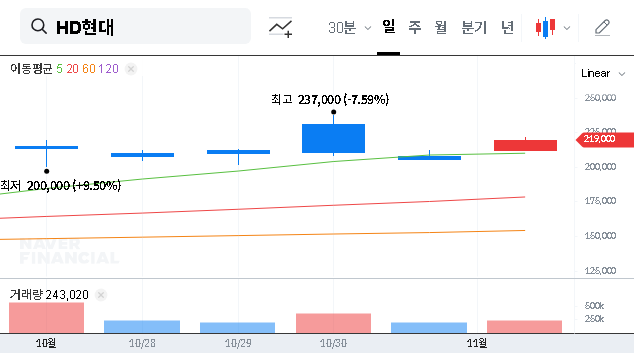
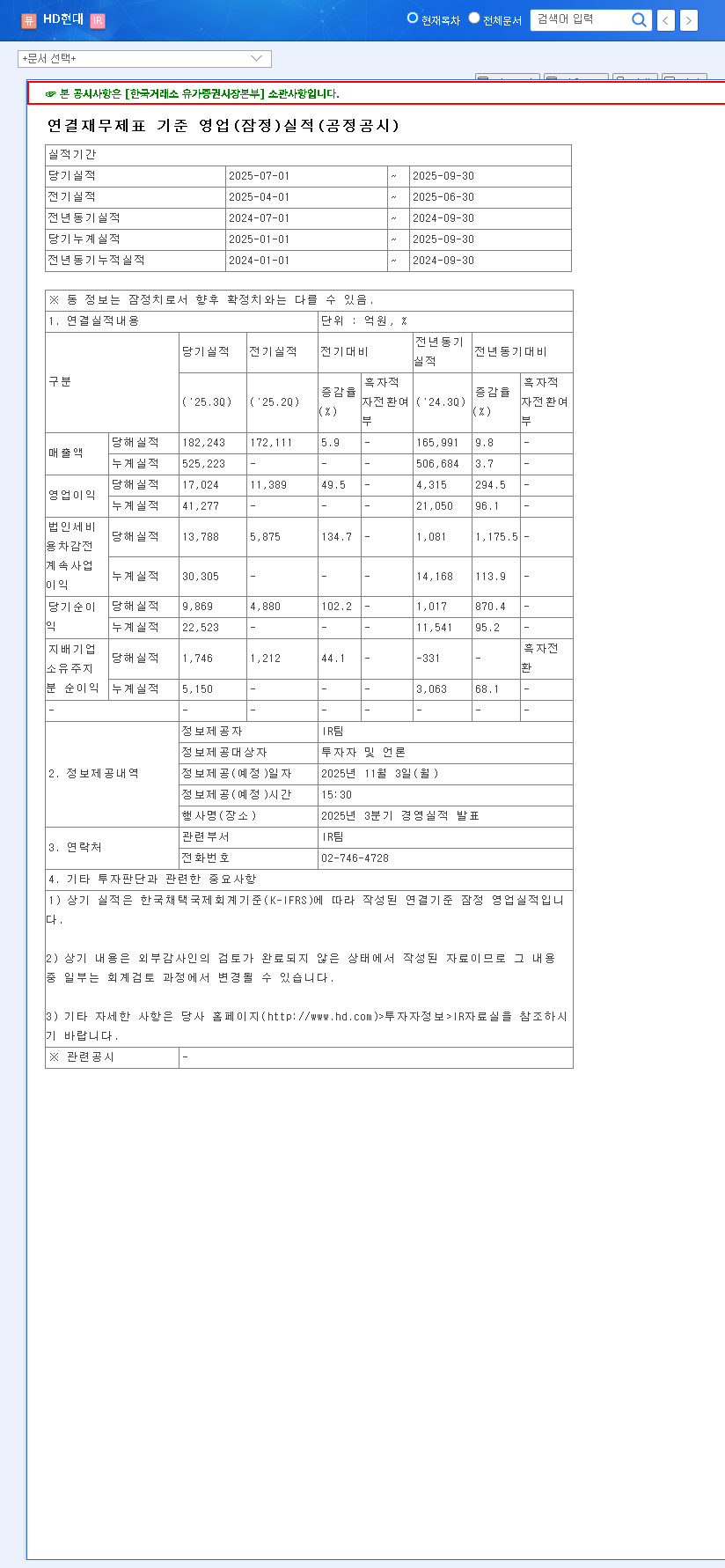
    According to the company’s Official Disclosure, HD HYUNDAI CO.,LTD. announced impressive provisional figures for Q3 2025. The company reported a consolidated revenue of KRW 18.22 trillion and an operating profit of KRW 1.70 trillion. These figures decisively surpassed market consensus estimates compiled by sources like Reuters, exceeding revenue forecasts by 7% and operating profit by a remarkable 16%.

    The central story of the HD HYUNDAI Q3 earnings is one of operational strength clashing with financial volatility. While the core businesses demonstrated robust health, external and non-recurring factors dealt a significant blow to the net income, creating a tale of two very different financial outcomes.

    However, this top-line success was severely undercut by the net income figures. At just KRW 174.6 billion, net income fell short of market expectations by a staggering 84% and represented a 65% plunge from the previous quarter. This dramatic drop was attributed to a confluence of one-off expenses and financial market headwinds.

    What Drove the Strong Revenue and Operating Profit?

    • Diversified Portfolio Strength: Robust performance and solid demand across key segments, including shipbuilding, marine services, refining, and construction machinery, fueled top-line growth.
    • Enhanced Operational Efficiency: Disciplined cost-saving initiatives, improved productivity, and a strategic focus on high-value-added products significantly boosted operating margins.

    Why Did Net Income Plummet?

    • Foreign Exchange Losses: Significant volatility in global currency markets led to substantial foreign exchange-related losses, directly impacting profitability.
    • Investment Valuation Losses: The company recorded valuation losses on its financial investment assets and experienced a decline in the value of its equity investments in associate companies.
    • One-Off Costs: Although not fully detailed, the report indicated the presence of unexpected, non-recurring expenses that negatively affected the bottom line.

    Segment-by-Segment Performance Analysis

    A detailed look at the HD HYUNDAI financial results reveals varying dynamics across its core business units.

    Shipbuilding & Marine Segment

    This division remains a key growth engine, benefiting from strong global demand for eco-friendly vessels. The robust order backlog for high-value ships like LNG carriers provides excellent revenue visibility. However, a potential slowdown in new orders and global economic headwinds pose medium-term risks.

    Refining Segment (HD Hyundai Oilbank)

    The refining business enjoys strong competitiveness due to its scale and efficiency. Short-term performance is buoyed by rising oil prices and healthy refining margins. The primary risks are volatility in oil and currency markets, alongside the long-term structural decline in demand for fossil fuels due to EV adoption.

    Electric & Electronic Segment

    This segment is well-positioned to capitalize on global electrification and renewable energy trends. Growing demand for smart grids, power equipment, and Energy Storage Systems (ESS) creates significant opportunities, particularly in the US market. The main challenge is intensifying competition in the high-voltage product space.

    Construction Machinery Segment

    With a high dependency on exports, this division is sensitive to global economic health and currency fluctuations. While the expansion of compact equipment and rental markets is a positive, a slowdown in major markets like China’s real estate sector presents a significant headwind.

    Investment Outlook & Strategic Analysis

    The HD HYUNDAI Q3 earnings paint a picture of a company with solid operational fundamentals but facing significant short-term financial volatility. For investors, the key is to look past the one-off shock and evaluate the underlying health and future growth prospects of the core businesses. For a deeper understanding, investors may want to review our guide on How to Analyze Industrial Sector Stocks.

    Investment Opinion: Neutral

    While the core business strength is undeniable, the net income miss introduces uncertainty that warrants a neutral stance. The market will be closely watching for a recovery in financial stability in the coming quarters. The negative impact on the stock price is likely to be contained if the company can demonstrate that these financial losses were indeed temporary.

    Key Monitoring Points for Investors:

    • Q4 Earnings Recovery: The most critical factor will be the resolution of one-off costs and a return to net income stability in the fourth quarter.
    • Macroeconomic Management: How effectively the company mitigates risks from currency and oil price volatility.
    • Eco-Friendly Transition: Progress and profitability in new growth areas like sustainable energy and digital marine solutions.
    (267250) HD HYUNDAI Q3 Earnings Analysis (2025): Revenue Soars, Net Income Shocks 관련 이미지
  • Speco Secures KRW 4.6 Billion Contract with Hanwha Ocean for Naval Steering Gear: A Catalyst for Growth?


    Speco Secures KRW 4.6 Billion Contract with Hanwha Ocean for Naval Steering Gear: A Catalyst for Growth? 대표 차트 이미지


    Speco Wins KRW 4.6 Billion Contract with Hanwha Ocean for Naval Steering Gear

    Speco has secured a contract worth KRW 4.6 billion with Hanwha Ocean to supply steering gear and other components for naval vessels. The contract period spans from September 11, 2025, to December 31, 2029, totaling 4 years and 3 months. This represents approximately 14.3% of Speco’s 2024 revenue, suggesting a substantial contribution to revenue growth.

    Contract Significance: Boosting Marine Machinery Business and Profitability

    This contract is projected to positively impact Speco’s marine machinery business. The nature of the defense and offshore plant business typically commands high margins, potentially leading to improved profitability. Additionally, supplying components for naval vessels strengthens Speco’s position in the military and specialized ship markets, contributing to future growth momentum.

    Key Investment Highlights

    • Accelerated growth in marine machinery: Increased orders are anticipated based on advanced technologies like stabilized steering gear.
    • Stable revenue stream: The 4-year and 3-month contract duration provides a stable revenue base.
    • Improved profitability potential: Supplying military components offers higher margins, contributing to overall profitability improvement.

    Risk Factors and Investment Considerations

    Volatility in the construction market and sluggish performance in the wind power business remain risk factors. Furthermore, diversification efforts are necessary to reduce reliance on specific customers. Investors should consider these factors comprehensively when making investment decisions.


    FAQ

    What is the contract value between Speco and Hanwha Ocean?

    KRW 4.6 Billion.

    How will this contract impact Speco?

    It is expected to boost Speco’s marine machinery business, contribute to stable revenue, and improve profitability.

    What are Speco’s main business segments?

    Construction machinery, marine machinery, and wind power.


    Speco Secures KRW 4.6 Billion Contract with Hanwha Ocean for Naval Steering Gear: A Catalyst for Growth? 관련 이미지
    Speco Secures KRW 4.6 Billion Contract with Hanwha Ocean for Naval Steering Gear: A Catalyst for Growth? 관련 이미지


  • Jinsung T.E.C. Announces Share Buyback: Impact on Stock Price

    1. What’s the Share Buyback About?

    Jinsung T.E.C. plans to repurchase and retire 449,645 shares worth approximately KRW 5.5 billion on September 5, 2025. This represents about 2.0% of the company’s market capitalization.

    2. Why the Buyback?

    Share buybacks are a way for companies to enhance shareholder value. Reducing the number of outstanding shares increases earnings per share (EPS) and book value per share (BPS). It also signals that the company is using its capital efficiently, potentially increasing investor confidence.

    3. How Will This Affect the Stock Price?

    Share buybacks typically have a positive impact on stock prices. They are seen as a shareholder-friendly move, boosting investor sentiment and potentially driving up share prices. However, the effect of a buyback can be short-lived, and long-term stock performance depends more on the company’s fundamentals and market conditions.

    • Positive Factors: Enhanced shareholder value, positive investor sentiment, improved financial structure.
    • Considerations: Short-term effect, influence of fundamentals and market conditions.

    4. What Should Investors Do?

    Jinsung T.E.C. has solid fundamentals, and this share buyback is a positive sign. While a short-term price increase is possible, investors should continuously monitor macroeconomic changes and industry competition before making investment decisions. It’s also important to pay attention to the stock’s reaction after the buyback is completed and whether the company announces any further shareholder return policies.

    What is a share buyback?

    A share buyback is when a company repurchases its own shares from the market and retires them.

    Why do companies buy back their shares?

    To increase shareholder value, defend the stock price, and improve capital efficiency.

    Do share buybacks always have a positive impact on stock price?

    Generally yes, but not always. It depends on a variety of factors, including company fundamentals and market conditions.

  • Heungkuk (010240) 2025 Half-Year Report Analysis: Profitability Achieved, But Risks Remain

    1. Heungkuk’s 2025 Half-Year Performance: What Happened?

    Heungkuk achieved an operating profit of KRW 3.7 billion in the first half of 2025, marking a return to profitability. However, sales continued to decline year-over-year, and net income decreased. This presents a mixed bag of positive and negative signals.

    2. Underlying Concerns: Why These Results?

    The sales decline is attributed to a general downturn in the construction machinery industry and increased competition. The decrease in net income suggests potential increases in cost burdens or one-time expenses. Furthermore, FX volatility impacts foreign exchange gains and losses, increasing uncertainty surrounding earnings.

    3. Heungkuk’s Future: What’s Next?

    Heungkuk’s future performance hinges on the recovery of the global construction market. Cost reduction efforts to improve profitability and establishing hedging strategies against FX volatility are crucial. The growth of overseas markets like India and the US will be key to offsetting sluggish domestic performance.

    • Positive Factors: Return to operating profit, potential growth in overseas markets
    • Negative Factors: Continued decline in sales, decrease in net income, FX volatility

    4. Action Plan for Investors

    Investors should reassess Heungkuk’s target price and investment thesis. In-depth analysis of future earnings forecasts and a review of FX risk management strategies are necessary.

    Heungkuk Investment FAQ

    Q: What is the outlook for Heungkuk’s stock price?

    A: Heungkuk’s stock price is expected to be highly sensitive to the recovery of the construction market and FX volatility. Significant short-term price fluctuations are possible, so caution is advised.

    Q: What is Heungkuk’s main business?

    A: Heungkuk’s primary business is the manufacturing and sale of construction machinery parts. Key customers include Volvo Group and HD Hyundai Construction Equipment.

    Q: What should investors consider when investing in Heungkuk?

    A: Investors should consider the construction market cycle, FX volatility, and the company’s efforts to improve profitability.

  • Speco (013810) H1 2025 Earnings Analysis: Turnaround Potential and Investment Strategy

    1. What Happened at Speco?

    Speco recorded revenue of KRW 15.245 billion in H1 2025, marking an impressive 54% year-on-year increase. The recovery of the construction equipment sector and strengthened sales in the Middle East and Southeast Asia drove this growth.

    2. Why These Results?

    The main drivers behind the revenue growth are the normalization of the construction equipment market and increasing demand for eco-friendly equipment. Securing a stable revenue base, such as the supply contract for ship stabilizers and steering gears, also contributed positively.

    3. So, What’s Next for Speco?

    Speco demonstrated turnaround potential by not only increasing revenue but also significantly narrowing its operating loss. The stable performance of the construction machinery and marine machinery businesses, along with the growth potential of new eco-friendly energy businesses, are positive signs. However, improving profitability, which remains in the red, is the top priority. The sluggish performance of the Mexican wind power business, intensifying competition in the construction machinery market, and volatility in exchange rates and raw material markets require continuous monitoring.

    4. What Should Investors Do?

    While Speco shows positive momentum, investment decisions should be made cautiously. It’s advisable to closely monitor the trend of profitability improvement and the resolution of macroeconomic uncertainties, considering a dollar-cost averaging strategy. Active investment can be considered upon confirmation of a return to profitability and sustained earnings improvement.

    What was Speco’s revenue in H1 2025?

    Speco’s revenue in H1 2025 was KRW 15.245 billion, a 54% increase year-on-year.

    What are Speco’s main businesses?

    Speco’s main businesses are construction machinery, marine machinery, wind power generation, and recycled asphalt plants.

    What should investors be aware of when considering Speco?

    While Speco has growth potential, improving profitability and managing market risks are key challenges. Investors should consider these factors.

  • Motrex Investment Analysis: Declining H1 2025 Earnings, Future Growth Potential?

    1. What Happened?: Motrex H1 2025 Earnings Analysis

    Motrex’s H1 2025 earnings saw a decline in both sales and operating profit compared to the same period last year. The downturn in the automotive electronics division significantly impacted the overall results. Rising raw material prices and intensifying competition also contributed to the decline in profitability.

    2. Why Did This Happen?: Analysis of the Causes of the Downturn

    The decline in sales in the automotive electronics division is due to the volatility of the global automotive market and intensifying competition. Rising raw material prices and exchange rate fluctuations also had a negative impact on profitability. On the other hand, the construction machinery business maintained solid performance and stable growth.

    3. So What Will Happen?: Future Growth Engines and Outlook

    Motrex is striving to secure future growth engines through investments in new businesses such as EV charging and battery businesses. However, the success of these new businesses remains uncertain, and market competition is fierce. In addition, the possibility of a global economic slowdown and volatility in raw material prices are still risk factors.

    4. What Should Investors Do?: Action Plan

    Investing in Motrex requires a cautious approach. It is crucial to closely monitor the performance of new businesses, global economic conditions, and changes in the competitive landscape, and to make investment decisions by comprehensively considering the company’s future growth potential and risks.

    Frequently Asked Questions

    What are Motrex’s main businesses?

    Motrex’s main businesses are automotive electronics and construction machinery. Recently, the company has also ventured into new businesses such as EV charging and battery businesses.

    How was Motrex’s performance in H1 2025?

    Both sales and operating profit decreased compared to the same period of the previous year. The sluggish performance of the automotive electronics division was particularly noticeable.

    How is Motrex’s future growth potential evaluated?

    While the company is striving to secure growth engines through investments in new businesses, there are also uncertainties such as intensifying market competition and the possibility of a global economic slowdown.

  • HD Hyundai Construction Equipment Q2 Earnings Call: 5 Key Factors for Investors to Watch

    What’s Happening? → The Crucial Q2 Earnings Call on July 24

    On July 24, 2025, at 1:30 PM (KST), HD Hyundai Construction Equipment will hold its Investor Relations (IR) meeting to announce its Q2 2025 financial results. The figures and forward-looking statements from this event will be critical, directly influencing investor sentiment.

    Why? → Mixed Signals from Q1 and Uncertainty in Q2

    First, it’s essential to review the Q1 performance. In Q1 2025, HD HCE reported consolidated revenue of KRW 906.8 billion and an operating profit of KRW 41.6 billion.

    • 🔻 Revenue Decline: This was primarily due to a slowdown in the global construction equipment market and a real estate slump in China. The production halt at its Chinese subsidiary (Hyundai Jiangsu) also contributed.
    • 🔼 Operating Profit Increase: Despite lower sales, the company successfully defended its profitability through effective cost management and improved sales strategies, which is a positive sign.

    This mixed Q1 report amplifies the uncertainty surrounding Q2 performance. The outcome for the second quarter will be determined by the following key variables.

    So What? → The 5 Key Variables That Will Define Q2 Results

    Here are the five critical points to focus on during the Q2 results and the subsequent IR call:

    1. Global Economic Headwinds: As indicated by high US Treasury yields, a high-interest-rate environment is the biggest factor dampening construction investment. A continued global slowdown will inevitably impact sales.
    2. Raw Material and Currency Volatility: Rising prices for raw materials, including crude oil, could squeeze the operating profit margin (4.6% in Q1). Conversely, as a major exporter, the recent strength of the US Dollar against the Korean Won could positively impact revenue and profitability, making the net effect of FX a key point of analysis.
    3. The Persistent China Factor: Signals of an economic slowdown in China, such as the falling container freight index, persist. A recovery in China’s real estate market will be crucial for the company’s sales in the region.
    4. Uncertainty from Production Relocation: The impact of the Chinese production facility relocation, mentioned in the Q1 report, needs to be clarified. Investors should check for any one-off costs or production disruptions that may have occurred in Q2.
    5. Interest Rates and Domestic Sentiment: Changes in South Korea’s benchmark interest rate and bond yields could affect domestic construction investment sentiment, acting as a variable for the domestic market performance.

    Investor Action Plan → How to React Before and After the IR

    Given the high external uncertainty, a cautious approach is more advisable than bold predictions.

    • 🗓️ Before the IR: Adopt a ‘wait and see’ approach while gathering information. Monitor Q2 earnings estimates from securities analysts and assess the potential impact of the aforementioned FX and commodity price movements.
    • 📢 After the IR: This is the most critical phase. Check if the announced Q2 results met market expectations. More importantly, closely analyze management’s future guidance and the Q&A session. The key is to understand the company’s concrete strategy for overcoming the current challenges.
    • 🚨 Risk Management: The stock price could become volatile depending on the earnings announcement. Be sure to establish and adhere to your own risk management strategy, such as adjusting your investment exposure.

    In conclusion, HD Hyundai Construction Equipment’s Q2 IR will serve as a vital barometer for future investment decisions. A disciplined analysis of the reported numbers and the strategy behind them will be key to making a successful investment.

    Q. When is HD Hyundai Construction Equipment’s Q2 2025 earnings call?

    A. The company is scheduled to hold its Q2 2025 earnings call (IR) on Thursday, July 24, 2025, at 1:30 PM Korea Standard Time.

    Q. How did HD Hyundai Construction Equipment perform in Q1 2025?

    A. In Q1 2025, the company reported revenue of KRW 906.8 billion and an operating profit of KRW 41.6 billion. While revenue decreased year-over-year, operating profit increased due to cost management efforts.

    Q. What are the main drivers for HD Hyundai Construction Equipment’s stock price?

    A. Key factors include the global construction market outlook, raw material prices (e.g., crude oil), foreign exchange rates (KRW/USD, KRW/EUR), the economic situation in the Chinese market, and interest rate trends.

    Q. What is a recommended investment strategy following the HD HCE IR event?

    A. It is crucial to compare the announced Q2 results with market consensus and carefully analyze the future guidance and growth strategy presented by management. A cautious approach and robust risk management are advised, as the stock may experience high volatility post-announcement.

  • Korea’s Construction Robotics Leader Jinwoo Eng. Changes Major Shareholder: What Investors Need to Know

    Jinwoo Eng. Faces Major Shareholder Change: What’s the Significance?

    On July 16, 2025, the major shareholder of Jinwoo Engineering & Construction (079900) changed from Motrex Jinwoo No. 1 Co., Ltd. to Motrex Co., Ltd. This change is a result of Motrex Jinwoo No. 1 Co., Ltd. being absorbed and merged into Motrex Co., Ltd. Notably, there has been no change in the shareholding ratio, which remains at 77.61%. This indicates that there is no fundamental shift in the practical management or governance structure of Jinwoo Engineering & Construction.

    The primary objective of this merger is to enhance management resource efficiency and improve profitability through cost reduction, ultimately maximizing shareholder value. Such synergistic effects from the merger have the potential to positively contribute to Jinwoo Engineering & Construction’s profit margin improvement and long-term growth. However, the realization of these effects needs to be closely monitored through future earnings reports.

    Q1 Earnings and Fundamental Analysis

    In the first quarter of 2025, Jinwoo Engineering & Construction delivered robust performance, with increases in operating and net profit despite a decrease in revenue. This suggests successful implementation of effective cost management strategies and price adjustments for its products, even amidst rising raw material costs. However, the risk of currency fluctuations due to a high proportion of exports and the potential for a slowdown in the construction market pose uncertainties for long-term growth.

    Stock Performance, Market Reaction, and Macroeconomic Environment Analysis

    Over the past year (August 2024 – July 2025), Jinwoo Engineering & Construction’s stock price has shown significant volatility, making it difficult to identify a clear trend. This suggests that uncertainties related to macroeconomic indicators and construction market outlooks have had a greater impact on the stock price even before the major shareholder change announcement. Close observation of the market’s reaction immediately following the announcement is crucial.

    Analyzing macroeconomic indicators, the current high-interest-rate environment could dampen construction investment. US and European benchmark rates remain high, and while the Korean benchmark rate has recently seen a slight decrease, it remains elevated. Treasury yields also reflect this overall high-rate environment.

    Regarding exchange rates, while the KRW/USD exchange rate has slightly declined recently, there haven’t been significant fluctuations, and the KRW/EUR exchange rate is not expected to be greatly affected either. Nevertheless, future exchange rate volatility remains a factor to monitor continuously. As for raw material prices, international oil prices have shown volatility but not a significant upward trend in recent months. However, specific information on PLATE prices requires further verification.

    The construction market shows several indicators suggesting a potential slowdown. US 10-year Treasury yields, benchmark interest rates in major economies, and the China Container Freight Index all support this possibility, which could also impact the domestic construction market.

    Key Risk Factors to Consider for Investment

    When considering an investment in Jinwoo Engineering & Construction, investors must be aware of the following key risk factors:

    • Construction Market Slowdown: A recession in domestic and international construction markets is the biggest risk factor that could lead to a decrease in the company’s revenue.
    • Exchange Rate Fluctuations: Due to a high proportion of exports, currency fluctuations directly impact profitability.
    • Rising Raw Material Prices: A sharp increase in raw material prices could put pressure on profit margins.
    • Intensifying Competition: Increased competition in the global construction machinery market could pose challenges to maintaining market share.

    Conclusion and Investment Strategy Recommendations

    While the major shareholder change for Jinwoo Engineering & Construction might cause some short-term market reactions, its long-term impact on the company’s fundamentals is expected to be limited, given that there has been no change in shareholding and the merger aims at improving efficiency.

    However, macroeconomic risks such as a slowdown in the construction market and exchange rate fluctuations are present. Therefore, investors should make prudent investment decisions by continuously monitoring the following:

    • Closely observe future earnings reports to confirm how merger synergies are materializing.
    • Keep a close eye on market conditions and outlooks for the construction industry.
    • Continuously track the company’s cost management strategies and R&D investment performance.

    Ultimately, investment decisions should be made cautiously, aligning with an individual’s risk tolerance and investment goals. Furthermore, a reassessment of the company’s value is needed upon securing additional information, such as the upcoming Q2 earnings results and recent raw material price trends.

    What does the major shareholder change at Jinwoo Engineering & Construction signify?

    On July 16, 2025, Jinwoo Engineering & Construction’s major shareholder changed from Motrex Jinwoo No. 1 Co., Ltd. to Motrex Co., Ltd. due to an absorption merger. However, as the shareholding ratio remains unchanged, there is no significant alteration in the actual governance structure. The merger primarily aims to enhance operational efficiency and profitability.

    How might the merger with Motrex affect Jinwoo Engineering & Construction’s financial results?

    Given that the merger’s objective is to improve profitability through enhanced operational efficiency and cost savings, it could positively impact profit margins in the long run. However, the realization of these effects needs to be verified through future earnings reports, and external factors like the construction market and exchange rates will also play a crucial role.

    What risks does the current construction market slowdown pose to Jinwoo Engineering & Construction?

    A slowdown in domestic and international construction markets directly affects the construction industry, a major revenue source for Jinwoo Engineering & Construction, potentially leading to decreased sales. Given the company’s high export ratio, the condition of overseas construction markets is also a critical factor to consider.

    What are the most important risks to consider when investing in Jinwoo Engineering & Construction?

    The key risks to consider for investment are: first, potential revenue decline due to a slowdown in domestic and international construction markets; second, the impact of exchange rate fluctuations on profitability due to a high export ratio; third, pressure on profit margins from rising raw material prices; and fourth, increased competition in the global construction machinery market.

    What should investors focus on when considering an investment in Jinwoo Engineering & Construction?

    When considering an investment, it is crucial to continuously monitor future earnings reports to confirm whether the merger synergies translate into actual performance improvements. Investors should also prudently make investment decisions while closely observing construction market trends, exchange rate movements, cost management strategies, and R&D investment performance.