Tag: Business Strategy

  • (000370) Hanwha General Insurance: K-ICS Stability Analysis & Carrot Subsidiary Risk [2025 Investor Deep Dive]

    (000370) Hanwha General Insurance: K-ICS Stability Analysis & Carrot Subsidiary Risk [2025 Investor Deep Dive]

    For investors tracking Hanwha General Insurance, recent disclosures paint a complex picture of stability shadowed by significant risk. While the parent company demonstrates robust financial health, its digital subsidiary, Carrot General Insurance, is facing a solvency crisis that demands immediate attention. This deep-dive insurance investor analysis breaks down the latest K-ICS ratio data, quarterly earnings, and market factors to provide a clear outlook on the opportunities and threats facing the entire Hanwha General Insurance group.

    Understanding the Korean Insurance Capital Standard, or K-ICS ratio, is paramount. It’s the primary measure of an insurer’s ability to meet its obligations to policyholders, making it a critical indicator of financial soundness. A high ratio signals stability, while a low one is a major red flag.

    Unpacking Recent Disclosures: A Tale of Two Companies

    Two recent official filings provide the foundation for our analysis, revealing the stark contrast between Hanwha General Insurance and its subsidiary. This information is derived directly from the company’s H1 2025 report correction and its Q3 2025 provisional earnings announcement.

    Hanwha General Insurance: A Stable K-ICS Ratio

    The parent company confirmed a healthy solvency position, which is a positive signal for investors looking for stability.

    • Confirmed K-ICS Ratio: 214.3%, an improvement from 209.3% in the previous period, comfortably above regulatory minimums.
    • Underlying Risk Factor: The K-ICS ratio before applying transitional measures stands at 179.5%. While still acceptable, this lower figure highlights a potential vulnerability to future regulatory tightening or abrupt changes in the economic climate.
    • Q3 2025 Profitability: The company reported a net profit of KRW 71.6 billion, indicating sustained profitability despite a slight decrease in overall revenue.

    Hanwha General Insurance’s core operations appear resilient, with a solid solvency margin and consistent profitability. However, the true test lies in how it manages the severe financial distress of its subsidiary.

    Carrot General Insurance: A Solvency Crisis

    The situation at Carrot General Insurance is dire. The digital insurer’s K-ICS ratio has plummeted, signaling a critical threat to its viability and a significant risk for its parent company.

    • Critically Low K-ICS Ratio: A mere 67.08%. This is far below the regulatory minimum of 100% and the recommended level of 150%, indicating the company does not have sufficient capital to cover its risks.
    • Rapid Decline: The ratio has fallen sharply from 281.26% just a few quarters ago, highlighting severe operational or financial mismanagement.
    • Urgent Need for Action: This level of financial soundness failure will trigger regulatory intervention and requires an immediate and substantial capital injection or a complete business overhaul.

    Investor Outlook: Balancing Stability with Contagion Risk

    For investors, the central question is whether Hanwha General’s strength can absorb Carrot’s weakness. The subsidiary’s crisis is more than just a footnote; it’s a material risk that could impact the parent company’s consolidated financial statements, credit rating, and stock performance. Understanding the macroeconomic environment is also key. For more on this, see our Guide to Investing in the Korean Insurance Market.

    Key Risk Factors to Monitor

    • Carrot’s Financial Contagion: The most immediate risk. The cost of bailing out Carrot General Insurance could be a significant drain on Hanwha’s capital and management resources.
    • Interest Rate Volatility: Rising interest rates can negatively impact the valuation of an insurer’s bond portfolio and increase solvency capital requirements. A deep understanding of how interest rates affect insurers is critical.
    • Regulatory Scrutiny: Financial regulators will be closely watching both companies. Any tightening of K-ICS rules or forced corrective measures on Carrot could create further pressure.

    This analysis is based on data from the company’s official public disclosures. Official Disclosure: Click to view DART report.

    Frequently Asked Questions (FAQ)

    What is the current financial health of Hanwha General Insurance?

    Hanwha General Insurance recorded a K-ICS (solvency capital ratio) of 214.3% as of H1 2025, which stably meets regulatory standards. However, its K-ICS before transitional measures was 179.5%, indicating potential capital burden factors in response to future interest rate fluctuations.

    What does Carrot General Insurance’s low K-ICS ratio signify?

    Carrot General Insurance’s K-ICS of 67.08% is a critically low level, signifying insufficient capital to cover potential losses. This poses a severe threat to its business operations and signals an urgent need for capital injection or restructuring.

    How do Carrot’s financial issues impact Hanwha General Insurance?

    As Carrot is a subsidiary, its deteriorating financial health could negatively affect Hanwha General Insurance’s consolidated financial statements. This may lead to a decline in the parent company’s credit rating and require costly capital support, creating downward pressure on Hanwha’s corporate value.

    What should investors consider when investing in Hanwha General Insurance?

    Investors should closely monitor Carrot General Insurance’s capital injection plans, the impact of macroeconomic changes (like interest rates) on the group’s overall K-ICS ratio, and Hanwha’s strategic response to the competitive and digital landscape of the insurance industry.

    Conclusion: While Hanwha General Insurance maintains a relatively stable foundation, the severe financial challenges at Carrot General Insurance represent a group-wide risk that cannot be ignored. The success or failure of Carrot’s financial turnaround will be a critical variable in evaluating the future corporate value of Hanwha General Insurance.

    Disclaimer: This report is prepared based on the information provided, and actual investment decisions should be made by investors at their own discretion and responsibility.

    (000370) Hanwha General Insurance: K-ICS Stability Analysis & Carrot Subsidiary Risk [2025 Investor Deep Dive] 관련 이미지
  • (021240) COWAY Q3 2025 Earnings & Stock Analysis: A Deep Dive for Investors

    (021240) COWAY Q3 2025 Earnings & Stock Analysis: A Deep Dive for Investors

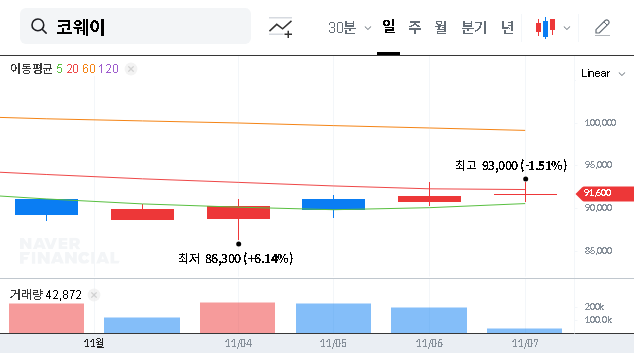
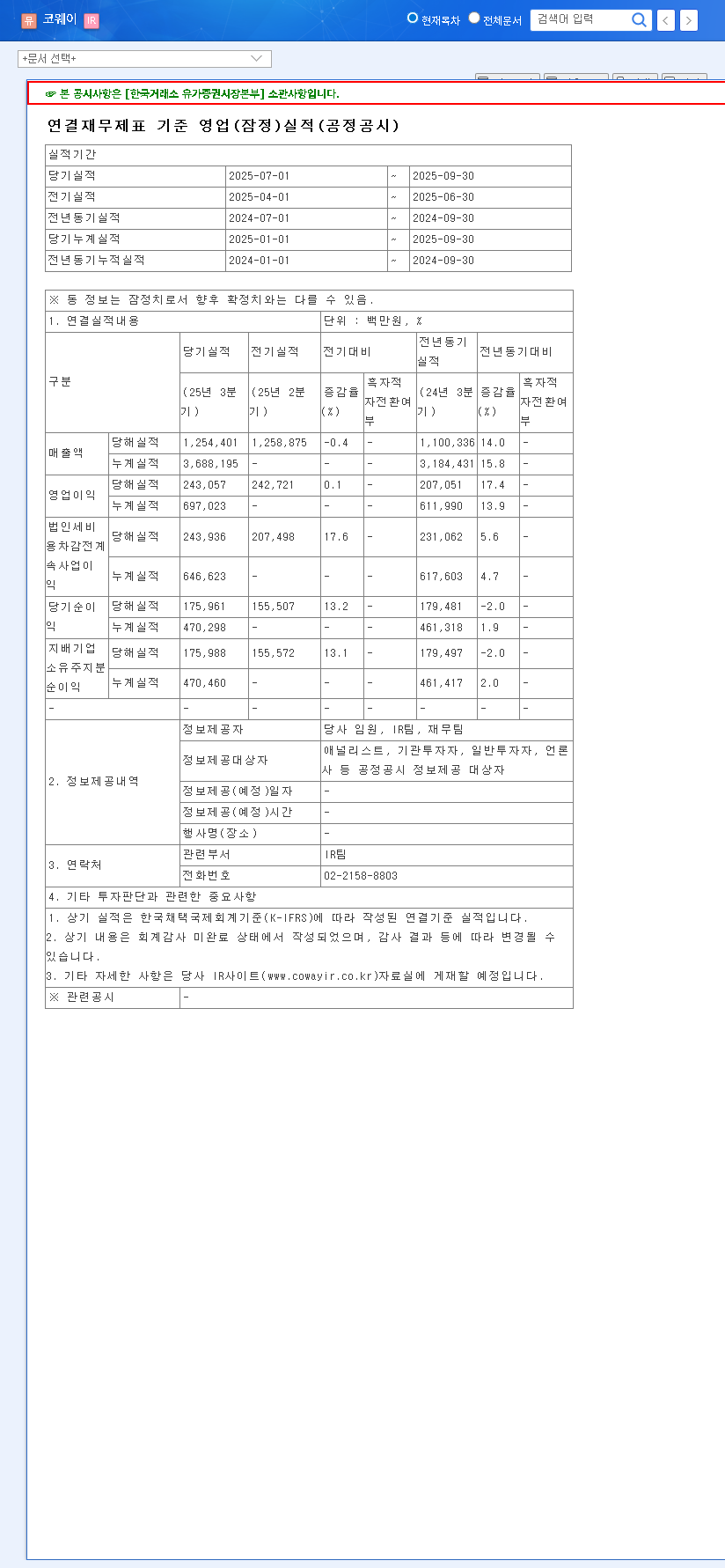
    The upcoming COWAY Q3 2025 earnings announcement and subsequent investor relations (IR) call represent a pivotal moment for shareholders and market watchers. Scheduled for November 11, 2025, at 10 AM KST, this event offers more than just a financial snapshot; it provides a crucial window into the strategic direction of COWAY Co., Ltd., a leader in the environmental home appliance market. Investors are keen to understand the company’s performance amidst a complex global economic landscape. The official details of the event can be found in the Official Disclosure. This analysis will delve into COWAY’s fundamental strengths, pressing risks, and what to expect from the highly anticipated COWAY investor relations conference.

    Robust Fundamentals: The Pillars of COWAY’s Success

    COWAY’s consistent performance is built on a foundation of several key strategic advantages. While the H1 2025 results were strong—showing a 17.0% year-on-year revenue increase to KRW 2.4338 trillion—understanding the underlying drivers is essential for any long-term COWAY stock analysis.

    The Power of a Stable Rental Business Model

    The cornerstone of COWAY’s financial stability is its massive rental and membership base, boasting over 7.36 million accounts. This subscription-like model, which accounts for over 90% of revenue, generates predictable, recurring cash flows. Unlike companies reliant on one-time sales, COWAY’s rental system creates a loyal customer ecosystem and a formidable barrier to entry for competitors, ensuring financial resilience even during economic downturns.

    Strategic Diversification into New Growth Arenas

    To secure future growth, COWAY has successfully expanded beyond its core offerings of water and air purifiers. The strategic push into new rental lineups, such as mattresses and massage chairs, has been well-received. This diversification not only opens up new revenue streams but also reduces the company’s dependence on a single market segment, positioning it to capture a larger share of the consumer’s home wellness budget.

    Expanding Global Footprint

    Consistent growth in key overseas markets, particularly Malaysia and the United States, is a critical component of COWAY’s long-term strategy. This international expansion mitigates risks associated with the highly competitive domestic South Korean market and strengthens overall business stability. Investors will be closely watching for updates on international account growth and profitability during the COWAY Q3 2025 earnings call.

    Navigating Headwinds: Key Risks on the Horizon

    Despite its strengths, COWAY is not immune to challenges. A thorough analysis requires acknowledging the potential risks that could impact future profitability and stock performance.

    For investors, the key is not just to see the impressive growth but to understand how management plans to navigate the increasing macroeconomic and competitive pressures.

    • Macroeconomic Volatility: With a significant portion of its sales overseas, COWAY is exposed to exchange rate fluctuations. The rising KRW against the USD and EUR could negatively impact reported earnings. Furthermore, the global trend of rising interest rates, as tracked by sources like global central banks, will increase the company’s funding costs, especially with a debt-to-equity ratio of 94.3% as of H1 2025.
    • Intensified Competition: The environmental home appliance market is fiercely competitive. Both domestic and international players are vying for market share, necessitating continuous investment in R&D and marketing, which can pressure profit margins.
    • Non-Core Investment Scrutiny: The company’s investment in the MBX virtual asset (token) has been noted as a potential risk. During the COWAY investor relations Q&A, management will likely face tough questions on this topic. A lack of clear, convincing answers could heighten investor anxiety about the company’s capital allocation strategy.

    Investor Action Plan for the IR Event

    To make an informed decision, investors should actively engage with the information presented during the IR event. Focus on the following key areas:

    • Analyze the Presentation: Look beyond the headline numbers. Scrutinize the detailed performance of overseas operations, the growth trajectory of new business lines, and the specific strategies outlined for managing debt and currency risks.
    • Monitor the Q&A Session: The Q&A is often the most revealing part of an IR call. Pay close attention to the questions asked by analysts and the depth and confidence of management’s responses. This is where their grasp of the challenges will be tested.
    • Evaluate Future Guidance: Any forward-looking statements or changes in guidance will be critical. Management’s tone—whether optimistic, cautious, or defensive—can provide valuable clues about the company’s internal outlook for Q4 and beyond.

    In conclusion, while COWAY’s strong market position and business model provide a solid foundation, the upcoming COWAY Q3 2025 earnings call will be a crucial test of management’s ability to navigate a challenging environment. A transparent and forward-thinking presentation could reinforce investor confidence, whereas ambiguity on key risks could lead to market disappointment.

    (021240) COWAY Q3 2025 Earnings & Stock Analysis: A Deep Dive for Investors 관련 이미지
  • (018260) Samsung SDS IR: A Deep Dive into their AI & Cloud Growth Strategy for Investors

    (018260) Samsung SDS IR: A Deep Dive into their AI & Cloud Growth Strategy for Investors

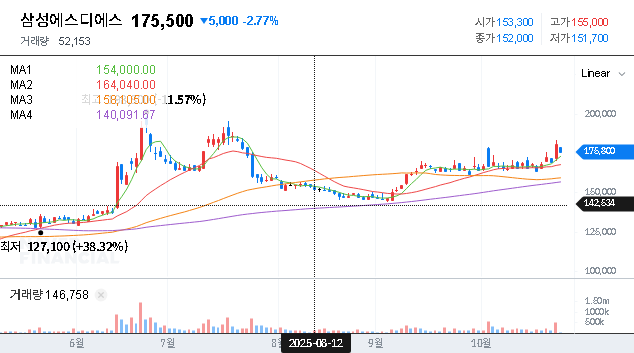
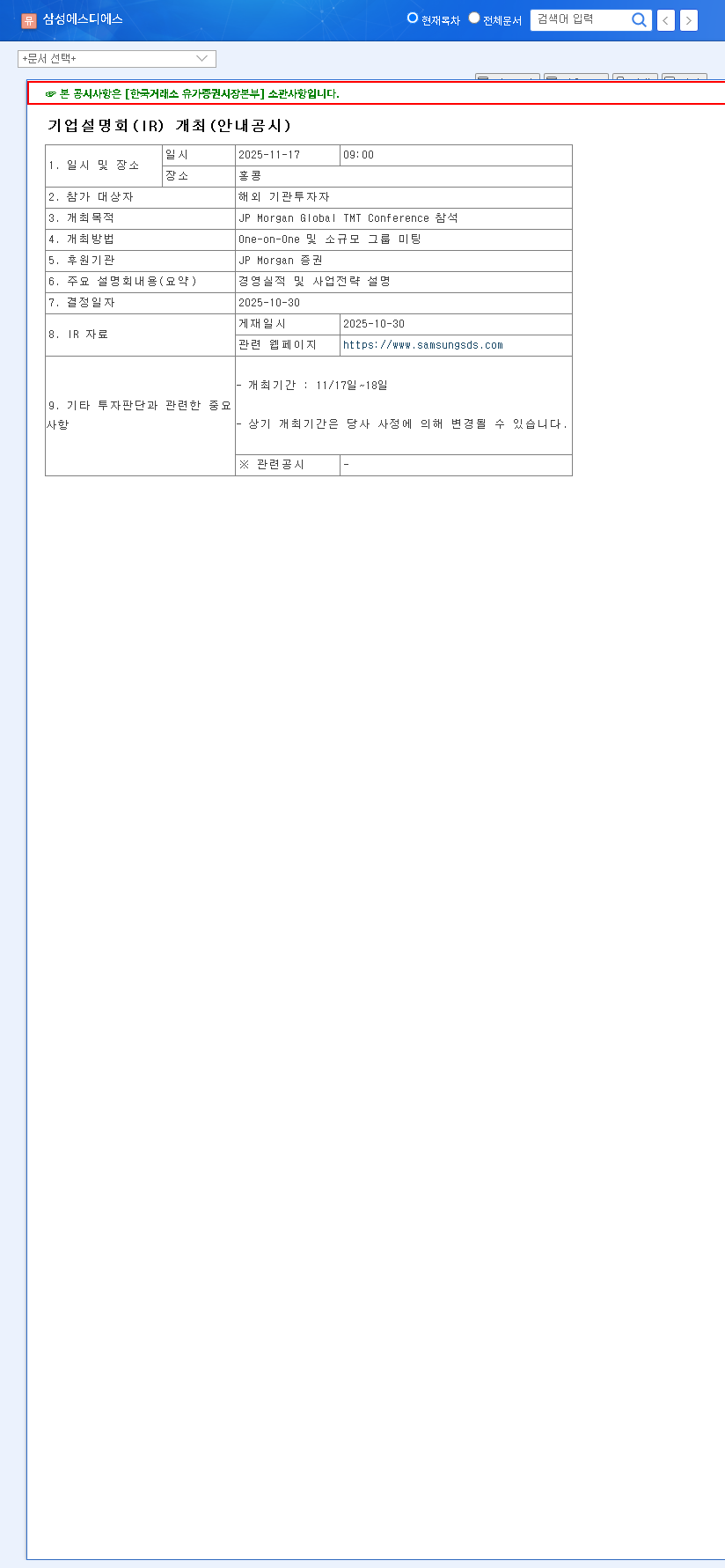
    In the fast-paced world of tech investment, a company’s Investor Relations (IR) session is a critical event, offering a transparent glimpse into its future trajectory. For investors focused on cutting-edge technology, the upcoming SAMSUNG SDS IR is a can’t-miss opportunity. It serves as a vital platform for the company to communicate its growth roadmap, particularly concerning its ambitious SAMSUNG SDS AI strategy and expanding cloud business.

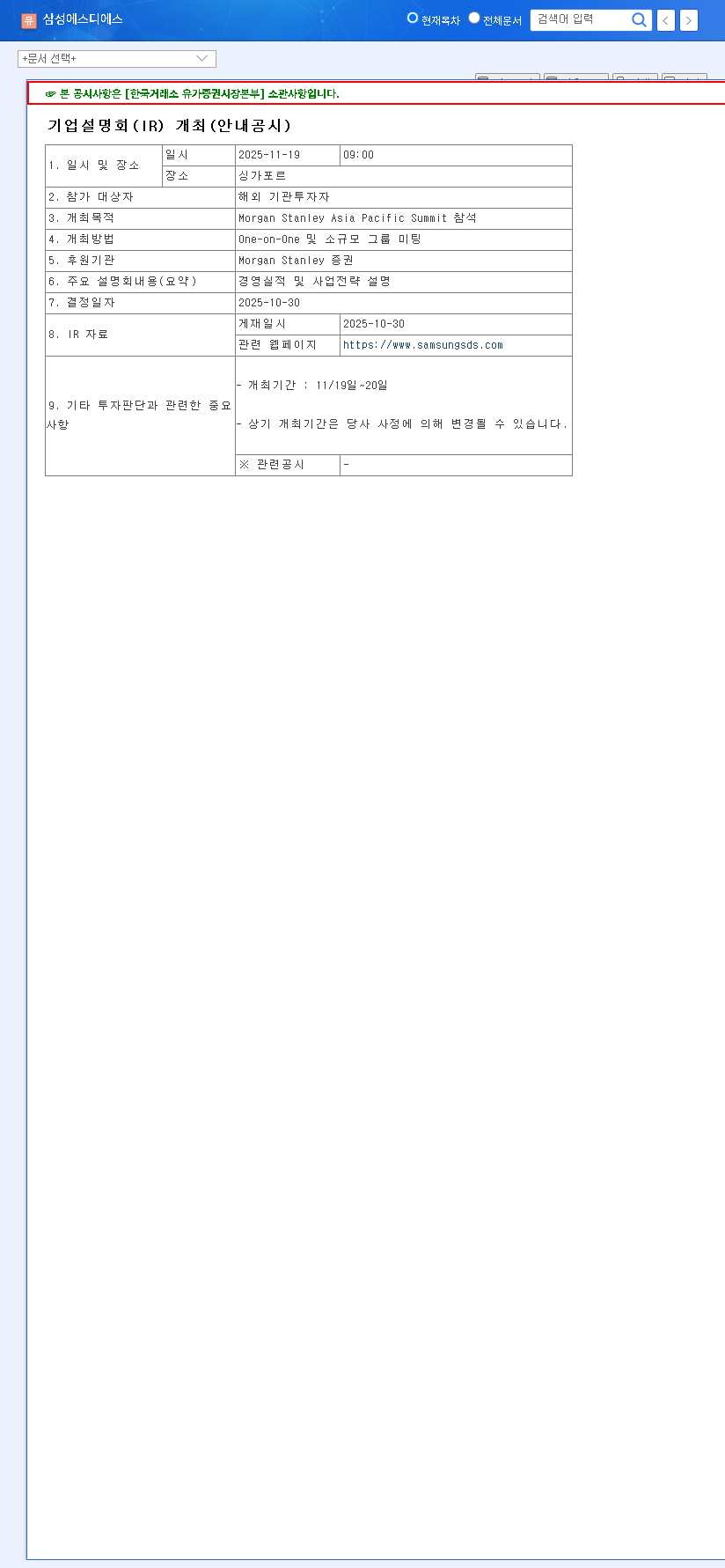
    On November 19, 2025, SAMSUNG SDS CO., LTD. is set to present at the prestigious Morgan Stanley Asia Pacific Summit. With consistent growth propelled by its core engines—Artificial Intelligence (AI) and cloud computing—this event is more than a standard update; it’s a declaration of future intent. This analysis will break down everything investors need to know, from the company’s fundamentals to the strategic implications of the IR and how to position your portfolio accordingly.

    The Main Event: SAMSUNG SDS’s Vision at the Global IR

    The IR session hosted by SAMSUNG SDS is a strategic move to engage with global investors and articulate a compelling vision for long-term growth. This isn’t merely an earnings call; it’s a platform to detail the intricate business strategies that underpin its performance, with a special focus on the high-growth sectors of AI and cloud services. By presenting at a top-tier event like the Morgan Stanley summit, the company aims to solidify its standing in the global market and build robust investor confidence.

    This SAMSUNG SDS IR is a pivotal moment for the company to demonstrate not just its current success, but its strategic foresight in capitalizing on the global demand for enterprise AI and cloud transformation.

    Why Investors Should Pay Attention: A Deep Dive into Fundamentals

    SAMSUNG SDS has consistently demonstrated strong fundamentals, with sustained growth across both its IT Services and Logistics divisions. The real story for Samsung SDS investors, however, lies in the engines driving this expansion: the SAMSUNG SDS cloud business and its generative AI services.

    IT Services: Fueled by AI and Cloud Dominance

    The IT Services division is the company’s powerhouse, with revenue growth directly fueled by the rapid expansion of its cloud services and the strategic deployment of generative AI solutions for enterprises. The company is expertly navigating the expanding global AI market, which according to market research from firms like Gartner, is set for exponential growth. This positions SAMSUNG SDS to capture significant new opportunities.

    • Impressive Growth: Cloud revenue in H1 2025 surged an incredible 21.3% year-over-year, showcasing strong market adoption and service quality.
    • High Profitability: This growth translated to a 17.4% YoY increase in operating profit, largely attributed to the high-margin nature of the cloud business.
    • Positive Outlook: The global demand for digital and cloud transformation remains exceptionally strong, providing a favorable tailwind for future Samsung SDS growth.

    Logistics: Digital Transformation as a Competitive Edge

    While the IT division captures headlines, the Logistics division is undergoing its own powerful transformation. By expanding its digital forwarding services, like its Cello Square™ platform, SAMSUNG SDS is enhancing its global competitiveness. Though facing increased competition, this digital-first approach is key to securing stable revenue and navigating a complex global supply chain environment. Managing profitability remains a key challenge, but its commitment to innovation is a positive indicator. For more details on this strategy, investors can review the company’s Official Disclosure on the DART system.

    Stellar Financial Health

    Underpinning these growth stories is a foundation of sound financial health. SAMSUNG SDS maintains an impressive debt-to-equity ratio of just 33.23%, indicating low leverage and high stability. This financial prudence allows the company to reinvest strategically in its future, with ongoing investments in data center expansion and R&D (1.54% of revenue) to further bolster its AI and Cloud capabilities.

    Looking Ahead: Potential Impacts and Strategic Risks

    This SAMSUNG SDS IR presents a clear opportunity to enhance its global recognition. However, savvy investors must weigh the potential upside against inherent market risks.

    • Positive Signal: A strong presentation on its SAMSUNG SDS AI strategy can significantly boost investor confidence and expand its global shareholder base.
    • Risk of High Expectations: The market has high hopes. The presentation must deliver specific, credible roadmaps to avoid a negative reaction if it’s perceived as falling short.
    • Macroeconomic Headwinds: Global interest rate hikes, commodity price fluctuations, and geopolitical risks could dampen IT investment and logistics demand, impacting future performance.
    • Competitive Pressure: The AI and cloud markets are fiercely competitive. Investors will be looking for clear differentiators and strategies to maintain a competitive edge.

    Action Plan for Investors

    To make an informed decision, investors should approach the SAMSUNG SDS IR with a strategic mindset. Focus on these key areas:

    Key Questions to Ask During the IR:

    • What are the specific, tangible commercialization achievements of their generative AI services? You can learn more about this in our guide to AI enterprise solutions.
    • How does their technology roadmap for the SAMSUNG SDS cloud business differentiate them from major hyperscalers?
    • What are the concrete steps being taken to improve profitability in the competitive logistics sector?
    • How is the company proactively managing risks related to currency fluctuations and macroeconomic uncertainty?

    Ultimately, it’s crucial to adopt a mid-to-long-term perspective. Short-term stock fluctuations are inevitable, but the real value lies in how effectively the vision presented at this IR aligns with the company’s potential for sustained, long-term growth. The clarity of the presentation will be the ultimate determinant of its success. This event is a prime opportunity to gauge the strength of Samsung SDS growth for the years to come.

    (018260) Samsung SDS IR: A Deep Dive into their AI & Cloud Growth Strategy for Investors 관련 이미지
  • (018260) SAMSUNG SDS IR Analysis 2025: A Deep Dive into Cloud & AI Growth Strategy

    (018260) SAMSUNG SDS IR Analysis 2025: A Deep Dive into Cloud & AI Growth Strategy

    The upcoming SAMSUNG SDS IR (Investor Relations) conference, scheduled for November 3, 2025, is poised to be a pivotal event for investors and market analysts. More than a standard financial review, this conference will unveil the company’s strategic vision, with a significant focus on its aggressive expansion into cloud computing and generative AI. This in-depth analysis unpacks the fundamentals, evaluates the growth drivers, and provides a clear roadmap for what to expect, helping you make informed investment decisions.

    As a key player in the digital transformation landscape, SAMSUNG SDS aims to leverage this platform to showcase its future roadmap. Can the company’s strategy in cloud and AI services truly accelerate its growth trajectory and exceed market expectations? Let’s explore the data and potential outcomes.

    Event Overview: The H2 2025 SAMSUNG SDS IR Conference

    SAMSUNG SDS CO., LTD. has confirmed its Investor Relations conference for domestic institutional investors will take place on November 3, 2025, at 9:00 AM. The primary agenda includes the presentation of financial results for the first half of 2025 and, more critically, a detailed outline of future business strategies. The key talking points are expected to revolve around the company’s two primary engines for SAMSUNG SDS growth: the enhancement of its cloud and AI capabilities and the expansion of its global digital logistics business.

    This isn’t just a report on past performance; it’s a forward-looking statement on how SAMSUNG SDS plans to dominate the next wave of enterprise technology. Investors will be scrutinizing the tangible plans for monetizing AI and improving profitability across all segments.

    Fundamental Analysis: A Strong Financial Foundation

    Robust Performance in H1 2025

    SAMSUNG SDS has demonstrated consistent and solid growth, reporting a total revenue of KRW 7.017 trillion in the first half of 2025, a notable 5.8% increase year-over-year. This growth is not monolithic but diversified across its core divisions.

    • IT Service Division: This division saw revenues climb by 3.3%. The standout performer was SAMSUNG SDS Cloud services, which surged by an impressive 21.4%. This highlights the success of their strategic pivot towards generative AI solutions and next-gen tech services.
    • Logistics Division: Benefitting from an expanding global market and the digitization of forwarding services, this division grew by 7.1%. However, its lower operating profit margin remains a key challenge that investors will want to see addressed at the SAMSUNG SDS IR event.
    • Financial Stability: The company’s balance sheet is exceptionally strong, with a low debt-to-equity ratio of 33.23%, providing a stable platform for future investment and growth.

    Strategic Focus on AI and Cloud Services

    The market environment is highly favorable, with the global IT service sector projected to grow significantly. SAMSUNG SDS is perfectly positioned to capture this growth, thanks to its deep investment in high-demand technologies. The company’s strategy is centered on accelerating its transformation into a cloud-native organization and strengthening its generative SAMSUNG SDS AI business. Key initiatives include:

    • FabriX: A platform designed to streamline the integration of generative AI into enterprise systems, enabling businesses to build and deploy custom AI applications securely.
    • Brity Copilot: An AI-powered assistant that enhances productivity by automating tasks and providing intelligent insights directly within existing workflows.
    • GPUaaS (GPU as a Service): Providing on-demand access to high-performance computing resources, which are essential for training and running complex AI models. This is a critical service in the current AI landscape, according to market analysis from sources like Gartner.

    Market Expectations and Investment Thesis

    The consensus among market analysts is positive, with many maintaining a ‘BUY’ rating for SAMSUNG SDS stock. This optimism is fueled by the robust growth in its core IT businesses and the vast market potential of its new generative AI services. The stable financial backing of the Samsung Group further solidifies its position. However, a comprehensive Samsung SDS stock analysis must also consider potential risks.

    The company’s success will depend on its ability to improve profitability in the logistics division and navigate global economic uncertainties. If the SAMSUNG SDS IR presentation fails to deliver a convincing strategy or falls short of lofty market expectations, it could temper investor enthusiasm. The full details of the company’s filing can be reviewed in the Official Disclosure (Source: DART).

    Action Plan: Key Watch Points for Investors

    For investors tuning into the event, the focus should be on specifics. Vague promises won’t suffice; the market will be looking for concrete data and clear roadmaps. To better understand the technology at play, you might want to read our guide on how generative AI is transforming business.

    Here are the critical points to watch for during the presentation:

    • AI & Cloud Revenue Models: Look for specific performance indicators (KPIs) and clear monetization strategies for FabriX, Brity Copilot, and other AI services.
    • Logistics Profitability Plan: Demand a convincing and detailed plan for improving the operating margins in the logistics division.
    • Medium-to-Long-Term Forecasts: Pay attention to any new business plans or updated financial forecasts that can shed light on the company’s long-term growth ambitions.

    In conclusion, this SAMSUNG SDS IR event is a crucial opportunity for the company to reinforce investor confidence. By effectively communicating its strategic direction in AI and cloud, and by addressing concerns about profitability, SAMSUNG SDS can set a positive tone for its stock performance and solidify its position as a leader in the digital era.

    (018260) SAMSUNG SDS IR Analysis 2025: A Deep Dive into Cloud & AI Growth Strategy 관련 이미지
  • (031440) Shinsegae Food PEF Investment: A Deep Dive into the ₩50B ‘Beauty Synergy’ Strategy

    (031440) Shinsegae Food PEF Investment: A Deep Dive into the ₩50B ‘Beauty Synergy’ Strategy

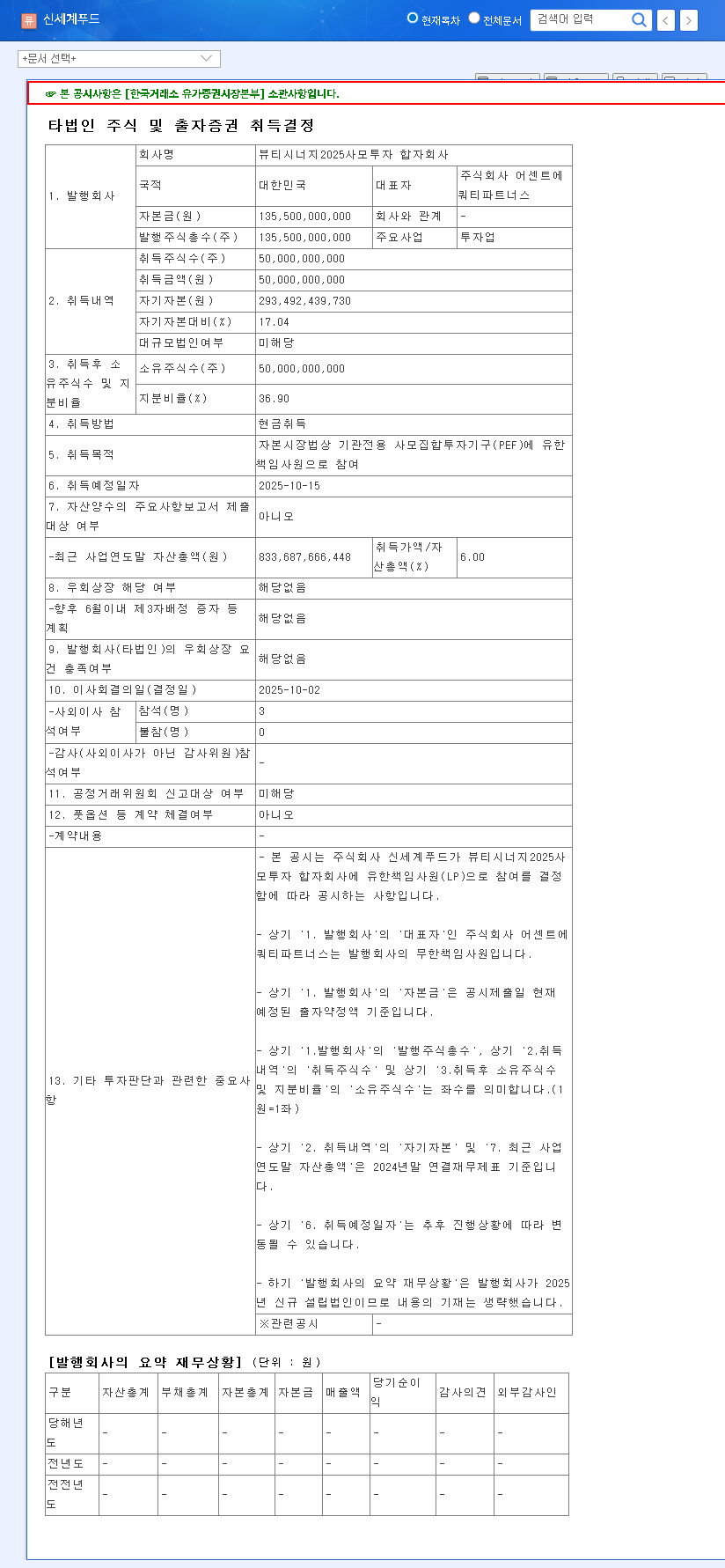
    Shinsegae Food (031440) has made a decisive move that has the market buzzing: a landmark Shinsegae Food PEF investment of ₩50 billion. This significant capital injection into the ‘Beauty Synergy 2025 Private Equity Partnership’ represents over 17% of the company’s equity, sparking a critical debate among investors. Is this a calculated masterstroke to unlock new avenues for growth, or a high-stakes gamble with uncertain returns? This deep-dive analysis unpacks the strategic rationale, financial implications, and potential risks associated with this pivotal investment, providing you with the insights needed to evaluate Shinsegae Food’s future trajectory.

    The ₩50 Billion Deal: What We Know

    Investment Details and Structure

    On October 2, 2025, Shinsegae Food formally announced its commitment to invest ₩50 billion into the ‘Beauty Synergy 2025 Private Equity Partnership.’ This transaction positions Shinsegae Food as a key Limited Partner (LP) with a substantial 36.90% stake in the fund. The official disclosure, filed with the regulatory authorities (Source), confirms this is a structured investment in an institutional private equity fund under the Capital Markets Act. As an LP, Shinsegae Food provides capital but entrusts the active investment management to the fund’s General Partner (GP), indicating a strategy focused on financial returns and strategic exposure rather than direct operational control.

    This investment is not just a financial transaction; it’s a strategic signal. Shinsegae Food is looking beyond its traditional food business, aiming to capture value in adjacent, high-growth industries through this PEF investment vehicle.

    Decoding the Strategic Rationale

    Pursuing New Growth Engines in a Stagnant Market

    The core motivation behind the Shinsegae Food PEF investment is the pressing need to secure new growth engines and diversify its business portfolio. The company’s H1 2025 financial report paints a picture of a mature business, with flat revenue in its core Sourcing & Distribution segment and declining sales in Manufacturing & Service. While the freight brokerage business shows promise, it’s not enough to drive significant corporate growth. This investment is a clear attempt to break out of this slow-growth cycle by tapping into the dynamic world of private equity, which offers access to innovative, unlisted companies and M&A opportunities that would otherwise be out of reach.

    What’s in a Name? The ‘Beauty Synergy’ Clue

    The fund’s name, ‘Beauty Synergy 2025,’ is highly suggestive. It strongly implies that the investment targets will be within the beauty, wellness, or health sectors. This opens up exciting possibilities for synergy with Shinsegae Food’s core competencies. The global trend towards “nutricosmetics” or “beauty foods”—products that offer beauty benefits from within—is a multi-billion dollar market. Shinsegae could leverage the PEF’s investments to:

    • Develop new health-functional food products.
    • Gain insights into consumer trends in the wellness space.
    • Potentially acquire innovative beauty or wellness brands discovered by the fund.

    Financial Impact and Risk Assessment

    A Significant Cash Outlay

    The ₩50 billion investment is a major financial commitment. It represents nearly all of the company’s H1 2025 cash and cash equivalents of ₩49.2 billion. This will undoubtedly place short-term pressure on the company’s liquidity. However, the balance sheet has shown recent strength, with a debt-to-equity ratio that improved to 145.10%. This suggests that while the cash position will be tight, the company is not over-leveraging itself to make the deal, mitigating the risk of a severe financial crisis. For more on how companies manage such investments, you can review guides on corporate capital allocation strategies.

    The High-Risk, High-Reward Nature of PEF Investments

    Private equity offers the potential for outsized returns but comes with significant risks. As a Limited Partner, Shinsegae Food’s success is tied to the expertise of the fund manager and the performance of the underlying portfolio companies. Key risks include:

    • Performance Uncertainty: There is no guarantee of returns, and the initial capital could be lost.
    • Illiquidity: PEF investments are typically locked up for several years, meaning the ₩50 billion is not accessible.
    • Information Asymmetry: Shinsegae Food may have limited visibility into the day-to-day operations of the portfolio companies.

    Furthermore, macroeconomic factors like interest rate changes and raw material costs, as tracked by sources like Bloomberg Markets, will influence the profitability of the companies the fund invests in, adding another layer of external risk.

    Investor Action Plan: Key Monitoring Points

    For current and potential investors, this Shinsegae Food growth strategy requires careful observation. While it presents a compelling long-term vision, its success is not guaranteed. Focus on the following key areas:

    • PEF Portfolio Disclosure: Watch for any announcements regarding the specific companies ‘Beauty Synergy 2025’ invests in. This will be the first concrete evidence of the fund’s direction.
    • Quarterly Financial Impact: Monitor Shinsegae Food’s financial statements for any reported gains or losses from the investment. This will indicate the fund’s performance.
    • Synergy Execution: Look for new product launches, partnerships, or business initiatives from Shinsegae Food that are explicitly linked to the PEF’s activities. This will be the true test of the ‘synergy’ aspect.

    Frequently Asked Questions (FAQ)

    Q1: What is the primary goal of Shinsegae Food’s PEF investment?

    The main objective is to secure new growth engines and expand its business portfolio. It is a strategic effort to find high-return opportunities outside its traditional food business to enhance long-term corporate value.

    Q2: How does this ₩50 billion investment impact Shinsegae Food’s finances?

    The large investment will cause a short-term cash outflow and pressure liquidity. However, the company’s recently improved debt-to-equity ratio suggests that a severe deterioration of its financial structure is unlikely.

    Q3: What kind of companies will ‘Beauty Synergy 2025’ invest in?

    While the specific portfolio is not yet public, the name strongly suggests a focus on the beauty industry and related wellness sectors. Shinsegae Food is participating as a Limited Partner, not a direct operator.

    Q4: What should investors watch most closely regarding this deal?

    Investors should monitor the specific investment targets of the PEF, its impact on Shinsegae Food’s financial statements, and any tangible business synergies that emerge between the fund’s portfolio and Shinsegae’s core operations.

    (031440) Shinsegae Food PEF Investment: A Deep Dive into the ₩50B 'Beauty Synergy' Strategy 관련 이미지
  • Samsung Securities IR on August 11th: Key Insights & Stock Forecast for Investors

    1. Key IR Highlights: Q1 Earnings and Future Strategies

    Samsung Securities will announce its Q1 2025 earnings and key business strategies on August 11th at 9:00 AM KST via a domestic NDR. This is a significant opportunity to assess the company’s performance amidst the downturn in the domestic stock market and understand its future growth drivers.

    2. Positive Scenarios: Growth Momentum

    • Overseas Business Expansion and Corporate Finance Performance: Growth in overseas stock custody fees and increased operating profit from products due to interest rate cuts are positive factors for stock price appreciation.
    • Targeting the Ultra-High-Net-Worth and Retirement Markets: Presenting a concrete roadmap for these new market strategies can raise expectations for long-term growth potential.
    • Risk Management Strategies: Clearly outlining measures to address macroeconomic risks such as global recession and interest rate hikes can build investor confidence.
    • Shareholder Return Policy Enhancement: Dividend policies and plans to enhance shareholder value can stimulate investment sentiment.

    3. Negative Scenarios: Increased Uncertainty

    • Falling Short of Market Expectations: If the earnings outlook or business strategies fail to meet market expectations, it could lead to a stock price decline.
    • Amplified Risk Factors: Concerns about US interest rate hikes and a potential global recession could negatively impact market sentiment. The company’s strategy for dealing with KRW/USD exchange rate volatility will be particularly important.
    • Unexpected Negative News: Unforeseeable negative news could significantly impact the stock price.

    4. Investor Action Plan: Analyze the IR Information Thoroughly

    Investors should carefully review the information presented at the IR and consider additional information like market expectations, competitor performance, and subsidiary performance before making investment decisions. Pay close attention to Samsung Securities’ strategy for navigating KRW/USD exchange rate fluctuations.

    Q: When is the Samsung Securities IR scheduled?

    A: It is scheduled for August 11, 2025, at 9:00 AM KST.

    Q: What are the key topics of the IR?

    A: The main topics are the Q1 2025 earnings results and key business strategies.

    Q: What should investors pay attention to in the IR?

    A: Investors should focus on the Q1 earnings analysis, future business strategies, risk management plans, and the company’s strategy for dealing with KRW/USD exchange rate volatility.

  • Doosan Robotics Acquires ONExia: Reshaping the Robotics Landscape?

    1. What Happened?

    On July 28, 2025, Doosan Robotics acquired an 89.59% stake in US-based robotics solutions provider ONExia for 35.6 billion KRW.

    2. Why the Acquisition?

    Doosan Robotics aims to enhance its competitiveness in the collaborative robot market and accelerate its entry into the service robot market by acquiring ONExia’s core technologies. This move signifies a strategic expansion beyond manufacturing automation into diverse service sectors.

    3. What are the Implications?

    • Financial Impact: Short-term financial burdens due to acquisition costs are expected, but long-term profitability improvements are anticipated through synergies with ONExia.
    • Business Impact: An expanded technology portfolio, enhanced market competitiveness, diversified business for stable growth, and increased North American market penetration are projected. However, external factors like the global economic slowdown and rising raw material prices must be considered.

    4. What Should Investors Do?

    This acquisition can be interpreted as a positive signal, enhancing Doosan Robotics’ long-term growth potential. However, risks such as post-acquisition integration challenges, increased market competition, and macroeconomic uncertainties exist. Investors should consider these factors comprehensively before making investment decisions.

    Frequently Asked Questions

    How will the ONExia acquisition affect Doosan Robotics’ stock price?

    Short-term stock price volatility is possible, but a positive long-term impact is expected. ONExia’s technology and market competitiveness are projected to contribute to Doosan Robotics’ growth. However, stock prices can fluctuate based on market conditions and company performance, so prudent investment decisions are crucial.

    What kind of robots does Doosan Robotics manufacture?

    Doosan Robotics primarily manufactures collaborative robots and plans to accelerate its entry into the service robot market through the acquisition of ONExia.

    Who are Doosan Robotics’ competitors?

    Key competitors include Universal Robots, Fanuc, and ABB.