In a significant move for investors, JB Financial Group has released its H1 2025 earnings report, showcasing stable profitability, and simultaneously announced a substantial KRW 40 billion share buyback program. These developments raise critical questions: What do they signal about the company’s confidence? And how should investors position themselves in light of this news? This comprehensive analysis will break down the financial performance, explore the strategic implications of the share buyback, and provide a clear outlook on what’s next for JB Financial Group’s stock.
This report moves beyond the headlines, offering actionable insights by dissecting the fundamental drivers and potential risks facing JB Financial Group. We aim to equip you with the knowledge needed to make informed investment decisions.
Unpacking the H1 2025 Financial Performance
JB Financial Group reported a consolidated net profit of KRW 370.4 billion for the first half of 2025. While this represents a marginal 0.1% year-over-year increase, the stability in a challenging macroeconomic environment is noteworthy. The overall performance was a mixed bag across its key subsidiaries, reflecting different market exposures and operational focuses.
Subsidiary Performance Breakdown
- •Jeonbuk Bank: Posted a healthy net profit of KRW 116.6 billion, up 3.4%, demonstrating resilient growth.
- •Gwangju Bank: Saw a 7.9% decrease in net profit to KRW 148.4 billion, largely attributed to headwinds from a slowing real estate market and increased household loan risks.
- •JB Woori Capital: Continued its strong trajectory with a 6.6% profit increase to KRW 131.7 billion.
- •PPCBank (Cambodia): Contributed KRW 25.0 billion, highlighting the value of its international diversification.
The Group’s fundamentals remain robust, with an industry-leading Return on Equity (ROE) of 13.1% and a low Cost-to-Income Ratio (CIR) of 35.8%. The Common Equity Tier 1 (CET1) Ratio stands at a stable 12.40%, indicating solid capital adequacy. For a detailed breakdown, you can view the Official Disclosure on the DART system.
The KRW 40 Billion Share Buyback: A Signal of Confidence
Perhaps the most significant news for investors is the decision to execute a KRW 40 billion JB Financial Group share buyback. This move, representing nearly 1% of the company’s market capitalization, is a powerful tool for enhancing shareholder value. A share buyback reduces the number of shares outstanding, which can increase key metrics like Earnings Per Share (EPS) and often leads to a higher stock price due to improved supply-demand dynamics.
This action is widely interpreted as a signal from management that they believe the company’s stock is undervalued. By investing its own capital to repurchase shares, the board demonstrates strong confidence in the firm’s future prospects and financial stability. The buyback is scheduled to run from October 29, 2025, to February 3, 2026.
Future Outlook: Opportunities and Risks
While the buyback and stable earnings paint a positive picture, a balanced investment thesis requires examining both the potential upsides and the challenges ahead. Investors should stay informed by following broader market analysis from sources like Reuters Financial News.
Key Investment Opportunities
- •Enhanced Shareholder Returns: The aggressive share buyback signals a commitment to returning capital to shareholders, which is highly attractive to investors.
- •Strong Profitability Metrics: High ROE and ROA relative to peers indicate efficient and profitable operations.
- •Digital Transformation: Ongoing investments in MyData services and fintech partnerships (e.g., Toss Bank) position the group for future growth in the digital banking landscape.
Potential Headwinds to Monitor
- •Subsidiary Performance: The slowdown at Gwangju Bank needs to be watched closely, as prolonged weakness could drag down group results.
- •Asset Quality: The rising Non-Performing Loan (NPL) ratio at JB Woori Capital (2.71%) requires careful risk management to prevent further deterioration.
- •Macroeconomic Pressures: High inflation, interest rate volatility, and currency fluctuations pose risks to the entire banking sector’s profitability and credit quality.
Conclusion: An Investor’s Action Plan
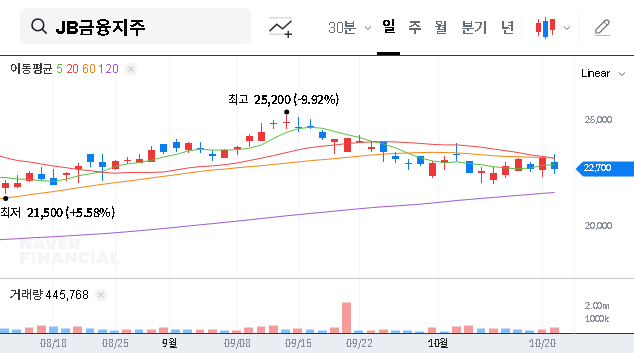
The overall investment outlook for JB Financial Group appears positive, anchored by solid fundamentals and a strong commitment to shareholder value via the share buyback. The short-term impact of the buyback is likely to be supportive of the stock price.
For the mid-to-long term, success will depend on the company’s ability to navigate the identified risks. Investors should monitor the performance recovery at Gwangju Bank, asset quality trends at JB Woori Capital, and the progress of its digital initiatives. For those looking to learn more about this sector, our guide on How to Analyze Bank Stocks provides valuable context. Ultimately, while JB Financial Group presents a compelling case, diligent monitoring of these key variables is essential for any investment strategy.
Disclaimer: This analysis is for informational purposes only and does not constitute financial advice. All investment decisions should be made based on your own research and discretion.