Tag: ASF

  • KT&G Acquires Swedish Nicotine Pouch Company: Investment Strategy Analysis


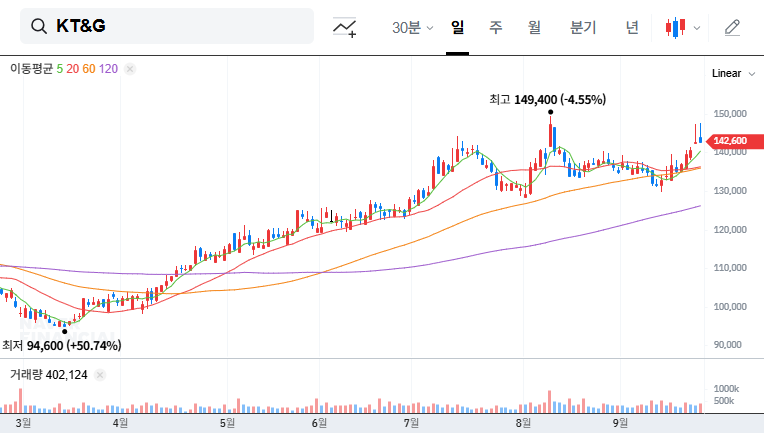
    KT&G Acquires Swedish Nicotine Pouch Company: Investment Strategy Analysis 대표 차트 이미지


    Why Did KT&G Acquire a Nicotine Pouch Company?

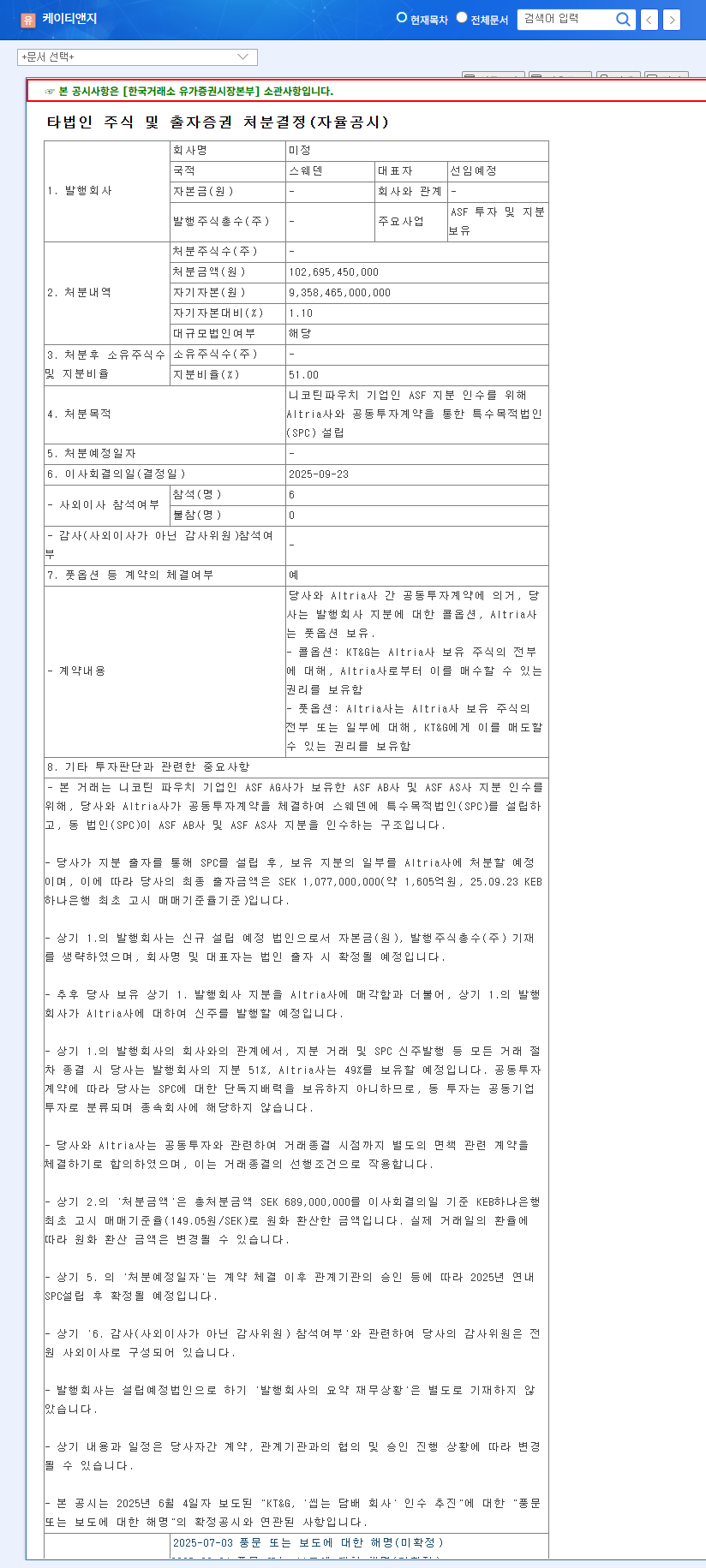
    KT&G, in partnership with Altria, is acquiring the Swedish nicotine pouch company ASF. By investing approximately KRW 160.5 billion, KT&G aims to enter the high-growth nicotine pouch market and secure new growth engines beyond the existing cigarette and heated tobacco (HNB) markets.

    Analyzing the Positive and Negative Impacts of the Acquisition

    • Positive Aspects:
      • Diversification of business portfolio and securing new growth engines
      • Synergy creation through collaboration with Altria
      • Potential for long-term increase in corporate value
    • Negative Aspects:
      • Financial burden due to acquisition costs
      • Possibility of short-term decline in ROE/EPS
      • Risk of intensified competition in emerging markets and exchange rate fluctuations

    Key Strategies for Investors

    • Review of post-acquisition integration (PMI) strategy
    • Continuous monitoring of nicotine pouch market trends
    • Confirmation of KT&G’s information disclosure and communication with shareholders
    • Risk management according to changes in macroeconomic indicators


    FAQ

    What is the purpose of KT&G’s acquisition of ASF?

    To diversify its business portfolio and secure new growth engines by entering the high-growth nicotine pouch market.

    What is the impact of this acquisition on KT&G’s stock price?

    It is expected to be positive in the long term, but stock price volatility may increase in the short term due to financial burdens, etc.

    What should investors pay attention to?

    It is important to closely monitor post-acquisition integration strategies, market competition, and macroeconomic changes before making investment decisions.
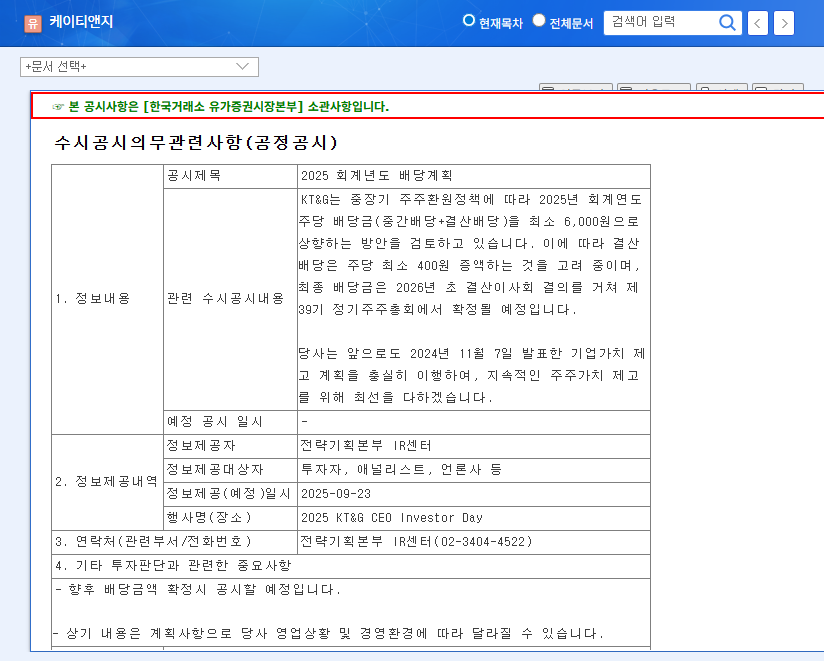
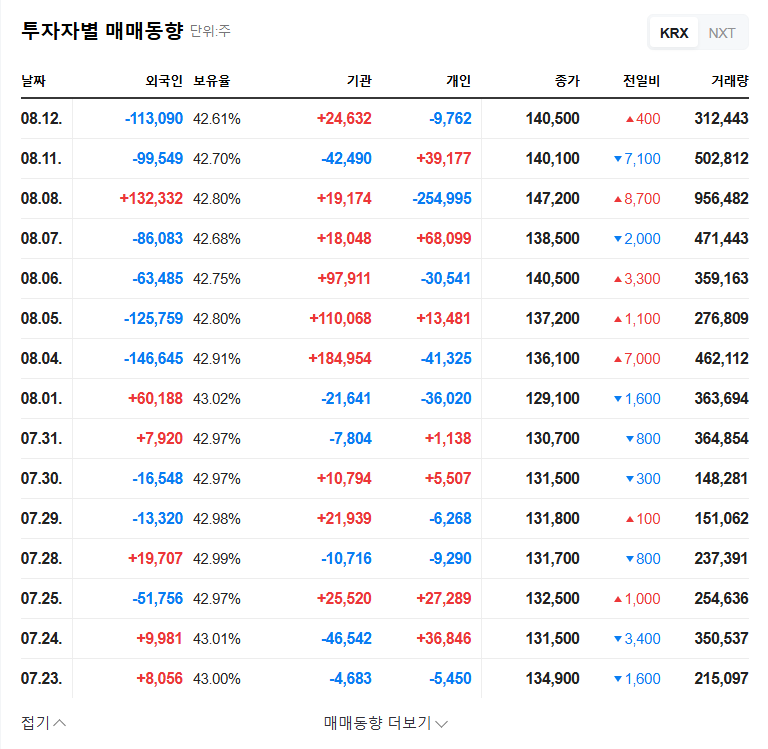
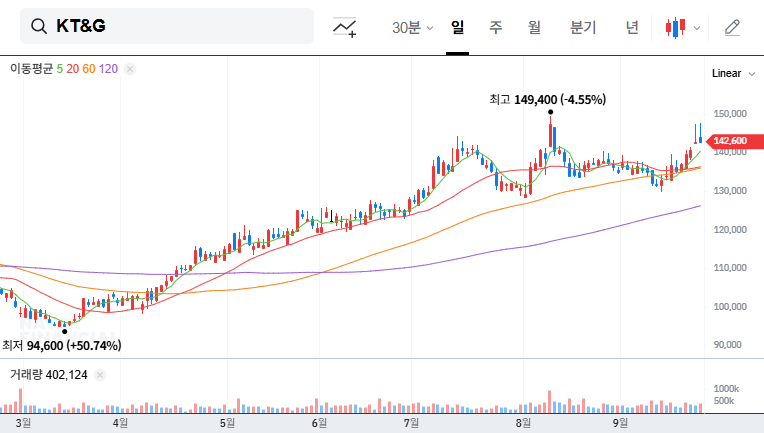


    KT&G Acquires Swedish Nicotine Pouch Company: Investment Strategy Analysis 관련 이미지
    KT&G Acquires Swedish Nicotine Pouch Company: Investment Strategy Analysis 관련 이미지


  • KT&G Acquires Swedish Nicotine Pouch Company ASF: Investment Strategy Analysis

    KT&G Acquires Swedish Nicotine Pouch Company ASF: Investment Strategy Analysis 대표 차트 이미지

    1. What Happened?: KT&G Acquires 51% Stake in ASF

    On September 23, 2025, KT&G signed a contract to acquire a 51% stake in the Swedish nicotine pouch company ASF for 102.7 billion KRW. This investment represents 1.10% of KT&G’s capital.

    2. Why is it Important?: Securing New Growth Engine and Market Diversification

    The acquisition of ASF is a significant step towards diversifying KT&G’s business portfolio, which is currently concentrated on cigarettes and HNB (Heat-not-Burn), and entering the rapidly growing nicotine pouch market. This is expected to contribute to creating new revenue streams and securing future growth amid strengthening regulations.

    3. What’s Next?: Analyzing Opportunities and Risks

    Positive Impacts

    • New Growth Engine: Entering the rapidly growing nicotine pouch market secures a new growth engine.
    • Strengthened Global Competitiveness: Building upon the HNB partnership experience with PMI, KT&G can potentially expand into the global nicotine pouch market.
    • Business Diversification: Reduces dependence on the existing tobacco business and establishes a stable revenue structure through portfolio diversification.

    Negative Impacts and Considerations

    • Increased Financial Burden: Possibility of increased financial burden due to the 102.7 billion KRW investment. Careful monitoring is required considering the increasing debt ratio trend.
    • New Business Risks: Preparation is needed for uncertainties in the nicotine pouch market (regulatory changes, intensified competition, etc.).
    • Synergy Creation: The key is how much synergy can be created with existing businesses.

    4. What Should Investors Do?: Investment Strategy Recommendations

    • Maintain a Long-Term Perspective: Focus on long-term growth potential rather than short-term volatility.
    • Monitor Financial Health: Continuously check financial indicators such as changes in the debt ratio.
    • Track New Business Performance: Consistently analyze whether market competitiveness is secured and synergy is created after the ASF acquisition.
    • Consider Macroeconomic Variables: Understand the impact of macroeconomic variables such as exchange rates and interest rates and reflect them in investment strategies.
    What is the purpose of KT&G’s acquisition of ASF?

    KT&G aims to enter the rapidly growing nicotine pouch market through the acquisition of ASF and pursue business diversification by reducing its dependence on the existing tobacco business.

    Will this acquisition have a positive impact on KT&G’s stock price?

    It can be positive in terms of securing long-term growth momentum, but increased financial burden and new business risks should also be considered. Stock price volatility may occur depending on market conditions and the company’s strategic execution.

    What precautions should be taken when investing?

    Before making an investment decision, carefully analyze KT&G’s financial soundness changes, whether market competitiveness is secured after the ASF acquisition, and the impact of macroeconomic variables.

    KT&G Acquires Swedish Nicotine Pouch Company ASF: Investment Strategy Analysis 관련 이미지
    KT&G Acquires Swedish Nicotine Pouch Company ASF: Investment Strategy Analysis 관련 이미지
  • JoongAng Vaccine Q2 Earnings Shock: Slowing Pet Vaccine Growth, ASF & AI Woes Continue

    1. JoongAng Vaccine Q2 Earnings: Key Figures

    JoongAng Vaccine reported preliminary Q2 2025 earnings of KRW 12 billion in sales, KRW 1.5 billion in operating profit, and KRW 0.7 billion in net profit, all marking decreases from Q1. Considering the strong performance in the first quarter, this decline is particularly concerning.

    2. Analyzing the Downturn: Multiple Headwinds

    • Slowing Pet Vaccine Growth: A key factor in the decline appears to be the slowing growth of the pet vaccine segment, which drove growth in Q1. Seasonal factors and increased competition are likely contributors.
    • Drop in One-Off Service Revenue: The substantial service revenue recognized in Q1 was absent in Q2, negatively impacting the results.
    • Rising Raw Material Prices and Exchange Rates: JoongAng Vaccine, heavily reliant on imported raw materials, faced increased cost pressures due to the rising KRW/USD and KRW/EUR exchange rates, as well as rising oil prices.
    • Ongoing ASF and AI Outbreaks: The continued outbreaks of African Swine Fever (ASF) and Avian Influenza (AI) created uncertainty in the livestock industry, impacting JoongAng Vaccine’s sales in the swine and poultry segments.

    3. Investment Strategy and Implications: Proceed with Caution

    The disappointing Q2 results are expected to put downward pressure on JoongAng Vaccine’s stock price. Investors should proceed with caution in the short term and closely monitor future earnings releases and announcements for insights into the company’s response strategy. Key areas to watch include the sustainability of pet vaccine growth and the company’s strategy for managing raw material price and exchange rate fluctuations.

    4. Long-Term Perspective: Focus on Growth Strategy and Risk Management

    From a long-term perspective, investors should focus on JoongAng Vaccine’s growth strategy and risk management capabilities. The company’s ability to navigate external factors like ASF and AI, along with its success in securing future growth drivers, will be crucial in assessing its long-term investment value.

    Q: What are the main reasons for JoongAng Vaccine’s poor Q2 performance?

    A: A combination of factors contributed, including slowing pet vaccine growth, a decline in one-off service revenue, rising raw material prices and exchange rates, and the ongoing impact of ASF and AI.

    Q: What should investors consider when evaluating JoongAng Vaccine?

    A: In the short term, caution is advised. Investors should closely review future earnings releases and announcements to assess the company’s response strategy. Long-term considerations include the sustainability of pet vaccine growth, the company’s approach to managing raw material price and exchange rate volatility, its overall growth strategy, and its risk management capabilities.