Tag: Antibody-drug conjugate

  • (298380) ABL Bio’s ADC Power Play: Analyzing the NEOK Bio Acquisition & Pipeline Impact

    (298380) ABL Bio’s ADC Power Play: Analyzing the NEOK Bio Acquisition & Pipeline Impact

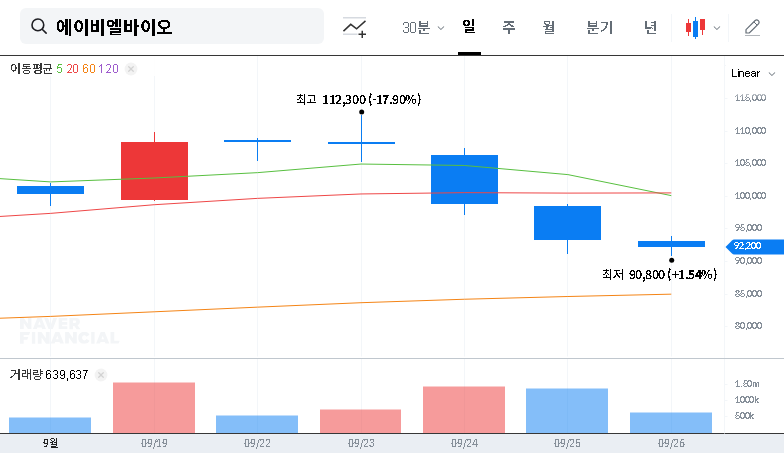
    The ABL Bio ADC strategy has taken a bold leap forward, signaling a pivotal moment for the company and the broader oncology landscape. In a decisive move to fortify its position in the highly competitive biotech arena, ABL Bio Inc. (298380) has announced a major equity investment in NEOK Bio, Inc., a firm specializing in the clinical development of Antibody-Drug Conjugates (ADCs). This is more than a simple financial transaction; it’s a calculated maneuver to build a robust pipeline and secure a dominant role in the future of targeted cancer therapy. This deep-dive analysis will unpack the specifics of the investment, its strategic implications, and what it means for the future of ABL Bio’s stock and corporate value.

    Understanding Antibody-Drug Conjugates (ADCs): The ‘Magic Bullet’ of Oncology

    Before delving into the specifics of the deal, it’s crucial to understand why ADCs are generating so much excitement. Often described as ‘biological missiles,’ an antibody-drug conjugate is a highly targeted biopharmaceutical drug that combines a monoclonal antibody with a potent cytotoxic payload. The antibody is designed to seek out and bind to specific proteins (antigens) on the surface of cancer cells, delivering the chemotherapy agent directly to the tumor while largely sparing healthy cells. This precision approach, as explained by leading research bodies like the National Cancer Institute, promises greater efficacy and reduced side effects compared to traditional chemotherapy.

    This isn’t just an investment; it’s a declaration of ABL Bio’s ambition to lead the next wave of targeted cancer therapies through a world-class ABL Bio ADC program.

    The Deal: A Closer Look at the ABL Bio and NEOK Bio Partnership

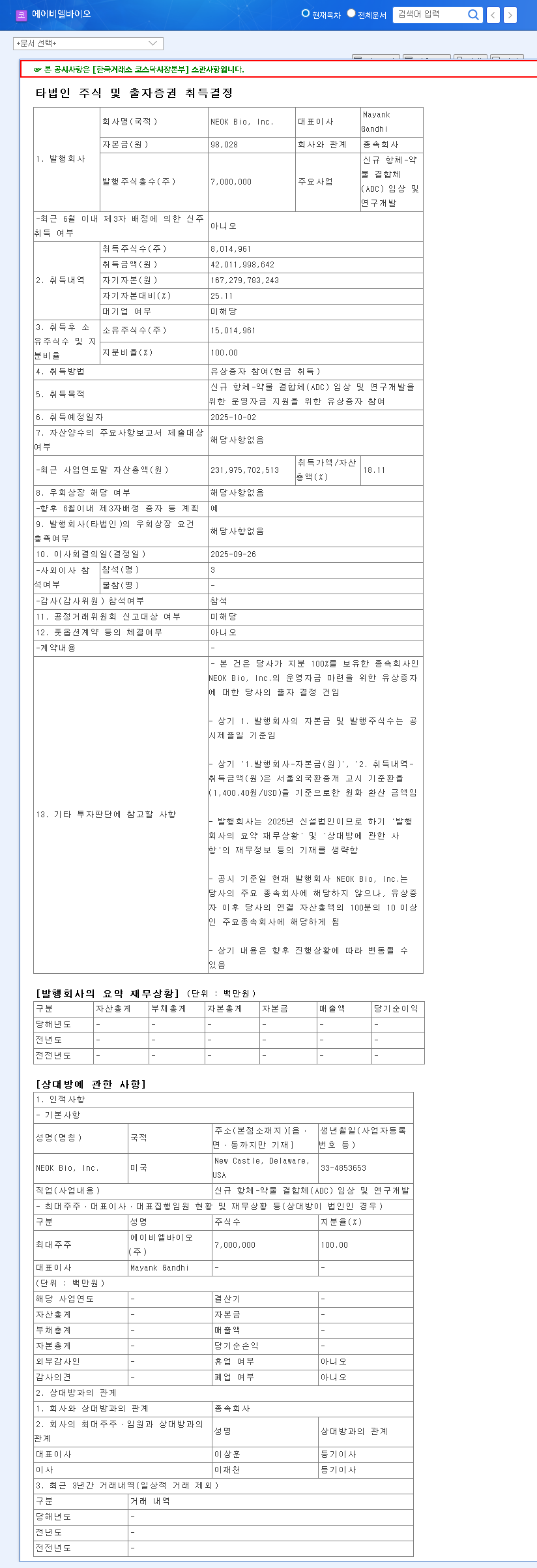
    On October 28, 2025, ABL Bio cemented its commitment by acquiring a controlling 95.26% stake in NEOK Bio, Inc. through a capital increase valued at approximately KRW 14.3 billion (Source: Official Disclosure). Uniquely, this wasn’t a straightforward cash purchase. ABL Bio is transferring its promising new drug candidates, ABL206 and ABL209, to NEOK Bio in exchange for new shares. This structure underscores a deep, symbiotic partnership founded on technology and equity, designed to fast-track global clinical trials and amplify R&D efforts in the ADC space.

    The Strategic Rationale Behind the ABL Bio ADC Expansion

    This NEOK Bio investment is a direct reflection of ABL Bio’s robust financial health and forward-looking strategy. The company’s H1 2025 report revealed a 133% year-over-year revenue surge to KRW 77.9 billion, driven by a landmark technology transfer deal with GSK. With a healthy cash position of KRW 132.7 billion and a low debt-to-equity ratio, ABL Bio is perfectly positioned to fund this expansion without financial strain. By pairing its world-class bispecific antibody platform, Grabody™, with NEOK Bio’s specialized clinical trial and ADC development expertise, ABL Bio aims to create a powerhouse of innovation and accelerate its ABL Bio pipeline development.

    Implications: Opportunities and Hurdles on the Horizon

    This strategic alliance presents both immense opportunities and notable challenges that investors must consider. The potential for synergy is the most compelling upside.

    Key Advantages of the Investment

    • Pipeline Fortification: Acquiring specialized ADC expertise immediately enhances the value of candidates ABL206 and ABL209, significantly de-risking their path through clinical development.
    • Future Growth Engine: The ADC market is one of the fastest-growing segments in oncology. This move positions ABL Bio to capture a significant share of this high-value market.
    • Technological Synergy: This partnership sets the stage for future breakthroughs by combining ABL Bio’s antibody engineering, including their Grabody™ bispecific antibody platform, with NEOK Bio’s conjugation and payload technologies.

    Potential Risks and Considerations

    • Clinical Trial Uncertainty: New drug development is inherently risky. The success of the entire ABL Bio ADC venture hinges on positive clinical outcomes from NEOK Bio’s trials.
    • Integration Challenges: Merging company cultures and aligning R&D strategies will require significant management resources and effort to ensure a seamless and productive integration.

    Investor Takeaway: Navigating ABL Bio’s Next Chapter

    ABL Bio’s investment in NEOK Bio is a forward-thinking move that could redefine its growth trajectory. While the risks associated with drug development are real, the strategic rationale is sound. Investors should closely monitor the clinical trial progress of NEOK Bio’s ADC candidates, the realization of synergies with ABL Bio’s existing platforms, and the efficiency of the post-acquisition integration. This decisive step into the ADC arena has the potential to be the catalyst that elevates ABL Bio to the next tier of global biopharmaceutical leaders, making the ABL Bio stock one to watch closely.
    (298380) ABL Bio's ADC Power Play: Analyzing the NEOK Bio Acquisition & Pipeline Impact 관련 이미지
  • Curient’s Dual Payload ADC Deal: Game Changer or Gamble?


    Curient's Dual Payload ADC Deal: Game Changer or Gamble? 대표 차트 이미지


    Curient’s Dual Payload ADC Deal: What Does it Mean?

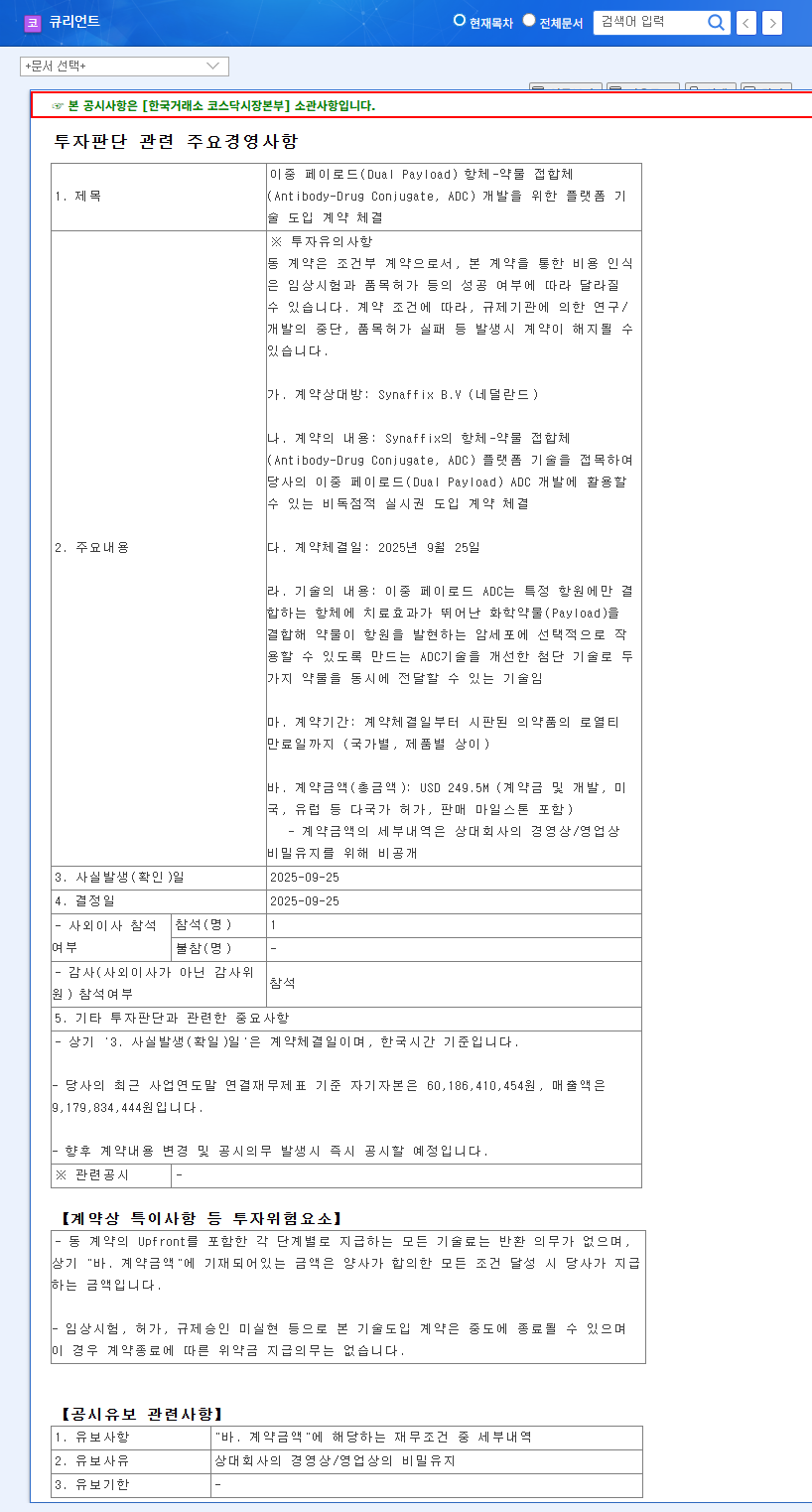
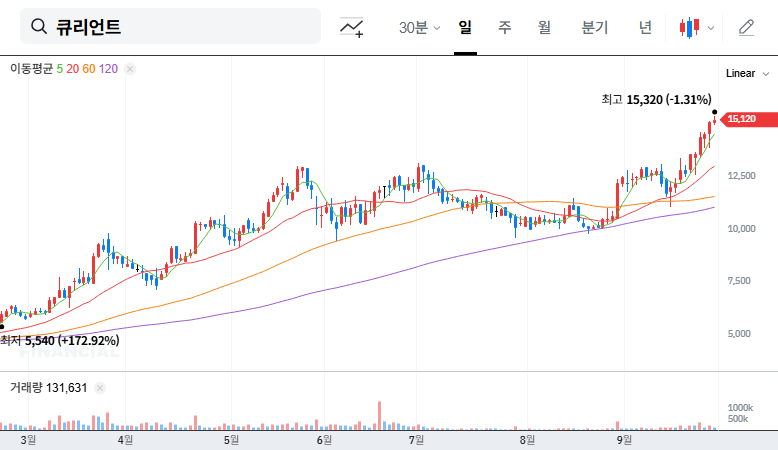
    On September 25, 2025, Curient signed a $249.5 million deal with Synaffix B.V. to acquire their dual payload ADC platform technology. This allows Curient to leverage Synaffix’s cutting-edge ADC technology to accelerate the development of next-generation cancer treatments.

    Why Dual Payload ADCs Matter

    Dual payload ADCs deliver two drugs simultaneously to cancer cells. They offer the potential for increased efficacy and overcoming drug resistance, positioning them as a potential game changer in cancer therapy. This deal provides Curient with a growth engine in the rapidly expanding ADC market and potential synergies with existing pipelines like Mocaciclib and Adricetinib.

    What Investors Should Consider

    While this deal marks a positive step towards Curient’s long-term growth, investors should consider the following risks:

    • Financial Burden: The $249.5 million in upfront and milestone payments could strain Curient’s finances.
    • Clinical Development Uncertainty: Drug development is inherently risky, and there’s no guarantee of success for dual payload ADC technology.
    • Increased Stock Volatility: Clinical trial results and milestone payment timings could lead to increased stock volatility.

    Investment Action Plan

    Curient’s move into dual payload ADCs is innovative but warrants cautious investment. Closely monitor clinical results, financial strategy, and competitive landscape. Focus on a long-term perspective rather than short-term stock fluctuations. The current analyst rating is ‘Neutral’.


    Frequently Asked Questions

    What are dual payload ADCs?

    They are next-generation antibody-drug conjugates that deliver two anti-cancer drugs simultaneously to cancer cells, potentially improving efficacy and overcoming drug resistance.

    What does this deal mean for Curient?

    It provides Curient entry into the rapidly growing ADC market and a potential growth engine, along with potential synergies with their existing drug pipeline.

    What are the key investment considerations?

    The financial burden of the deal, the inherent uncertainty of clinical development, and the potential for increased stock volatility are all factors investors should consider.


    Curient's Dual Payload ADC Deal: Game Changer or Gamble? 관련 이미지
    Curient's Dual Payload ADC Deal: Game Changer or Gamble? 관련 이미지


  • Legochem Bio Enters ADC Collaboration with GO THERAPEUTICS: Investment Analysis


    Legochem Bio Enters ADC Collaboration with GO THERAPEUTICS: Investment Analysis 대표 차트 이미지


    1. What Happened?

    On September 9, 2025, Legochem Bio signed a joint research and antibody technology licensing agreement with GO THERAPEUTICS for the development of new antibody-drug conjugates (ADCs). Through this agreement, Legochem Bio plans to develop new ADCs by incorporating GO THERAPEUTICS’ antibody technology. The agreement is conditional upon regulatory approval and can be terminated if research and development is discontinued or if product approval fails. The financial details of the agreement were not disclosed.

    2. Why Does It Matter?

    This agreement holds significant implications for strengthening and expanding Legochem Bio’s ADC pipeline. The introduction of new antibody technology can complement the existing pipeline and increase the possibility of developing new ADCs. Furthermore, the collaboration with a US biotech company serves as an opportunity to demonstrate Legochem Bio’s technological prowess in the global market and increases the potential for future licensing and commercialization.

    3. So What?

    • Positive Outlook: Successful joint research may lead to the development of new ADC candidates, securing additional milestone and royalty revenue, and strengthening global market competitiveness.
    • Potential Risks: The inherent uncertainties of clinical development, the difficulty in assessing the value due to non-disclosure of the agreement amount, and the volatility of the KRW/USD exchange rate should be considered.

    4. What Should Investors Do?

    This agreement is a positive factor that supports Legochem Bio’s long-term growth potential. However, due to uncertainties such as the progress of clinical development and regulatory approvals, a cautious approach is necessary when making investment decisions. It is crucial to closely monitor future disclosures and market conditions while formulating an investment strategy.


    Frequently Asked Questions (FAQ)

    What is the agreement with GO THERAPEUTICS about?

    It is a joint research agreement for the development of new ADCs and a licensing agreement for Legochem Bio to incorporate GO THERAPEUTICS’ antibody technology.

    Why is this agreement important for Legochem Bio?

    It is expected to contribute to the strengthening and expansion of the ADC pipeline, validation of technological capabilities, and securing future growth engines.

    What are the key points to consider for investment?

    Uncertainties in clinical development, non-disclosure of the agreement amount, and KRW/USD exchange rate fluctuations should be considered.


    Legochem Bio Enters ADC Collaboration with GO THERAPEUTICS: Investment Analysis 관련 이미지


  • Intocell Applies for Phase 1 IND for Anticancer Drug: Investment Opportunity Analysis

    Intocell Applies for Phase 1 IND for Anticancer Drug: Investment Opportunity Analysis 대표 차트 이미지

    What Happened?

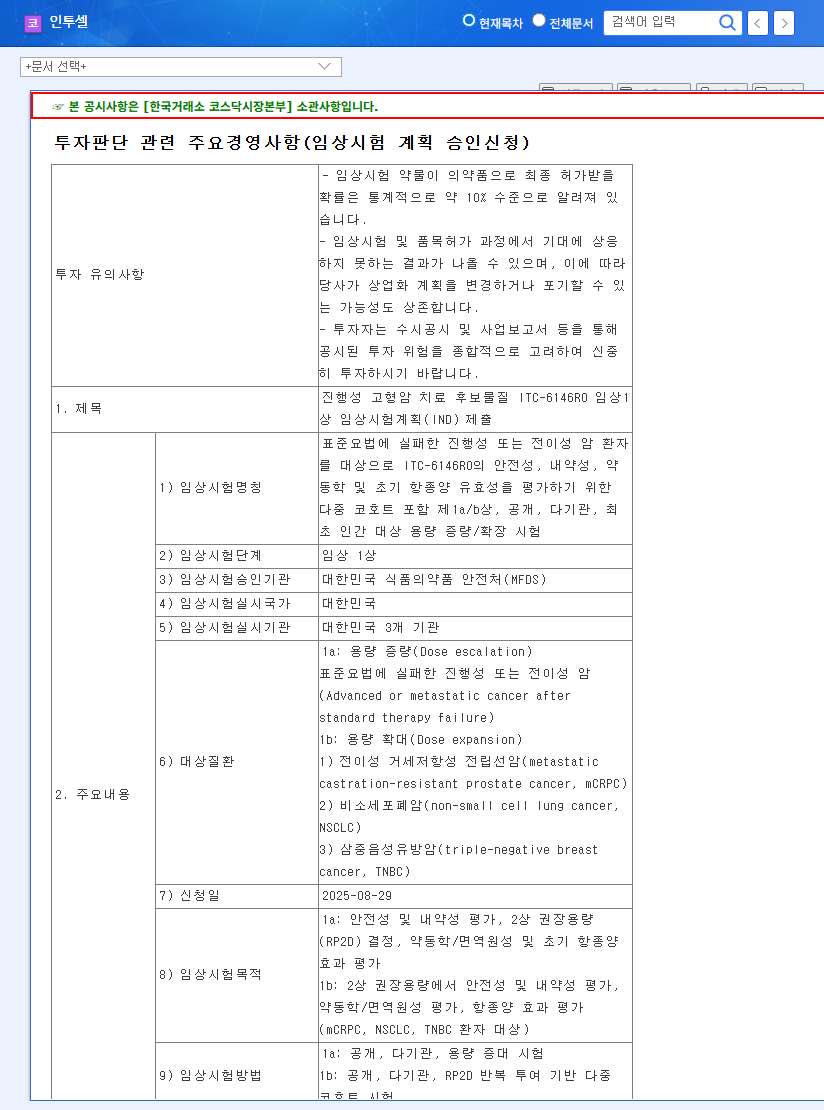
    Intocell announced on August 29, 2025, that it had completed the application for Investigational New Drug (IND) approval for a Phase 1 clinical trial of its anti-B7-H3 antibody-drug conjugate (ADC), ITC-6146RO, in Korea. ITC-6146RO is Intocell’s core pipeline, and this IND application is a significant milestone marking the entry into the clinical stage.

    Why is it Important?

    This IND application is a significant event showcasing Intocell’s differentiated ADC platform technology and growth potential. ITC-6146RO, developed based on OHPAS linker and PMT technology, is expected to demonstrate high efficacy and safety compared to existing anticancer treatments and contribute to securing a competitive edge in the global ADC market.

    What’s Next?

    Once the IND is approved and the Phase 1 clinical trial verifies safety and efficacy, the possibility of technology transfer and partnership agreements is expected to increase, positively impacting Intocell’s future revenue generation. Furthermore, successful clinical results are likely to enhance market confidence and act as a momentum for stock price increases.

    What Should Investors Do?

    • Monitor Clinical Progress: After IND approval, investors should closely watch the results of Phase 1 clinical trials and the progress towards subsequent clinical phases.
    • Check for Technology Transfer and Partnership Opportunities: Successful clinical results can lead to technology transfer and partnerships, so pay attention to related news.
    • Analyze Competitors: Analyze the competitive landscape of the ADC market and evaluate Intocell’s relative competitiveness.
    • Check Financial Soundness: It is crucial to confirm funding plans for continued R&D and the company’s financial stability.
    • Consider Risk Factors: Make informed investment decisions by considering potential risks such as the possibility of clinical trial failure, regulatory approval uncertainty, and intensifying competition.
    What are Intocell’s core technologies?

    Intocell’s core competencies are its OHPAS linker platform and PMT technology. The OHPAS linker has advantages in drug applicability, blood stability, and drug release rate, while PMT technology aims to improve the therapeutic index (TI) by minimizing normal cell entry.

    What is ITC-6146RO?

    ITC-6146RO is Intocell’s core pipeline anti-B7-H3 ADC. B7-H3 is a protein expressed in various cancer cells, and ITC-6146RO targets it for anticancer effects.

    When will the IND be approved?

    The timing of IND approval depends on the MFDS’s review schedule and is difficult to predict accurately.

    Intocell Applies for Phase 1 IND for Anticancer Drug: Investment Opportunity Analysis 관련 이미지
    Intocell Applies for Phase 1 IND for Anticancer Drug: Investment Opportunity Analysis 관련 이미지
  • Intocell (287840) Investment Analysis: ADC Technology vs. Lack of Profitability, What’s the Future?

    1. What Happened? Analysis of Intocell’s 2025 Semi-Annual Results

    Intocell recorded zero sales, an operating loss of 3.7 billion won, and a net loss of 3.8 billion won in its 2025 semi-annual report. Even considering that it is a research and development-focused company, the results are disappointing. In particular, the issue of contract termination with a specific partner has increased market concerns.

    2. Why These Results? Fundamental Analysis

    • Strengths: Excellent ADC platform technology (OHPAS, PMT), diverse pipeline (ITC-6146RO, etc.), collaboration with major pharmaceutical companies, secured patents, government support
    • Weaknesses: Chronic deficit, high R&D expenses, declining sales, contract termination issue

    Intocell’s core competitiveness lies in its innovative ADC platform technology. However, the difficulty in generating profits and high R&D expenditures continue to be a burden.

    3. What’s Next? Market Conditions and Outlook

    The ADC market is expected to have high growth. If Intocell’s technology is recognized in the market, it can achieve significant growth. However, key events such as clinical trial results, new partnership agreements, and technology transfer must be successful. Macroeconomic conditions, interest rates, and exchange rate fluctuations can also affect Intocell’s growth.

    4. What Should Investors Do? Action Plan

    In the short term, investors should be wary of stock price volatility. From a long-term perspective, it is necessary to closely monitor the progress of clinical trials, the status of partnership agreements, and the success of technology transfer. Investors should keep in mind that investment decisions are their own responsibility.

    What is Intocell’s core technology?

    Intocell possesses antibody-drug conjugate (ADC) platform technologies, OHPAS and PMT. These technologies offer high versatility, stability, and efficacy, providing differentiated competitiveness.

    What is Intocell’s main pipeline?

    Intocell’s main pipeline is ITC-6146RO, a B7-H3 targeted ADC candidate. It is currently preparing to enter Phase 1 clinical trials, and additional pipelines such as HER3 and PSMA are also under development.

    What should I be aware of when investing in Intocell?

    Intocell has high growth potential, but it has not yet generated profits and continues to record losses. In addition, stock price volatility can be high depending on clinical trial results and partnership agreements, so caution is advised when investing.