Tag: 460860

  • (460860) DONGKUK STEEL MILL Q3 2025 Earnings: A Deep Dive Analysis for Investors

    (460860) DONGKUK STEEL MILL Q3 2025 Earnings: A Deep Dive Analysis for Investors

    The latest DONGKUK STEEL MILL Q3 2025 earnings report has sent a fascinating and complex signal to the market. In a surprising turn, DONGKUK STEEL MILL Co., Ltd. unveiled preliminary results that defied expectations. While revenue saw a minor decline, the company reported a remarkable surge in profitability, significantly outperforming forecasts. This performance showcases a resilient operational strategy in a challenging market and raises important questions for investors about the company’s future trajectory.

    This comprehensive analysis will unpack the layers of this financial announcement, exploring the core reasons behind the profit surprise, the broader steel industry outlook 2025, and the potential impact on Dongkuk Steel’s stock. We will provide critical investor insights to help you navigate what comes next.

    Unpacking the DONGKUK STEEL MILL Q3 2025 Earnings Surprise

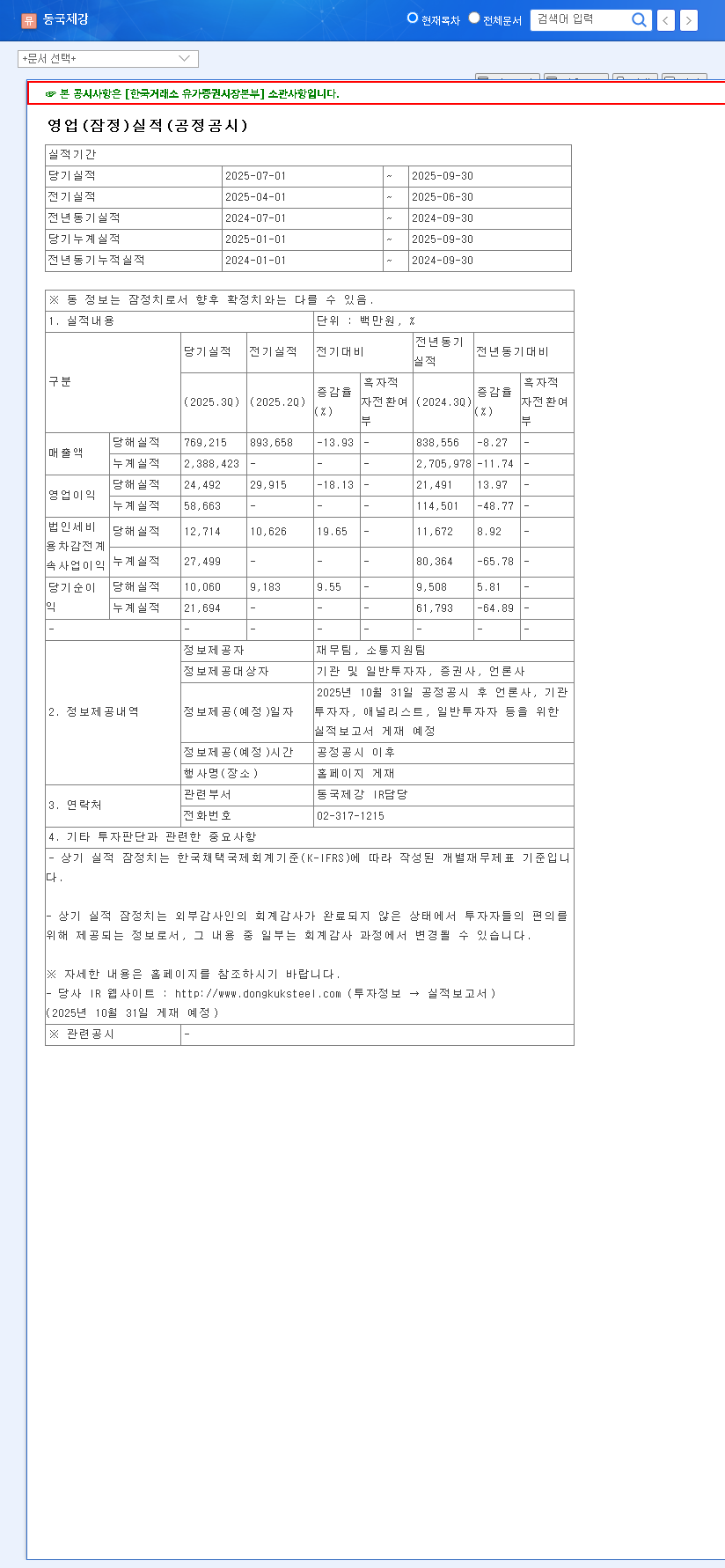
    On October 31, 2025, DONGKUK STEEL MILL released its preliminary third-quarter financial performance, the details of which can be verified in the Official Disclosure. The report presented a stark contrast between top-line revenue and bottom-line profit.

    The core story is one of operational excellence and financial acumen. Despite facing revenue headwinds, the company’s ability to drive profitability demonstrates fundamental strength.

    Key Financial Highlights vs. Market Consensus:

    • Revenue: KRW 769.2 billion, which was 5% below the market estimate of KRW 812.5 billion.
    • Operating Profit: KRW 24.5 billion, a solid 13% above the market estimate of KRW 21.6 billion.
    • Net Profit: KRW 10.1 billion, an astounding 274% above the market estimate of KRW 2.7 billion.

    The Paradox: Why Profits Soared as Revenue Slipped

    The divergence between revenue and profit is the central puzzle of this earnings report. The revenue miss suggests challenges in overall steel demand or heightened price competition. However, the impressive profit figures point to a highly effective internal strategy.

    1. Masterful Cost Controls and Product Mix Optimization

    The 13% beat in operating profit was not accidental. It is likely the result of rigorous cost discipline, including supply chain efficiencies, optimized production schedules, and energy cost management. Furthermore, a strategic shift in the product mix—prioritizing high-margin products like specialized shipbuilding plates over lower-margin construction steel—has likely bolstered profitability per ton, even on lower overall sales volume.

    2. Favorable Non-Operating Factors

    The massive 274% surprise in net profit indicates significant contributions from below the operating line. Key factors could include positive foreign exchange effects from a weak Korean Won (which benefits export-denominated earnings), gains on derivatives used for hedging, or positive returns from equity method investments. While beneficial, investors must analyze if these are one-time gains or part of a sustainable trend.

    Investment Analysis: Dongkuk Steel Stock Outlook

    This mixed earnings report creates a nuanced outlook for the company’s stock. For a broader perspective on market trends, investors can consult global industry reports from organizations like the World Steel Association.

    Short-Term vs. Long-Term Stock Impact

    In the short term, the stock may experience volatility. The revenue miss could weigh on sentiment, but the significant profit beat is a powerful counter-narrative that is likely to attract investors focused on fundamentals. The long-term trajectory will depend on the sustainability of this high-profitability model. If Dongkuk Steel can continue to manage costs effectively and capitalize on its strategic initiatives, the company financial performance could build strong investor confidence. For more details, see our deep dive into Dongkuk’s long-term strategy.

    Key Risks and Considerations for Investors

    • Macroeconomic Volatility: Fluctuations in exchange rates and raw material prices remain a significant risk that could pressure margins.
    • Sustainability of Profits: A thorough analysis is needed to determine if the non-operating gains are repeatable or one-off events.
    • Market Demand: A prolonged slowdown in key sectors like construction could eventually hinder even the most efficient profit-generating machine.
    • Future Growth Engines: The success of new ventures, such as Glass Fiber Reinforced Plastic (GFRP), is crucial for long-term diversification and growth.

    Conclusion: An Action Plan for Investors

    The DONGKUK STEEL MILL Q3 2025 earnings report is a testament to the company’s resilience and strategic prowess. While the revenue dip warrants attention, the exceptional profitability demonstrates strong fundamentals and operational control. This is a positive signal for investors who value efficiency and strong management.

    Moving forward, investors should monitor the company’s Q4 guidance, pay close attention to management’s commentary on conference calls regarding the drivers of profitability, and track the progress of its diversification efforts into new materials like GFRP. While market risks persist, this quarter’s performance suggests Dongkuk Steel is well-equipped to navigate them.
    (460860) DONGKUK STEEL MILL Q3 2025 Earnings: A Deep Dive Analysis for Investors 관련 이미지
  • (460860) Dongkuk Steel Stock Analysis: Is the NPS Stake Sale a Warning Sign?

    (460860) Dongkuk Steel Stock Analysis: Is the NPS Stake Sale a Warning Sign?

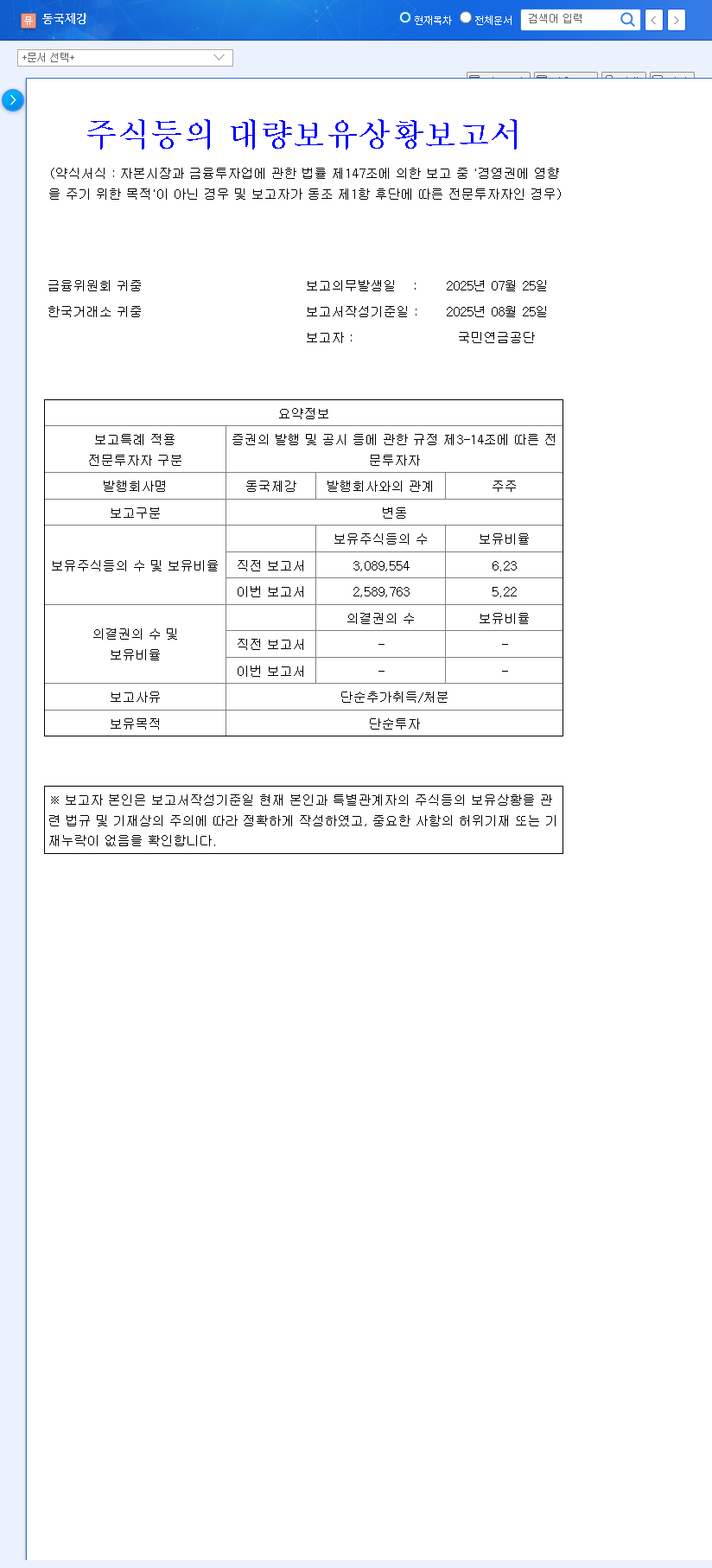
    The recent disclosure from South Korea’s National Pension Service (NPS) announcing a reduction in its ownership of Dongkuk Steel stock has sent ripples through the investment community. When one of the country’s largest institutional investors adjusts its position, the market takes notice. The NPS reduced its stake from 6.23% to 5.22%, a move that raises critical questions for current and potential investors.

    What does this stake reduction truly signify for the future of Dongkuk Steel? Is this a signal of underlying weakness, or merely a portfolio rebalancing? This in-depth analysis will explore the full implications of this event on the Dongkuk Steel stock price, its core fundamentals, and provide actionable strategies for your investment decisions.

    The Disclosure: What Exactly Happened?

    On October 1, 2025, the National Pension Service (NPS) filed an official ‘Report on Major Shareholdings’ concerning Dongkuk Steel (Market Cap: KRW 450.9 billion). The report, available on the public DART system (Official Disclosure), confirmed the key detail: the NPS’s stake in Dongkuk Steel decreased from 6.23% to 5.22%. This 1.01 percentage point reduction was categorized as a result of a ‘simple additional acquisition/disposal’, but the reasons behind such a move warrant a closer look.

    A Deep Dive into Dongkuk Steel Stock Fundamentals

    To understand the NPS’s decision, we must analyze the fundamental health of Dongkuk Steel. The company faces a mix of significant headwinds and promising strategic initiatives.

    1. Challenging Market and Underperforming Earnings

    The first half of 2025 was tough for Dongkuk Steel, primarily due to a broad downturn in the global steel market and a slowdown in the domestic construction sector. Financial results reflected this pressure:

    • Revenue: KRW 1.6192 trillion, showing a notable decline year-over-year.
    • Operating Profit: KRW 34.2 billion, also significantly lower than the same period last year.
    • Key Detractor: Falling export prices for the company’s long and heavy steel products severely impacted profitability.

    2. Future-Oriented Growth Strategies

    Despite the challenging environment, Dongkuk Steel is not standing still. The company is actively pursuing several initiatives aimed at sustainable growth and shareholder value:

    • ‘Steel for Green’ Strategy: A commitment to investing in eco-friendly processes to ensure long-term sustainability and meet ESG demands.
    • GFRP Business Diversification: The company is entering the Glass Fiber Reinforced Plastic (GFRP) market, a high-growth sector. This move diversifies its portfolio away from traditional steel, with sales expected to commence in late 2025.
    • Enhanced Shareholder Returns: Management has raised the minimum dividend to KRW 400 per share for three years and already declared an interim dividend of KRW 200, signaling confidence to the market.

    3. Complex Macroeconomic Factors

    No Dongkuk Steel investment can be evaluated in a vacuum. Broader economic trends play a crucial role. For an in-depth look at market trends, investors often consult resources like the World Steel Association. Key factors include:

    • Exchange Rate: A rising KRW/USD exchange rate (KRW 1,400.50) can be a double-edged sword. While it benefits exporters, it increases the cost burden for companies like Dongkuk Steel that rely heavily on imported raw materials.
    • Interest Rates: Sustained high interest rates increase borrowing costs and can dampen construction activity, a key demand driver for steel.

    Impact of the NPS Sale on Dongkuk Steel Stock

    The sale by a major institutional investor like the NPS sends a powerful short-term negative signal. However, long-term value will ultimately be dictated by the company’s ability to execute its growth strategy and navigate the market recovery.

    Short-Term: Negative Sentiment and Volatility

    The immediate impact is likely negative. The NPS is a market bellwether, and its selling can trigger a decline in investor confidence, putting downward pressure on the Dongkuk Steel stock price. Investors should anticipate increased trading volume and heightened price volatility as the market digests this news. Learning to interpret moves by institutional investors is a key skill.

    Mid- to Long-Term: Fundamentals are Key

    The long-term outlook depends heavily on why the NPS sold. If it was a simple portfolio rebalancing, the impact may be fleeting. If it was based on deep concerns about Dongkuk Steel’s fundamentals, it could signal a prolonged period of weakness. The market will now watch to see if other investors absorb this selling pressure and if the company’s strategic initiatives, like the GFRP business, begin to bear fruit.

    Investor Action Plan: Should You Buy Dongkuk Steel Stock Now?

    Given the disappointing first-half earnings and a high PER of around 40x (as of June 30, 2025), the stock carries a valuation burden. The NPS Dongkuk Steel sale adds another layer of uncertainty.

    • Short-Term (1-3 Months): Caution. It is prudent to wait and observe the market’s reaction. A premature purchase could lead to catching a falling knife. Monitor support levels and wait for signs of stabilization.
    • Mid- to Long-Term (6-12+ Months): Observe and Approach. A successful Dongkuk Steel investment from here hinges on tangible improvements in fundamentals. If the GFRP business shows strong performance and the steel market begins a cyclical recovery, the current price could represent an attractive entry point, especially if the NPS sale proves to be purely strategic.

    Frequently Asked Questions (FAQ)

    What does the NPS’s reduction in Dongkuk Steel stake mean?

    It means the National Pension Service sold a portion of its shares, decreasing its holding from 6.23% to 5.22%. As a major institutional investor, this action is seen as a negative short-term signal that can pressure the stock price.

    What is Dongkuk Steel’s recent financial performance?

    For the first half of 2025, both revenue and operating profit declined compared to the previous year. This was caused by a slowdown in the construction and steel markets and falling export prices.

    What is Dongkuk Steel’s GFRP business?

    GFRP (Glass Fiber Reinforced Plastic) is a new business venture for Dongkuk Steel. It represents a key part of their strategy to diversify and find new growth engines outside the traditional steel sector, with sales planned for late 2025.

    What are the key factors to monitor for Dongkuk Steel stock?

    Investors should closely watch any further selling by the NPS, the actual sales performance of the new GFRP business, the pace of the global steel market recovery, outcomes of any major legal issues, and the company’s overall ESG compliance.

    (460860) Dongkuk Steel Stock Analysis: Is the NPS Stake Sale a Warning Sign? 관련 이미지