The recent announcement of the ENJET stock option exercise has captured the attention of the market, raising important questions for current and potential investors. With 130,000 new shares set to enter the market, understanding the nuances of this corporate action is crucial. This detailed ENJET stock analysis will break down the event, explore the concept of share dilution, and provide a strategic guide for navigating the potential impacts on your portfolio.
First, What is a Stock Option Exercise?
Before diving into ENJET’s specific situation, let’s clarify the fundamentals. A stock option gives an employee or executive the right, but not the obligation, to purchase a set number of company shares at a predetermined price, known as the ‘exercise price’ or ‘strike price’. When they ‘exercise’ this option, the company issues new shares to them. While this can be a powerful tool for attracting and retaining talent, it directly impacts the company’s stock structure. For a deeper understanding, you can review this comprehensive guide to employee stock options from a reputable financial source.
The exercise of stock options always introduces new shares into the market, which can dilute the ownership stake of existing shareholders and potentially influence the stock’s price in the short term.
The ENJET Stock Option Exercise: The Official Details
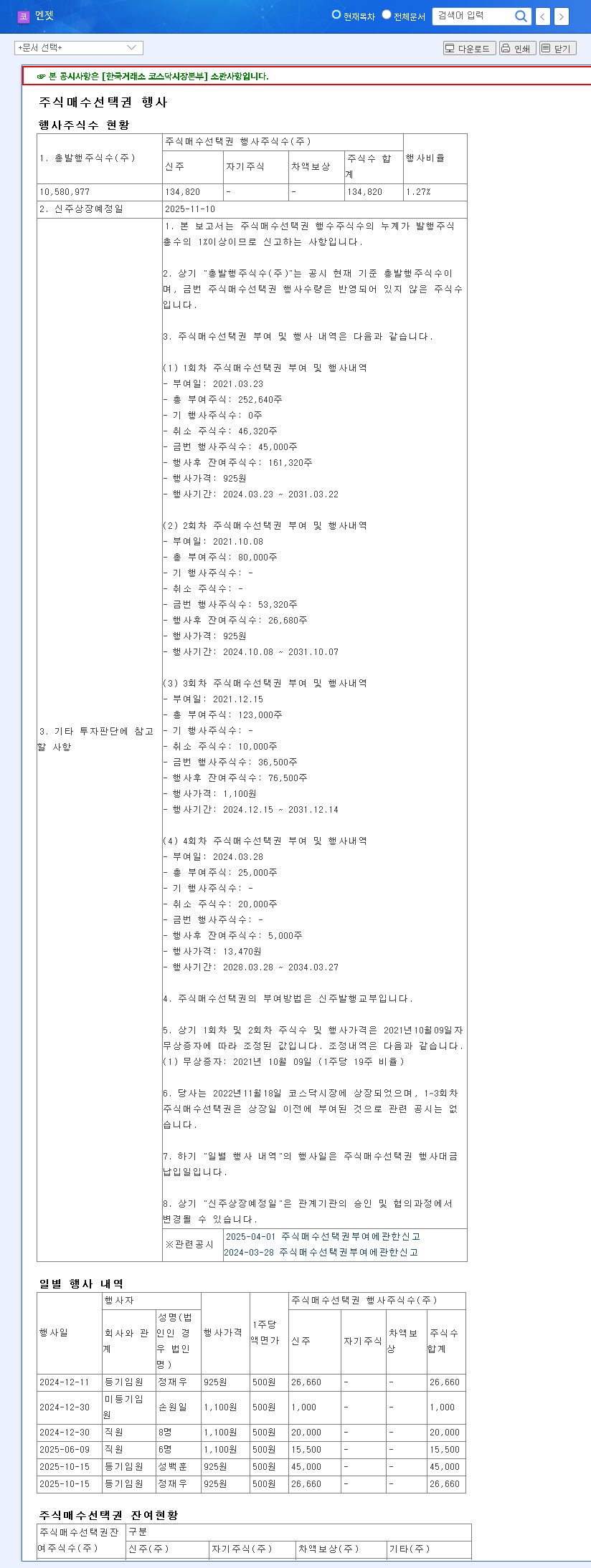
According to the official corporate filing, the specifics of the ENJET stock option exercise are as follows:
- •Announcement Date: October 15, 2025
- •New Shares Issued: 130,000
- •Percentage of Total Shares: 1.27%
- •Scheduled Listing Date: November 10, 2025
This information creates a clear timeline for investors to watch. The full details can be verified through the Official Disclosure (DART Source). This increase in the total number of shares is what leads to the primary concern for investors: ENJET share dilution.
Analyzing the Impact: Share Dilution and Market Psychology
A 1.27% increase in the float (the number of shares available for trading) might seem small, but its impact can be multifaceted. Here’s how it typically plays out:
Immediate Effects of ENJET Share Dilution
From a purely mathematical standpoint, when you increase the number of shares without a corresponding increase in the company’s value, the value per share decreases. This can put short-term downward pressure on the stock price. Furthermore, the individuals exercising their options may choose to sell their newly acquired shares to realize a profit, creating additional selling pressure around the listing date.
Long-Term Investor Perception
Conversely, a stock option exercise can be a positive signal. It implies that insiders believe the company’s stock is valuable and has future growth potential. If the options were granted as part of a long-term incentive plan, their exercise could signify confidence from key personnel. The market’s interpretation will heavily depend on one crucial, undisclosed piece of data.
The Missing Piece: ENJET’s Exercise Price
The single most important variable in this ENJET stock analysis is the exercise price of these options. Without it, any conclusion is purely speculative. The exercise price determines the incentive for the option holders to sell:
- •Low Exercise Price: If the exercise price is significantly below the current market price, the immediate profit potential is high. This dramatically increases the likelihood of a sell-off as option holders look to cash in on their gains, creating strong downward pressure.
- •High Exercise Price: If the exercise price is close to or even above the current market price, the incentive to sell immediately is low. This could be interpreted as a bullish signal, suggesting that insiders believe the stock price will rise well above this level in the future.
An Investor Guide: Your Action Plan
Given the incomplete information, a proactive approach is necessary. This ENJET investor guide outlines the essential steps to take before making any decisions:
- •Find the Exercise Price: This is priority number one. Scour the official DART filings, company press releases, or investor relations communications to find this number.
- •Conduct Fundamental Analysis: Re-evaluate ENJET’s core health. Look at recent earnings reports, revenue growth, profit margins, and industry trends. Is the company fundamentally strong enough to absorb these new shares without significant price impact? If you are new to this, learn more about our fundamental analysis techniques.
- •Analyze Market Sentiment: Review what analysts and financial news outlets are saying. Is this event viewed as a routine corporate procedure or a red flag? Check brokerage reports for any updated ratings or price targets.
- •Monitor Trading Volume: As the listing date of November 10, 2025, approaches, keep a close eye on the stock’s trading volume. A significant spike in volume could signal the beginning of a sell-off or increased investor interest.
In conclusion, while the ENJET stock option exercise introduces a degree of uncertainty and potential short-term volatility, it is a manageable event for the informed investor. By focusing on due diligence and uncovering the critical missing data, you can move from a position of reaction to one of strategic foresight.