Investors in Bumhan Fuel Cell Co.,Ltd. are closely watching the company’s latest strategic financial maneuver: a decision to issue ₩20 billion in private convertible bonds (CBs). This significant capital raise marks a pivotal moment, presenting both a powerful catalyst for growth and potential risks for existing shareholders. The central question for every Bumhan Fuel Cell investment is whether this CB issuance will unlock new opportunities or introduce burdensome share dilution. This comprehensive analysis goes beyond the headlines to provide the in-depth insights you need to navigate this development.
First, What Exactly is a Convertible Bond?
Before diving into the specifics of the Bumhan Fuel Cell CB issuance, it’s essential to understand the instrument itself. A convertible bond is a hybrid security that starts as a corporate bond but includes an option for the investor to convert it into a predetermined number of the issuing company’s common shares at a later date. This offers the safety of a bond (regular interest payments and principal return) with the upside potential of a stock. For a deeper understanding, resources like Investopedia provide excellent explanations. For the company, it’s an attractive way to raise capital at a lower interest rate than traditional debt.
Deconstructing the ₩20 Billion Issuance
Bumhan Fuel Cell has outlined specific terms for this private placement, which are critical for a complete convertible bond analysis. The key details, based on the official disclosure, are as follows. For complete transparency, you can view the Official Disclosure (Source) on DART.
- •Issuance Size: ₩20 billion (approx. 7.23% of current market cap).
- •Subscription Date: October 28, 2025.
- •Conversion Period: October 28, 2026, to September 28, 2028.
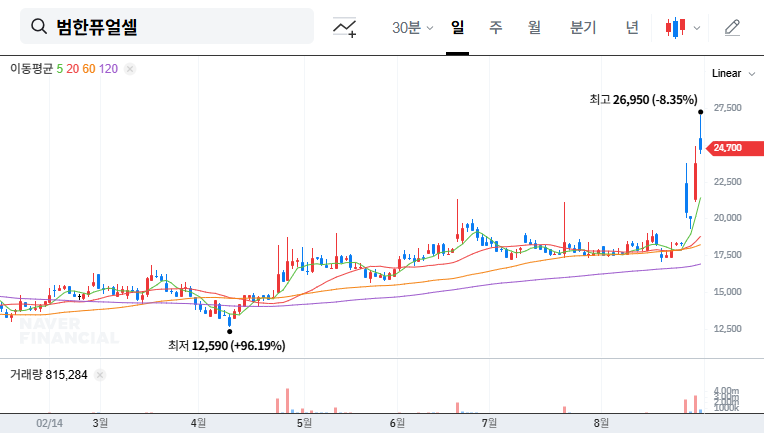
- •Conversion Price: ₩29,302 (set slightly above the current market price).
- •Coupon Rate: 0% (no periodic interest payments).
- •Yield to Maturity (YTM): 3.0% (the return if held to maturity without conversion).
- •Investors: Private placement to venture capital funds, including ‘Suseong KOSDAQ Venture D1~D5’.
Potential Upsides: Fueling Future Growth
Securing Capital for Innovation and Expansion
The most direct benefit of the Bumhan Fuel Cell CB issuance is the infusion of ₩20 billion in working capital. In the capital-intensive hydrogen fuel cell industry, this funding is critical for accelerating research and development (R&D), expanding production facilities, and scaling operations. This investment can strengthen the company’s competitive position and ability to capture market share, which you can learn more about in our article on hydrogen market trends.
A Vote of Confidence from Venture Capital
The participation of multiple venture investment funds is a significant endorsement. These sophisticated investors conduct rigorous due diligence, and their investment signals a strong belief in Bumhan Fuel Cell’s long-term growth trajectory and management. This can boost overall market confidence and attract further investment into the Bumhan Fuel Cell stock.
A convertible bond issuance is a double-edged sword: it provides the fuel for ambitious growth but requires careful management to avoid diluting the value for those who built the foundation—the existing shareholders.
Potential Risks: What Investors Must Watch
The Inevitable Share Dilution Risk
The primary concern for current shareholders is share dilution risk. When the bonds are converted, new shares are created, increasing the total number of outstanding shares. This means each existing share represents a smaller percentage of ownership in the company, which can dilute earnings per share (EPS) and potentially place downward pressure on the stock price.
Navigating Future Selling Pressure
Once the conversion period begins in late 2026, the venture funds may convert their bonds and sell the newly acquired shares to realize profits. This can create a significant selling pressure, or ‘overhang,’ on the market. Anticipation of this event could lead to increased stock price volatility as the conversion date approaches.
An Investor’s Action Plan
Given the mixed implications of the Bumhan Fuel Cell CB issuance, investors should adopt a strategic and well-researched approach. Rather than a knee-jerk reaction, consider the following actions:
- •Evaluate Long-Term Vision: If you believe in the company’s fundamental growth story and its position in the hydrogen fuel cell sector, the short-term risk of dilution may be an acceptable trade-off for long-term capital appreciation fueled by this investment.
- •Monitor Key Dates: Mark your calendar for the start of the conversion period (October 28, 2026). Monitor the stock’s performance and trading volume as this date approaches to gauge market sentiment regarding potential selling pressure.
- •Conduct Deep Due Diligence: It is imperative to research how Bumhan Fuel Cell plans to specifically utilize the funds. Look for detailed business plans, analyze the competitive landscape, and assess the company’s financial projections post-issuance.
Conclusion: A Balanced Perspective is Key
The ₩20 billion Bumhan Fuel Cell CB issuance is a significant corporate action with clear benefits and tangible risks. For the company, it’s a strategic move to secure growth capital. For investors, it introduces a complex dynamic of future potential versus immediate dilution concerns. The most prudent path forward is not to make a hasty judgment but to engage in thorough analysis, weigh the long-term vision against the short-term volatility, and make an investment decision that aligns with your personal risk tolerance and financial goals.