Tag: 380540

  • (380540) OptiCore Inc. CB Acquisition: Investment Analysis & Stock Outlook

    (380540) OptiCore Inc. CB Acquisition: Investment Analysis & Stock Outlook

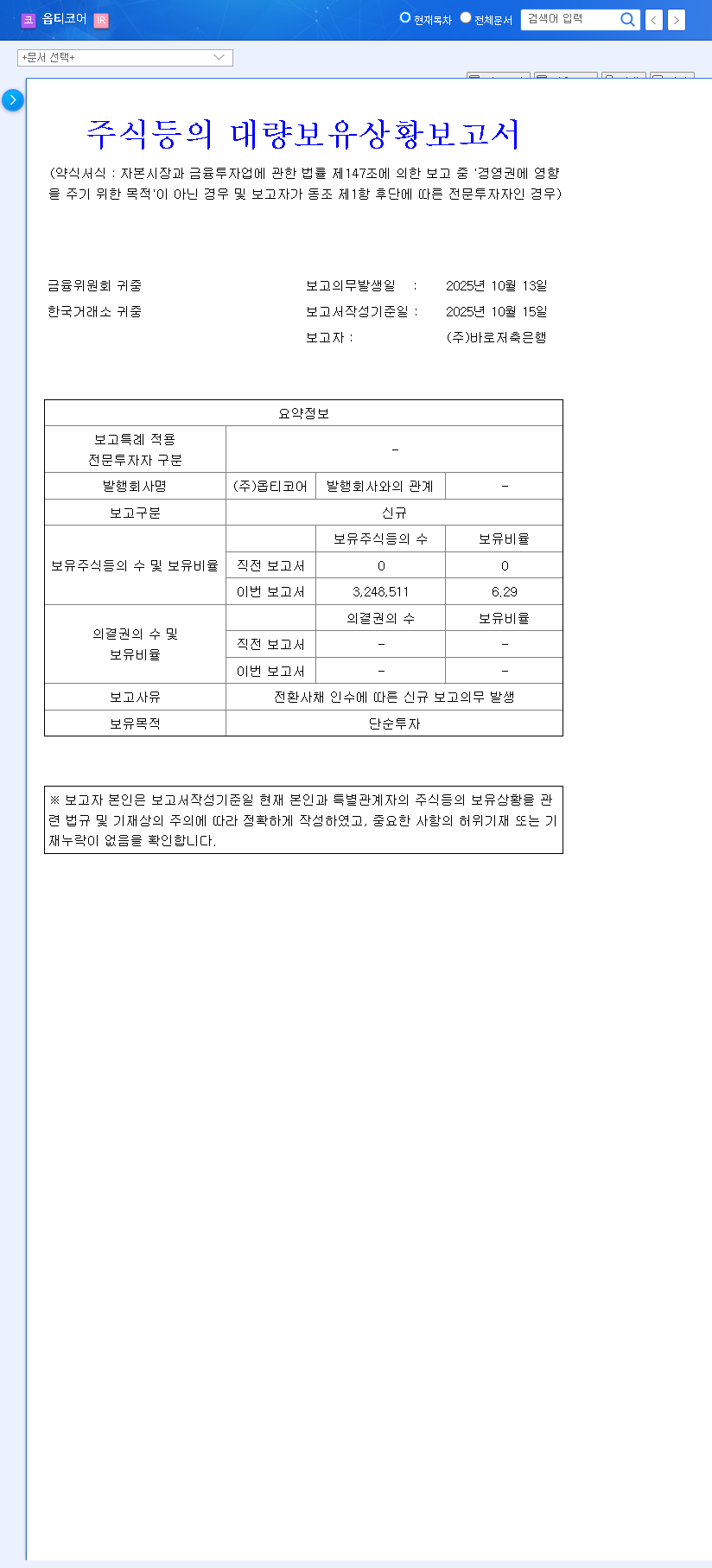
    The recent OptiCore Inc. CB acquisition by Baro Savings Bank has sent ripples through the investment community, casting a spotlight on a company at a critical crossroads. This move, potentially giving the bank a 6.29% stake, raises crucial questions for current and prospective investors. Is this a vote of confidence in a struggling tech firm, or a precursor to further market volatility? Navigating this complex situation requires a deep understanding of the forces at play.

    This comprehensive analysis breaks down the acquisition’s implications, examines OptiCore’s underlying financial health, and provides a clear action plan to help you make an informed OptiCore Inc. investment decision.

    The Event: Baro Savings Bank’s Strategic Move

    On October 16, 2025, Baro Savings Bank officially acquired a significant tranche of Convertible Bonds (CBs) issued by OptiCore Inc. According to the official filing, this acquisition could translate into a 6.29% ownership stake upon conversion. While the bank has stated its purpose as ‘simple investment,’ the sheer size of the stake makes this a noteworthy event that warrants careful scrutiny. For a full breakdown, you can review the Official Disclosure (DART).

    A convertible bond is a type of debt security that the holder can convert into a specified number of a company’s common stock. It’s a hybrid security with features of both debt and equity. Understanding this is crucial to grasping the OptiCore Inc. CB acquisition. You can learn more about how convertible bonds work on Investopedia.

    Context: The Challenges Facing OptiCore Inc.

    To understand why this CB issuance was necessary and what the acquisition means, we must first look at the significant headwinds OptiCore is facing. The company is navigating a perfect storm of market decline, financial complexity, and leadership transition.

    1. Severe Market Downturn & Weak Performance

    The optical communications market, OptiCore’s core business, has stagnated. A key factor is the reduced investment in front-end industries following the initial 5G rollout boom. This has directly impacted OptiCore’s top line, with H1 2025 revenue plummeting by 45% year-on-year to 5.2 billion KRW and operating losses widening to 3.7 billion KRW.

    2. Complex and Leveraged Financial Structure

    To stay afloat, OptiCore has relied heavily on capital raises through large convertible bonds and rights offerings. This has created a complex balance sheet, with financial assets measured at fair value through profit or loss soaring to around 30 billion KRW. This introduces volatility and makes a fundamental stock analysis challenging.

    3. A Pivot Towards New Growth Engines

    Recognizing the need for diversification, management is exploring new ventures. These include developing high-speed optical transceivers for the booming data center market, expanding overseas, and entering new sectors like factory automation and laser processing. The success of these initiatives is paramount to the company’s long-term survival and growth.

    Analyzing the Impact of the CB Acquisition

    The acquisition by Baro Savings Bank OptiCore stakeholders are watching will have distinct short-term and long-term consequences.

    Short-Term (1-3 Months): Selling Pressure & Sentiment Shifts

    The most immediate risk is potential selling pressure. If Baro Savings Bank converts the CBs into shares and sells them on the open market, the increased supply (share dilution) could push the stock price down. This overhang can create negative market sentiment, even if the bank’s stated intent is ‘simple investment.’

    Medium to Long-Term (3+ Months): A Path to Stability?

    Over the long term, the presence of a significant institutional investor like Baro Savings Bank could enhance corporate credibility and diversify the investor base. While not their stated goal, the possibility of the bank taking a more active role in management if the company’s situation deteriorates (or improves dramatically) cannot be dismissed. Ultimately, the conversion or repayment of these bonds will alter the company’s financial structure, ideally reducing debt and strengthening its equity base.

    Investor Action Plan: How to Approach Your OptiCore Investment

    This CB acquisition is a signal, but not a solution to OptiCore’s fundamental challenges. An informed investment strategy must focus on tangible business progress. For further reading, you might want to explore our guide on how to analyze tech company financials.

    • Monitor Institutional Moves: Keep a close watch on Baro Savings Bank’s filings. Any signs of conversion and selling should be noted, as this could signal short-term price pressure.
    • Track Fundamental Improvements: The real driver of long-term value will be results. Look for quarterly reports showing progress in the new business segments (e.g., data center transceiver sales) and improvements in core profitability.
    • Assess Management’s Execution: Pay attention to the new leadership’s strategic decisions and their ability to execute the turnaround plan. Clear communication and hitting milestones are key positive indicators.
    • Consider Market Context: No company exists in a vacuum. A broader recovery in the optical communications sector or continued high demand from data centers could provide a significant tailwind for OptiCore’s recovery.

    Conclusion: A Pivotal Moment for OptiCore Inc.

    The OptiCore Inc. CB acquisition by Baro Savings Bank is more than a simple financial transaction; it’s a critical indicator of the company’s future trajectory. While it provides a much-needed capital injection, it does not erase the underlying operational and market challenges. For investors, the path forward requires a focus on fundamentals, diligent monitoring, and a long-term perspective that looks beyond short-term market noise.
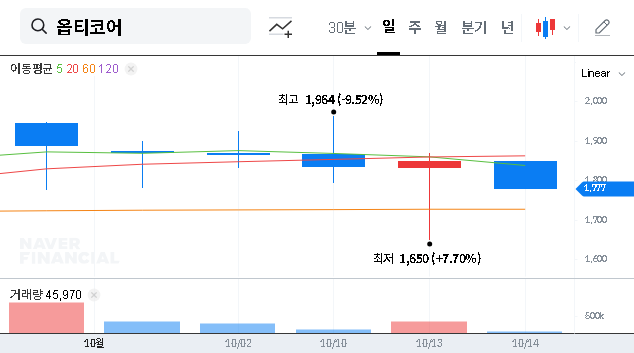
    (380540) OptiCore Inc. CB Acquisition: Investment Analysis & Stock Outlook 관련 이미지
  • (380540) OptiCore Inc. Stock Analysis (380540): Shareholder Divestment & Future Outlook

    (380540) OptiCore Inc. Stock Analysis (380540): Shareholder Divestment & Future Outlook

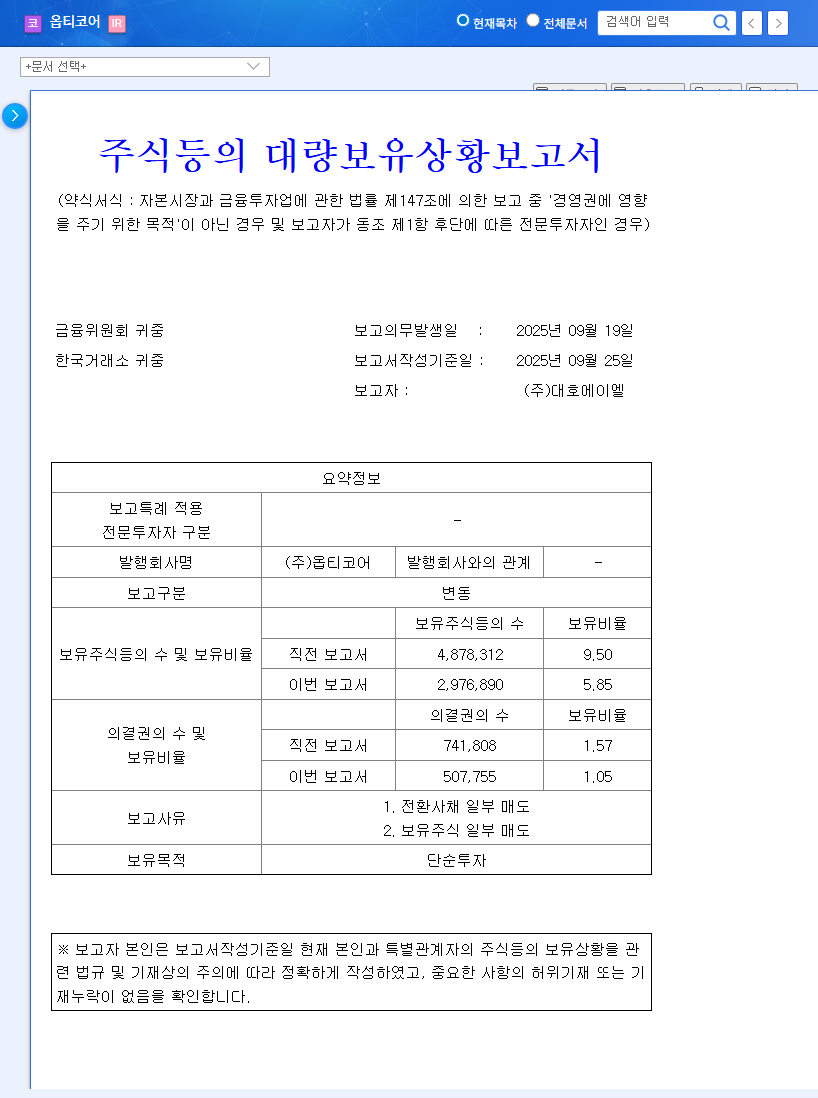
    Recent market activity surrounding OptiCore Inc. (380540) has created a complex scenario for investors. A major shareholder, Daeho AEL, has significantly reduced its stake while simultaneously redeeming convertible bonds. This comprehensive OptiCore Inc. stock analysis will dissect these events, evaluate the company’s fundamental health, and provide actionable strategies for navigating both the immediate market pressures and the promising long-term opportunities tied to the AI revolution.

    We will explore how this major shareholder divestment impacts market sentiment, assess OptiCore’s core business in high-speed optical transceivers, and weigh the risks against its potential to become a key infrastructure player in the new data-centric economy.

    Event Overview: A Major Shareholder Makes a Move

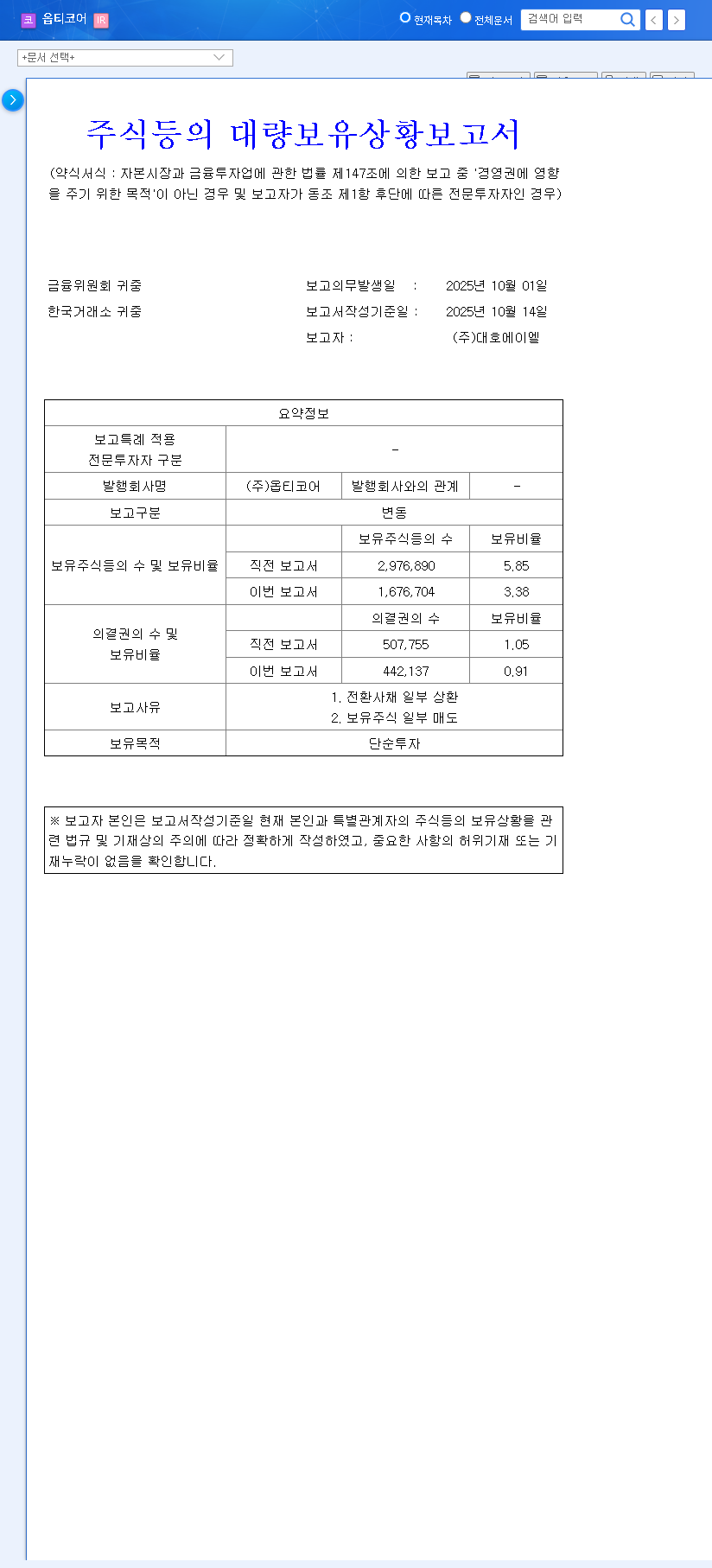
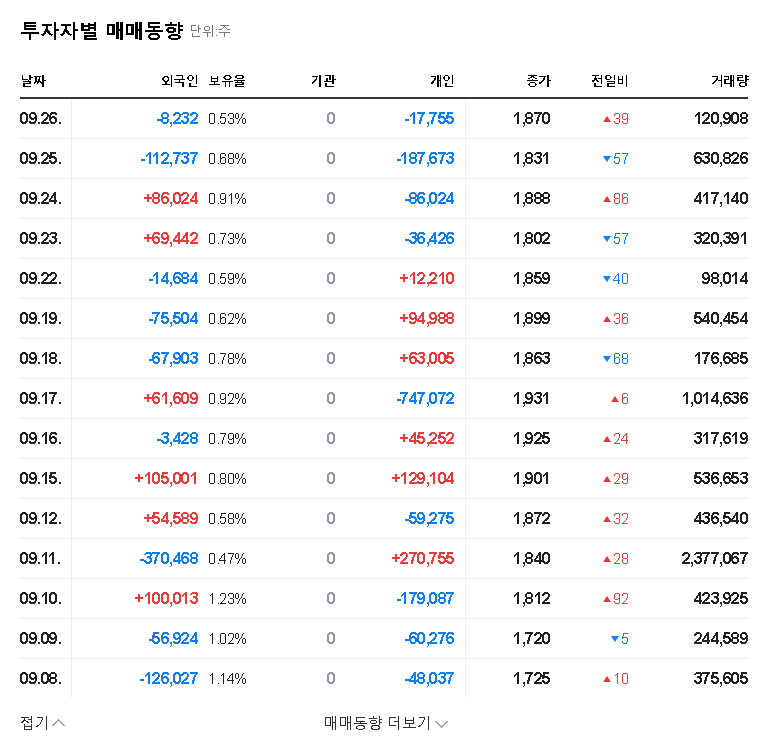
    On October 14, 2025, OptiCore Inc. filed a disclosure that caught the market’s attention. The filing revealed significant changes in the holdings of Daeho AEL, a major shareholder. This wasn’t a simple buy or sell; it was a compound event involving both share sales and the redemption of convertible bonds.

    The details were outlined in a Report on Large-Volume Shareholding, a mandatory disclosure for substantial stakeholders in South Korea. The official report can be viewed here: Official Disclosure (DART).

    Key Details of the Change:

    • Reporting Entity: Daeho AEL
    • Shareholding Before Report: 5.85%
    • Shareholding After Report: 3.38%
    • Net Change: A significant -2.47% reduction.
    • Reason for Change: Stated as a partial redemption of convertible bonds and a partial sale of held shares.

    In-Depth OptiCore Inc. Stock Analysis: Fundamentals & Market Impact

    To understand the implications, we must look beyond the headline and evaluate OptiCore’s underlying corporate health. The company stands at a crossroads, with strong tailwinds from the AI sector but significant headwinds from its recent financial performance and internal controls.

    Fundamental Strengths (The AI Opportunity)

    • AI Data Center Focus: OptiCore is strategically developing high-speed optical transceivers (400G and 800G), which are critical components for the massive data centers powering the AI boom.
    • Technology Internalization: Through its subsidiaries, the company is internalizing core technologies like Laser Diodes (LD), strengthening its supply chain and competitive edge.
    • Business Diversification: Management is pursuing new frontiers in automation, quantum cryptography, and autonomous driving to create multiple long-term revenue streams.
    • Global Market Expansion: Active efforts are underway to increase exports, particularly to the lucrative North American market, reducing reliance on domestic demand.

    Identified Risk Factors & Headwinds

    • Poor Recent Performance: The first half of 2025 saw revenue decrease by 45% and a shift to an operating loss, largely due to a slowdown in 5G network investments.
    • Rising Debt Levels: Increased issuance of convertible bonds has pushed the debt-to-equity ratio up to 32.52%, increasing financial risk.
    • Governance Concerns: Recent changes in key executives and an auditor’s opinion flagging deficiencies in the internal accounting control system raise questions about management stability and transparency.
    • Macroeconomic Uncertainty: Global inflation, fluctuating interest rates, and geopolitical risks could delay customer investments and impact profitability.

    The core conflict for investors is clear: A major shareholder’s sale signals short-term caution, yet the company’s long-term strategic alignment with the AI industry presents a compelling growth narrative. The key is determining if and when fundamentals will outweigh market sentiment.

    Actionable Investment Strategy for OptiCore Inc.

    Considering the shareholder divestment, the fundamental picture, and the broader market, a bifurcated investment strategy is recommended.

    Short-Term Strategy (1-3 Months)

    A cautious, wait-and-see approach is prudent. The sale by Daeho AEL introduces significant selling pressure and can negatively impact investor sentiment, likely causing short-term price volatility. Before considering an entry, investors should watch for signs of price stabilization, a clear reversal of the downtrend on significant volume, or major positive company-specific news.

    Mid-to-Long-Term Strategy (6+ Months)

    Long-term success hinges on a fundamental turnaround. The redemption of the OptiCore convertible bond is a positive step, as it cleans up the balance sheet. However, investors should seek concrete evidence of growth. To better understand these financial instruments, you can read this guide on how convertible bonds work from a trusted financial source.

    Key metrics to monitor include:

    • Quarterly earnings reports showing revenue growth and a return to profitability.
    • Announcements of new contracts for 400G/800G transceivers.
    • Progress on resolving the internal accounting control deficiencies.

    For more insights, you can read our guide on analyzing tech stocks for long-term growth.

    Conclusion

    In summary, while the OptiCore shareholder divestment by Daeho AEL creates a short-term headwind for the stock, the long-term investment thesis remains intact but requires verification. The partial bond redemption improves financial health, but the company’s ultimate value will be determined by its ability to execute its AI-focused strategy, win in the high-speed transceiver market, and resolve its internal governance issues. Prudent investors should remain watchful, prioritizing fundamental progress over speculative price action.

    (380540) OptiCore Inc. Stock Analysis (380540): Shareholder Divestment & Future Outlook 관련 이미지
  • (380540) OptiCore Optical Transceiver Contract: AI Data Center Deal & Stock Analysis

    (380540) OptiCore Optical Transceiver Contract: AI Data Center Deal & Stock Analysis 대표 차트 이미지

    A Game-Changer? Analyzing OptiCore’s AI Data Center Deal

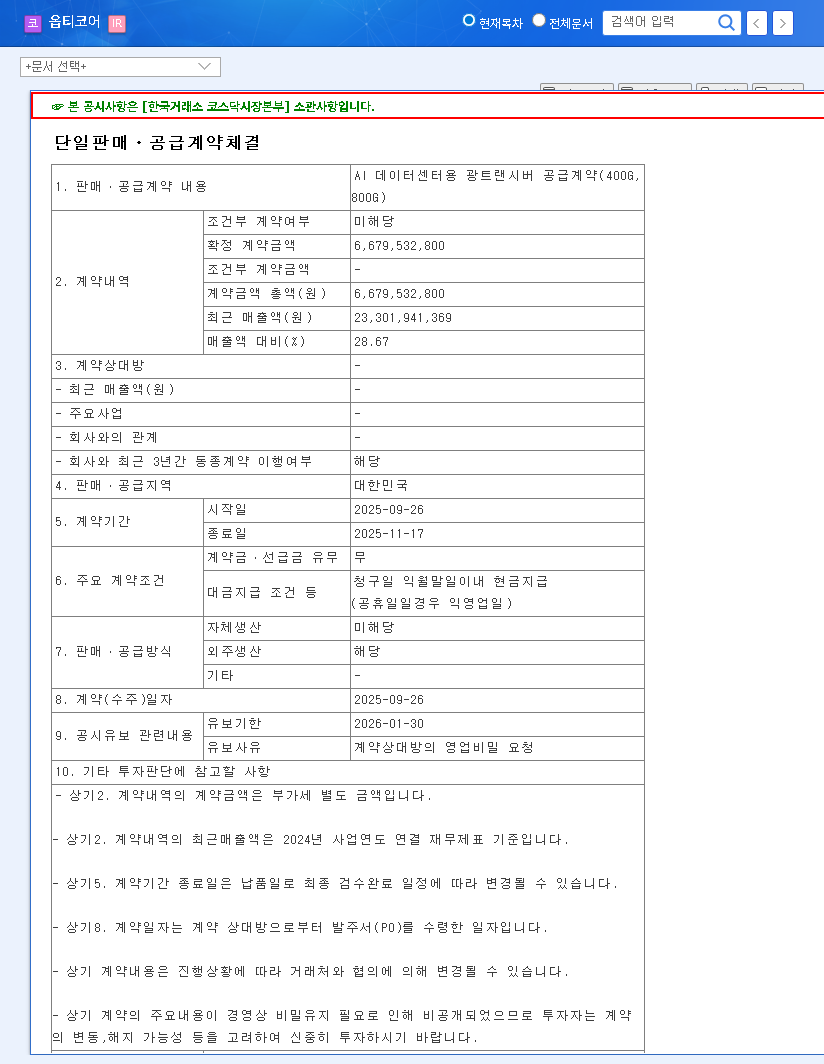
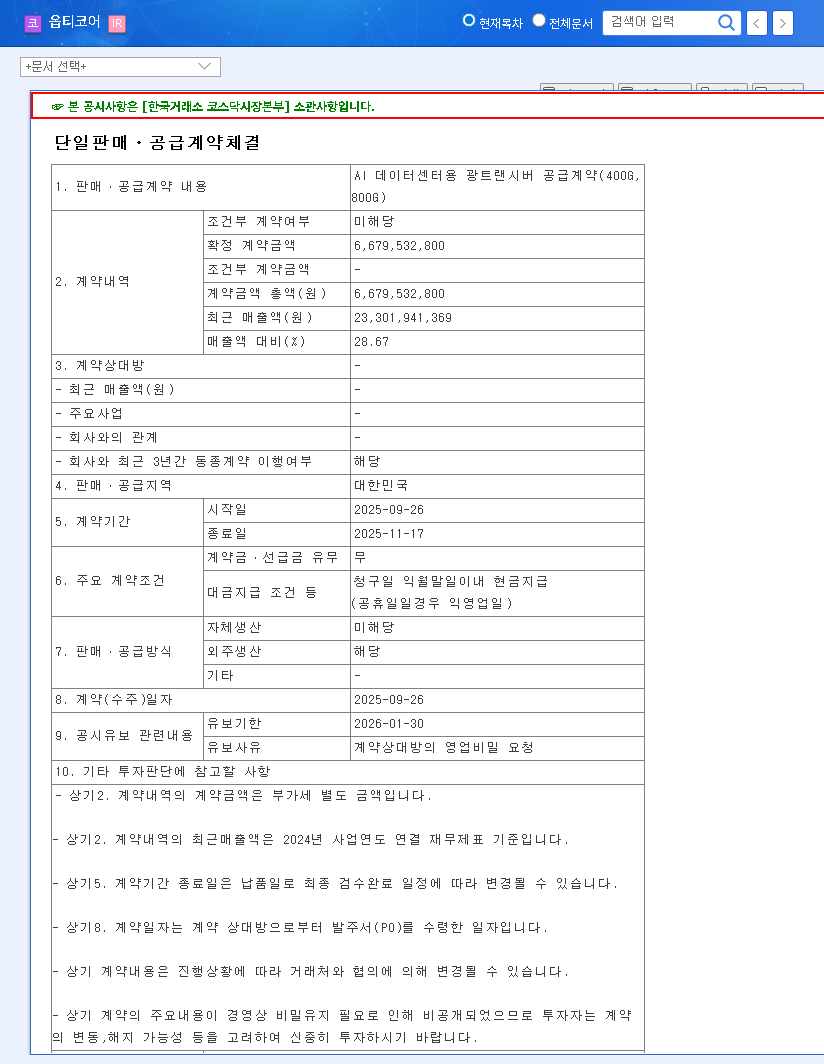
    OptiCore has just announced a pivotal ₩6.7 billion (approx. $5 million USD) supply contract for its advanced OptiCore optical transceiver technology, specifically designed for AI data centers. This news has electrified investors, as the contract value represents a staggering 28.67% of the company’s entire first-half 2025 revenue. For a company navigating a tough market, this deal is more than just a number—it’s a potential turning point.

    Is this a temporary boost or the beginning of a sustained, AI-driven turnaround for OptiCore? This deep-dive analysis examines the fundamentals, stock price implications, and a rational investment strategy for stakeholders.

    Deconstructing the Landmark ₩6.7 Billion Contract

    On September 29, 2025, OptiCore formally disclosed the contract, providing critical details. The deal involves the supply of next-generation 400G and 800G optical transceivers—the essential high-speed hardware that acts as the nervous system for modern AI data centers. These components enable the massive parallel processing required by AI models. The contract is for a domestic client in South Korea and has a remarkably short execution period, from September 26 to November 17, 2025. This rapid timeline means the revenue will be recognized almost immediately, providing a significant boost to Q4 performance. All information is based on the company’s public filing. (Source: Official Disclosure)

    Why This Deal Matters: Context is Everything

    A Lifeline Amidst Financial Headwinds

    This contract arrives at a crucial time. OptiCore’s H1 2025 financials painted a challenging picture, with revenue down 45% year-over-year and an operating loss of ₩3.7 billion. This slump was primarily driven by a global slowdown in 5G infrastructure investment, a core market for the company. To understand the full scope of these challenges, you can read our analysis of the 5G market downturn. This new contract for AI data center transceivers provides a vital new revenue stream that could help offset the weakness in its traditional business.

    Entering the AI Gold Rush

    The AI industry is experiencing explosive growth, fueling unprecedented demand for specialized data center infrastructure. According to market research from leading analysts, the global AI infrastructure market is projected to grow exponentially. Securing this deal proves that OptiCore’s technology is competitive and relevant in this high-stakes arena. It serves as a critical proof-of-concept, establishing the company as a credible supplier of high-speed AI data center transceivers and potentially opening doors to larger, global clients.

    A Balanced View: Bull vs. Bear Case

    The Bull Case: Positive Catalysts

    • Immediate Revenue Impact: The short contract duration ensures the ₩6.7 billion will be booked quickly, drastically improving Q4 2025 results.
    • AI Market Validation: This deal legitimizes the OptiCore optical transceiver product line for the lucrative AI sector, enhancing brand credibility.
    • Improved Investor Sentiment: Positive news flow can provide strong momentum for OptiCore’s stock price, which has been under pressure due to poor fundamentals.

    The Bear Case: Key Considerations

    • One-Off vs. Recurring: The short, one-month duration raises questions about sustainability. Is this a one-time order or the start of a long-term relationship?
    • Profitability Uncertainty: The disclosure lacks detail on profit margins. A high-revenue, low-margin contract would have a much smaller impact on the bottom line.
    • Limited Geographic Scope: A domestic contract doesn’t yet advance the company’s stated goal of significant overseas expansion.

    Investment Strategy & Future Outlook

    For current and prospective OptiCore investors, this news is unequivocally positive. It provides a tangible sign of progress in a high-growth sector. The immediate impact on the stock price is likely to be favorable as market sentiment improves.

    However, a long-term OptiCore stock analysis demands a cautious, evidence-based approach. The shift from ‘a glimmer of hope’ to ‘a confirmed turnaround’ depends entirely on what happens next. Investors should monitor the following key performance indicators closely in upcoming quarters:

    • Follow-on Orders: The most critical factor is securing recurring revenue for its 400G 800G transceivers.
    • Margin Improvement: Future earnings reports must show that this new business line is profitable.
    • Global Expansion: Announcements of new contracts outside of South Korea will be a major catalyst.

    In conclusion, this contract is a significant victory for OptiCore. It provides a much-needed short-term boost and a strategic foothold in the AI revolution. While it’s too early to declare a complete fundamental turnaround, it marks the most promising development for the company in years. Vigilant monitoring of the factors above will be key to any long-term OptiCore investment thesis.

    (380540) OptiCore Optical Transceiver Contract: AI Data Center Deal & Stock Analysis 관련 이미지
    (380540) OptiCore Optical Transceiver Contract: AI Data Center Deal & Stock Analysis 관련 이미지
  • (380540) Opticore Convertible Bond Issuance: A Deep Dive for Investors on Stock Price & Share Dilution

    (380540) Opticore Convertible Bond Issuance: A Deep Dive for Investors on Stock Price & Share Dilution 대표 차트 이미지

    The recent Opticore convertible bond issuance has sent ripples through the investment community. The company announced its decision to issue KRW 9 billion in convertible bonds (CBs) to secure vital capital for future growth engines. While this move signals confidence and provides necessary funding, it also introduces the critical risk of share dilution for existing stockholders. This comprehensive analysis will explore the nuances of this financial maneuver, its potential impact on the Opticore stock price, and offer a strategic outlook for investors.

    We will dissect the issuance details, weigh the pros and cons, and provide a forecast for both short-term and long-term price direction, helping you make an informed investment decision.

    First, What Are Convertible Bonds?

    Before diving into Opticore’s specifics, it’s essential to understand the instrument at play. Convertible bonds are a hybrid security, acting initially as a standard bond that pays interest to the holder. However, they carry a unique feature: the option to convert the bond into a predetermined number of the issuing company’s common shares at a specific price. This offers investors the safety of a bond with the potential upside of a stock. Learn more about convertible bonds from a trusted financial source.

    In essence, it’s a loan to the company that can later be swapped for ownership (stock). This flexibility makes it an attractive, albeit complex, fundraising tool.

    Dissecting the Opticore Convertible Bond Issuance

    Opticore is raising KRW 9 billion through a private placement to fund its operations and critical Research & Development (R&D) initiatives. Here are the key details from the official filing. For a complete breakdown, investors can review the Official Disclosure on the DART system.

    • Issuance Amount: KRW 9 billion
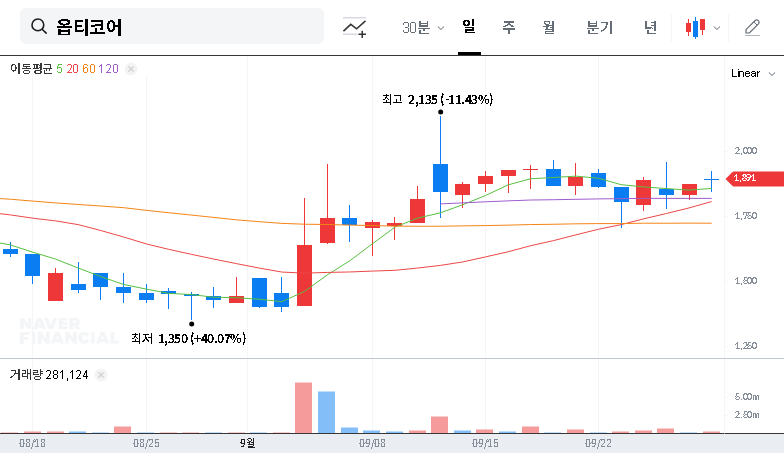
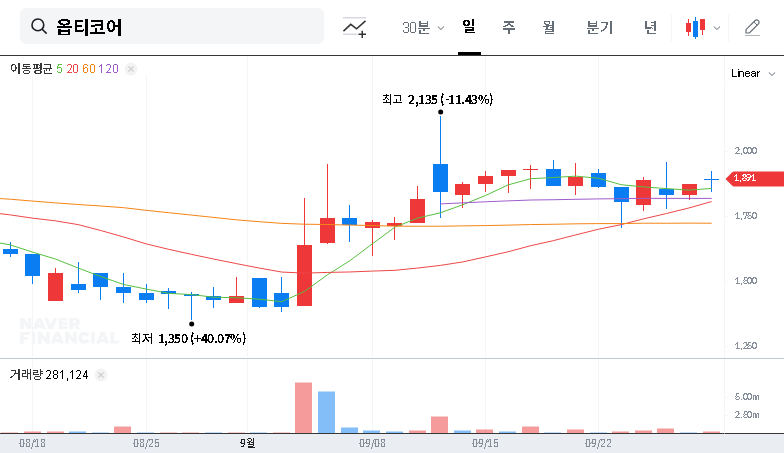
    • Conversion Price: KRW 1,847 (Slightly below the current stock price of KRW 1,891, increasing conversion likelihood)
    • Interest Rates: 2.0% coupon rate, 7.0% yield-to-maturity (YTM)
    • Conversion Period: From October 13, 2026, to September 13, 2028
    • Key Investors: A consortium of institutional investors including Baro Savings Bank, Korea Investment & Securities, and JC Asset Management.

    The Double-Edged Sword: Growth vs. Dilution

    This fundraising move presents both significant opportunities and notable risks for the company and its shareholders.

    The Upside: Fueling Future Growth in AI and 6G

    The primary positive takeaway is Opticore’s proactive stance on securing its future. Amid declining revenue in its core business, this capital injection is earmarked for R&D in high-growth sectors like Artificial Intelligence (AI) and the coming 6G era. Securing this funding, especially from reputable institutional investors, demonstrates a strong commitment to innovation and enhances short-term financial stability.

    The Downside: Understanding Share Dilution and Financial Burden

    The most significant risk is share dilution. When these bonds are converted, new shares are created. This increases the total number of outstanding shares, meaning each existing share represents a smaller percentage of the company. It’s like cutting a pizza into more slices; each slice becomes smaller. This can negatively impact metrics like Earnings Per Share (EPS), a key factor in stock valuation. To learn more, read our guide on Understanding Key Financial Metrics for Investors.

    Additionally, the bond’s interest payments add a direct financial burden, and the increased debt raises the company’s financial leverage, which could be a concern if the investments do not yield profitable returns promptly.

    Stock Price Forecast: Short-Term Pain for Long-Term Gain?

    Short-Term Outlook: Navigating Investor Sentiment

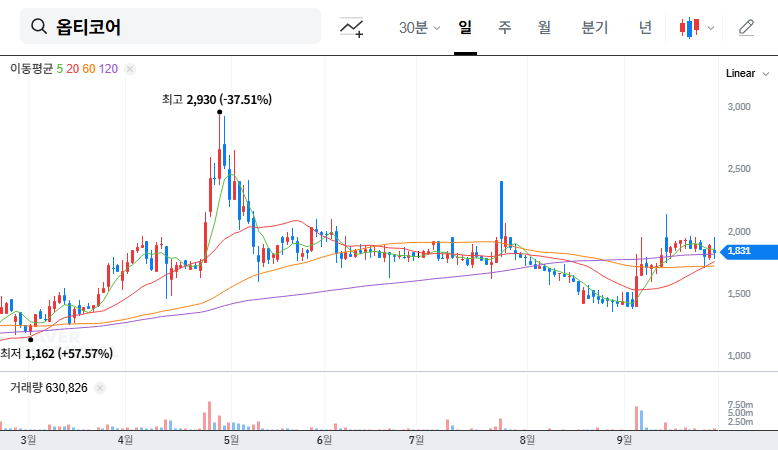
    In the short term, the market is likely to focus on the negatives. The overhang of potential share dilution can suppress investor sentiment. Traders may price in the risk of an increased share count, potentially leading to downward pressure or sideways movement in the Opticore stock price. The positive news of the funding may be overshadowed by these immediate concerns.

    Mid-to-Long-Term Outlook: The Bet on Innovation

    The long-term trajectory of Opticore’s stock will be determined by one thing: execution. The success or failure of the R&D and new business ventures funded by this KRW 9 billion will be the ultimate catalyst. If Opticore can develop and commercialize new technologies in AI and 6G, it could create substantial new revenue streams, improve fundamentals, and drive the stock price significantly higher, far outweighing the initial dilution. Conversely, if these investments fail to materialize, the company will be left with a heavier debt load and a diluted shareholder base, a recipe for poor stock performance.

    A Strategic Investment Blueprint

    Given the dual nature of the Opticore convertible bond issuance, a prudent investment strategy is required.

    • Monitor for Progress: Keep a close eye on company announcements regarding its R&D progress, partnerships, and new product timelines. Tangible results are the key to long-term value creation.
    • Assess Short-Term Volatility: Be prepared for price fluctuations in the near term. A cautious approach is warranted until the market digests the full impact of the potential dilution.
    • Evaluate the Macro Environment: Factors like interest rates and market liquidity will influence both Opticore’s financing costs and overall investor appetite for growth stocks.

    In conclusion, Opticore’s convertible bond issuance is a calculated risk. It’s a strategic pivot towards future technologies, financed in a way that presents both a challenge and an opportunity for investors. The ultimate verdict on whether this was a smart move will be written in the company’s performance over the coming years.

    (380540) Opticore Convertible Bond Issuance: A Deep Dive for Investors on Stock Price & Share Dilution 관련 이미지
    (380540) Opticore Convertible Bond Issuance: A Deep Dive for Investors on Stock Price & Share Dilution 관련 이미지
  • Opticore Stock Forecast: Major Shareholder Divestment – What Investors Need to Know


    Opticore Stock Forecast: Major Shareholder Divestment - What Investors Need to Know 대표 차트 이미지


    1. What Happened? : Analysis of Opticore’s Stake Divestment

    Daeho AL, Opticore’s largest shareholder, reduced its stake from 9.50% to 5.85% through the sale of convertible bonds and a portion of its held shares. This has created considerable market shock, and investors are expressing concerns about the future stock price trajectory.

    2. Why Did This Happen? : Background of the Divestment and Investor Sentiment Analysis

    The stated reasons for the sale are ‘partial sale of convertible bonds’ and ‘partial sale of held shares’, which are somewhat general. This uncertainty contributes to a decline in investor confidence. Especially considering Opticore’s challenging business environment (declining sales, widening operating losses, increasing financial burden, etc.), this stake sale is likely to be interpreted as a negative signal.

    3. So, What Happens to the Stock Price? : Opticore Stock Forecast and Volatility Analysis

    In the short term, Opticore’s stock price is expected to face downward pressure. The possibility of a large volume of sell-offs can amplify short-term stock price volatility. However, there’s a chance that the market has already partially factored in the potential stake sale. The future stock price trend will depend on further sell-offs, changes in Daeho AL’s remaining stake, and Opticore’s fundamental improvements.

    4. What Should Investors Do? : Investment Strategy and Precautions

    • Be aware of short-term stock price volatility.
    • Closely monitor the company’s business outlook and improvements in its financial status.
    • Pay attention to additional information disclosures and changes in market conditions.


    Frequently Asked Questions (FAQ)

    How will Opticore’s major shareholder’s stake sale affect the stock price?

    In the short term, it’s likely to put downward pressure on the stock price. Declining investor sentiment and sell-offs can burden the stock price.

    Should I invest in Opticore now?

    Investment decisions should be made carefully. Consider the company’s fundamentals, future business prospects, and market conditions comprehensively before making any investment decisions. Be cautious of short-term stock price volatility.

    What is the outlook for Opticore?

    The outlook will depend on factors such as further stake sales by Daeho AL and the company’s efforts to improve its fundamentals. Close monitoring is necessary.


    Opticore Stock Forecast: Major Shareholder Divestment - What Investors Need to Know 관련 이미지
    Opticore Stock Forecast: Major Shareholder Divestment - What Investors Need to Know 관련 이미지


  • Opticore’s After-Hours Trading Surge: Analyzing the Impact and Future Outlook

    1. What Happened?

    On August 22nd, Opticore saw significant after-hours trading activity. A large buy order of ₩1.1 billion from an institutional investor was recorded, alongside a smaller sell order from foreign investors totaling ₩0.08 billion. A total of 762,185 shares were traded.

    2. Why Did This Happen?

    Opticore reported declining sales and a shift to negative earnings in the first half of 2025. This was attributed to the slowdown in 5G investments and subsequent weaker demand for optical transceivers. However, Opticore is pursuing growth strategies, including developing high-speed optical transceivers for data centers in the AI era, expanding into overseas markets, and diversifying its business. The large institutional buy order could indicate a positive outlook on these growth strategies.

    3. What’s Next?

    The institutional buy order is expected to positively impact short-term supply and demand dynamics, potentially supporting Opticore’s stock price. It could also improve investor sentiment. However, increased price volatility is possible depending on market reactions in the following trading sessions.

    4. What Should Investors Do?

    Investors should carefully evaluate Opticore’s long-term growth potential rather than focusing solely on short-term price fluctuations. Key factors to monitor include the performance of new businesses, success in overseas market expansion, and management of financial health. Further changes in shareholding patterns should also be observed. While the after-hours trading activity might be a positive sign, sustainable stock price growth depends on fundamental improvements and the successful execution of growth strategies.

    Frequently Asked Questions

    What is after-hours trading?

    After-hours trading refers to the buying and selling of securities outside of regular trading hours. It can often reflect specific investor intentions or changing market conditions.

    What is the outlook for Opticore’s stock price?

    Opticore’s stock price is likely to be influenced by various factors, including the performance of new businesses, success in overseas market expansion, and the overall macroeconomic environment.

    What should investors consider before investing?

    Investors should consider the company’s financial health, growth strategies, and the competitive landscape before making any investment decisions. It’s important to remember that investments always carry risk and careful consideration is essential.