The recent announcement of the HiDeep capital reduction—a massive 80% cut—has understandably sent shockwaves through the investment community. For a company like HiDeep Inc. (365590) with a market capitalization of KRW 78.2 billion, such a drastic measure raises critical questions. Is this a savvy financial maneuver to clean up the balance sheet, or a distress signal that investors should heed? This comprehensive analysis will break down the what, why, and how of this decision, providing a clear roadmap for investors.
We will explore the short-term volatility, mid-term re-evaluation, and long-term outlook for HiDeep’s stock, covering the crucial period from the announcement on October 20, 2025, to the trading resumption on January 15, 2026. Most importantly, we’ll highlight the significant risk factors and strategic considerations to help you navigate this complex financial event.
First, What is a Gratuitous Capital Reduction?
Before diving into HiDeep’s specifics, it’s essential to understand the mechanism at play. A gratuitous capital reduction is a corporate action where a company reduces its stated capital without providing any compensation to shareholders. This is typically done to wipe out accumulated deficits or losses from the company’s balance sheet. By reducing the number of outstanding shares (in this case, through stock consolidation), the company can eliminate its deficit and present a healthier financial statement. However, as the name implies, it doesn’t change the company’s underlying intrinsic value or solve fundamental business problems on its own. It is a financial reset button. For a deeper dive into the concept, you can refer to authoritative sources like Investopedia’s guide on capital reduction.
The Official HiDeep Capital Reduction Announcement
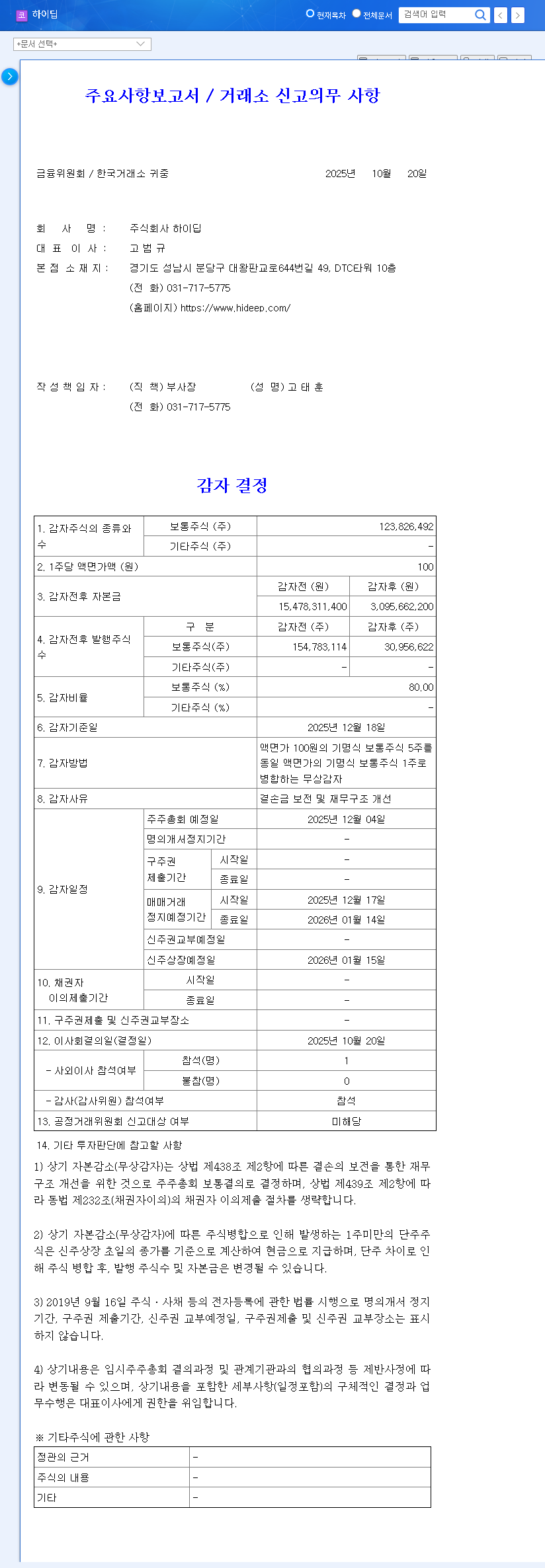
On October 20, 2025, HiDeep officially disclosed its decision for a significant 80% capital reduction. The primary reason cited was to ‘offset accumulated losses and improve its financial structure.’ This is a classic textbook reason for such a move, often undertaken when a company is facing capital impairment—a situation where total liabilities exceed total assets, or accumulated losses have eroded shareholder equity.
The core purpose of this action is to resolve a state of capital impairment, enhance the company’s financial statements, and create a healthier foundation for future fundraising and long-term investment.
Key Details at a Glance:
- •Reduction Ratio: 80.0% for common stock.
- •Shares Reduced: 123,826,492 common shares.
- •Method: Gratuitous reduction via stock consolidation (5 common shares merged into 1).
- •Official Disclosure: Source (DART Report)
Important Timeline for Investors:
- •Shareholders’ Meeting: December 4, 2025
- •Record Date: December 18, 2025
- •Trading Suspension Starts: December 17, 2025
- •Trading Resumption Date: January 15, 2026
Investor Impact Analysis: Short, Mid, and Long-Term
Understanding the investor implications is paramount. The effects of the HiDeep capital reduction will unfold in distinct phases.
Short-Term (Now until Dec 17, 2025): High Volatility & Negative Sentiment
An 80% capital reduction is a severe measure that signals urgent financial distress. In the immediate term, investors should anticipate significant downward pressure on the stock price. This act is a negative catalyst, often interpreted as a failure of past strategies. Expect heightened trading volume as existing shareholders exit and speculative traders enter, creating a volatile environment. Investor sentiment will likely remain weak, as the underlying profitability issues are not resolved by this accounting change alone.
Mid-Term (Dec 17, 2025 – Jan 15, 2026): The Information Vacuum
During the trading suspension, the market will digest this news. Investors and analysts will scrutinize any new information, searching for HiDeep’s future business plans and the true effectiveness of this financial restructuring. While the stock consolidation will mechanically increase the per-share price, it’s crucial to remember this does not create value. The company’s total market capitalization remains unchanged at the point of resumption. The focus will shift entirely to what comes next: can management present a credible turnaround story?
Long-Term (Post-Jan 15, 2026): A Story of Two Paths
The long-term trajectory depends entirely on execution. On the positive side, a cleaner balance sheet makes the company more attractive for new funding and partnerships. If HiDeep can leverage this financial reset to launch successful new business lines, improve profitability, and demonstrate strong management, the stock price could recover and grow. Conversely, if this is merely a cosmetic fix without addressing core operational weaknesses, the stock price will likely continue its decline. The long-term value hinges on fundamental business improvement, not accounting maneuvers.
Critical Risk Factors for HiDeep Investors
Prudent investors must monitor these key risks following the HiDeep capital reduction:
- •Unresolved Profitability: The reduction cleans the slate but doesn’t create revenue. If the core business continues to lose money, financial problems will reappear.
- •Lingering Negative Perception: A capital reduction of this magnitude can permanently damage a company’s reputation, making it difficult to attract long-term investors.
- •Market & Competitive Pressures: Any external headwinds, such as increased competition or a downturn in their industry, could derail recovery efforts.
- •Future Dilution Risk: A clean balance sheet may be a prelude to raising new capital. If new shares are issued, it could dilute the value for existing shareholders who endured the reduction.
Conclusion: A Strategic Guide for Prudent Investment
HiDeep’s 80% capital reduction is a clear signal of past financial struggles, but it is also a potential turning point. Investors should shift their focus from the event itself to what follows. The key to a successful investment from here is not the stock consolidation but the company’s ability to execute a viable turnaround strategy.
Moving forward, it is essential to continuously monitor company disclosures, analyze new business strategies, and track financial performance post-reduction. For more guidance on evaluating companies in similar situations, consider reading related articles on how to analyze a company’s financial health. Always base investment decisions on thorough research and professional advice, especially during periods of high uncertainty.