Tag: 241560

  • (241560) Doosan Bobcat Dividend Analysis (241560): What Investors Must Know for Q4 2025

    (241560) Doosan Bobcat Dividend Analysis (241560): What Investors Must Know for Q4 2025

    The recent announcement of the Doosan Bobcat dividend for Q4 2025 has captured significant attention from the investment community. For current and prospective shareholders of Doosan Bobcat Inc. (KRX: 241560), this decision raises crucial questions: Does this payout signal underlying strength despite a challenging first half of the year? And how should this factor into your long-term view of Doosan Bobcat stock? This comprehensive analysis will explore the specifics of the dividend, dissect the company’s financial health, and evaluate the macroeconomic environment to provide a clear, actionable perspective for investors.

    Unpacking the Q4 2025 Doosan Bobcat Dividend Announcement

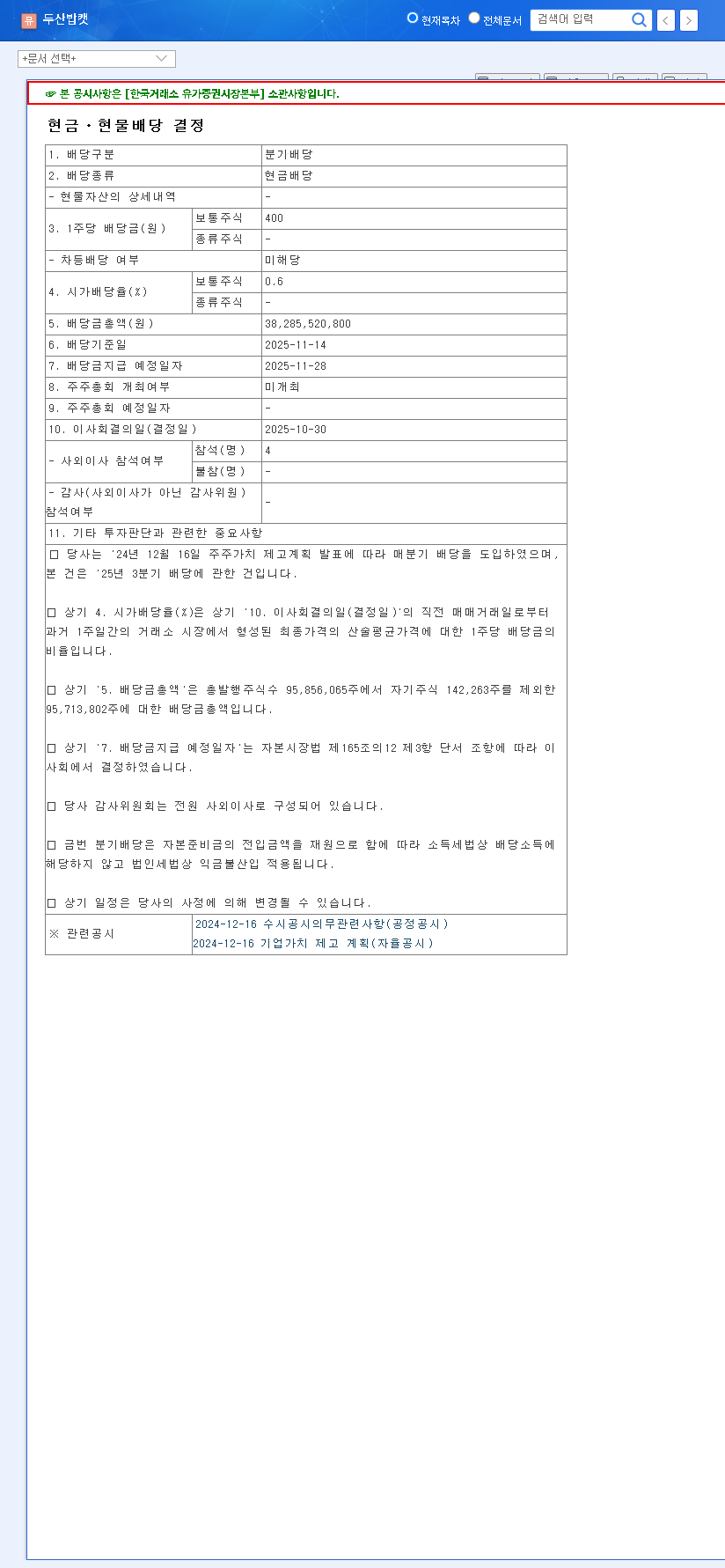
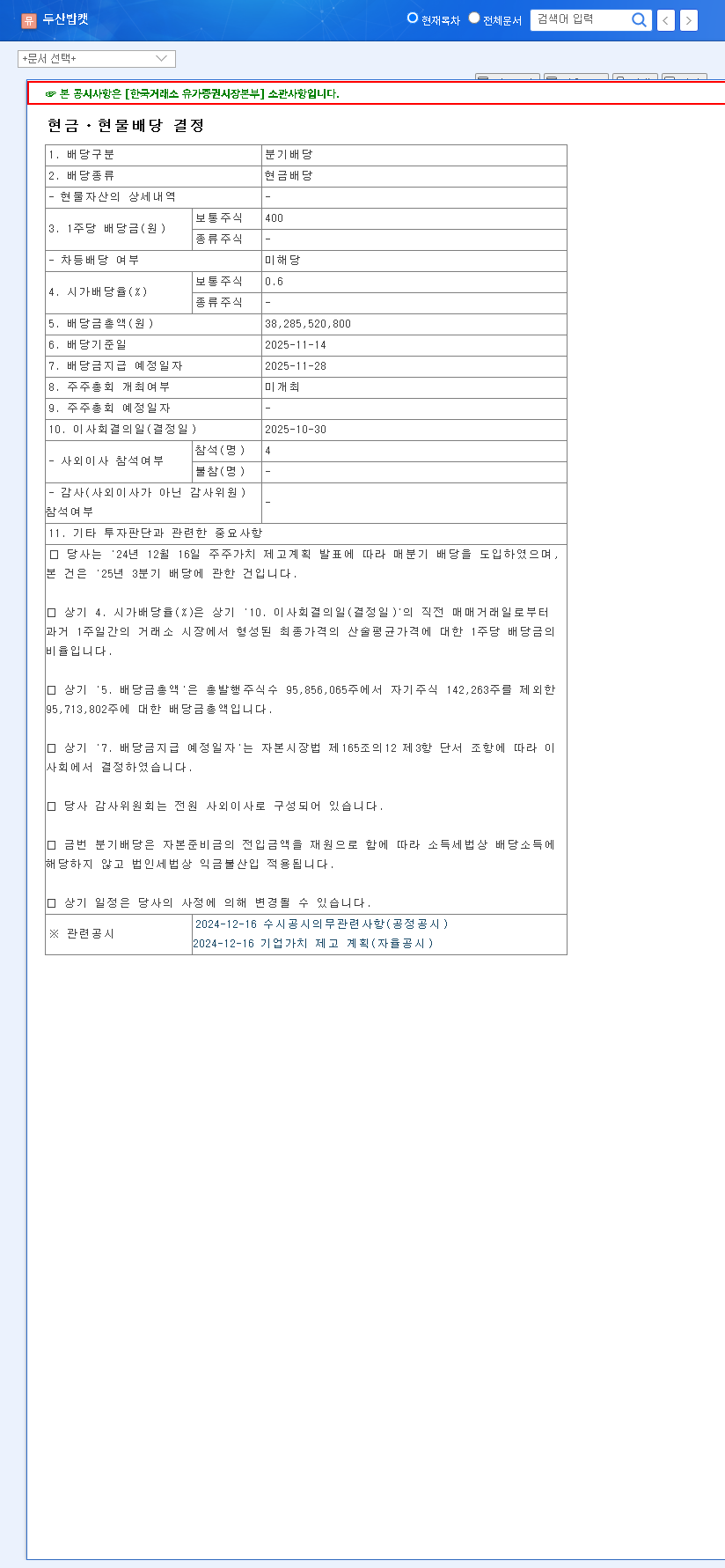
    On October 30, 2025, Doosan Bobcat Inc. officially declared its quarterly cash dividend, reinforcing its commitment to its shareholder return policy. This move, detailed in their Official Disclosure (Source), is often seen as a sign of management’s confidence in future cash flow stability. Here are the critical details at a glance:

    • Event Type: Cash Dividend (Quarterly)
    • Dividend per Common Share: 400 KRW
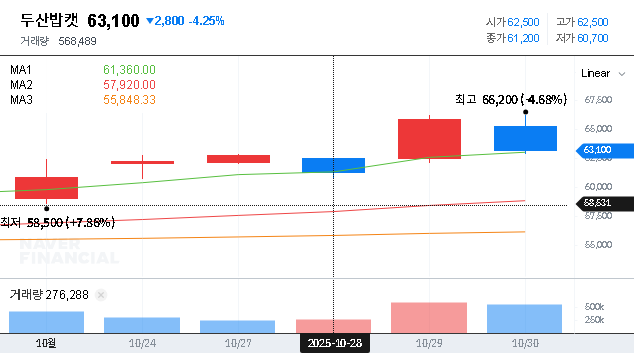
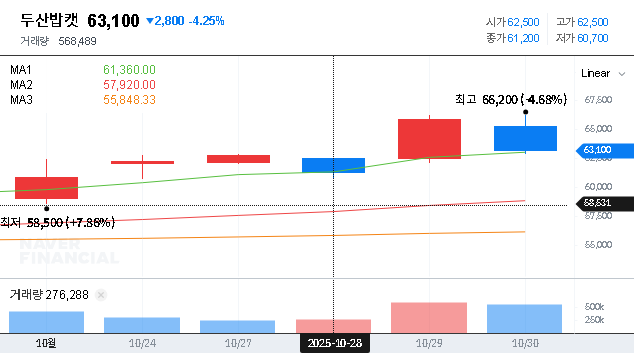
    • Dividend Yield: Approximately 0.6% (based on a price of 81,048 KRW)
    • Record Date: November 14, 2025
    • Payment Date: November 28, 2025

    Financial Health & Market Headwinds: The ‘Why’ Behind the Payout

    To fully appreciate this dividend decision, we must place it in the context of the company’s recent performance and the broader economic climate. While the payout is a positive gesture, the underlying financials reveal a more complex picture.

    A Challenging H1 2025 Performance

    The first half of 2025 was marked by significant headwinds for Doosan Bobcat. A downturn in the global construction equipment and industrial vehicle markets led to a steep 52% year-over-year revenue decline. This slump compressed the operating profit margin from 9.4% to just 4.3%, signaling a sharp erosion in profitability. Despite this, the company’s operating cash flow saw a 21% increase, a testament to efficient working capital management. This cash flow strength is a critical factor enabling the company to sustain its shareholder return policies, including this 241560 dividend payment.

    Navigating the Macroeconomic Landscape

    The external environment remains a primary concern for any Doosan Bobcat investor analysis. Persistent high-interest rates in key markets like North America and Europe directly impact sales, as they increase the cost of financing for customers purchasing heavy equipment. While a weaker KRW can benefit exports, volatile energy prices and shipping costs present ongoing risks to the company’s cost structure. For more on market trends, investors often consult resources like Bloomberg’s construction industry reports.

    The decision to issue a dividend amidst declining revenue and macroeconomic pressure suggests management’s confidence in a second-half recovery and the long-term strategic value of its recent acquisitions.

    What This Dividend Means for Doosan Bobcat Stock Investors

    How should investors interpret this event? The implications can be viewed from both a positive (bullish) and a cautious (bearish) perspective.

    The Bull Case: Positive Signals for Long-Term Value

    • Commitment to Shareholders: A consistent dividend, even a modest one, attracts income-focused investors and signals a disciplined approach to capital allocation.
    • Fundamental Recovery on the Horizon: The payout can be seen as management telegraphing a belief in a profitable turnaround for the full year, boosting investor confidence in the Doosan Bobcat stock outlook.
    • Strategic Diversification: The recent acquisition of Doosan Motrol Co., Ltd. expands the company’s portfolio into hydraulic components, creating new revenue streams and growth potential that may not be fully priced into the stock yet. You can learn more by reading our guide on how to analyze industrial acquisitions.

    The Bear Case: Potential Risks and Considerations

    • Profitability Concerns: The sharp drop in H1 2025 performance is a major red flag. If market conditions do not improve, the sustainability of future dividend payments could come into question.
    • Macroeconomic Uncertainty: A global economic slowdown remains a potent threat that could further suppress demand for construction and industrial equipment, impacting revenue and cash flow.
    • Modest Yield: At 0.6%, the current dividend yield is relatively low and may not be compelling enough to attract significant new capital or offset potential price volatility.

    Strategic Outlook: Key Takeaways for Your Investment Thesis

    The Q4 2025 Doosan Bobcat dividend is a positive gesture of shareholder commitment but should not be viewed in isolation. The company’s long-term investment appeal hinges on a demonstrable recovery in its core markets and the successful integration of its new hydraulics business. While the dividend provides a small return, investors should focus more on the upcoming earnings reports for signs of a sustained operational turnaround.

    In conclusion, this dividend decision adds a layer of stability to the investment case but the primary driver for Doosan Bobcat stock will be its ability to navigate economic uncertainty and execute on its growth strategy. Cautious optimism is warranted, with a keen eye on performance metrics in the coming quarters.

    Disclaimer: This analysis is for informational purposes only and should not be considered investment advice. All investment decisions are the sole responsibility of the investor.
    (241560) Doosan Bobcat Dividend Analysis (241560): What Investors Must Know for Q4 2025 관련 이미지
  • (241560) Doosan Bobcat Q3 Results: Deep Dive Analysis for Investors (2025)

    (241560) Doosan Bobcat Q3 Results: Deep Dive Analysis for Investors (2025)

    The latest provisional Doosan Bobcat Q3 results have created a complex narrative for investors. While the company celebrated a modest revenue beat, a significant shortfall in profitability has raised serious questions about its operational health and future stock performance. According to the Official Disclosure, the divergence between sales and earnings points to mounting pressures from both a slowing global economy and rising operational costs.

    This in-depth Doosan Bobcat analysis will dissect the Q3 performance, explore the root causes of the profitability decline, and provide a clear outlook for investors navigating this uncertain period. We will examine the challenges facing the construction equipment market and what it means for Doosan Bobcat stock.

    Doosan Bobcat Q3 Results: A Closer Look at the Numbers

    At first glance, the top-line figures seem encouraging. However, the story quickly changes as we move down the income statement, revealing significant challenges to Doosan Bobcat profitability.

    • Revenue: KRW 2,115.2 billion, which is a 3.4% beat over market consensus. This suggests continued demand and effective sales execution.
    • Operating Profit: KRW 133.6 billion, a significant 18.0% miss compared to expectations. This is the first major red flag, indicating that the cost of generating revenue is escalating.
    • Net Profit: KRW 81.9 billion, a staggering 36.2% below forecasts. This dramatic shortfall highlights the combined impact of operational issues and financial costs.

    Analyzing the Profitability Gap: External Pressures & Internal Shifts

    The sharp decline in profitability wasn’t caused by a single factor but a confluence of challenging macroeconomic conditions and internal business dynamics. Understanding these pressures is key to evaluating the company’s future.

    Global Headwinds: The Macroeconomic Squeeze

    Doosan Bobcat operates in a cyclical industry, making it highly sensitive to global economic trends. Several external factors are currently compressing margins:

    • Construction Market Slowdown: Persistently high interest rates in North America and Europe, driven by central bank policies (as detailed by institutions like the Federal Reserve), have cooled the construction boom. This directly impacts sales of heavy equipment.
    • Elevated Costs: A surge in raw material prices, particularly steel, and volatile logistics costs tied to global shipping indexes have directly increased the cost of goods sold.
    • Currency and Rate Volatility: While a strong USD can boost translated revenue, it also creates hedging challenges. More importantly, rising interest rates increase the company’s financing costs, directly eating into net profit.

    Internal Strategy: Diversification vs. Core Business Weakness

    Internally, Doosan Bobcat is making strategic moves to build long-term resilience. The acquisition of Motrol Co., Ltd. introduced a hydraulic equipment business, a smart diversification that has already shown impressive growth of over 120%. This new segment is a bright spot, contributing positively to the top line.

    However, this positive step was overshadowed by a significant slump in the core Construction Equipment (CE) division. Sales in key markets of North America and Europe fell sharply, causing the segment’s operating profit to plummet by 32.4%. This highlights a vulnerability in the company’s primary revenue stream that the new ventures cannot yet fully offset.

    While top-line growth is positive, the market’s focus has decisively shifted to bottom-line execution and margin preservation. The immediate reaction to the Doosan Bobcat Q3 results will be driven by the profit miss.

    Doosan Bobcat Stock: Investor Outlook and Key Factors

    For current and potential investors, the key question is how this translates to stock performance. The outlook is bifurcated between short-term headwinds and long-term potential.

    Short-Term Caution Warranted

    In the short term, downward pressure on Doosan Bobcat stock is almost inevitable. The market typically punishes significant earnings misses harshly, as they signal potential underlying issues with cost control or demand forecasting. Investors will likely remain cautious until there is clear evidence of margin stabilization.

    Path to Long-Term Value Recovery

    Despite the short-term pain, Doosan Bobcat is laying the groundwork for future growth. Investors should monitor the progress of these initiatives, as they will be the primary catalysts for a long-term re-rating of the stock. For more context, you can read our analysis of broader construction sector trends.

    Final Verdict & Investor Checklist

    The Doosan Bobcat Q3 results signal a period of transition. The company achieved sales growth but failed to protect its bottom line. A conservative, observant approach is recommended. Investors should closely monitor the following points in upcoming quarters:

    • Cost Management: Look for specific commentary and results related to controlling raw material and logistics expenses.
    • Core Business Rebound: Is the decline in the Construction Equipment segment stabilizing or reversing?
    • New Segment Contribution: How is the hydraulic equipment business contributing to overall profitability, not just revenue?
    • Shareholder Returns: Are buybacks and dividends being maintained, signaling management’s confidence?

    Ultimately, a sustained improvement in Doosan Bobcat profitability will be the most critical factor in restoring investor confidence and driving the stock price higher.

    (241560) Doosan Bobcat Q3 Results: Deep Dive Analysis for Investors (2025) 관련 이미지
  • (241560) Doosan Bobcat Q3 Earnings 2025: A Deep-Dive Financial Analysis for Investors

    (241560) Doosan Bobcat Q3 Earnings 2025: A Deep-Dive Financial Analysis for Investors

    As the highly anticipated Doosan Bobcat Q3 earnings announcement for 2025 approaches, investors and market analysts are on high alert. Following a challenging first half of the year, the upcoming Investor Relations (IR) conference on October 30, 2025, represents a critical juncture for the global leader in compact construction equipment. This report will provide a comprehensive financial analysis of the company’s position, exploring the factors that will shape the Doosan Bobcat stock performance and offering a detailed roadmap for investors navigating this pivotal event.

    Will the third quarter signal a robust turnaround, or will macroeconomic headwinds continue to apply pressure? We delve into the H1 performance, the strategic acquisition of Doosan Motrol, and the key indicators to watch during the announcement. For official corporate filings, please refer to the company’s disclosure. (Source: Official DART Disclosure)

    Reviewing H1 2025: Navigating a Slowdown

    To understand the significance of the Q3 results, we must first examine the challenges faced in the first half of 2025. The company’s consolidated performance revealed a slowdown that has set a cautious tone in the market.

    Key Financial Metrics from H1 2025

    • Revenue & Profitability Dip: Consolidated revenue fell by 12.3% year-over-year to 3,011,017 thousand USD. More concerning was the 32.4% drop in operating profit to 283,088 thousand USD, signaling significant margin compression.
    • Segment Performance: The decline was primarily driven by underperformance in the Portable Power segment and a general slowdown in the North American and European construction markets. However, the core Compact Equipment segment remained a pillar of strength, contributing 77.4% of total revenue.
    • Financial Health: Despite profitability concerns (ROE at 1.71 USD and operating margin at 9.4%), the company’s financial structure remains stable with a debt-to-equity ratio of 75.77%.

    The acquisition of Doosan Motrol in late 2024 is a strategic masterstroke. Securing an in-house hydraulics supply chain not only de-risks manufacturing but also positions Bobcat as a more integrated and innovative player in the construction equipment industry.

    Unpacking the Doosan Bobcat Q3 Earnings Potential

    The upcoming Doosan Bobcat Q3 earnings report is the market’s first real chance to see if the company’s strategies are paying off. The stock price could swing significantly based on whether the results and outlook are positive or negative.

    Potential Positive Catalysts

    • Performance Rebound: Any sign of recovery in the Portable Power segment or continued resilience in Compact Equipment could signal a bottoming-out process, boosting investor confidence.
    • Hydraulics Synergy: Concrete details on cost savings, production efficiencies, and new product capabilities from the Doosan Motrol acquisition would be a major positive.
    • Shareholder Returns: The ongoing 200 billion KRW share buyback is expected to support EPS. Further positive guidance on shareholder-friendly policies could lift the stock.

    Key Risks and Headwinds

    • Persistent Weakness: If Q3 results show a continued slide or fall short of already tempered expectations, it could trigger a significant sell-off.
    • Macroeconomic Pressure: Persistent high interest rates in the US and Europe can dampen demand for high-cost machinery. According to Reuters, global recession fears remain a significant overhang for industrial sectors.
    • Competitive Environment: The construction equipment industry is fiercely competitive. Any loss of market share to rivals would be a major red flag for investors.

    Investor Action Plan & Final Outlook

    This financial analysis 2025 points to a critical need for clarity from Doosan Bobcat’s management. Investors should approach the IR event with a clear checklist:

    1. Listen for the ‘Why’: Demand a clear explanation for the H1 revenue decline and specific strategies to address it, particularly in the Portable Power segment.

    2. Scrutinize Future Guidance: Pay close attention to the outlook for Q4 and early 2026. Is management confident in a recovery? Are they seeing green shoots in key markets?

    3. Assess Investment ROI: The company plans to invest ~301,787 thousand USD in 2025. Investors need to understand where this capital is going and what the expected returns are. For a broader context, see our 2025 Construction Equipment Industry Outlook.

    In conclusion, the Doosan Bobcat Q3 earnings call is more than just a financial report; it’s a referendum on the company’s strategy and resilience. A positive surprise could reignite the stock, while a disappointment could lead to further downside. Cautious and informed participation in the upcoming investor relations event will be key to making sound investment decisions.

    (241560) Doosan Bobcat Q3 Earnings 2025: A Deep-Dive Financial Analysis for Investors 관련 이미지
  • (241560) Doosan Bobcat Q3 2025 IR: Stock Price Analysis & Investor Guide (241560)

    (241560) Doosan Bobcat Q3 2025 IR: Stock Price Analysis & Investor Guide (241560)

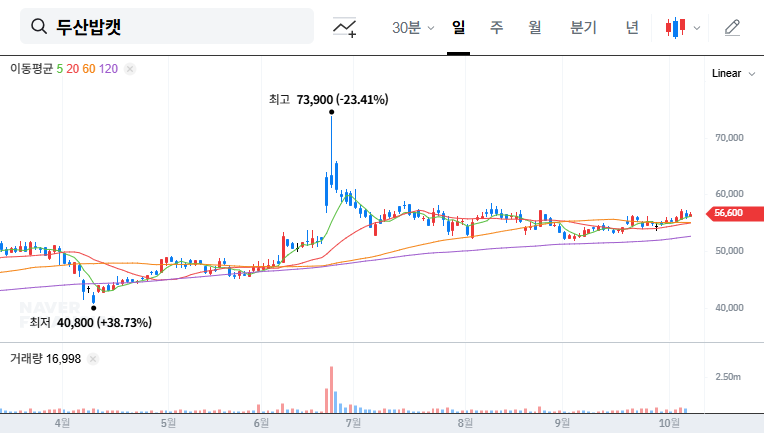
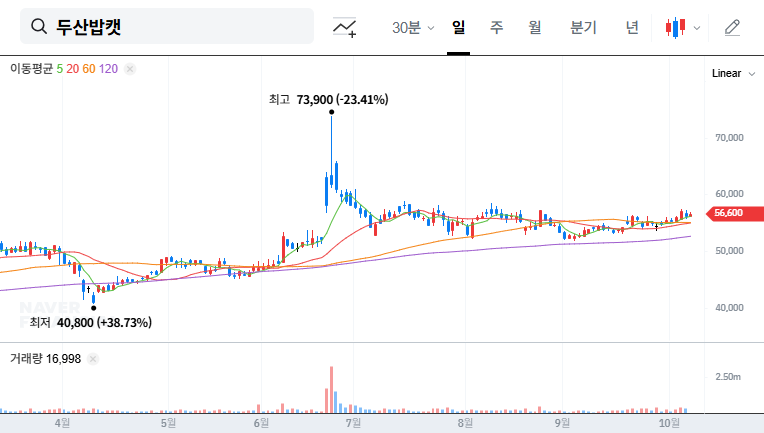
    Investors in Doosan Bobcat Inc. (241560) are marking their calendars for a pivotal event. The upcoming Doosan Bobcat Q3 2025 IR (Investor Relations) session is poised to be a critical moment, offering deep insights into the company’s performance and future strategy. This briefing isn’t just about the numbers; it’s a forward-looking statement on navigating macroeconomic headwinds and sustaining growth. For those monitoring the Doosan Bobcat stock price, this event will be a key determinant of market sentiment and future valuation.

    With factors like fluctuating global construction demand, persistent high interest rates, and volatile raw material costs creating a complex landscape, this IR serves as a crucial platform. It’s an opportunity for management to reaffirm the company’s fundamentals and articulate a clear vision for the future. Let’s explore the key details and what investors should be watching for.

    Event Details: The Q3 2025 Investor Relations Briefing

    Doosan Bobcat has officially scheduled its Investor Relations (IR) session for domestic institutional investors. Here are the essential details:

    • Event: Q3 2025 Business Performance Briefing & Q&A
    • Date: October 31, 2025
    • Time: 09:00 AM (KST)
    • Format: Non-Deal Roadshow (NDR)
    • Source: Official Disclosure (DART)

    Analyzing Doosan Bobcat’s Financial Health & Market Position

    Before the IR, it’s vital to understand the company’s current standing, which is a mix of robust fundamentals and significant external pressures. This forms the basis for any 241560 stock analysis.

    Core Strengths (Bullish Factors)

    • Shareholder Commitment: The company has a proven track record of returning value to shareholders, exemplified by its 200 billion KRW share buyback and cancellation program.
    • Diversified Global Footprint: A resilient sales network spanning North America, Europe, and Asia, combined with a diverse portfolio (construction, portable power, material handling), helps buffer against regional downturns. New ventures into agriculture and landscaping further mitigate construction market cyclicality.
    • Future-Focused R&D: Significant and sustained investment in electrification, automation, and unmanned technology positions Doosan Bobcat as a leader in the next generation of industrial equipment.

    Headwinds & Challenges (Bearish Factors)

    • Macroeconomic Pressure: The global economic slowdown, as reported by sources like Reuters, and higher interest rates are directly impacting construction equipment demand, leading to recent declines in sales and operating profit.
    • Currency and Cost Volatility: As a global operator, Doosan Bobcat is exposed to foreign exchange fluctuations (KRW/USD, KRW/EUR). In addition, volatile raw material prices can squeeze profit margins if not managed effectively.
    • Rising Investment Costs: While crucial for long-term growth, the heavy investment in R&D and new technologies can exert short-term pressure on profitability metrics.

    The central question for the Doosan Bobcat Q3 2025 IR is whether the company’s long-term strategic initiatives can convincingly outweigh the short-term macroeconomic challenges in the eyes of investors.

    Potential Scenarios for the Doosan Bobcat Stock Price

    The market’s reaction will hinge on the details and tone of the presentation. Here are three potential outcomes for the Doosan Bobcat stock price following the IR.

    1. The Bullish Scenario (Positive Impact)

    If management delivers better-than-expected Q3 Doosan Bobcat earnings, provides a confident outlook for Q4 and 2026, and showcases tangible progress in new markets or technologies, investor confidence could surge. Any announcement of further shareholder return policies would act as a powerful catalyst, potentially driving the stock price higher.

    2. The Neutral Scenario (Limited Impact)

    The company might report in-line earnings but offer a cautious outlook, citing ongoing global uncertainty. In this case, the stock may see little movement. While the strong fundamentals prevent a sell-off, the lack of a near-term catalyst could keep the stock trading within its current range as investors adopt a ‘wait-and-see’ approach.

    3. The Bearish Scenario (Negative Impact)

    A miss on Q3 earnings, coupled with a downward revision of future guidance, would likely disappoint the market. If management fails to provide clear strategies to counter declining sales or rising costs, it could trigger a sell-off. Increased concerns about interest rate sensitivity or market share loss to competitors would amplify the negative reaction.

    Action Plan: Key Items for Investors to Monitor

    To make an informed decision, investors should actively listen and analyze the following aspects during and after the Doosan Bobcat investor relations call:

    • Forward-Looking Guidance: Pay closest attention to the outlook for Q4 2025 and the preliminary forecast for 2026. Are they signaling stabilization, recovery, or further decline?
    • Margin Commentary: Listen for management’s comments on operating profit margins. Are they successfully passing on costs? How are they managing supply chain and material price volatility?
    • Institutional Q&A: The questions from institutional analysts can reveal underlying concerns in the market. The tone and depth of management’s answers are often very telling.
    • Capital Allocation Strategy: Look for any updates on share buybacks, dividends, or major capital expenditure plans. For more on this, review our guide on how to analyze a company’s financial statements.

    Ultimately, the Doosan Bobcat Q3 2025 IR is a major event that will provide clarity on the company’s trajectory. By carefully analyzing the information presented against the broader economic context, investors can make more strategic and well-informed decisions regarding their position in Doosan Bobcat (241560).

    (241560) Doosan Bobcat Q3 2025 IR: Stock Price Analysis & Investor Guide (241560) 관련 이미지
  • Doosan Bobcat Investment Strategy After Corporate Briefing: Analyzing Short-Term Uncertainty and Long-Term Growth Potential

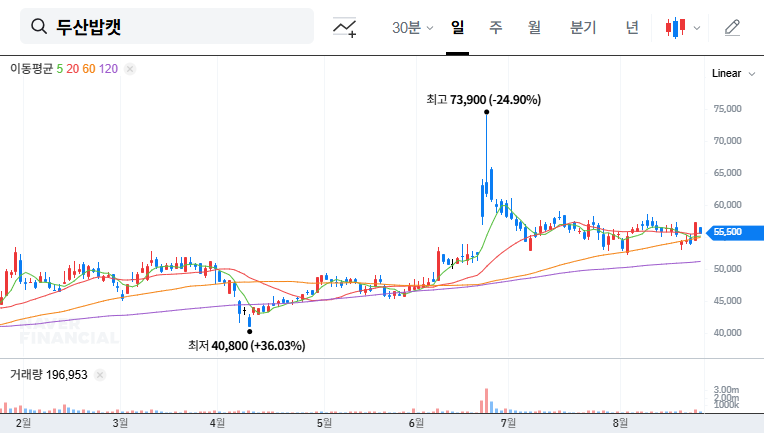
    Doosan Bobcat Investment Strategy After Corporate Briefing: Analyzing Short-Term Uncertainty and Long-Term Growth Potential 대표 차트 이미지

    What Happened?: Doosan Bobcat Holds Corporate Briefing

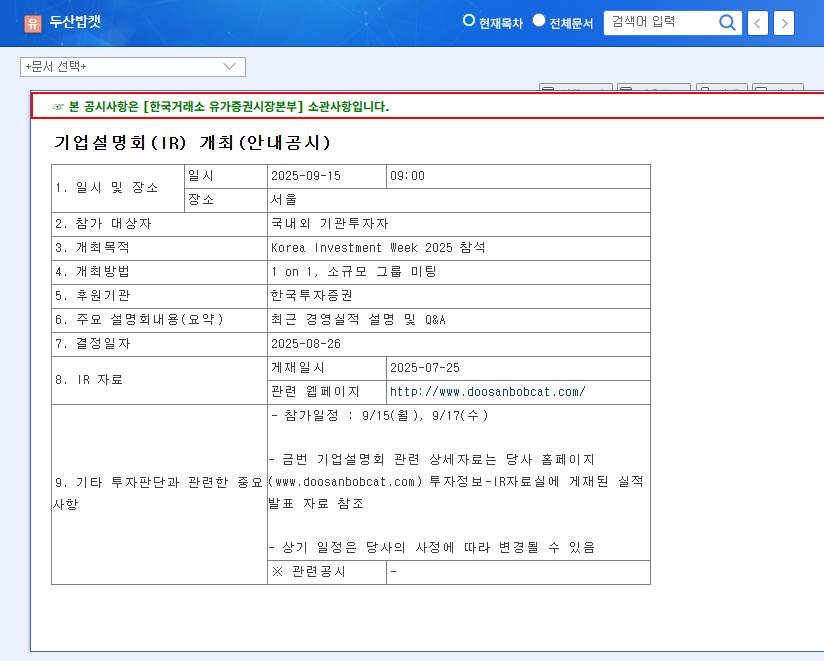
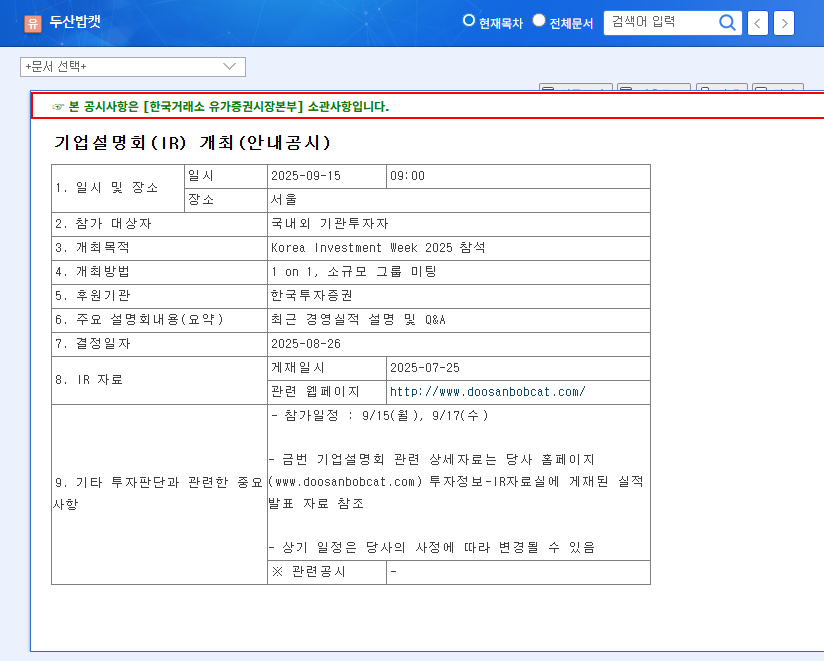
    Doosan Bobcat held a corporate briefing at Korea Investment Week 2025 on September 15, 2025. The company presented its recent performance results and future growth strategies, followed by a Q&A session with investors.

    Why It Matters: Balancing Short-Term Uncertainty with Long-Term Growth

    Doosan Bobcat experienced a decline in performance in the first half of 2025 due to factors such as the global construction slowdown. However, the company maintains long-term growth potential thanks to its strong brand recognition, new technology development, and business diversification. This corporate briefing was a crucial opportunity to accurately diagnose the current situation and assess future strategies.

    Fundamental Analysis: Short-Term Challenges vs. Long-Term Opportunities

    • Short-term threats: Global economic slowdown, raw material price volatility
    • Long-term opportunities: Strong brand power, new technology development (electrification, autonomous driving), hydraulic equipment business acquisition, shareholder return policy

    Investor Action Plan: “Wait and See” Strategy

    • Short-term: Analyze corporate briefing results and monitor macroeconomic indicators
    • Long-term: Make investment decisions after confirming construction market recovery, new business performance, and synergy effects

    It is crucial to carefully review the contents of the corporate briefing and management’s response strategies, and to continuously monitor macroeconomic variables when making investment decisions.

    How was Doosan Bobcat’s performance in the first half of 2025?

    Revenue in the first half of 2025 was USD 3.01102 billion, down 12.26% year-on-year, and operating profit was USD 283.09 million, down 32.19% year-on-year. The deteriorating global macroeconomic environment, including the global construction slowdown, was the main cause.

    What are Doosan Bobcat’s future growth drivers?

    Doosan Bobcat’s future growth drivers include strong brand recognition, development of electrification and autonomous driving technologies, business diversification through the acquisition of the hydraulic equipment business, and an active shareholder return policy.

    What should investors consider when investing in Doosan Bobcat?

    Investors should consider the corporate briefing content, management’s commitment to improving performance and future growth strategies, and macroeconomic variables when making investment decisions.

    Doosan Bobcat Investment Strategy After Corporate Briefing: Analyzing Short-Term Uncertainty and Long-Term Growth Potential 관련 이미지
  • Doosan Bobcat at KB Korea Conference 2025: A Turnaround Opportunity?

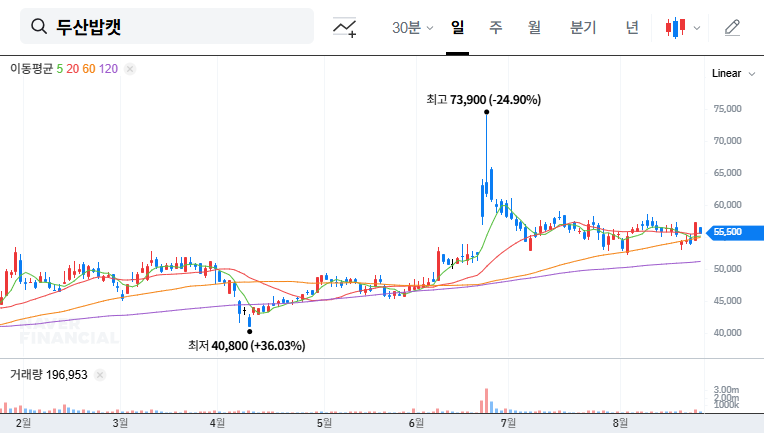
    Doosan Bobcat at KB Korea Conference 2025: A Turnaround Opportunity? 대표 차트 이미지

    1. Doosan Bobcat IR Event: What Happened?

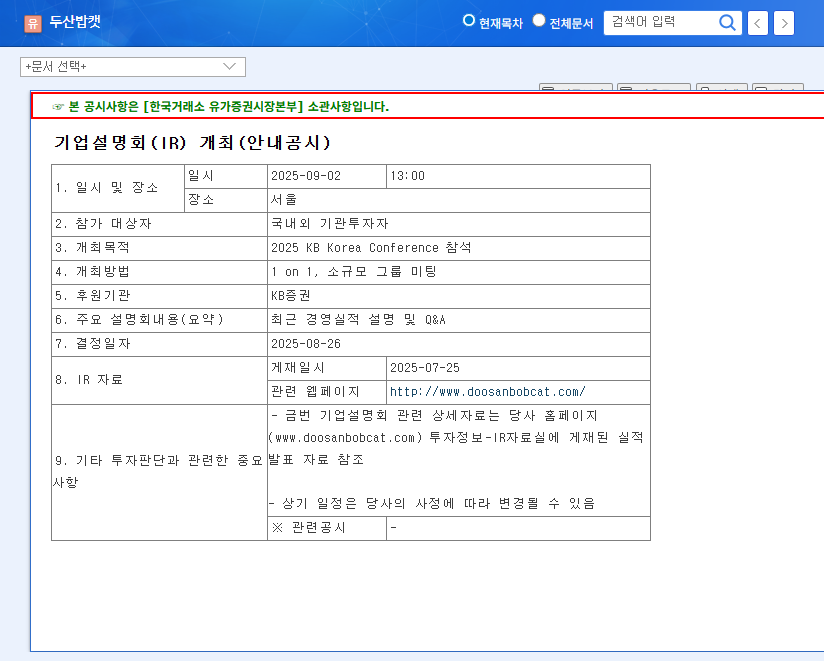
    Doosan Bobcat held an investor relations (IR) presentation at the 2025 KB Korea Conference on September 2nd. The company presented its recent performance results and future business strategies, followed by a Q&A session with investors.

    2. Key Analysis: Why is it Important?

    Doosan Bobcat has experienced a performance slump in recent years. This IR was a crucial opportunity to assess the company’s potential for a turnaround. Investors were particularly interested in the synergy effects following the Doosan Mottrol acquisition and the company’s strategy for securing future growth engines. The company’s response to external factors such as the global economic slowdown and raw material price volatility was also a key concern.

    3. Key Takeaways and Outlook: What’s Next?

    The core messages of this IR were the earnings improvement outlook, the strategy to maximize synergy effects from the Doosan Mottrol acquisition, and the company’s vision for future growth. The stock’s direction will likely depend on whether the company delivered positive messages that met market expectations. Management’s firm commitment to growth and presentation of a concrete action plan will play a crucial role in improving investor sentiment.

    • Positive Scenario: A positive earnings outlook and the presentation of a concrete growth strategy could improve investor sentiment, leading to a potential stock price increase.
    • Negative Scenario: If performance falls short of market expectations or the future outlook is uncertain, the stock price could decline.

    4. Action Plan for Investors

    Investors should thoroughly review the IR materials and related analysis reports, carefully evaluating the company’s medium to long-term growth potential. An investment strategy focused on the company’s fundamentals and future value, rather than short-term stock price fluctuations, is recommended.

    Frequently Asked Questions

    What are Doosan Bobcat’s main businesses?

    Doosan Bobcat’s primary businesses are construction equipment and hydraulics. They recently strengthened their hydraulics business segment through the acquisition of Doosan Mottrol.

    What were the key takeaways from this IR?

    Key takeaways include the outlook for earnings improvement, synergy effects from the Doosan Mottrol acquisition, and strategies for securing future growth engines.

    What should investors be aware of?

    Investors should consider external risk factors such as the global economic slowdown and raw material price volatility. They should also carefully analyze the speed and sustainability of the company’s earnings improvement.

    Doosan Bobcat at KB Korea Conference 2025: A Turnaround Opportunity? 관련 이미지