Tag: 204270

  • (204270) JNTC Treasury Stock Disposal: A Deep-Dive Stock Analysis for Investors

    (204270) JNTC Treasury Stock Disposal: A Deep-Dive Stock Analysis for Investors

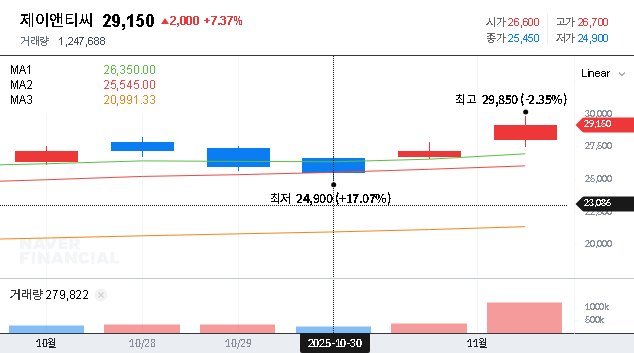
    JNTC CO.,LTD. (KOSDAQ: 204270) has captured significant market attention with its recent announcement of a major JNTC treasury stock disposal. The company plans to raise approximately 12.4 billion KRW, a move that comes at a critical juncture, given its struggling first-half 2025 performance. For investors, this raises a crucial question: is this a desperate measure to shore up failing finances, or a strategic masterstroke to fund next-generation growth? This comprehensive JNTC investor guide will dissect the company’s fundamentals, analyze the implications of the disposal, and provide a clear roadmap for your investment decisions.

    The Catalyst: A 12.4 Billion KRW Treasury Stock Disposal

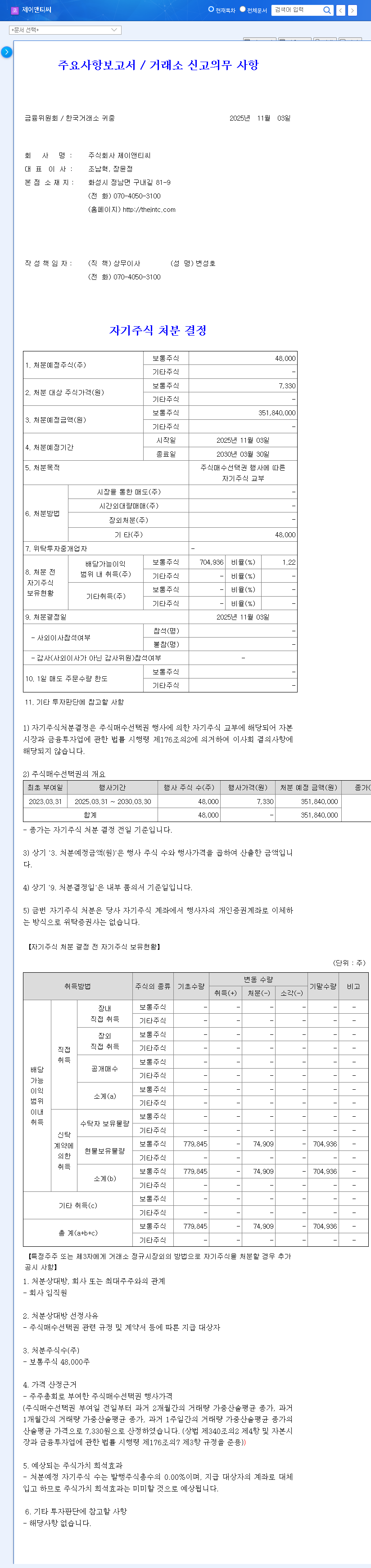
    On November 3, 2025, JNTC officially announced its decision to dispose of 381,000 of its own treasury shares. According to the Official Disclosure on DART, the purpose is not a simple market sale but to raise capital by issuing JNTC exchangeable bonds (EB) with these shares as the underlying asset. This method was chosen to secure vital liquidity for company operations and to finance future investment initiatives.

    Why Now? An Urgent Need Fueled by Challenging Fundamentals

    The timing of this JNTC treasury stock disposal is directly linked to the company’s deteriorating financial health and a tough market environment. A closer look at the JNTC fundamentals reveals a company under pressure:

    • Severe Sales Decline: First-half 2025 sales plummeted to 104.1 billion KRW, a staggering 45.9% drop year-over-year. The core reinforced glass business was hit hard by reduced orders from the Greater China region amid a global smartphone market slowdown.
    • Plummeting Profitability: The company fell deep into the red, posting an operating loss of 38 billion KRW and a net loss of 57.6 billion KRW, a significant expansion of its deficit.
    • Rising Financial Burden: The debt-to-equity ratio climbed to 103.90%, signaling increased financial risk and pressure on the balance sheet.

    This isn’t just about plugging a hole. Management’s use of exchangeable bonds signals a calculated move to secure capital while attempting to manage shareholder dilution, betting that future growth will outweigh the immediate risks.

    JNTC’s Strategic Pivot: The Growth Engines of Tomorrow

    Despite the grim financials, JNTC is not standing still. The capital raised is earmarked for ventures that could redefine the company’s future. This is a critical part of any JNTC stock analysis.

    1. The TGV Glass Substrate Business

    JNTC is making a significant push into the high-tech semiconductor space with its TGV (Through-Glass Via) glass substrate business. As demand for advanced semiconductor packaging soars, driven by AI and high-performance computing, glass substrates offer superior performance over traditional materials. Success in this area could transform JNTC into a key player in the semiconductor supply chain.

    2. The Automotive Display Cover Glass Market

    The automotive industry’s shift towards electric vehicles (EVs) and sophisticated in-car infotainment systems has created a booming market for large, durable, and complex cover glass. JNTC is aggressively pursuing this segment, aiming to leverage its glass processing expertise to secure long-term contracts with major automakers. Increased orders here could provide a stable, high-growth revenue stream to offset the volatile smartphone market.

    Investor Outlook: Risks and Opportunities

    The JNTC treasury stock disposal creates a clear split between short-term risks and long-term potential.

    Short-Term Risk: Market Overhang and Dilution

    The market generally views treasury stock sales as a negative short-term signal. The issuance of JNTC exchangeable bonds introduces a potential ‘overhang’—a large block of shares that could enter the market when the bonds are converted. This potential for future selling pressure and share dilution can weigh on the stock price in the near term.

    Long-Term Opportunity: A Successful Transformation

    The long-term bull case rests entirely on execution. If the 12.4 billion KRW is successfully deployed to scale the TGV substrate and automotive glass businesses, leading to visible revenue and profit growth, the company’s valuation could be completely re-rated. Investors with a longer time horizon may see the current price weakness as a compelling entry point for a potential turnaround story.

    Key Monitoring Points for Investors

    For those considering an investment in JNTC, close monitoring of the following is essential:

    • New Business Traction: Watch for announcements of mass production, new client acquisitions, and revenue contribution from the TGV and automotive segments.
    • Core Business Recovery: Any signs of stabilization or recovery in the legacy reinforced glass business would be a significant positive.
    • Financial Health: Track quarterly reports for improvements in profitability, debt levels, and cash flow.
    • Bond Conversion Status: Monitor the status of the exchangeable bonds and any potential conversions to shares.

    (204270) JNTC Treasury Stock Disposal: A Deep-Dive Stock Analysis for Investors 관련 이미지
  • (204270) JNTC Exchangeable Bond: A Deep Dive Analysis for Investors (204270)

    (204270) JNTC Exchangeable Bond: A Deep Dive Analysis for Investors (204270)

    On November 3, 2025, a significant financial maneuver by JNTC CO.,LTD. (204270) sent ripples through the market. The company announced the issuance of a KRW 12.4 billion JNTC exchangeable bond, a strategic decision packed with implications for the company’s future and its shareholders. With unusual terms, including a 0% interest rate and an exchange price dramatically higher than the current stock value, investors are right to ask: What does this mean for my investment? This in-depth JNTC stock analysis will dissect the bond’s details, evaluate the company’s fundamentals, and provide a clear outlook for potential investment strategies.

    This report leverages information from the company’s official public filing to explore the long-term significance of this financial event, viewing it not just as a capital raise, but as a critical indicator of JNTC’s growth trajectory and financial resilience.

    Deconstructing the JNTC Exchangeable Bond

    An exchangeable bond gives the holder the right to exchange the bond for shares of the issuing company’s stock at a predetermined price. It’s a hybrid security that combines features of both debt and equity. To understand this specific JNTC CO.,LTD. investment vehicle, let’s examine the key terms as outlined in the Official Disclosure.

    Key Bond Specifications

    • Total Issuance Size: KRW 12.4 billion
    • Issuance Method: Private Placement
    • Interest Rate: 0% coupon and 0% yield to maturity
    • Exchange Price: KRW 32,553
    • Current Stock Price (approx.): KRW 1,613
    • Exchange Period: November 18, 2025, to October 11, 2030

    The two most striking features are the 0% interest rate and the enormous gap between the current stock price and the exchange price. A 0% interest rate means JNTC is acquiring KRW 12.4 billion in capital without any immediate interest payment burden, a significant advantage for a company facing financial pressures. However, the high exchange price suggests that bondholders are betting on a massive, long-term appreciation of the 204270 stock price, a scenario that seems distant today.

    This bond issuance is a calculated gamble: JNTC secures interest-free capital to fuel a turnaround, while investors make a long-shot bet on the company’s future growth narrative paying off spectacularly.

    Why Now? A Fundamental Analysis of JNTC

    To understand the urgency behind this move, we must look at JNTC’s recent performance. The 2025 semi-annual report paints a picture of a company at a crossroads. Declining revenues in its core reinforced glass business, coupled with rising costs, have led to a sharp deterioration in profitability and mounting operating losses. This financial strain highlights the critical need for an injection of capital.

    Pivoting Towards Future Growth Engines

    Despite the challenges, JNTC is not standing still. The company is actively diversifying its portfolio to secure new revenue streams. The capital from the KRW 12.4 billion bond is likely earmarked for these strategic initiatives. Key areas of focus include:

    • Automotive Displays: Development of cover glass for the growing automotive display market.
    • Semiconductor Components: Investment in TGV (Through-Glass Via) glass substrates, a high-potential area linked to advanced semiconductor packaging. For more on this trend, see our latest analysis of the semiconductor industry.

    Success in these new ventures could dramatically reshape JNTC’s financial future and justify the optimistic exchange price set for the bond.

    Investor Implications: Risk and Reward

    For current and prospective shareholders, the JNTC exchangeable bond presents a complex picture. On one hand, it provides immediate financial relief and funds for potentially lucrative new projects. On the other, it introduces the long-term risk of shareholder dilution. If JNTC’s turnaround is successful and the stock price soars past KRW 32,553, bondholders will convert their bonds into new shares, diluting the ownership stake of existing shareholders. To learn more about this financial mechanism, you can read about how exchangeable bonds work on high-authority sites.

    The key for investors is to monitor the execution. How effectively will management deploy this new capital? Will the investments in TGV glass and automotive displays generate tangible returns? The answers to these questions will determine whether this bond is a bridge to recovery or simply a temporary stopgap.

    Comprehensive Outlook and Final Takeaways

    JNTC’s decision to issue this exchangeable bond is a bold strategic move to navigate current financial difficulties while seeding future growth. For investors, the focus should shift from short-term price volatility to long-term fundamentals. The primary determinant of success will be the company’s ability to translate this capital into improved profitability and market leadership in its new ventures. A cautious, fundamentals-driven approach is paramount.

    Frequently Asked Questions (FAQ)

    What is the JNTC exchangeable bond?

    It is a KRW 12.4 billion private placement bond that allows the holder to exchange it for JNTC shares in the future at a price of KRW 32,553. Notably, it carries a 0% interest rate, meaning JNTC doesn’t have to pay interest on the funds raised.

    How will this issuance affect JNTC’s stock price?

    In the short term, the impact may be muted due to the massive gap between the current stock price and the exchange price. The long-term impact depends entirely on the success of the investments made with the bond proceeds. If new ventures thrive, it could drive significant stock appreciation, though this also brings the risk of future share dilution.

    What is JNTC’s current financial situation?

    JNTC is facing profitability challenges with declining revenue and operating losses. However, it is strategically investing in new growth areas like automotive display glass and TGV glass substrates for semiconductors to diversify and improve its financial health.

    What should investors monitor moving forward?

    Investors should focus on three key areas: 1) The company’s progress in its new business ventures and any improvements in profitability. 2) Management’s clear communication and execution of their investment plan. 3) Macroeconomic factors like interest rates and raw material costs that could impact operations.

    (204270) JNTC Exchangeable Bond: A Deep Dive Analysis for Investors (204270) 관련 이미지
  • (204270) JNTC CO.,LTD. (204270) Stock Analysis: Self-Stock Disposal & H1 2025 Performance Deep Dive

    (204270) JNTC CO.,LTD. (204270) Stock Analysis: Self-Stock Disposal & H1 2025 Performance Deep Dive

    For investors in JNTC CO.,LTD. (204270), recent announcements have raised serious concerns. The decision for a self-stock disposal combined with a deeply challenging H1 2025 financial report has created significant market uncertainty. This comprehensive JNTC stock analysis will dissect these events, evaluate the company’s financial health, and provide a clear, strategic investment outlook to help you navigate the path forward.

    Dissecting the JNTC CO.,LTD. Self-Stock Disposal

    On November 3, 2025, JNTC CO.,LTD. disclosed a plan to dispose of 300,000 of its own common shares, valued at approximately KRW 2.1 billion. According to the company’s filing, the stated purpose of this disposal is to grant shares tied to the exercise of employee stock options. You can view the Official Disclosure for complete details. While such a move can sometimes signal management’s long-term commitment, the context of JNTC’s current financial distress dramatically mutes any potential positive sentiment from this action.

    The Motivation Behind the Move

    The key details of the JNTC self-stock disposal are as follows:

    • Disposal Volume: 300,000 common shares.
    • Total Value: Approximately KRW 2.1 billion.
    • Stated Purpose: Fulfilling obligations from the exercise of stock options.

    Ordinarily, using treasury stock for employee compensation can be a positive, aligning employee interests with shareholder value. However, against the backdrop of severe operational losses, the market is likely to view this as a neutral-to-negative event, as it does nothing to address the core fundamental weaknesses plaguing the company.

    A Red Flag: JNTC H1 2025 Performance Collapse

    To fully understand the limited impact of the stock disposal, one must analyze the shocking JNTC H1 2025 performance report. The results paint a picture of a company facing significant management difficulties and a crisis in its core business segments.

    Key Factors Driving the Downturn

    • Plummeting Revenue: Consolidated revenue fell by a staggering 46.4% year-over-year to KRW 56 billion.
    • Massive Losses: The company swung to a massive operating loss of KRW 38 billion and a net loss of KRW 57.6 billion.
    • Core Business Failure: The Reinforced Glass division was hit hard by declining demand for mobile products in the Greater China region. While the Connector business grew, it was nowhere near enough to offset the primary segment’s collapse.

    Deteriorating Financial Health: A Closer Look

    The operational failure has led to a rapid decline in financial stability. Total debt has surged to KRW 287.1 billion, pushing the debt-to-equity ratio to a precarious 103.90%. Furthermore, with negative operating cash flow, the company will face an increasing burden to secure funding for its operations and investments, a difficult task in the current high-interest-rate environment. To learn more about these metrics, you can read our guide on understanding key financial ratios for tech companies.

    Navigating a Turbulent Market: Future Outlook for JNTC

    While JNTC is investing in future technologies, the current financial storm and intense market pressures require immediate, tangible results to restore investor confidence and stabilize the 204270 stock.

    Intensifying External Pressures

    JNTC’s internal problems are compounded by a harsh external environment:

    • Smartphone Market Slowdown: A global cooling in smartphone sales, as reported by authorities like Bloomberg, directly impacts the core reinforced glass business.
    • Geopolitical Risks: As an export-heavy company, tensions between the US and China create supply chain and demand uncertainty.
    • High Interest Rates: The global monetary tightening cycle increases borrowing costs and dampens investment sentiment for struggling companies.

    Can New Ventures Provide a Lifeline?

    JNTC is not standing still. The company is pursuing diversification into automotive display glass, wearable device glass, and, most notably, TGV (Through-Glass Via) substrates for semiconductors. TGV is a promising technology for advanced chip packaging. However, the path from R&D to commercialization and meaningful revenue is long and capital-intensive. While increased R&D spending (3.2% of sales) is a positive sign, it may not deliver results fast enough to offset the current massive losses.

    Investment Thesis & Recommendations for JNTC Stock

    The JNTC self-stock disposal is a minor event overshadowed by catastrophic operational performance. In the short term, it will have a negligible defensive effect on the stock price. The mid-to-long-term trajectory of JNTC CO.,LTD. 204270 depends entirely on its ability to turn around its core business or achieve a significant breakthrough in its new ventures.

    Actionable Advice for Investors

    Given the high degree of risk and fundamental weakness, a deeply conservative and cautious approach is warranted. Our JNTC stock analysis leads to the following recommendations:

    • Reduce & Observe: The risk of further price declines is high. Consider reducing your investment proportion and moving to a wait-and-see stance.
    • Monitor Key Turnaround Signals: Defer any new investment until there is clear evidence of performance improvement, tangible results from new business lines (especially TGV substrates), and concrete steps to improve the balance sheet.
    • Look Beyond Headlines: Do not interpret minor corporate actions like this stock disposal as signs of a turnaround. Focus on the fundamental financial and operational data.

    In conclusion, JNTC CO.,LTD. is navigating a period of severe distress. Until the company can demonstrate a credible path back to profitability and financial stability, investors should exercise extreme caution.

    (204270) JNTC CO.,LTD. (204270) Stock Analysis: Self-Stock Disposal & H1 2025 Performance Deep Dive 관련 이미지
  • JNTC Acquires Vietnamese Subsidiary: A Turnaround Strategy?

    JNTC Acquires Vietnamese Subsidiary: A Turnaround Strategy? 대표 차트 이미지

    1. What Happened?

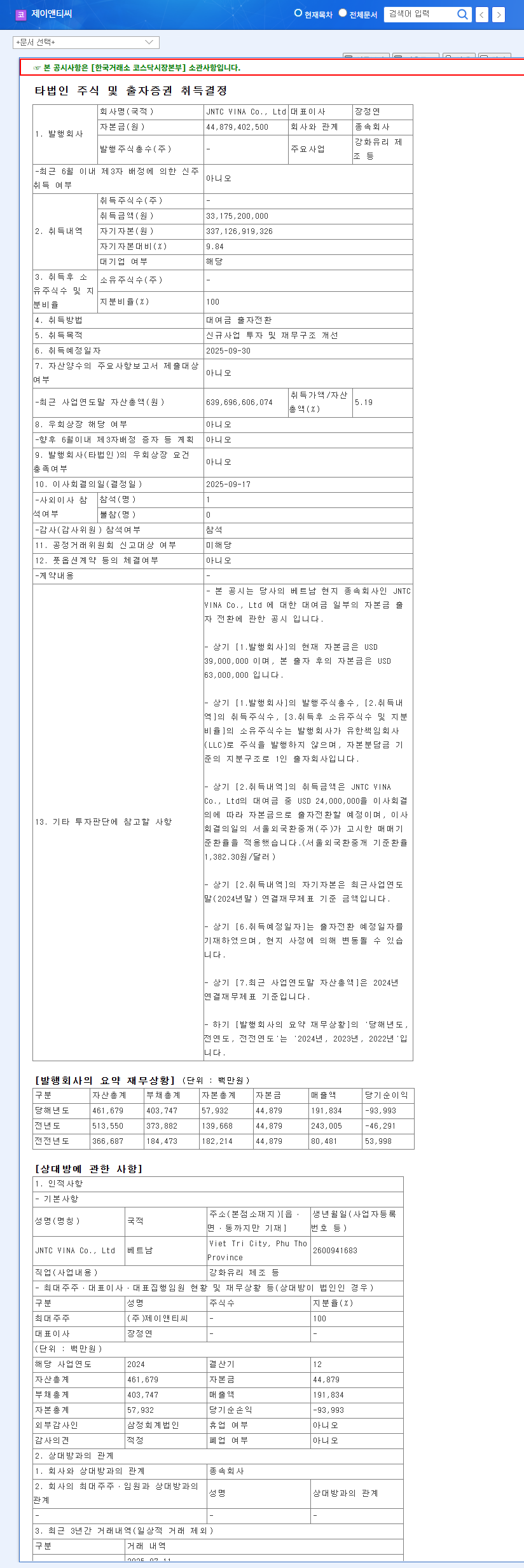
    JNTC announced the acquisition of a 100% stake in JNTC VINA Co., Ltd. for 33.2 billion KRW on September 30, 2025. The acquisition will be executed through debt-equity swap.

    2. Why the Acquisition?

    JNTC has been facing difficulties due to the smartphone market downturn and heavy reliance on Chinese clients. To overcome these challenges, JNTC is seeking new business opportunities such as automotive displays and semiconductor glass substrates. The acquisition of the Vietnamese subsidiary is part of a strategy to diversify its business and secure future growth engines. Additionally, JNTC expects to improve its financial structure through the debt-equity swap.

    3. What’s the Impact?

    • Positive Effects:
      • Entry into new business areas and expansion into overseas markets
      • Improved financial structure (debt ratio reduction)
      • Securing long-term growth drivers
    • Potential Risks:
      • Uncertainty regarding investment performance
      • Overseas business risks (exchange rate fluctuations, local regulations, etc.)
      • Short-term financial burden

    4. What Should Investors Do?

    Investors should consider the following:

    • Monitoring JNTC VINA’s business plans and performance
    • Checking JNTC’s financial restructuring progress
    • Analyzing the impact of changes in macroeconomic indicators
    • Confirming the maintenance of existing business competitiveness and the performance of new businesses

    JNTC needs to regularly disclose information on investment plans and the performance of its Vietnamese subsidiary to build investor confidence.

    Frequently Asked Questions

    Will this acquisition positively impact JNTC’s stock price?

    While short-term volatility is possible due to the investment cost, the acquisition’s long-term impact on stock price is likely positive, considering the potential for new business growth and improved financial structure.

    What kind of company is JNTC VINA?

    JNTC VINA is a tempered glass manufacturing company based in Vietnam. It is expected to serve as JNTC’s overseas production base.

    What are JNTC’s main businesses?

    JNTC mainly produces tempered glass and connectors used in smartphones, tablet PCs, etc.

    JNTC Acquires Vietnamese Subsidiary: A Turnaround Strategy? 관련 이미지
    JNTC Acquires Vietnamese Subsidiary: A Turnaround Strategy? 관련 이미지
  • JNTC Stock Forecast: Major Shareholder Increases Stake, What’s the Investment Strategy?

    1. What Happened?: Jinwoo Engineering Acquires Additional 0.01% Stake in JNTC

    Jinwoo Engineering increased its stake in JNTC from 66.10% to 66.11% through an on-market purchase. The number of shares purchased was 4,905, with the purpose of influencing management control.

    2. Why It Matters: Securing Management Stability…Limited Short-Term Stock Impact

    Although numerically insignificant, this stake increase is interpreted as a symbolic act demonstrating the major shareholder’s commitment to strengthening management control. While the short-term impact on the stock price is expected to be limited, it can be a positive signal for long-term management stability.

    3. What’s Next?: Focus on Fundamentals and External Variables

    JNTC has high growth potential in new business areas such as automotive displays, wearables, and semiconductors, but the impact of external variables such as exchange rates, raw material prices, and demand in the Chinese market must also be considered. Currently holding over 700 billion won in accumulated orders, potential fluctuations in performance due to external environmental volatility should also be kept in mind.

    • Strengths: Growth potential of new business segments, over 700 billion won in accumulated orders
    • Weaknesses: Volatility in exchange rates and raw material prices, slowdown in Chinese market demand

    4. What Should Investors Do?: Establishing Investment Strategies from a Long-Term Perspective

    Focus on long-term growth potential rather than short-term stock price fluctuations. It is crucial to make investment decisions by continuously monitoring the performance of new business segments, market demand recovery, and external environmental variables.

    Frequently Asked Questions

    What is the impact of this stake change on JNTC’s stock price?

    The short-term impact is expected to be minimal, but it can be a positive signal for long-term management stability.

    What are the future prospects for JNTC?

    There is high growth potential in new business areas, but the impact of external variables such as exchange rates, raw material prices, and Chinese market demand must also be considered.

    What are the key points to consider when investing?

    Focus on long-term growth potential rather than short-term stock price fluctuations, and continuously monitor external environmental variables.