Tag: 107640

  • (107640) HanJungNCS US ESS Production: Analyzing the ₩24.3B Investment & Market Impact

    (107640) HanJungNCS US ESS Production: Analyzing the ₩24.3B Investment & Market Impact

    The global transition to renewable energy is creating unprecedented demand for critical infrastructure, with Energy Storage Systems (ESS) at the very heart of this revolution. In a decisive move to capture this growth, HanJungNCS.Co.,Ltd has announced a landmark 24.3 billion KRW investment to establish a HanJungNCS US ESS production facility. This strategic expansion into North America is poised to reshape the company’s future, but it also introduces new challenges. This analysis explores the profound implications of this venture, from market opportunities to investor considerations.

    The Landmark Investment: What We Know

    HanJungNCS.Co.,Ltd has confirmed that its subsidiary, HANJUNG AMERICA CO. (Indiana), will acquire new facilities and infrastructure to build a dedicated production hub. This investment is not just about acquiring assets; it’s a strategic declaration of intent to become a dominant player in the lucrative North American market. According to the Official Disclosure, the acquisition is scheduled for completion by November 18, 2025.

    This 24.3 billion KRW investment is aimed squarely at securing a state-of-the-art ESS production base, enabling localized manufacturing, reducing logistical complexities, and enhancing our cost competitiveness in the North American region.

    Why North America? The Booming US ESS Market

    The decision to establish a HanJungNCS US ESS production base is fueled by the explosive growth of the American renewable energy sector. Favorable government policies, such as the Inflation Reduction Act (IRA), provide significant incentives for domestic manufacturing. Furthermore, the increasing reliance on intermittent power sources like solar and wind has created a critical need for grid stabilization, a role perfectly filled by advanced Energy Storage Systems. Data from authoritative sources like the U.S. Energy Information Administration (EIA) project continued, robust growth in this sector for the next decade. By producing locally, HanJungNCS can better serve this demand and build a resilient supply chain, a crucial lesson learned from recent global disruptions.

    Key Strategic Benefits of the Investment

    • Accelerated Market Penetration: A local presence allows for faster response times, customized product development, and stronger relationships with North American clients, driving market share growth.
    • Enhanced Cost Competitiveness: Onshoring production eliminates substantial international shipping costs and potential tariffs, directly improving profit margins.
    • Synergy with EV Business: The facility can create powerful synergies with HanJungNCS’s EV components division, as both rely on similar core technologies. Explore this further in our guide to the EV components market.
    • Securing Future Growth: This move solidifies HanJungNCS’s position as a forward-looking company committed to the future of energy, boosting investor confidence.

    Navigating the Challenges: A Clear-Eyed View of Risks

    While the upside is significant, this ambitious Energy Storage System investment is not without risks. Investors should remain aware of potential hurdles that could impact the project’s timeline and profitability.

    • Financial & Cash Flow Strain: An outlay of 24.3 billion KRW is substantial and may place short-term pressure on the company’s cash reserves, requiring meticulous financial management.
    • Operational & Execution Risks: Establishing a new facility in a foreign market involves navigating different regulatory landscapes, labor laws, and supply chain logistics.
    • Intensifying Competition: The US ESS market is attracting global players. HanJungNCS must differentiate through superior technology, quality, and service to succeed.
    • Macroeconomic Volatility: Fluctuations in exchange rates, interest rates, and raw material prices could impact production costs and overall project ROI.

    Investor Outlook & Future Milestones

    From a long-term perspective, the expansion of HanJungNCS US ESS production capabilities is a powerful catalyst for growth. It signals a proactive strategy to capitalize on one of the most significant economic shifts of our time. While short-term stock price volatility is possible due to the capital expenditure, the move solidifies the company’s growth narrative. Prudent investors may consider a phased approach, aligning their positions with key project milestones.

    Key Points to Monitor:

    • Progress on the facility’s construction and operational launch date.
    • Announcement of new customer contracts and partnerships in North America.
    • Quarterly reports detailing initial production output and sales performance from the US subsidiary.
    • Impact of macroeconomic factors (e.g., KRW/USD exchange rate) on the company’s financials.

    Frequently Asked Questions (FAQ)

    Q1: What is the main driver for HanJungNCS’s US investment?

    The primary driver is to capitalize on the rapidly growing US ESS market, driven by renewable energy adoption. Local production enhances cost-competitiveness and strengthens their market position.

    Q2: How will the ₩24.3B investment affect HanJungNCS financially?

    It may cause short-term pressure on cash flow. However, the company’s sound financial base suggests it is manageable, and the long-term potential for increased revenue and profitability is expected to outweigh the initial cost.

    Q3: What are the growth prospects for the North American ESS market?

    The market is projected for sustained, high growth due to government clean energy policies and the essential need for grid stabilization, making it a critical region for any major ESS player.
    (107640) HanJungNCS US ESS Production: Analyzing the ₩24.3B Investment & Market Impact 관련 이미지
  • (107640) HanJungNCS Rights Offering: A Deep Dive into the US ESS Market Gamble & Investment Strategy

    (107640) HanJungNCS Rights Offering: A Deep Dive into the US ESS Market Gamble & Investment Strategy

    The recent announcement of the HanJungNCS rights offering has sent ripples through the investment community. The company, a key manufacturer of Energy Storage System (ESS) components, plans a significant capital injection into its US subsidiary, HANJUNG AMERICA CO. This move raises a critical question: is this a visionary leap to conquer the lucrative US ESS market, or a risky maneuver that could lead to significant shareholder dilution? This comprehensive analysis will dissect the offering, evaluate its potential impact, and provide a clear investment strategy for stakeholders.

    Deconstructing the HanJungNCS Rights Offering

    On November 11, 2025, HanJungNCS officially disclosed its plan to conduct a large-scale rights offering. According to the Official Disclosure on DART, the primary goal is to raise KRW 29 billion (approximately $21 million USD) for its US subsidiary. The funds are earmarked as follows:

    • KRW 24.3 Billion (~$17.5M USD): Designated for facility funds, aimed at expanding local production capacity.
    • KRW 4.7 Billion (~$3.5M USD): Allocated for operating funds to support the scaling of US operations.

    A critical detail is the high subscription ratio of 3.51 new shares for every existing share held. This unusually high ratio is the primary source of investor concern regarding potential shareholder dilution, as it significantly increases the total number of outstanding shares.

    The Bull Case: Seizing a Generational Opportunity

    The strategic rationale behind this move is clear: to establish a dominant foothold in the rapidly expanding US ESS market. This market is experiencing explosive growth, fueled by government incentives like the Inflation Reduction Act (IRA) and a nationwide push for renewable energy infrastructure. For more on this trend, see the latest analysis on the global energy storage market.

    Why Local Production is a Game-Changer

    By investing in HANJUNG AMERICA CO., the company aims to move beyond exporting and become a local manufacturer. This offers substantial competitive advantages:

    • Supply Chain Resilience: Reduces dependency on international shipping, mitigating geopolitical risks and logistical bottlenecks.
    • Cost Efficiency: Lowers transportation costs and potentially avoids import tariffs, improving profit margins.
    • Market Responsiveness: Enables faster delivery times and closer collaboration with US-based clients, enhancing customer service and competitiveness.

    This capital infusion is not merely for expansion; it’s a strategic repositioning to become an integral part of the American renewable energy ecosystem, a move experts at BloombergNEF have highlighted as critical for foreign suppliers.

    The Bear Case: The High Cost of Ambition

    Despite the compelling growth story, the risks are substantial. The primary concern is the immediate and severe shareholder dilution.

    Understanding Shareholder Dilution and Financial Strain

    When a company issues a large number of new shares, each existing share represents a smaller percentage of the company. This can negatively impact the stock’s Earnings Per Share (EPS), a key metric used by investors to assess profitability. The high 3.51 ratio means the number of shares will multiply, putting significant downward pressure on the stock price in the short term, especially during the ex-rights period.

    This financial maneuver also comes after a disappointing performance in the first half of 2025, raising questions about the parent company’s ability to execute this ambitious plan effectively while simultaneously improving its core profitability.

    Crafting Your Investment Strategy

    Navigating the HanJungNCS rights offering requires a nuanced approach tailored to your risk tolerance and investment horizon. The market will likely see increased volatility as it digests the conflicting news of long-term potential versus short-term pain.

    For the Long-Term Growth Investor:

    If you believe in the growth trajectory of the US ESS market and HanJungNCS’s ability to capture a slice of it, the price dip following the rights offering could be a prime buying opportunity. Consider participating in the offering to maintain your equity stake or using a staggered purchasing strategy to average down your cost basis during the period of peak volatility.

    For the Conservative or Value Investor:

    A more cautious approach is warranted. It would be prudent to wait and observe. Key performance indicators (KPIs) to monitor include:

    • The actual subscription rate of the offering, which signals market confidence.
    • Quarterly performance reports from HANJUNG AMERICA CO. post-investment.
    • Turnaround efforts and profitability improvements at the parent company, HanJungNCS.

    In conclusion, the HanJungNCS rights offering is a classic high-risk, high-reward scenario. The potential for long-term value creation by tapping into the US market is immense, but the immediate financial hurdles and shareholder dilution are significant. A successful outcome hinges entirely on flawless execution. Investors should base their decisions on a thorough assessment of the company’s progress and their own long-term conviction in its strategic vision.

    (107640) HanJungNCS Rights Offering: A Deep Dive into the US ESS Market Gamble & Investment Strategy 관련 이미지
  • (107640) HanJungNCS ESS Investment: A 19B KRW Gamble on Future Growth? | In-Depth Analysis

    (107640) HanJungNCS ESS Investment: A 19B KRW Gamble on Future Growth? | In-Depth Analysis

    In a bold move to capture a larger share of the booming green energy sector, HanJungNCS.Co.,Ltd has announced a landmark 19 billion KRW facility investment. This significant capital injection is aimed squarely at expanding its Energy Storage System (ESS) component production. The HanJungNCS ESS investment represents a pivotal moment for the company, positioning it to capitalize on explosive market demand. However, this aggressive growth strategy is not without substantial risks, especially given the company’s current financial pressures and the volatile macroeconomic climate. This analysis will explore both the promising opportunities and the potential pitfalls of this high-stakes venture.

    Dissecting the 19 Billion KRW Investment

    On November 10, 2025, HanJungNCS officially disclosed its plan for a ‘New Facility Investment.’ The core objective is to significantly scale up its manufacturing capacity for critical ESS components. The 19 billion KRW investment, which constitutes a substantial 23.62% of the company’s equity capital, is scheduled to unfold over a one-year period, concluding on October 31, 2026. This move is a clear strategic pivot, designed to reinforce the company’s position within the high-growth ESS market. For complete transparency, you can view the Official Disclosure (DART) on the matter.

    The Bull Case: Fueling Future Growth in the ESS Market

    From a strategic standpoint, the timing of this investment appears impeccable. The global demand for energy storage solutions is surging, driven by the global transition to renewable energy sources like solar and wind, which require robust storage to ensure grid stability.

    Tapping into Explosive Market Growth

    Expanding production capacity allows HanJungNCS to directly address the soaring demand within the global Energy Storage System (ESS) market. This proactive expansion is expected to drive significant top-line growth for the company’s ESS division, positioning it to capture increased market share from competitors who may be slower to scale.

    This investment isn’t just about producing more; it’s about cementing a leadership position in a market that will define the future of energy for decades to come.

    Sharpening the Technological Edge

    The investment will also fund advancements in HanJungNCS’s core technologies, such as its sophisticated liquid cooling systems for ESS units. Enhancing these capabilities creates a competitive moat, enabling the company to produce higher-value, more efficient products. This technological differentiation is crucial for attracting premium clients and diversifying its customer base beyond its current portfolio.

    The Bear Case: A Cautious Financial Analysis

    Despite the clear growth opportunities, the HanJungNCS ESS investment places immense pressure on an already strained financial structure. A closer look at the company’s recent performance reveals several red flags that investors cannot ignore.

    Deteriorating Profitability and Cash Flow

    The company’s H1 2025 report painted a concerning picture, with operating profit declining and the company slipping into a net loss. This was attributed to rising costs and administrative expenses. Furthermore, the operating profit margin saw a dramatic fall from 16.21% in 2022 to just 4.87% in 2024. With a debt-to-equity ratio already over 100% and negative operating cash flow, taking on this new investment could severely test the company’s financial resilience. For those wanting to learn more, here is our guide to analyzing corporate financials.

    The Uncertainty of Investment Recovery

    There is a significant time lag between capital expenditure and revenue generation. It may take several quarters, or even years, for this new facility to translate into meaningful profit. During this period, HanJungNCS remains vulnerable to external shocks such as fluctuations in raw material prices (like Resin), rising global interest rates that increase borrowing costs, and intensified market competition. The method of funding this 19 billion KRW—be it through debt, equity, or internal reserves—will be critical in determining the immediate impact on its balance sheet.

    A Prudent Strategy for Investors

    The HanJungNCS ESS investment is a classic high-risk, high-reward scenario. The long-term potential is undeniable, but the short-term financial hurdles are significant. Investors should adopt a cautious and diligent approach, focusing on the following key areas:

    • Financial Health Monitoring: Scrutinize the investment’s funding plan. Keep a close watch on the company’s efforts to manage its debt and improve operating cash flow as the project progresses.
    • Path to Profitability: Look for concrete evidence that the investment is leading to enhanced productivity and economies of scale. Are cost-management strategies effectively offsetting rising expenses?
    • Competitive Landscape: Continuously assess HanJungNCS’s position within the competitive ESS market. Is its technology maintaining a competitive edge, and are its new products gaining traction?
    • Market Volatility: Be prepared for short-term stock price volatility. The combination of positive growth news and negative financial reports could lead to significant price swings.

    In conclusion, while HanJungNCS is making a necessary and forward-looking investment, the immediate financial risks warrant a cautious ‘wait-and-see’ approach. The success of this venture will depend entirely on disciplined execution, prudent financial management, and a favorable market environment.

    (107640) HanJungNCS ESS Investment: A 19B KRW Gamble on Future Growth? | In-Depth Analysis 관련 이미지
  • (107640) HanJungNCS US ESS Investment: A KRW 29.1B Gamble on the American Market?

    (107640) HanJungNCS US ESS Investment: A KRW 29.1B Gamble on the American Market?

    In a significant strategic pivot, South Korean firm HanJungNCS.Co.,Ltd (107640) has announced a major HanJungNCS US ESS investment, committing KRW 29.1 billion (approximately $22 million USD) to fully acquire its US-based Energy Storage System (ESS) production subsidiary, HANJUNG AMERICA CO. This move, representing a substantial 36.16% of the company’s equity, is a bold declaration of its intent to capture a significant share of the rapidly expanding North American renewable energy market. The official disclosure for this transaction can be found here (Source: Official DART Report).

    This decision places HanJungNCS at a critical juncture. Will this massive capital outlay unlock a new era of growth and establish it as a key player in the American energy sector, or will the financial weight of the investment create a precarious burden? This comprehensive analysis explores the strategic rationale, potential rewards, and inherent risks of this pivotal move.

    The core question for investors is whether this investment is a calculated masterstroke to secure future growth or a high-stakes gamble that overextends the company’s financial resources. The answer lies in the execution.

    Deconstructing the KRW 29.1 Billion Decision

    Announced on November 10, 2025, the plan involves acquiring a 100% stake in HANJUNG AMERICA CO. by November 12, 2025. This isn’t just a paper transaction; it’s a direct infusion of capital to secure state-of-the-art facilities and provide crucial operational funds. The goal is to transform the subsidiary, established earlier in April 2025, from a nascent entity into a full-scale production powerhouse. This strategic HanJungNCS US ESS investment is designed to build a robust local production base, a critical component for success in the post-pandemic, supply-chain-conscious American market.

    Why the Aggressive North American Push?

    The timing of this investment is no coincidence. The North American ESS market is experiencing explosive growth, fueled by government initiatives and a societal shift toward sustainable energy. The U.S. government’s Inflation Reduction Act (IRA), for instance, provides substantial tax credits and incentives for locally manufactured green energy components. By establishing a strong manufacturing presence in the US, HanJungNCS not only bypasses potential tariffs and logistical headaches but also positions itself to directly benefit from these lucrative policies. As noted by the U.S. Energy Information Administration, the demand for battery storage is projected to surge in the coming years, creating a fertile ground for well-positioned manufacturers.

    Weighing the Opportunities and Risks

    A move of this magnitude is a double-edged sword. While the potential upside is immense, the financial and operational risks are equally significant. A balanced view is essential for any stakeholder or potential investor.

    The Bull Case: A New Growth Engine

    • Market Access & Supply Chain Stability: A US production base provides unparalleled access to the North American market, reducing shipping times and costs while insulating the company from global supply chain disruptions.
    • Full Financial Upside: By securing 100% ownership, HanJungNCS ensures that all profits and successes from the US subsidiary flow directly to its bottom line, enhancing overall corporate value and profitability.
    • Strategic Agility: Complete control over the US entity allows for swift, decisive action in response to market changes, a crucial advantage in the fast-evolving tech landscape. Explore our guide to understanding the ESS market for more context.

    The Bear Case: A Potential Financial Burden

    • Strained Financial Health: The KRW 29.1 billion investment is a major cash outlay. With a pre-existing debt-to-equity ratio of 101.0%, this move could strain short-term liquidity and place immense pressure on the company’s financial stability.
    • Execution and Market Risk: Success is not guaranteed. The competitive US ESS market includes established giants and nimble startups. If HanJungNCS fails to achieve its production targets or if market demand softens, the return on this significant investment could be jeopardized.
    • Currency Fluctuations: As a cash acquisition, the investment is exposed to KRW/USD exchange rate volatility. An unfavorable shift could increase the final cost and impact the future management of USD-denominated revenues.

    Investor Action Plan & Final Verdict

    The HanJungNCS US ESS investment is undeniably a forward-looking strategy that enhances the company’s long-term growth potential. Early and successful penetration of the American market could be transformative for corporate value. However, the immediate financial risk cannot be ignored.

    Investors should meticulously monitor the following key performance indicators:

    • US Subsidiary Performance: Track quarterly reports for production ramp-up, sales contracts, and market share growth within the US.
    • Financial Health Metrics: Pay close attention to the company’s debt ratio, cash flow statements, and profitability margins post-investment.
    • Market & Regulatory Changes: Stay informed about US energy policy shifts and the competitive landscape to gauge HanJungNCS’s adaptive capabilities.

    Ultimately, HanJungNCS is betting big on its ability to execute. If it can manage its finances prudently while effectively scaling its US operations, this investment could be a landmark success. If not, it could serve as a cautionary tale of ambition outpacing resources.

    (107640) HanJungNCS US ESS Investment: A KRW 29.1B Gamble on the American Market? 관련 이미지
  • (107640) HanJungNCS Large Shareholding Report: A Deep Dive into Management Instability & Stock Impact

    (107640) HanJungNCS Large Shareholding Report: A Deep Dive into Management Instability & Stock Impact

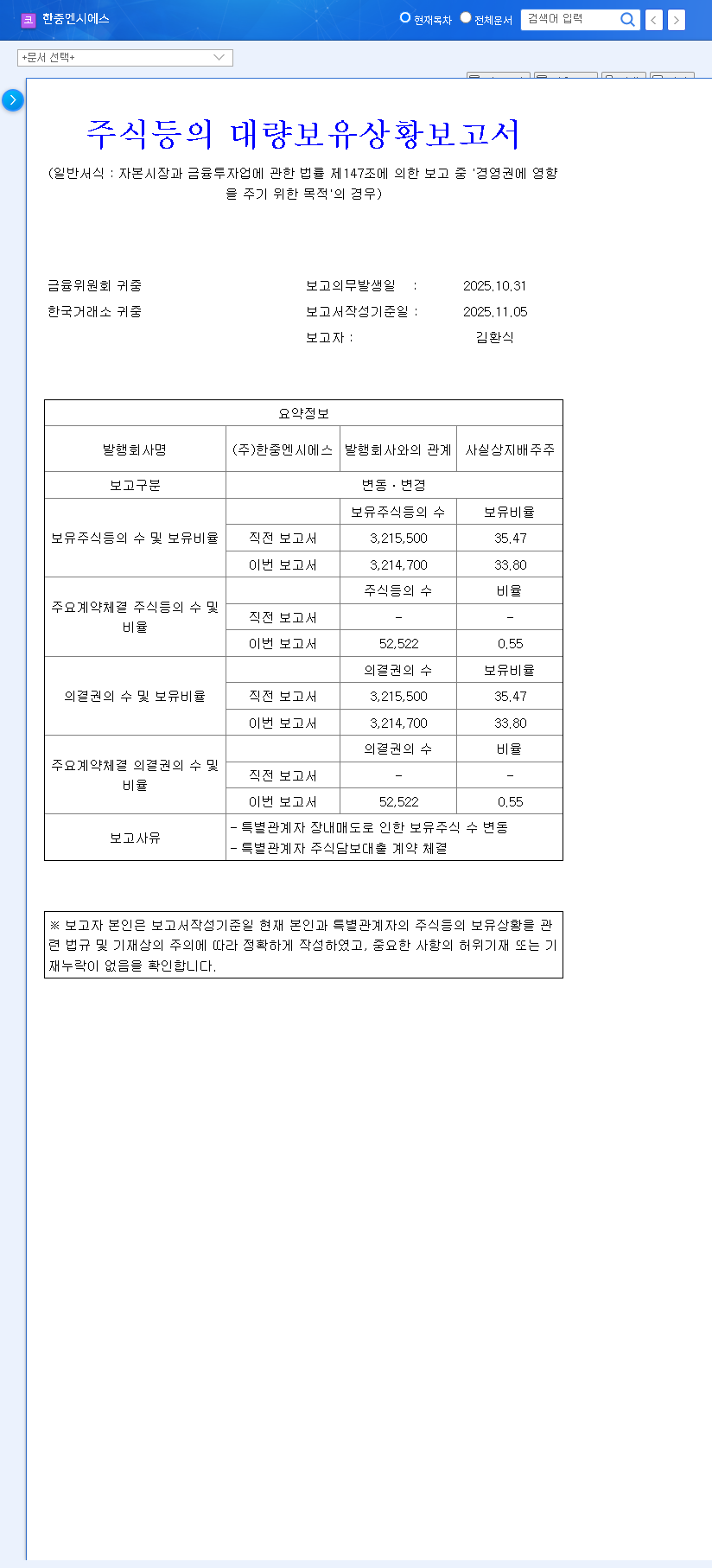
    The latest HanJungNCS Large Shareholding Report has sent ripples through the investment community. A notable reduction in shareholding by major shareholder Kim Hwan-sik and his specially related parties raises critical questions about the company’s future. This isn’t just a routine transaction; it’s a potential indicator of shifting internal dynamics and possible management instability. For current and prospective investors, understanding the full context behind this move is paramount for making informed decisions regarding HanJungNCS stock.

    This comprehensive analysis will deconstruct the disclosure, evaluate its potential impact on corporate governance and stock performance, and outline strategic considerations for investors navigating this period of uncertainty.

    Breaking Down the HanJungNCS Large Shareholding Report

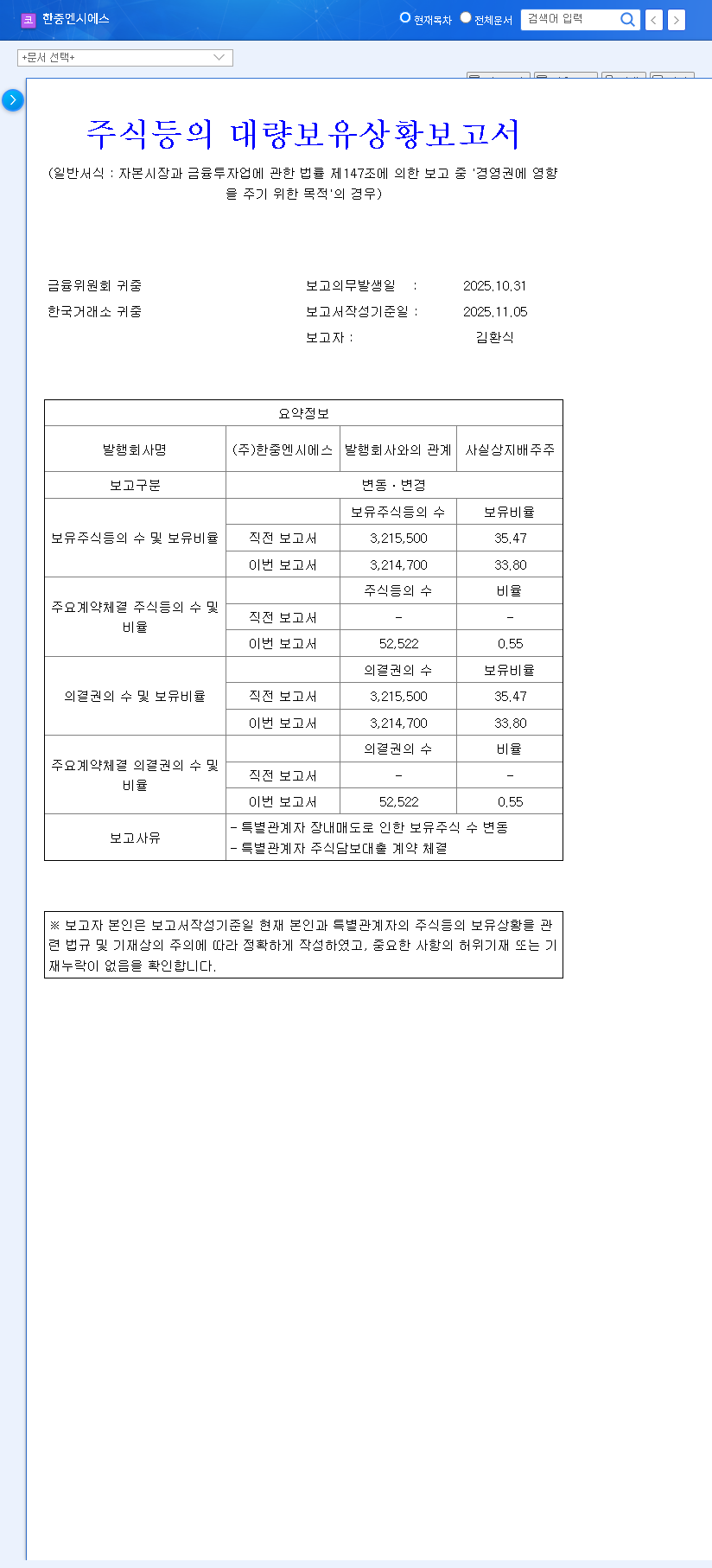
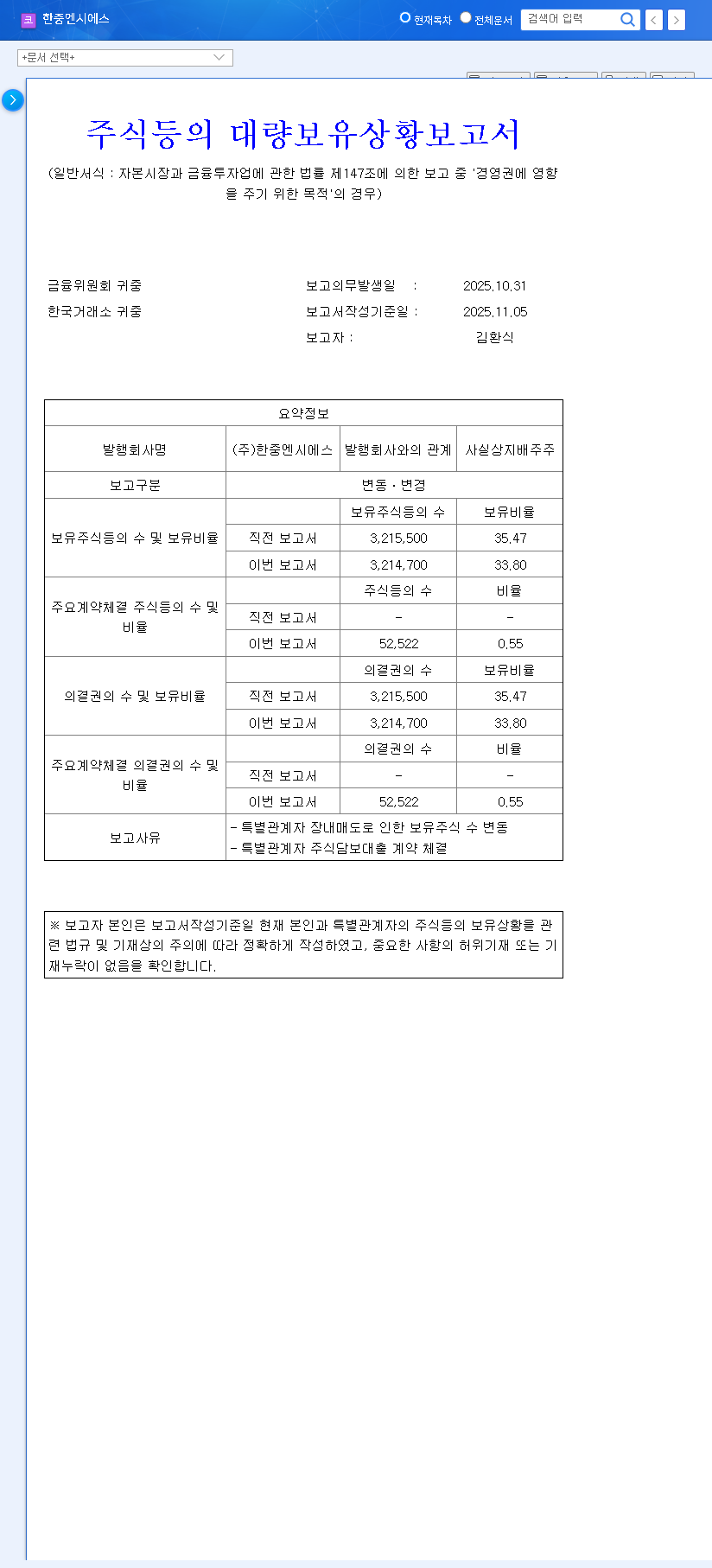
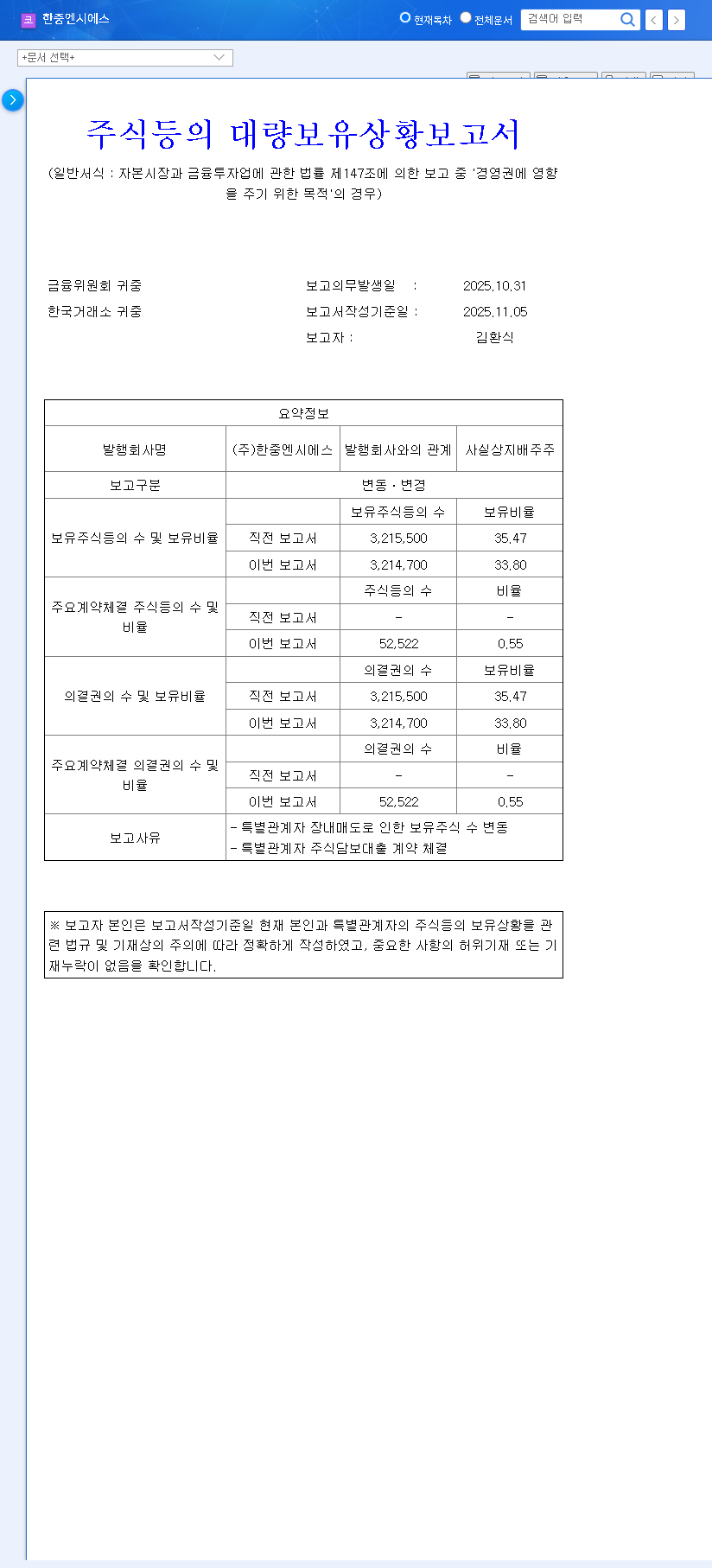
    HanJungNCS officially announced that its major shareholder, Kim Hwan-sik, along with specially related parties, decreased their collective stake in the company from 35.47% to 33.80%. This represents a meaningful reduction of 1.67 percentage points. The critical detail lies in the stated purpose of their shareholding: ‘influence on management rights.’ When a major shareholder whose goal is to influence management reduces their stake, the market takes notice. This action could stem from various events, including direct on-market sales or the establishment of stock collateral loan agreements, both of which have distinct implications.

    Why This Development Demands Investor Attention

    1. The Specter of Management Instability

    A reduction in a controlling shareholder’s stake can be interpreted as a weakening of their commitment or a prelude to further divestment. This perception can lead to management instability, creating uncertainty around long-term strategy, leadership, and operational execution. In the short term, such news often triggers negative investor sentiment, potentially leading to a decline in the HanJungNCS stock price as the market prices in this new risk factor. An ‘on-market sale by specially related parties’ is a direct injection of supply into the market, which can exert immediate downward pressure on the stock.

    The market abhors uncertainty. A change in the shareholding structure of a key management figure, without a clear and positive rationale, is often treated as a significant red flag until proven otherwise.

    2. The Nuance of Stock Collateral Loans

    If the reduction is due to a ‘stock collateral loan agreement,’ the situation is more complex. While not an immediate sale, it introduces a potential ‘overhang’ on the stock. This means a large block of shares could be forcibly sold into the market if the borrower defaults on the loan, creating a persistent risk of future selling pressure. Investors must monitor the terms of such agreements, as they can be a hidden source of volatility. For more on how markets react to such events, institutional analysis from sources like Bloomberg can provide valuable context.

    Fundamentals vs. Governance: A Balancing Act

    This shareholding news does not exist in a vacuum. It must be weighed against HanJungNCS’s underlying business fundamentals. The company operates in the high-growth sectors of Energy Storage Systems (ESS) and Electric Vehicle (EV) components, which present a compelling long-term narrative. However, recent financial performance, with a revenue decrease and a shift to an operating loss in H1 2025, complicates the picture.

    Key Strengths and Opportunities

    • Favorable Market Trends: Positioned to benefit from the global push for green energy and EV adoption. Learn more about the growth in the ESS market.
    • Key Partnerships: A strong, established relationship as a major partner to Samsung SDI provides a stable order base.
    • North American Expansion: The establishment of a new production subsidiary in North America is a significant catalyst for future growth.

    Key Weaknesses and Threats

    • Profitability Concerns: Recent financial underperformance raises questions about operational efficiency and margin pressure.
    • Client Concentration Risk: A high reliance on a single major client (72.04% of ESS component sales) is a significant vulnerability.
    • Macroeconomic Headwinds: Volatility in raw material prices and rising interest rates can negatively impact financial health.

    Investor Strategy: How to Respond

    A prudent approach is essential. Investors should avoid knee-jerk reactions and instead focus on diligent research and monitoring. Here are key steps to consider:

    • Analyze the Source: The first step is to review the Official Disclosure to understand the specifics of the transaction.
    • Monitor Management Communication: Pay close attention to any statements or actions from the company’s leadership that address governance stability.
    • Track Financial Performance: The company’s ability to improve performance in H2 2025 and beyond will be the ultimate determinant of long-term value.
    • Observe Market Sentiment: Watch for shifts in institutional ownership and analyst ratings following this disclosure.

    Conclusion

    The reduction in shareholding by a major shareholder introduces a new layer of risk for HanJungNCS investors. While the company’s position in promising growth industries remains a significant pull factor, the potential for management instability cannot be ignored. The long-term trajectory of HanJungNCS stock will ultimately depend on management’s ability to reassure the market of its stable leadership and, more importantly, to deliver tangible improvements in its financial fundamentals.

    (107640) HanJungNCS Large Shareholding Report: A Deep Dive into Management Instability & Stock Impact 관련 이미지
  • Hanjung ENC: 5.49% Stake Acquisition – Investment Opportunity or Not? Key Analysis and Investment Strategy


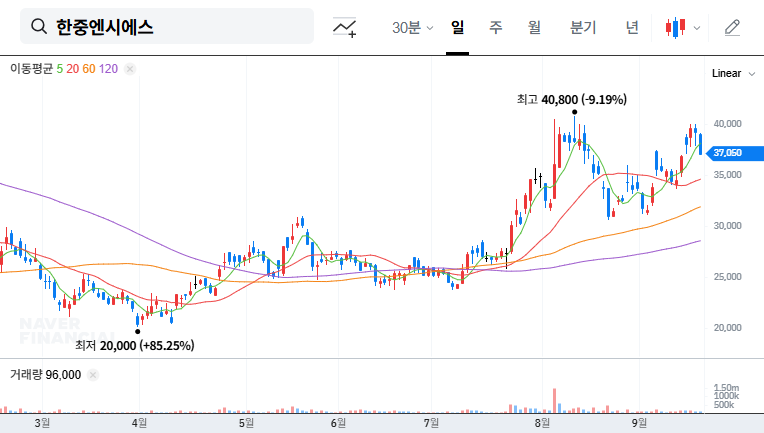
    Hanjung ENC: 5.49% Stake Acquisition - Investment Opportunity or Not? Key Analysis and Investment Strategy 대표 차트 이미지


    What Happened?

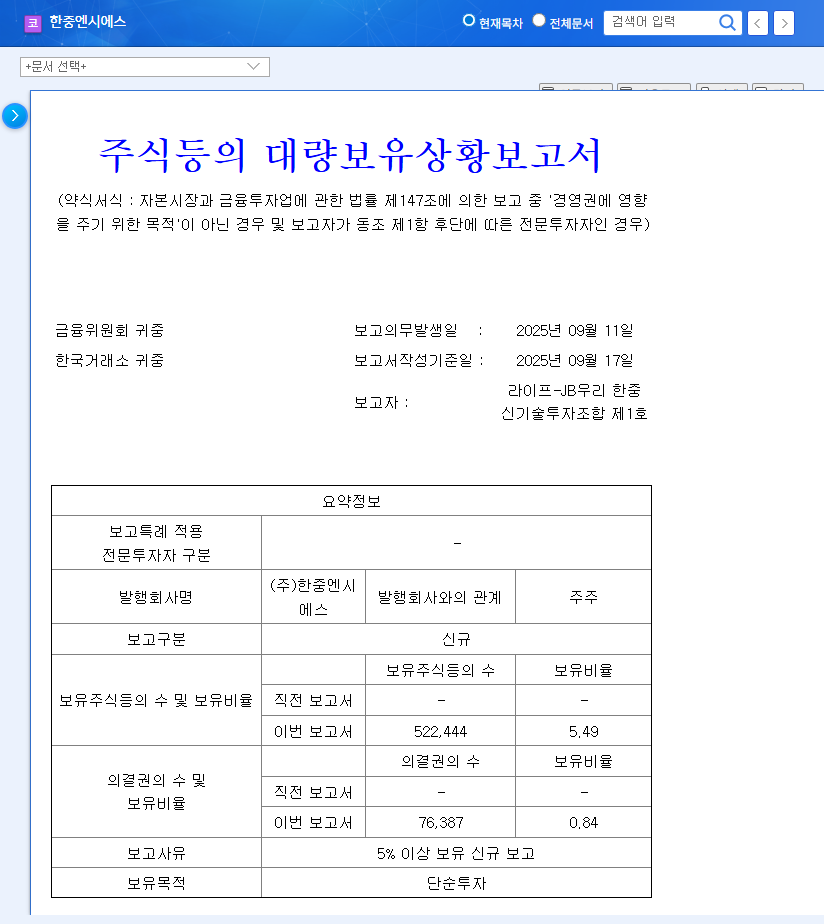
    Life-JB Woori Sino-Korean New Technology Investment Association No. 1 announced on September 17, 2025, that it has acquired a 5.49% stake in Hanjung ENC. This was achieved through the acquisition and conversion of convertible bonds (CBs), stated as a simple investment.

    What is Hanjung ENC?

    Hanjung ENC manufactures and sells ESS (Energy Storage System) and EV (Electric Vehicle) components. Although recently facing difficulties due to a sharp decline in ESS sales, the company is seeking a turnaround through EV business expansion and entry into the North American market.

    Why is This Investment Important?

    While stated as a simple investment, the market is interpreting this move in various ways. The acquisition of a significant 5.49% stake indicates the investment association’s bet on Hanjung ENC’s growth potential. This could even be interpreted as considering future management participation.

    What Should Investors Do?

    • Positive Aspects: The stake acquisition can attract market attention and provide momentum for stock price increases. This is especially true if coupled with improving fundamentals.
    • Negative Aspects: Investors should be wary of the continued sluggish performance in the ESS sector and the potential dilution effect from CB conversion.

    When making investment decisions, carefully consider the following:

    • Whether the ESS sector recovers
    • Growth potential of the EV component business
    • Further actions of the investing entity
    • Timing and volume of CB conversion


    FAQ

    What is Hanjung ENC’s main business?

    Hanjung ENC manufactures and sells ESS (Energy Storage System) and EV (Electric Vehicle) components.

    How will this investment affect Hanjung ENC’s stock price?

    It could provide positive momentum in the short term, but the mid-to-long-term stock price trend depends on the company’s earnings improvement.

    What are the key points to consider when investing?

    Consider the continued sluggish performance in the ESS sector and the dilution effect from CB conversions.


    Hanjung ENC: 5.49% Stake Acquisition - Investment Opportunity or Not? Key Analysis and Investment Strategy 관련 이미지
    Hanjung ENC: 5.49% Stake Acquisition - Investment Opportunity or Not? Key Analysis and Investment Strategy 관련 이미지


  • Hanjung NCS: Share Transfer and Future Outlook Amidst Sluggish Performance


    Hanjung NCS: Share Transfer and Future Outlook Amidst Sluggish Performance 대표 차트 이미지


    What Happened?

    On September 5, 2025, Hanjung NCS CEO Kim Hwan-sik and Oh Seung-ah transferred 1,800,000 and 200,000 shares, respectively, to Kim Sang-gyun. This resulted in a slight decrease in total ownership from 35.49% to 35.47%.

    Why Does it Matter?

    Hanjung NCS has been struggling with sluggish performance in the first half of 2025. Sales decreased by 6.4% year-on-year, and both operating profit and net income recorded losses. This share transfer under such circumstances could raise concerns among investors. However, the transfer can be interpreted as suggesting the possibility of future management succession or role sharing by increasing Kim Sang-gyun’s stake, rather than a change in management control.

    What’s Next?

    The share transfer itself is unlikely to directly impact the stock price. However, it can be seen as a sign of the owner family’s commitment to long-term management. Future stock price movements are expected to depend on fundamentals such as earnings improvement and performance in the North American ESS market.

    What Should Investors Do?

    Investors should focus on the company’s fundamental improvements and long-term growth potential rather than short-term stock price fluctuations. While the growth of the ESS and EV markets and the strengthening of eco-friendly policies can be positive factors for Hanjung NCS, raw material price volatility and intensifying competition pose risks. Therefore, careful analysis is required before making investment decisions.


    FAQ

    What are Hanjung NCS’s main businesses?

    Hanjung NCS’s main businesses are ESS (Energy Storage System) and automotive parts. In particular, they are pursuing entry into the North American ESS market based on their water-cooled cooling system technology.

    What is the impact of this share transfer on the stock price?

    The share transfer itself is not expected to have a significant impact on the stock price. However, it implies management stability and the possibility of succession.

    What is the outlook for Hanjung NCS?

    While the growth of the ESS and EV market is positive, overcoming sluggish performance and strengthening competitiveness are crucial. Success in the North American ESS market will be a key variable.


    Hanjung NCS: Share Transfer and Future Outlook Amidst Sluggish Performance 관련 이미지
    Hanjung NCS: Share Transfer and Future Outlook Amidst Sluggish Performance 관련 이미지


  • Hanjung NCS Rights Offering: Opportunity or Risk?


    Hanjung NCS Rights Offering: Opportunity or Risk? 대표 차트 이미지


    1. What Happened? Hanjung NCS Announces Rights Offering

    Hanjung NCS announced on September 3, 2025, a rights offering of 446,054 common shares at an issue price of KRW 33,628 per share, totaling approximately KRW 15 billion. Several institutional investors, including Shinhan Investment Corp. and KB Securities, are participating.

    2. Why a Rights Offering? Strengthening Finances and Fueling Growth

    This rights offering aims to improve the company’s financial structure and secure funds for new business investments. Facing challenges with declining sales and operating losses in the ESS segment in the first half of 2025, Hanjung NCS plans to use the proceeds to strengthen its financial health and invest in enhancing its competitiveness in the ESS and EV components business, as well as explore new markets.

    3. What’s Next? Analyzing the Opportunities and Risks

    Positive Aspects:

    • Improved financial structure and reduced debt-to-equity ratio
    • Investment in new businesses and strengthened R&D
    • Potential benefits from growth in the ESS and EV markets

    Negative Aspects:

    • Potential stock dilution (though limited by the 5% issuance ratio)
    • Increased capital costs and uncertainty regarding the use of funds
    • Uncertainty surrounding the recovery of the ESS business segment
    • Macroeconomic uncertainties (interest rate hikes, raw material price fluctuations)

    4. What Should Investors Do? Careful Observation and Continuous Monitoring

    The current offering price represents a discount of approximately 30% compared to the recent stock price, potentially making it attractive to investors. However, it is crucial to closely monitor the specific use of the funds raised and the recovery of the ESS business segment. Pay close attention to company announcements regarding the use of funds and the status of relationships with key customers and new orders in the ESS segment. Investors should be cautious of short-term stock price volatility and consider investment from a long-term perspective.


    FAQ: Addressing Your Questions About the Hanjung NCS Rights Offering

    What is a rights offering?

    A rights offering allows existing shareholders to purchase newly issued shares at a discounted price, raising capital for the company.

    What is the purpose of the Hanjung NCS rights offering?

    The offering aims to improve the company’s financial structure and secure funds for new business investments.

    How might the rights offering affect the stock price?

    There are both positive and negative potential impacts. The expectation of improved financial structure and growth opportunities may positively affect the stock price. Conversely, stock dilution from the new share issuance may put downward pressure on the price.

    What should investors consider?

    Investors should carefully evaluate the specific plans for the use of funds, market conditions, interest rate trends, and the potential recovery of the ESS business segment before making investment decisions.


    Hanjung NCS Rights Offering: Opportunity or Risk? 관련 이미지
    Hanjung NCS Rights Offering: Opportunity or Risk? 관련 이미지


  • Hanjung NCS Issues ₩15 Billion in Convertible Bonds: Investment Opportunity or Risk?

    Hanjung NCS Issues ₩15 Billion in Convertible Bonds: Investment Opportunity or Risk? 대표 차트 이미지

    1. What Happened? : ₩15 Billion Convertible Bond Issuance

    Hanjung NCS announced a private placement of ₩15 billion in convertible bonds (CBs) on September 3, 2025. The funds will be used for investments in ESS and EV projects, R&D, and operating expenses.

    2. Why? : Securing Funds for Growth Momentum

    Hanjung NCS is actively investing in expanding its ESS and EV components business overseas. The company needs funding for establishing a new ESS production subsidiary in the US, converting the ESS production line in its Chinese subsidiary, and securing future growth momentum. The CB issuance is a strategy to secure these necessary funds.

    3. What’s the Impact? : Opportunities and Risks

    Positive Aspects

    • • Increased Investment in Growth Industries: Capitalizing on high growth potential of ESS and EV markets.
    • • Potential Improvement in Financial Structure: Decreased debt ratio upon conversion of CBs to equity.

    Negative Aspects

    • • Potential Stock Dilution: Dilution of existing shareholder value upon conversion of CBs to equity.
    • • Interest Expense Burden: Incurring interest expenses until maturity (0% coupon rate, 1.0% maturity rate).
    • • Increased Financial Burden if Performance Remains Weak: Increased repayment burden if current trend of poor profitability continues.

    4. What Should Investors Do? : Key Investment Points and Strategies

    Investors should consider both the short-term liquidity benefits and the potential for stock dilution. The key investment points are the improvement of the company’s fundamentals and the actual performance of its ESS and EV businesses. Careful monitoring of quarterly earnings announcements, overseas business progress, and the conversion of CBs is crucial. The current investment opinion is ‘Neutral (Watchlist).’

    Frequently Asked Questions

    What are Convertible Bonds (CBs)?

    Convertible bonds (CBs) are bonds that give the holder the right to convert them into a predetermined number of shares of the issuing company’s common stock after a specified period. Investors can receive interest like a bond or convert them into stock to capitalize on potential price appreciation.

    How will the issuance of CBs affect Hanjung NCS’s stock price?

    In the short term, there may be a positive impact due to the influx of funds. However, in the long term, if the CBs are converted into stock, there is a possibility of stock dilution due to the increased number of shares.

    Should I invest in Hanjung NCS?

    Currently, the outlook is neutral. While the growth potential of the ESS and EV markets is positive, the continuing poor performance is a concern. Carefully review the company’s future performance and business progress before making an investment decision.

    Hanjung NCS Issues ₩15 Billion in Convertible Bonds: Investment Opportunity or Risk? 관련 이미지
    Hanjung NCS Issues ₩15 Billion in Convertible Bonds: Investment Opportunity or Risk? 관련 이미지
  • Hanjung NCS: Major Shareholder Change – What Investors Need to Know


    Hanjung NCS: Major Shareholder Change - What Investors Need to Know 대표 차트 이미지


    1. The Change: What Happened?

    On September 2, 2025, Hanjung NCS’s largest shareholder changed from Hwan-sik Kim et al. to Sang-gyun Kim et al. Critically, this change was due to an internal transfer of shares through gift/inheritance, with no change in the total number of shares or ownership percentage (35.47%).

    2. Why It Matters: Fundamentals and Market Analysis

    While the shareholder change itself may have limited direct impact, understanding Hanjung NCS’s current fundamentals and the market landscape is crucial.

    • 2.1. Unstable Financials

    As of H1 2025, Hanjung NCS continues to face challenges with declining sales, an operating loss, and a high debt-to-equity ratio. While the growth potential of the ESS/EV market and the company’s technological capabilities are positive, customer diversification and improved profitability are urgent needs.

    • 2.2. Volatile Market Conditions

    External factors such as rising raw material prices, exchange rate fluctuations, and high interest rates further pressure Hanjung NCS.

    3. The Outlook: Short-term and Long-term

    • 3.1. Short-Term Impact: Neutral Outlook

    The change in major shareholder, without a change in ownership percentage, is unlikely to significantly impact stock prices in the short term. The company’s poor performance is expected to be a stronger influence.

    • 3.2. Long-Term Impact: Dependent on New Strategies

    The new major shareholder’s management strategy, investment plans, and profitability improvement measures will significantly influence the company’s future value. The company’s success in overseas market expansion and debt management will be key variables.

    4. Investor Action Plan: Proceed with Caution

    A cautious approach is recommended in the short-term. Investors should closely monitor the new management’s strategy and performance improvements in the long term. Thoroughly analyze the company’s growth potential and make informed investment decisions.


    FAQ

    How will the change in Hanjung NCS’s major shareholder affect its stock price?

    Limited short-term impact is expected, but long-term volatility is possible depending on the new management’s strategy.

    What is Hanjung NCS’s current financial situation?

    As of H1 2025, the company faces challenges with declining sales, operating losses, and high debt levels.

    Should I invest in Hanjung NCS?

    Carefully consider the new management’s strategy and performance improvements before making any investment decisions.


    Hanjung NCS: Major Shareholder Change - What Investors Need to Know 관련 이미지
    Hanjung NCS: Major Shareholder Change - What Investors Need to Know 관련 이미지