Tag: 091810

  • (091810) T’way Air Stock Analysis (Q3 2025): Earnings Collapse & Critical Investor Warning

    (091810) T’way Air Stock Analysis (Q3 2025): Earnings Collapse & Critical Investor Warning

    The latest financial report for T’way Air stock has sent shockwaves through the market, revealing a severe downturn that demands immediate attention from current and prospective investors. The preliminary Q3 2025 earnings are not merely a disappointment; they represent a significant financial crisis for the low-cost carrier, with massive operating and net losses that raise fundamental questions about its stability and future viability. This detailed T’way Air financial analysis will dissect the alarming figures, explore the underlying causes, and provide a clear-eyed investor outlook to help you navigate this turbulence and protect your assets.

    The Alarming Numbers: T’way Air’s Q3 2025 Earnings Shock

    T’way Air Co., Ltd. announced preliminary T’way Air earnings for Q3 2025 that dramatically underperformed all market expectations. The results paint a grim picture of the airline’s current operational state. The full details can be reviewed in the Official Disclosure (DART).

    Key Financial Indicators (Preliminary)

    • Revenue: KRW 449.8 billion (5% below market expectation of KRW 471.0 billion)
    • Operating Profit: KRW -95.5 billion (A staggering 338% below market expectation of KRW -21.8 billion)
    • Net Profit: KRW -124.7 billion

    The most alarming figure is the operating loss, which missed consensus estimates by a jaw-dropping 338%. This indicates that the company’s profitability issues are not minor but have reached a critical and accelerating point. This trend of continuous losses since Q3 2024 shows a deepening financial wound that cannot be ignored.

    Why It Happened: A Deep Dive into the Causes

    The sharp decline in the T’way Air Q3 2025 performance is not due to a single factor but a perfect storm of internal inefficiencies and external pressures. Understanding these root causes is crucial for any T’way Air stock analysis.

    1. Soaring Costs & Weak Revenue

    Revenue falling short suggests either a failure to attract passengers or a need to slash fares amid fierce competition. More critically, the massive operating loss points to an inability to control costs. Key culprits include:

    • Sustained High Fuel Prices: Jet fuel remains a primary expense for airlines. Global volatility, as tracked by authorities like IATA, continues to compress margins across the industry.
    • Rising Labor and Maintenance Costs: Inflationary pressures are increasing operational expenses across the board, from salaries to aircraft maintenance.
    • Inefficient Cost Management: The scale of the loss suggests that internal cost control measures have been insufficient to counter these external pressures.

    2. Financial Burdens and Currency Woes

    Beyond operational issues, T’way Air’s bottom line was further eroded by increased financial costs in a high-interest-rate environment and significant foreign exchange losses due to a volatile currency market. These factors turned a large operating loss into an even larger net loss, compounding the damage to the company’s balance sheet.

    “This isn’t just a bad quarter; it’s a structural crisis. The widening losses point to a severe liquidity risk and raise serious concerns about the company’s ability to fund its operations and growth without immediate and substantial capital intervention.”

    The Critical Impact on T’way Air’s Future

    This earnings report will have profound and lasting negative impacts on T’way Air’s fundamentals and, consequently, its stock price.

    • Deepening Capital Impairment: The company was already facing a capital impairment of KRW -42.2 billion as of mid-2025. This quarter’s massive net loss will significantly worsen that position, threatening financial sustainability and risking credit rating downgrades.
    • Skyrocketing Debt-to-Equity Ratio: As capital erodes, the debt-to-equity ratio will climb sharply, signaling increased financial risk to creditors and investors.
    • Weakened Competitiveness: Financial distress makes it incredibly difficult to invest in new aircraft, expand routes, or compete on price. This could lead to a loss of market share in the hyper-competitive LCC sector.

    Investor Outlook: A Cautious Flight Plan is Essential

    Given the severity of the T’way Air earnings report, an extremely cautious and defensive investment approach is paramount. The short-term outlook for T’way Air stock is overwhelmingly negative, with continued downward pressure highly likely. A recovery in investor confidence is improbable until the company demonstrates a clear and credible path out of its financial distress. For more general advice, you can review our guide to investing in airline stocks.

    Key Variables to Monitor Closely:

    • Capital Injection Plans: The success or failure of planned capital injections (new shares, bonds) is the single most important factor. Any delay could be catastrophic.
    • Profitability Initiatives: Look for concrete evidence of effective cost-cutting, route optimization, and revenue diversification efforts.
    • Major Shareholder Impact: Monitor how the new largest shareholder, Sono International, influences management and financial stabilization efforts.

    In conclusion, investors should remain on the sidelines, meticulously monitoring the upcoming Q4 results and the tangible progress of recovery plans before making any decisions regarding T’way Air stock.
    (091810) T'way Air Stock Analysis (Q3 2025): Earnings Collapse & Critical Investor Warning 관련 이미지
  • (091810) T’way Air Stock Analysis: Decoding DB Securities’ Major Stake Sale & What It Means for Investors

    (091810) T’way Air Stock Analysis: Decoding DB Securities’ Major Stake Sale & What It Means for Investors

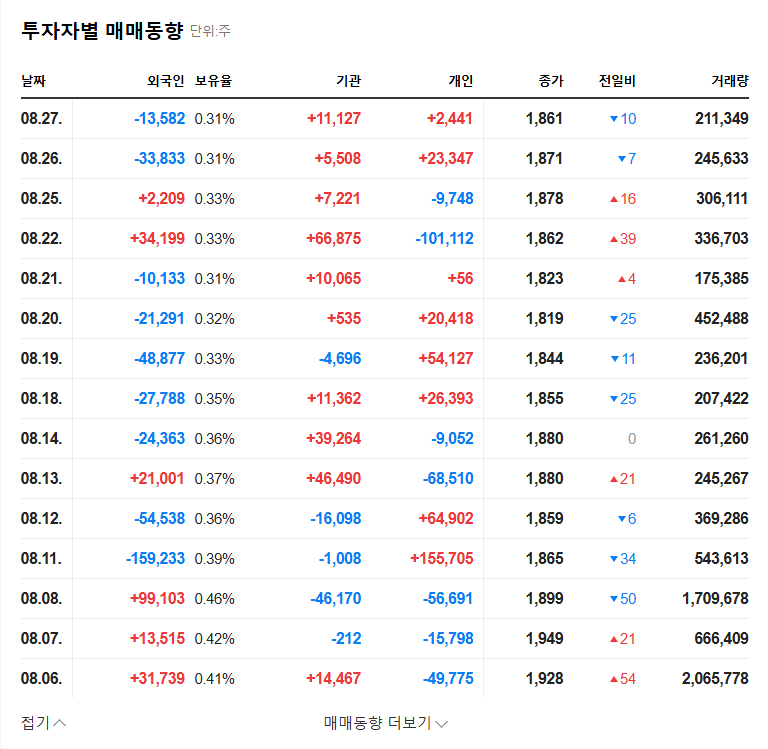
    Investors keeping a close eye on T’way Air stock have been met with a significant development: a major shareholder, DB Securities, has notably reduced its stake. The transaction, officially cited for a ‘simple investment’ purpose, involved the off-market sale of unsubscribed convertible bonds to an entity related to ‘Bithumb’. This move has understandably sparked questions and uncertainty among shareholders. Is this a signal of underlying issues within T’way Air, or simply a strategic portfolio adjustment by an institutional investor? This comprehensive T’way Air stock analysis will dissect the event, explain the key financial instruments involved, and provide a clear action plan for investors navigating this complex situation.

    The Core Event: DB Securities Reduces T’way Air Stake

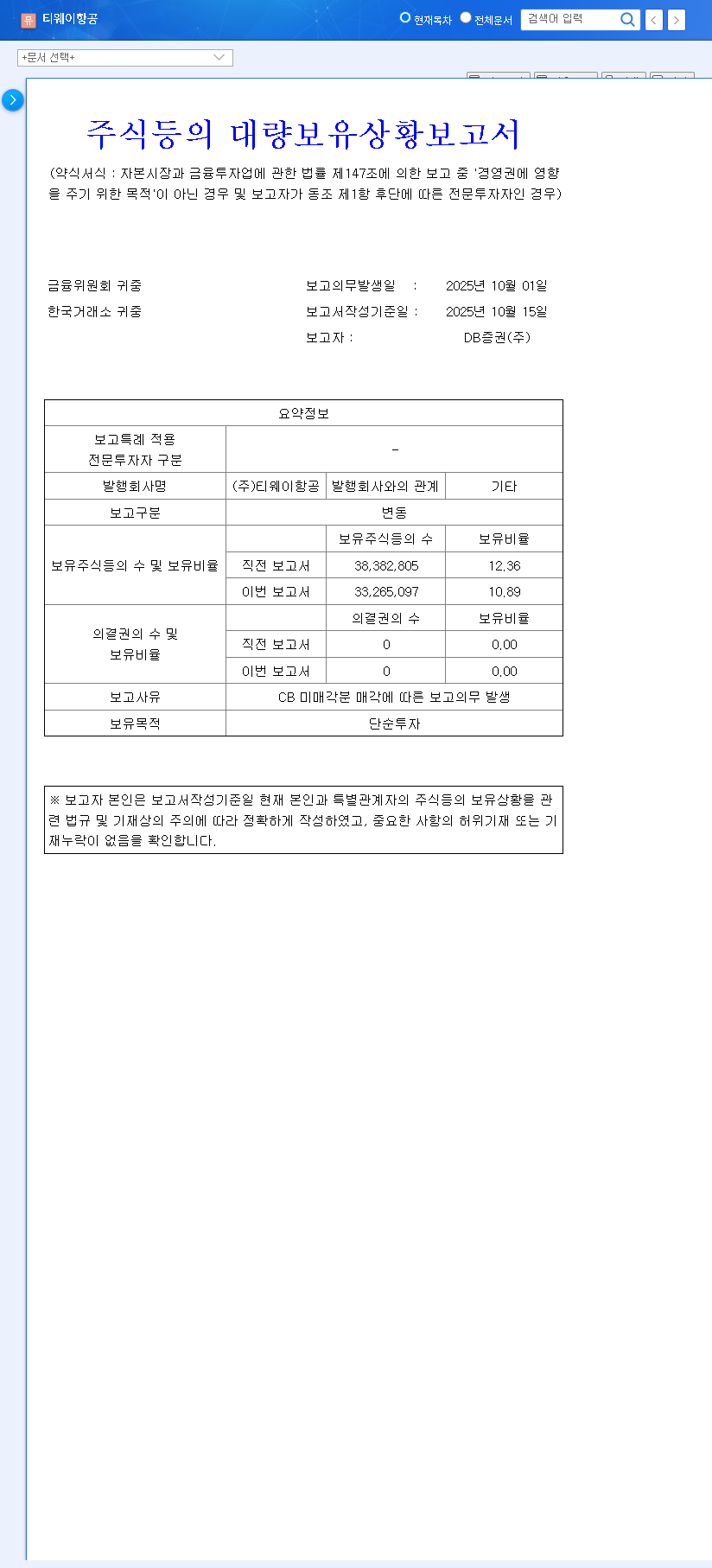
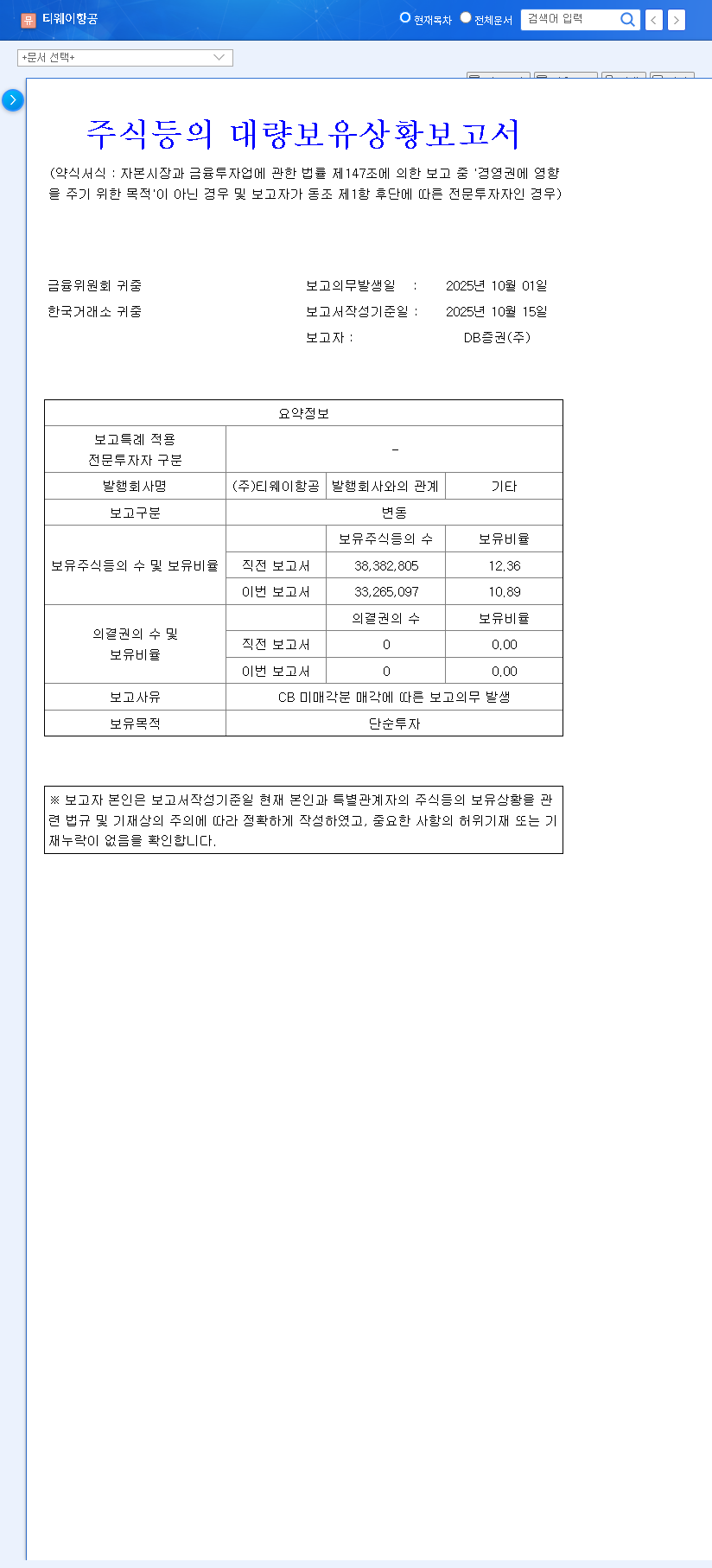
    DB Securities Co., Ltd., a prominent institutional investor, officially reported a change in its ownership of T’way Air. The key details of the transaction, as per the official disclosure, are as follows:

    • Reporting Entity: DB Securities (South Korea)
    • Stated Purpose: Simple Investment
    • Previous Shareholding: 12.36%
    • New Shareholding: 10.89% (a decrease of 1.47 percentage points)
    • Transaction: Sale of 5,117,708 shares of unsubscribed convertible bonds (CBs) via an off-market trade to Bithumb on October 1, 2025.
    • Official Disclosure: The full details can be reviewed in the Official DART Filing (Source).

    Why This Transaction is Raising Eyebrows

    On the surface, an institutional investor adjusting its portfolio is routine. However, the specifics of this sale—involving convertible bonds and an off-market trade to a cryptocurrency-affiliated entity—warrant a deeper look.

    Understanding Convertible Bonds (CBs)

    First, it’s crucial to understand what was sold. Convertible bonds are a hybrid security, part debt and part equity. A company like T’way Air issues them to raise capital, often at a lower interest rate than traditional loans. For the investor (DB Securities), CBs provide regular interest payments like a bond, but also hold the option to be converted into a predetermined number of common shares, offering upside potential if the T’way Air stock price rises. The sale of ‘unsubscribed’ CBs implies that DB Securities chose to sell the bonds themselves rather than convert them into stock.

    The ‘Off-Market’ Sale to Bithumb

    The sale was not conducted on the open stock market. An ‘off-market’ or ‘block’ trade is a private transaction between two parties. This method is often used for large volumes to avoid causing major price swings on the public market. The involvement of Bithumb, primarily known as a major cryptocurrency exchange, is particularly unusual. It suggests the buyer is a non-traditional financial player or a specific group of investors operating through that platform, adding a layer of complexity to the analysis of this T’way Air investment signal.

    The central question for investors is whether this sale reflects a lack of confidence in T’way Air’s future or is merely a procedural financial maneuver by DB Securities to realize profits or rebalance its assets.

    Potential Impact on T’way Air Stock and Investors

    Short-Term Market Concerns

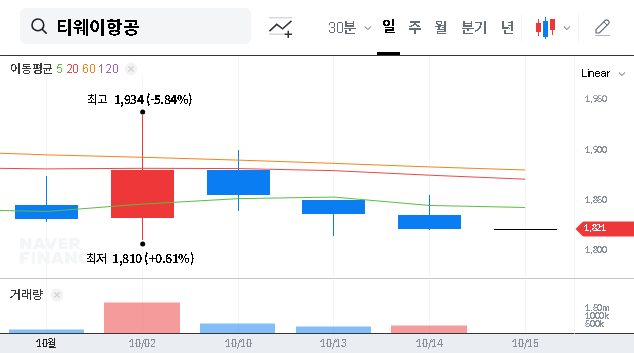
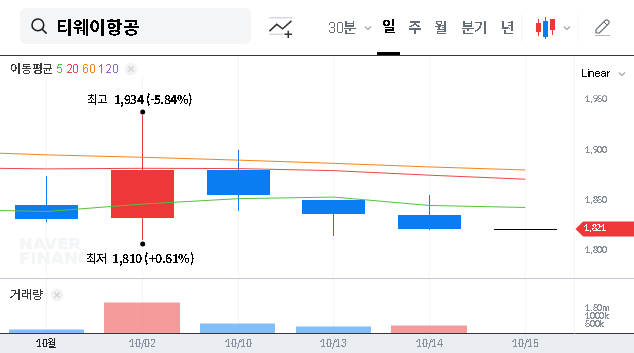
    In the short term, such a large sale can create negative sentiment. The market may interpret it as a major shareholder losing faith, potentially leading to increased selling pressure and stock price volatility. The fact that the CBs were not converted could also suggest that DB Securities did not see significant upside in the T’way Air stock price in the near future. This creates information asymmetry, where large players have different information than the average retail investor.

    Long-Term Fundamental Outlook

    Conversely, the ‘simple investment’ purpose could be the exact truth. Institutional investors frequently rebalance portfolios to lock in profits, manage risk, or comply with internal fund mandates. The sale might have nothing to do with T’way Air’s fundamental business operations. The global airline industry is still navigating a complex recovery, facing challenges from fuel costs and geopolitical tensions, as noted in high-authority sources like Reuters’ aviation industry reports. The long-term success of the T’way Air stock depends more on its route strategy, fleet efficiency, and competitive positioning than on a single shareholder’s transaction.

    Strategic Action Plan for T’way Air Investors

    Given the ambiguity, investors should focus on diligent research rather than reactive trades. Here is a checklist to guide your T’way Air investment decisions:

    • Analyze CB Terms: Investigate the original issuance terms of the convertible bonds. What was the conversion price? A high conversion price might explain why they were sold rather than exercised.
    • Monitor Institutional Holdings: Keep track of other major shareholders. Is DB Securities the only one selling, or is there a broader trend of institutional divestment?
    • Re-evaluate Company Financials: Conduct a fresh analysis of T’way Air’s balance sheet, income statement, and cash flow. Is the company’s debt manageable? Are revenues and passenger numbers trending positively?
    • Assess the Broader Industry: Put this event in context. How are other low-cost carriers performing? Understand the macro trends affecting the entire sector. For more on this, read Our Guide to Analyzing Airline Stocks.

    Conclusion: A Cautious but Informed Perspective

    DB Securities’ stake reduction in T’way Air is a notable event that introduces short-term uncertainty. However, it is not a definitive red flag against the company’s fundamentals. The ‘simple investment’ motive suggests it may be a portfolio management decision. For long-term investors, the focus should remain on T’way Air’s underlying business performance, competitive advantages, and financial health. This event underscores the importance of conducting thorough, independent research before making any decisions regarding your T’way Air stock holdings. Stay informed, analyze the data, and align your investment strategy with your long-term financial goals.

    (091810) T'way Air Stock Analysis: Decoding DB Securities' Major Stake Sale & What It Means for Investors 관련 이미지
  • T’way Air’s New Majority Shareholder: Is it a Turning Point?

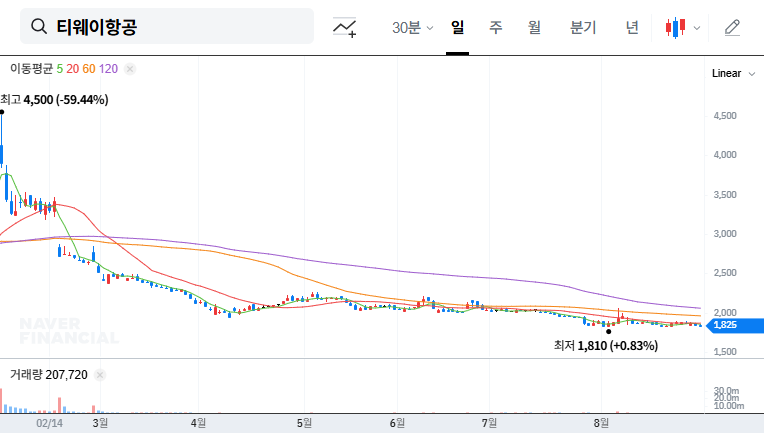
    T'way Air's New Majority Shareholder: Is it a Turning Point? 대표 차트 이미지

    What Happened?

    On August 29, 2025, T’way Air’s majority shareholder changed to Sono International through a third-party allocation paid-in capital increase. This decision aims to secure operating funds and improve the company’s financial structure.

    Why the Change?

    T’way Air is facing serious financial difficulties, including capital impairment, continuous operating losses, and a high debt ratio. External factors such as rising exchange rates, rising oil prices, and high interest rates are exacerbating the situation. To overcome these challenges, T’way Air secured investment from and transferred management rights to Sono International.

    What’s Next?

    Positive Outlook

    • Expected improvement in financial structure and resolution of capital impairment through secured funds
    • Potential for enhanced management stability and expertise with Sono International’s involvement
    • Expected synergy with Sono International’s travel and leisure business

    Negative Outlook and Risks

    • Uncertainty about actual financial and operational improvement despite secured funds
    • Increased pressure on management performance under the new majority shareholder
    • Intensifying competition in the LCC market and continued macroeconomic uncertainty

    What Should Investors Do?

    Investors considering T’way Air should carefully examine the following:

    • Monitor the progress and results of the capital increase and the use of funds
    • Check for improvements in operating performance and the new management’s strategy and execution capabilities
    • Continuously assess the impact of macroeconomic variables such as exchange rates, oil prices, and interest rates

    While the change in majority shareholder is a potentially positive sign, it’s crucial for investors to focus on long-term fundamental improvements rather than short-term stock price fluctuations.

    Who is the new majority shareholder of T’way Air?

    Sono International.

    Why did the majority shareholder change?

    The change occurred through a third-party allocation paid-in capital increase to secure operating funds and improve T’way Air’s financial structure.

    What are T’way Air’s main financial challenges?

    Capital impairment, continuous operating losses, and a high debt ratio. External challenges include rising exchange rates, oil prices, and interest rates.

    What is the outlook for T’way Air after the change?

    There are expectations for improved financial structure and management stability, but actual performance improvement remains uncertain. Risks include intensifying competition and macroeconomic uncertainty.

    T'way Air's New Majority Shareholder: Is it a Turning Point? 관련 이미지
    T'way Air's New Majority Shareholder: Is it a Turning Point? 관련 이미지
  • T’way Air Secures Investment from DB Securities: Opportunity or Risk? A Key Investor Analysis

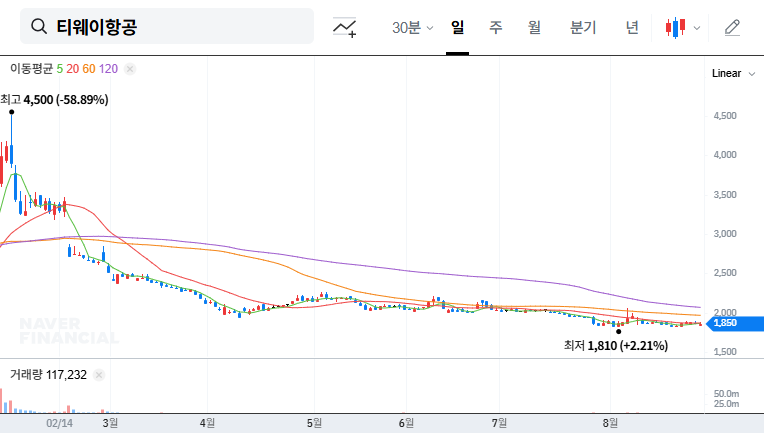
    T'way Air Secures Investment from DB Securities: Opportunity or Risk? A Key Investor Analysis 대표 차트 이미지

    1. What Happened?

    DB Securities acquired T’way Air’s CB/BW, securing a 17.62% stake. This is expected to provide a short-term cash injection for the airline.

    2. Why Does It Matter?

    T’way Air is currently in a state of capital impairment and reported weak earnings in the first half of 2025. DB Securities’ investment could play a crucial role in improving the airline’s financial structure. However, due to the nature of convertible bonds and bonds with warrants, there is a possibility of stock dilution upon conversion.

    • Positive Factors:
      • Short-term funding secured
      • Expectation of financial structure improvement
    • Negative Factors:
      • Potential for stock dilution
      • Continued poor performance
      • Capital impairment status

    3. What Should Investors Do?

    Before making an investment decision, carefully consider the following factors:

    • Management Strategy: Closely monitor the new management’s business strategies and execution capabilities.
    • Financial Indicators: Check the next quarterly earnings announcement for signs of financial improvement.
    • External Factors: Continuous monitoring of exchange rate and oil price volatility is necessary.
    • DB Securities’ Actions: Pay close attention to public announcements regarding DB Securities’ stake changes.

    4. Investor Action Plan

    The current investment recommendation for T’way Air is ‘caution.’ It is advisable to remain on the sidelines rather than making short-term investments and continuously monitor the factors mentioned above.

    Frequently Asked Questions

    Will DB Securities’ investment have a positive impact on T’way Air?

    It will help with short-term funding, but the long-term impact will depend on management’s strategy and market conditions. A cautious approach is recommended.

    Is it a good time to invest in T’way Air stock?

    Currently, the airline is in a state of capital impairment and continues to experience poor performance, so caution is advised. It’s best to decide on investment after confirming future management strategies and financial structure improvements.

    What is the future outlook for T’way Air?

    The recovery in air travel demand is positive, but the airline’s recovery potential will increase only if financial restructuring and management innovation are successful. Continuous monitoring is essential.

    T'way Air Secures Investment from DB Securities: Opportunity or Risk? A Key Investor Analysis 관련 이미지
    T'way Air Secures Investment from DB Securities: Opportunity or Risk? A Key Investor Analysis 관련 이미지