Tag: 058860

  • (058860) ktis Corporation Earnings (058860): Q3 2025 Analysis & Stock Outlook

    (058860) ktis Corporation Earnings (058860): Q3 2025 Analysis & Stock Outlook

    This in-depth analysis of the ktis Corporation earnings for Q3 2025 unpacks the preliminary results that have captured investor attention. With a staggering four-fold increase in net profit, it’s crucial for stakeholders to understand the underlying drivers. This report provides a comprehensive look at the company’s fundamentals, market position, and the sustainability of this growth to help you make informed decisions about the ktis Corporation stock.

    Q3 2025 Financial Highlights at a Glance

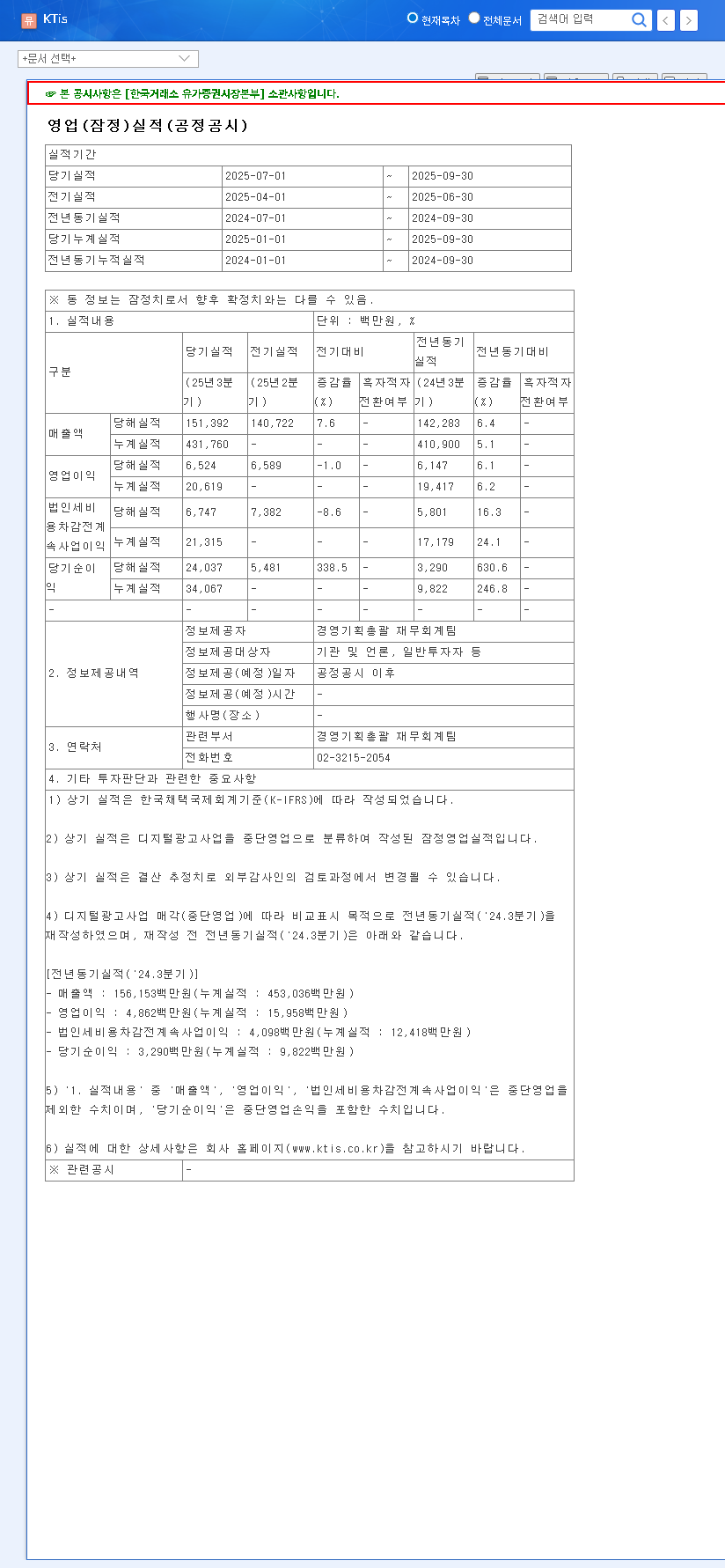
    ktis Corporation (ticker: 058860) released its preliminary Q3 2025 results, revealing a mixed but intriguing picture. While revenue saw modest growth and operating profit remained steady, the net profit figure tells a more dramatic story.

    • Revenue: KRW 156 billion, showing a slight increase from the previous quarter.
    • Operating Profit: KRW 6.6 billion, maintaining a stable level compared to Q2.
    • Net Profit: KRW 24.1 billion, a remarkable surge from KRW 5.5 billion in Q2 2025.

    This significant jump in net profit, despite flat operating profit, suggests the influence of non-operating or one-time financial events, a critical point for any ktis investment outlook.

    Dissecting the Net Profit Surge: A One-Time Event?

    The primary driver behind the explosive net profit growth is likely linked to non-operating activities. Analysis points towards gains from the divestiture of assets, specifically the spin-off and sale of its digital advertising business unit. Such events, while boosting the bottom line in a single quarter, are not indicative of core operational performance improvements.

    Investors must differentiate between sustainable operational growth and one-off financial gains. The key question for the ktis Corporation stock is whether its core businesses can generate long-term value, independent of asset sales. For full transparency, see the company’s Official Disclosure.

    Core Business and Financial Health Analysis

    Pivoting to High-Value AI Solutions

    ktis Corporation’s strategy centers on enhancing its core segments. The Contact Center Business remains a stable revenue generator, but the real future growth lies in its transformation into a high-value AICC (AI Contact Center) provider. This pivot towards AI is crucial for maintaining a competitive edge. Meanwhile, the Distribution Business aims for stability by focusing on 5G and bundled services, and the legacy Directory Assistance Business is being streamlined with AICC systems to improve efficiency as usage declines. Learn more about how companies are leveraging this technology in our guide on The Future of AI in Customer Service.

    A Check on Financial Soundness

    While the H1 2025 report showed revenue growth, operating profit declined due to increased investments and costs like depreciation. However, the company maintains healthy operating cash flow (KRW 38.077 billion), a positive sign of operational liquidity. Its debt-to-equity ratio of 84.85% is moderate, and when viewed alongside a Return on Equity (ROE) of 5.11%, it suggests a fair level of financial soundness. The divestiture of the digital ad business is a strategic move to focus on core competencies and enhance long-term value.

    Investment Outlook: Bull vs. Bear Case

    The latest ktis Corporation earnings present a nuanced picture for potential investors. Macroeconomic factors, such as stabilizing interest rates, could ease funding costs and create a favorable environment. For insights on global trends, investors often consult sources like Bloomberg Economics.

    The Bull Case (Reasons for Optimism)

    • AICC Growth Potential: Successful expansion into the AICC market could unlock significant high-margin revenue streams.
    • Strategic Focus: Divesting non-core assets shows a clear strategy to strengthen its main business lines.
    • Stable Core Operations: The company maintains stable operating profit and healthy cash flow from its foundational businesses.

    The Bear Case (Points of Caution)

    • Unsustainable Profit: The Q3 net profit is inflated by a one-time event and doesn’t reflect underlying profitability.
    • Cost Pressures: Rising costs and investment-related expenses (depreciation, leases) have been squeezing operating profit margins.
    • Competitive Market: The AICC space is becoming increasingly competitive, and ktis must execute flawlessly to capture market share.

    Final Recommendation: A Neutral Stance

    Given the current information, an investment opinion of ‘Neutral’ is prudent. While the Q3 2025 report contained positive signals, the headline net profit figure requires careful interpretation. True long-term value will be determined by the successful execution of the AICC strategy and the company’s ability to manage its cost structure effectively.

    Investors should monitor the tangible results from the AICC business expansion and upcoming quarterly reports for signs of sustained operational improvement before committing capital.
    (058860) ktis Corporation Earnings (058860): Q3 2025 Analysis & Stock Outlook 관련 이미지
  • KTis Merges with HNC Network: Impact Analysis for Investors

    KTis Merges with HNC Network: Impact Analysis for Investors 대표 차트 이미지

    What Happened?

    KTis will merge with its subsidiary HNC Network, with the merger date set for December 1, 2025. KTis will be the surviving entity, and HNC Network will be dissolved. By merging with HNC Network, which operates call centers and provides staffing services, KTis aims to strengthen its business competitiveness and improve management efficiency.

    Why the Merger?

    KTis has been focusing on its core contact center and distribution businesses after divesting its digital advertising division. This merger is interpreted as a strategy to enhance core business competitiveness by creating synergy in the call center business and increasing management efficiency. Cost reduction effects are also expected through organizational integration and operational streamlining.

    Potential Impact of the Merger

    • Positive Impacts: Synergy in call center business, enhanced management efficiency, potential improvement in financial structure.
    • Negative/Neutral Impacts: Potential short-term financial burden, uncertainty regarding synergy creation, potential lack of relevance with existing core businesses.

    While positive effects can be expected from the merger, factors such as short-term financial burden and uncertainty regarding synergy must also be considered.

    Action Plan for Investors

    Investors should closely monitor the synergy creation after the merger, its relevance to KTis’s core businesses, and the actual improvement in financial performance. It is crucial to pay attention to how KTis secures growth momentum and maintains competitiveness amidst the growth and intensifying competition in the AICC market. Carefully reviewing post-merger earnings announcements and management’s business strategies is essential.

    Frequently Asked Questions

    When is the merger date?

    December 1, 2025.

    What is the purpose of the merger?

    To strengthen business competitiveness and improve management efficiency.

    How will the merger affect KTis stock price?

    The potential impact of the merger can be both positive and negative. Stock price volatility may occur depending on various factors, including synergy creation and market conditions.

    KTis Merges with HNC Network: Impact Analysis for Investors 관련 이미지
    KTis Merges with HNC Network: Impact Analysis for Investors 관련 이미지
  • KTis (058860) Investment Analysis: Contact Center Growth vs. Distribution Business Decline

    1. What’s Happening with KTis?

    KTis continues its robust growth in the contact center business, but faces headwinds in its distribution segment, including declining sales of KT wired and wireless products and KT Plaza consignment business. The divestiture of the Townboard TV business signifies a shift in the company’s structure.

    2. Why These Developments?

    The decline in the distribution business is attributed to the changing telecommunications market environment and intensifying competition. The divestiture of the digital advertising business is a strategic move aimed at improving profitability and adjusting the business portfolio. Increased competition in the contact center market reflects the advancements in AI technology and market dynamics.

    3. What’s Next for KTis?

    KTis plans to strengthen its contact center business competitiveness by expanding its AICC business. It’s also pursuing diversification through new ventures such as financial product sales, product wholesale and brokerage, and paid job placement services. However, the recovery of the distribution business and the success of new ventures require ongoing monitoring.

    4. What Should Investors Do?

    KTis presents both growth potential and uncertainty. Investors should closely monitor the growth of the AICC business, the performance of new ventures, and the restructuring results before making investment decisions. The current investment recommendation is ‘Neutral’, with adjustments to strategy depending on future business performance and market conditions.

    What are KTis’s main businesses?

    KTis primarily focuses on contact center operations, alongside distribution and digital advertising businesses. The company is currently expanding its AI Contact Center (AICC) operations and pursuing new ventures like financial product sales.

    What is the investment outlook for KTis?

    While the growth in the contact center business is positive, the declining distribution business and uncertainties surrounding the restructuring pose challenges. Careful monitoring of AICC business growth and new business performance is crucial.

    What are the key factors to consider when investing in KTis?

    Investors should consider the performance of the distribution business, the company’s strategy following the digital advertising divestiture, the success of new ventures, and changes in macroeconomic indicators.