Tag: 033160

  • (033160) Convertible Bond Conversion Explained: MKElectron’s Impact on Stock Price

    (033160) Convertible Bond Conversion Explained: MKElectron’s Impact on Stock Price

    MKElectron recently announced the exercise of its ‘convertible bond conversion rights,’ a financial event that can send ripples through a company’s stock value. For investors, understanding the nuances of a convertible bond conversion is critical. Is it a sign of strength or a red flag for potential shareholder dilution? This comprehensive analysis will demystify MKElectron’s recent move, explore the direct impact on its stock price, and provide a clear action plan for making informed investment decisions.

    First, What is a Convertible Bond Conversion?

    Before diving into the MKElectron case, it’s essential to grasp the fundamentals. A convertible bond (CB) is a hybrid security that acts like a regular bond, paying interest to the holder. However, it comes with a unique feature: the option to convert the bond into a predetermined number of the issuing company’s common shares. The act of turning that bond into stock is the convertible bond conversion itself. Companies issue CBs as a flexible way to raise capital, often at a lower interest rate than traditional bonds because the conversion option offers investors potential upside.

    MKElectron’s Conversion: The Key Details

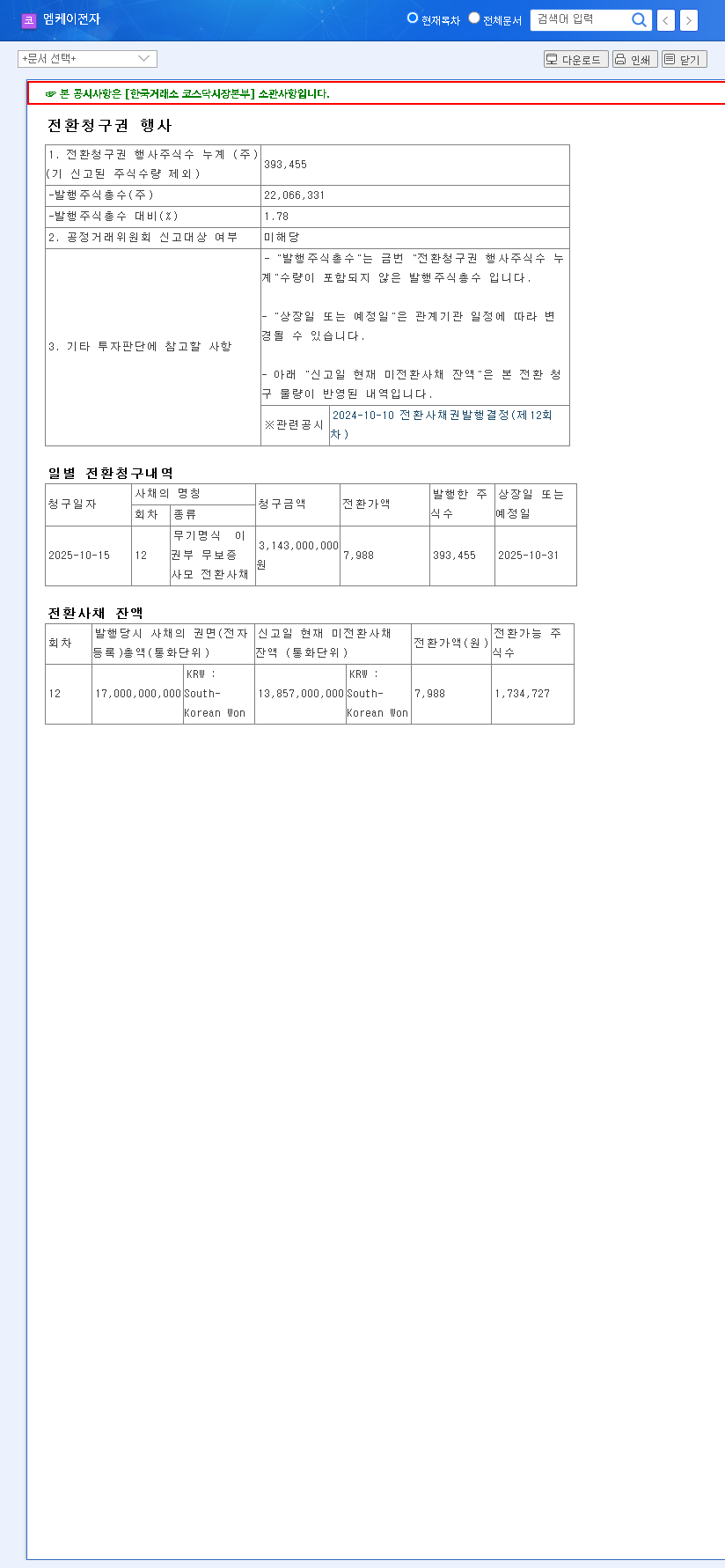
    On October 15, 2025, MKElectron (Market Cap: KRW 239.6 billion) filed a disclosure announcing a significant CB conversion event. Understanding the numbers is the first step in a proper investment analysis. You can view the Official Disclosure for complete details. Here are the critical facts:

    • Number of New Shares: 393,455
    • Proportion of Market Cap: 1.78%
    • Conversion Price: KRW 7,988 per share
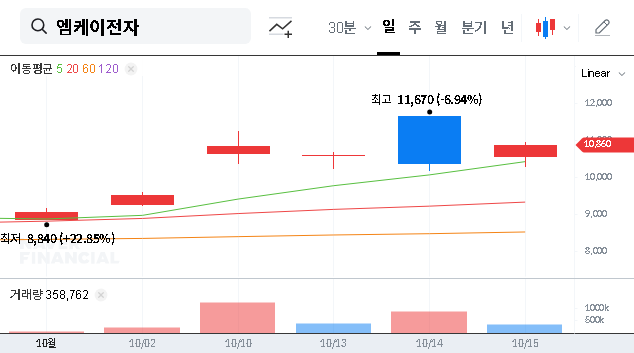
    • Stock Price at Announcement: KRW 10,232 per share
    • Expected Listing Date: October 31, 2025

    The key takeaway here is the spread between the conversion price (KRW 7,988) and the market price (KRW 10,232). This creates a strong incentive for bondholders to convert and potentially sell for an immediate profit, a crucial factor in predicting short-term stock behavior.

    Analyzing the Impact on MKElectron Stock

    A CB conversion is a double-edged sword, presenting both potential risks and benefits for the company and its shareholders.

    The Downside: Shareholder Dilution and Selling Pressure

    The most immediate concern is shareholder dilution. With 393,455 new shares entering the market, the ownership percentage of existing shareholders decreases. While the 1.78% increase is relatively small, it can still impact earnings per share (EPS). Furthermore, the profitable spread for bondholders can lead to significant selling pressure as new shares become available, potentially driving the stock price down in the short term. This is a classic arbitrage scenario that investors should anticipate around the listing date.

    The Upside: A Stronger Financial Foundation

    On the other hand, the conversion has significant long-term benefits. By converting debt into equity, MKElectron effectively cleans up its balance sheet. This has two positive effects: it reduces the company’s debt burden and eliminates future interest payments associated with those bonds. This improved financial structure can make the company more attractive to long-term investors and credit rating agencies. It also signals that the capital raised via the bonds was likely put to good use, fueling growth that made the conversion attractive in the first place.

    Investor Action Plan & Risk Assessment

    Given the limited public information, a cautious and analytical approach is necessary. Before making any decisions regarding MKElectron stock, investors must conduct thorough due diligence.

    Your Due Diligence Checklist

    • Fundamental Analysis: Go beyond the announcement. Scrutinize MKElectron’s recent financial statements, business reports, and strategic plans to evaluate its intrinsic value. You can learn more about analyzing company financial statements on our blog.
    • Market Sentiment: Seek out brokerage reports and professional investment analysis to understand how market experts view the company’s prospects post-conversion.
    • Monitor Price Action: Keep a close eye on the stock’s trading volume and price fluctuations around the October 31, 2025, listing date to see how the market absorbs the new shares.
    • Macro-Economic Factors: Consider the broader economic environment. Interest rates and industry trends can significantly influence a company’s performance, regardless of its capital structure. For a deeper dive into financial terminology, visit authoritative sources like Investopedia.

    Frequently Asked Questions (FAQ)

    What does MKElectron’s convertible bond conversion mean for investors?

    It can lead to short-term stock price volatility and minor shareholder dilution. However, it also positively impacts the company by reducing debt and improving its financial health, which requires a comprehensive analysis from investors.

    What are the direct impacts of this CB conversion on the stock price?

    The primary impact is potential downward pressure on the stock price. This is driven by the issuance of new shares and the likelihood that converting bondholders will sell their new shares to realize a profit, given the gap between the conversion price (KRW 7,988) and the market price (KRW 10,232).

    What are the positive aspects of this event for MKElectron?

    When bonds are converted to stock, the company’s debt-to-equity ratio improves and interest expense decreases. This strengthens the balance sheet and enhances financial stability, which can be a very positive long-term signal.
    (033160) Convertible Bond Conversion Explained: MKElectron's Impact on Stock Price 관련 이미지
  • MK Electron’s Treasury Stock Disposal: Opportunity or Risk? Investment Strategies Unveiled


    MK Electron's Treasury Stock Disposal: Opportunity or Risk? Investment Strategies Unveiled 대표 차트 이미지


    1. MK Electron’s KRW 10.7 Billion Treasury Stock Disposal: What’s Happening?

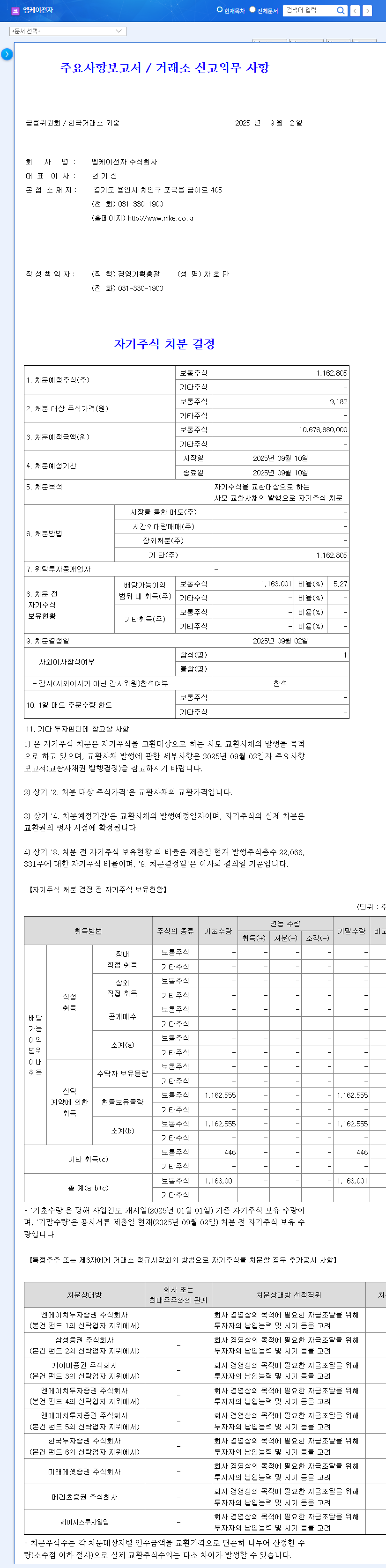
    On September 2, 2025, MK Electron announced its decision to dispose of 1,162,805 shares of treasury stock, equivalent to approximately KRW 10.7 billion. The purpose is to raise funds through the issuance of private exchangeable bonds and improve its financial structure.

    2. Why the Treasury Stock Disposal?

    The aim is to raise capital and improve financial health through the issuance of private exchangeable bonds. The funds are expected to be utilized for securing new growth engines, strengthening financial soundness, and expanding R&D investments.

    3. What’s the Impact on Stock Price? Investor Action Plan

    • Short-term impact: Dilution effects due to increased outstanding shares are possible, but the clear fundraising purpose suggests limited volatility.
    • Long-term impact: Efficient use of the funds can contribute to increased corporate value.
    • Investor action plan: Carefully consider the planned use of funds, dilution effects, and market conditions before making investment decisions. Closely monitor the performance of their new business, especially secondary battery materials, and the improvement of their financial soundness.

    4. Assessing MK Electron’s Fundamentals

    • Positive factors: No. 1 global market share in bonding wire, securing new growth engines (secondary battery materials, etc.), technological competitiveness, strengthened ESG management.
    • Considerations: Fluctuations in sales and profitability, high debt-to-equity ratio, negative operating cash flow, macroeconomic uncertainty.

    5. Market and Economic Outlook

    While the outlook for the semiconductor and secondary battery markets is positive, volatility in interest rates, exchange rates, and raw material prices pose risks.


    Frequently Asked Questions (FAQ)

    What is the purpose of MK Electron’s treasury stock disposal?

    The purpose is to raise funds through the issuance of private exchangeable bonds and improve the company’s financial structure.

    How will the treasury stock disposal affect the stock price?

    In the short term, there may be dilution effects due to the increase in outstanding shares. However, the long-term impact will depend on how the raised funds are utilized, which could positively or negatively affect the stock price.

    What are the key investment points for MK Electron?

    Key investment points include their leading global market share in bonding wire and securing new growth engines like secondary battery materials. However, investors should also consider the risks related to financial soundness and macroeconomic changes.


    MK Electron's Treasury Stock Disposal: Opportunity or Risk? Investment Strategies Unveiled 관련 이미지
    MK Electron's Treasury Stock Disposal: Opportunity or Risk? Investment Strategies Unveiled 관련 이미지


  • MK Electron Issues ₩10.7B Convertible Bonds: Impact on Financials and Stock Price?


    MK Electron Issues ₩10.7B Convertible Bonds: Impact on Financials and Stock Price? 대표 차트 이미지


    1. MK Electron Issues ₩10.7B Convertible Bonds: What’s Happening?

    MK Electron announced on September 2, 2025, the issuance of ₩10.7 billion in convertible bonds. These bonds will be issued privately, with a conversion price of ₩9,182 and a maturity rate of 2.0%. Key investors include Paros Multi Private Equity Trust No. 3 and others.

    2. Why the Convertible Bond Issuance?

    This bond issuance serves two main purposes. First, it aims to improve MK Electron’s financial structure, given its high debt-to-equity ratio. Second, it seeks to secure funds for investments in new businesses, such as secondary battery materials.

    3. What Does This Mean for Investors?

    • Positive Aspects: Enhanced financial stability, potential for increased corporate value through securing new growth engines.
    • Negative Aspects: Potential dilution of share value due to the conversion price being lower than the current stock price, potential increase in interest burden due to rising interest rates.

    MK Electron is leveraging its strong position in the bonding wire market to expand into new businesses. However, the sluggish performance in the first half of 2025 is a point of caution for investors.

    4. Investor Action Plan!

    Investors should consider the following factors when making investment decisions:

    • Recovery of the semiconductor industry
    • Performance of new businesses
    • Trends in financial structure improvement
    • Stock price volatility


    FAQ

    What are MK Electron’s main businesses?

    MK Electron specializes in semiconductor post-processing materials (bonding wires, solder balls). They are also venturing into new businesses like solder paste, test materials, and secondary battery materials (silicon anode materials).


    What are convertible bonds?

    Convertible bonds are bonds that can be converted into the issuing company’s stock after a certain period.


    How will this convertible bond issuance affect the stock price?

    In the short term, there are concerns about the dilution of share value. However, in the long term, improved financial structure and securing new growth engines can lead to stock price increases. However, stock price volatility may increase depending on various factors like the semiconductor industry and the performance of new businesses.


    MK Electron Issues ₩10.7B Convertible Bonds: Impact on Financials and Stock Price? 관련 이미지
    MK Electron Issues ₩10.7B Convertible Bonds: Impact on Financials and Stock Price? 관련 이미지


  • MK Electron (033160) H1 2025 Earnings: A Glimmer of Hope Amidst Challenges?

    1. What Happened at MK Electron?

    MK Electron’s revenue for H1 2025 declined by 37.5% year-on-year to KRW 475.5 billion, with operating profit margin dropping significantly to 2.21%. The company was directly impacted by the global semiconductor market downturn. Declines in sales of bonding wires and solder balls, by 37.1% and 41.2% respectively, were the main contributors.

    2. Why is MK Electron Facing These Challenges?

    The semiconductor industry downturn is the primary reason for MK Electron’s weak performance. The high debt-to-equity ratio (148.81%) also raises concerns about financial stability. Rising raw material prices and exchange rate volatility are additional burdens on profitability.

    3. So, What’s Next for MK Electron?

    On the positive side, the company returned to profitability in Q2 and has growth potential in new businesses (eco-friendly materials, secondary battery materials). However, the semiconductor market recovery, the actual performance of new businesses, and improvements in financial structure will determine the company’s future success. The current high P/E ratio of 43.3x and low P/B ratio of 0.53x reflect the market’s uncertainty.

    4. What Should Investors Do?

    • Avoid overreacting to short-term stock price fluctuations and consider investing from a mid-to-long-term perspective.
    • Continuously monitor the timing of the semiconductor market recovery, the performance of new businesses, and improvements in the financial structure.
    • Examine the company’s risk management efforts and strategies for responding to changes in the external environment.
    How was MK Electron’s Q2 2025 performance?

    MK Electron reported a return to profitability in Q2 2025, with revenue of KRW 336.1 billion, operating profit of KRW 11.7 billion, and net profit of KRW 6.2 billion.

    What are MK Electron’s main businesses?

    MK Electron’s core business is semiconductor materials, including bonding wires and solder balls. The company is also expanding into new businesses such as eco-friendly materials and secondary battery materials.

    What are the key investment considerations for MK Electron?

    Investors should consider the high debt-to-equity ratio, semiconductor market volatility, and uncertainty surrounding new businesses. Fluctuations in raw material prices and exchange rates are also important factors.