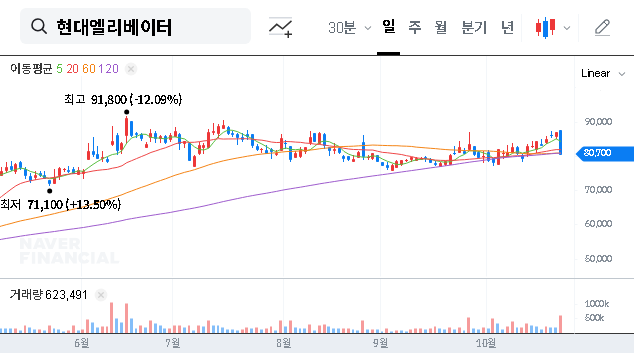
The latest HYUNDAI ELEVATOR dividend announcement has captured the attention of investors. With a 1,000 KRW per share payout confirmed for Q2 2025, many are asking a critical question: Is this a sign of underlying strength and a compelling buying opportunity, or is it a strategic move to placate shareholders amidst challenging market conditions? The company’s recent half-year performance shows a significant decline, shadowed by a broader slowdown in the construction industry, making this a complex decision point for any portfolio.
This comprehensive Hyundai Elevator investment analysis will dissect the dividend decision, evaluate the company’s core fundamentals, and weigh its future growth potential against persistent macroeconomic risks. Before you make a decision on HYUNDAI ELEVATOR stock, this guide will provide the clarity needed to formulate a prudent and informed investment strategy.
A Deep Dive into the Q2 2025 HYUNDAI ELEVATOR Dividend
On November 13, 2025, HYUNDAI ELEVATOR CO.,LTD reaffirmed its commitment to shareholders by announcing a cash dividend of 1,000 KRW per common share for the second quarter of 2025. This move, detailed in the company’s official disclosure (Source), provides a dividend yield of approximately 1.4% based on the current stock price. Key dates for investors are the ex-dividend date on November 30, 2025, with the actual payment scheduled for December 19, 2025.
This payout is a direct result of the quarterly dividend system the company adopted in March 2025. This shareholder return policy pledges to return over 50% of net profit to investors through either cash dividends or share buybacks. For investors, this signals a predictable and reliable return framework, which is especially valuable during periods of market volatility.
Financial Health & Market Position: An Investment Analysis
1. Uncontested Leader in the Korean Market
HYUNDAI ELEVATOR stands as the undisputed market leader in South Korea, holding the number one market share for elevators, escalators, and moving walks. Its revenue is reliably split between new installations—driven by major clients like Hyundai E&C—and a stable, recurring income from maintenance services. This dominant position creates a significant moat, making it difficult for competitors to erode its core business.
2. Resilient Financials Despite Sector Downturn
The first half of 2025 was undeniably tough. The slowdown in the construction sector led to a sharp 57.4% decrease in revenue and a 53.9% drop in operating profit year-over-year. However, a look at the balance sheet reveals a more positive story. The company has maintained a healthy financial structure, evidenced by a lower debt-to-equity ratio and an improved current ratio. These metrics indicate that despite lower earnings, the company is not over-leveraged and possesses sufficient liquid assets to cover its short-term liabilities—a key sign of stability for long-term investors.
While the dividend is a welcome sign, investors must balance this against the realities of a contracting construction market and assess the company’s ability to navigate these macroeconomic headwinds.
Future Growth Catalysts vs. Prevailing Risks
Key Growth Opportunities
Even in a challenging climate, HYUNDAI ELEVATOR is strategically investing in future growth:
- •Innovative Technology: The company is pushing the boundaries with investments in AI-based diagnostics, Urban Air Mobility (UAM) vertiports, and the commercialization of robot-linked elevator services, positioning itself for the smart cities of tomorrow.
- •Market Expansion: A growing demand for high-speed elevators in new skyscrapers and a robust replacement market for aging buildings provide dual avenues for sustained domestic and international growth.
- •ESG Commitment: By establishing a dedicated ESG Committee, HYUNDAI ELEVATOR is enhancing its corporate image and building long-term value, appealing to a growing base of socially conscious investors.
Critical Risk Factors to Monitor
Despite these strengths, significant risks remain that could impact the HYUNDAI ELEVATOR stock price:
- •Construction Industry Dependence: The company’s fortunes are closely tied to the cyclical nature of the construction market. A prolonged downturn will continue to pressure revenue.
- •Macroeconomic Volatility: Fluctuations in interest rates and currency exchange rates can impact borrowing costs, international competitiveness, and the translated value of overseas profits.
- •Global Competition: The elevator market is fiercely competitive, requiring constant innovation to maintain an edge in both technology and pricing against global giants.
Investment Outlook: Is Now the Time to Buy?
The HYUNDAI ELEVATOR dividend creates a compelling narrative, but it’s one piece of a larger puzzle. For short-term investors, the dividend may provide some positive price momentum. However, the fundamental issues causing the performance slump have not disappeared. A cautious approach is warranted.
For mid-to-long-term investors, the outlook is more optimistic. The company’s strong market position and forward-looking investments are significant assets. A strategy of phased buying could be effective, allowing investors to build a position while monitoring for signs of a construction market recovery. To understand the broader market dynamics, it’s helpful to review analyses on the South Korean construction sector outlook. The concept of a dividend yield is also crucial for evaluating such stocks, as explained by financial authorities like Investopedia.
In conclusion, while the dividend is an attractive feature, it should not be the sole basis for an investment. A comprehensive analysis of market conditions and company fundamentals points toward a cautious but potentially rewarding long-term opportunity.
Frequently Asked Questions (FAQ)
What is HYUNDAI ELEVATOR’s Q2 2025 dividend payment?
HYUNDAI ELEVATOR has announced a cash dividend of 1,000 KRW per common share for the second quarter of 2025.
When are the key dividend dates?
The ex-dividend date is November 30, 2025, and the payment date is December 19, 2025.
How has HYUNDAI ELEVATOR performed recently?
In the first half of 2025, revenue and operating profit decreased by 57.4% and 53.9% respectively, compared to the prior year, primarily due to a construction industry slowdown.
What is the long-term investment outlook for HYUNDAI ELEVATOR stock?
The long-term outlook has positive potential, thanks to its dominant market position, investments in future technologies like UAM, and a strong shareholder return policy. However, this is contingent on the recovery of the construction market and stable macroeconomic conditions.
Leave a Reply