Tag: 003540

  • (003540) DAISHIN SECURITIES Q3 2025 Earnings Analysis: Profit Soars 36%, But Red Flags Emerge

    (003540) DAISHIN SECURITIES Q3 2025 Earnings Analysis: Profit Soars 36%, But Red Flags Emerge

    The latest DAISHIN SECURITIES Q3 2025 earnings report presents a fascinating and complex picture for investors. In a period of sustained market volatility, the company has posted a provisional earnings announcement that is stirring significant debate. On one hand, core business performance, reflected by operating profit, has shattered market expectations. On the other, the bottom-line net income has faltered, raising critical questions about underlying financial health and future prospects.

    This comprehensive DAISHIN SECURITIES earnings analysis will dissect these contrasting results, explore the driving factors behind them, and provide a strategic guide for current and potential investors. What does this divergence signify for the DAISHIN SECURITIES stock, and how should you position your portfolio in response?

    While operating profit surged an impressive 36% above expectations, net income unexpectedly dipped 6% below forecasts, creating a complex narrative that requires a deeper look beyond the headlines.

    DAISHIN SECURITIES Q3 2025 Earnings: The Official Numbers

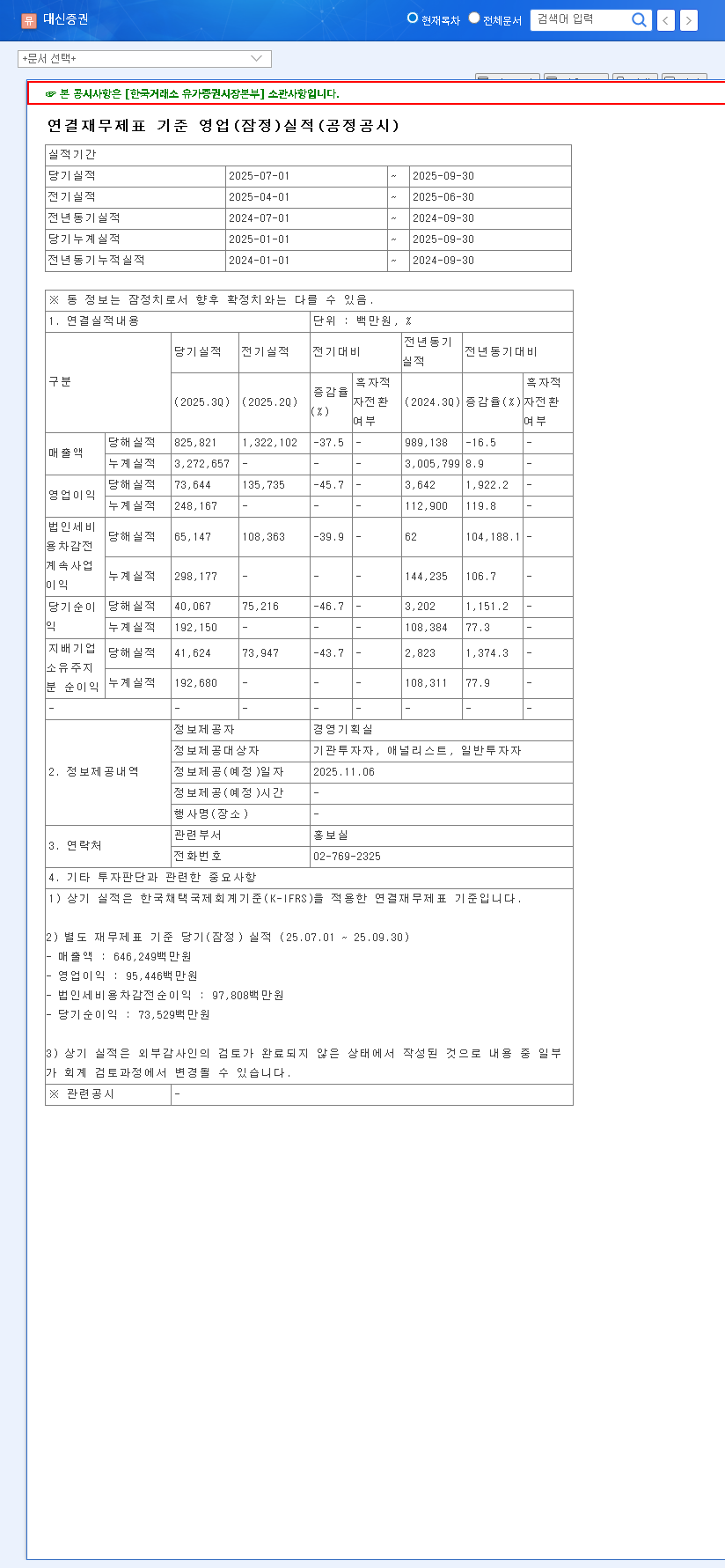
    According to the provisional data disclosed on November 6, 2025, the company’s consolidated performance for the third quarter revealed the following key metrics. For a complete and unfiltered view, investors can review the Official Disclosure filed with the Financial Supervisory Service (DART).

    • Revenue: KRW 825.8 billion (Market Estimate N/A)
    • Operating Profit: KRW 73.6 billion (36% above the market estimate of KRW 54.3 billion)
    • Net Profit: KRW 41.6 billion (6% below the market estimate of KRW 44.3 billion)

    The Bull & Bear Case: Deconstructing the Results

    The core of this quarter’s story lies in the significant gap between operational success and net profitability. Let’s break down the positive and negative drivers influencing these outcomes.

    The Bull Case: A Resilient Core Business

    The standout figure—operating profit of KRW 73.6 billion—is a powerful testament to the strength of DAISHIN SECURITIES’ primary business activities. This performance indicates that segments like brokerage, investment banking, and asset management are thriving despite a challenging economic backdrop. The company has shown a remarkable turnaround, maintaining a strong positive operating profit trend since Q1 2025, following a loss in Q4 2024. This consistent recovery builds confidence in the management’s strategy and operational execution.

    The Bear Case: The Mystery of the Net Income Miss

    Despite the robust operating profit, the net income of KRW 41.6 billion is a point of concern. This shortfall suggests that factors outside of core operations negatively impacted the bottom line. Such factors could include:

    • Non-operating Losses: Losses from the valuation of financial assets, investments in associate companies, or foreign exchange translations could be significant culprits.
    • One-Time Expenses: A specific, non-recurring cost or a significant litigation provision could have dragged down net profit.
    • Higher Corporate Taxes: An increase in the effective tax rate for the quarter could also explain the discrepancy. For more details, investors might want to review our guide on analyzing a company’s income statement.

    This quarterly decline in net income, when compared to Q1 (KRW 76.9 billion) and Q2 (KRW 75.2 billion), warrants close scrutiny in the full, audited report.

    Market Outlook and Strategic Considerations

    The forward-looking picture for securities company earnings is tied to broader market forces. A projected revenue decline for Q4 2025 could signal weakening investor sentiment or lower asset management fees. Furthermore, macroeconomic variables such as high KRW/USD exchange rates and interest rate policies from central banks can introduce significant volatility, as highlighted by recent global market analysis from Reuters. While stable U.S. Treasury yields may offer some stability, the overall environment remains uncertain.

    The company’s previously stated purpose for holding treasury shares—to enhance shareholder value and improve its financial structure—is a positive signal of shareholder-friendly policies. However, its direct impact on near-term profitability remains to be seen.

    Investor Guide: A Smart Action Plan

    Given the mixed signals from the DAISHIN SECURITIES Q3 2025 earnings, investors should adopt a cautiously optimistic approach. While the operational recovery is encouraging, the potential red flags cannot be ignored. Here is a checklist for informed decision-making:

    • Analyze the Full Report: Wait for the finalized, detailed financial statements to pinpoint the exact cause of the net income decline.
    • Monitor Revenue Trends: Closely watch for signs that the company is developing new growth drivers to counter the potential slowdown in revenue.
    • Track Treasury Stock Utilization: Observe how and when the company uses its treasury stock to ensure it translates into tangible shareholder value.
    • Assess Macro-Environment: Stay informed about changes in exchange rates, interest rates, and overall market sentiment that directly affect the securities industry.

    Frequently Asked Questions (FAQ)

    What are the key takeaways from DAISHIN SECURITIES’ Q3 2025 earnings?

    The key takeaway is a dual narrative: the company’s core operations are performing exceptionally well (operating profit up 36% over estimates), but its final net profit was dragged down by other factors (down 6% vs. estimates), signaling a need for deeper investigation.

    Why did net income decrease while operating profit rose?

    The most likely causes are non-operating factors. These can include valuation losses on investments, foreign exchange impacts, one-time expenses, or a higher-than-expected corporate tax bill. The full financial report will provide clarity.

    What should investors watch for in the coming months?

    Investors should focus on the detailed explanation for the net income miss, the company’s strategy to address declining revenue trends, and how management plans to use treasury stock to benefit shareholders.
    (003540) DAISHIN SECURITIES Q3 2025 Earnings Analysis: Profit Soars 36%, But Red Flags Emerge 관련 이미지
  • (003540) NPS Increases Daishin Securities Stake: A Full Analysis for Investors

    (003540) NPS Increases Daishin Securities Stake: A Full Analysis for Investors

    The recent move by Korea’s National Pension Service (NPS) to increase its stake in Daishin Securities (003540) has sent ripples through the investment community. While officially labeled a ‘simple investment,’ any action by a financial titan like the NPS warrants a closer look. This comprehensive analysis will unpack the implications of this development, from Daishin Securities’ core financial health to the broader macroeconomic landscape, providing investors with the critical insights needed to make informed decisions.

    We’ll explore what this vote of confidence from a major institutional investor signals and how it could influence the future trajectory of Daishin Securities stock.

    The Details: NPS Deepens Its Position in Daishin Securities

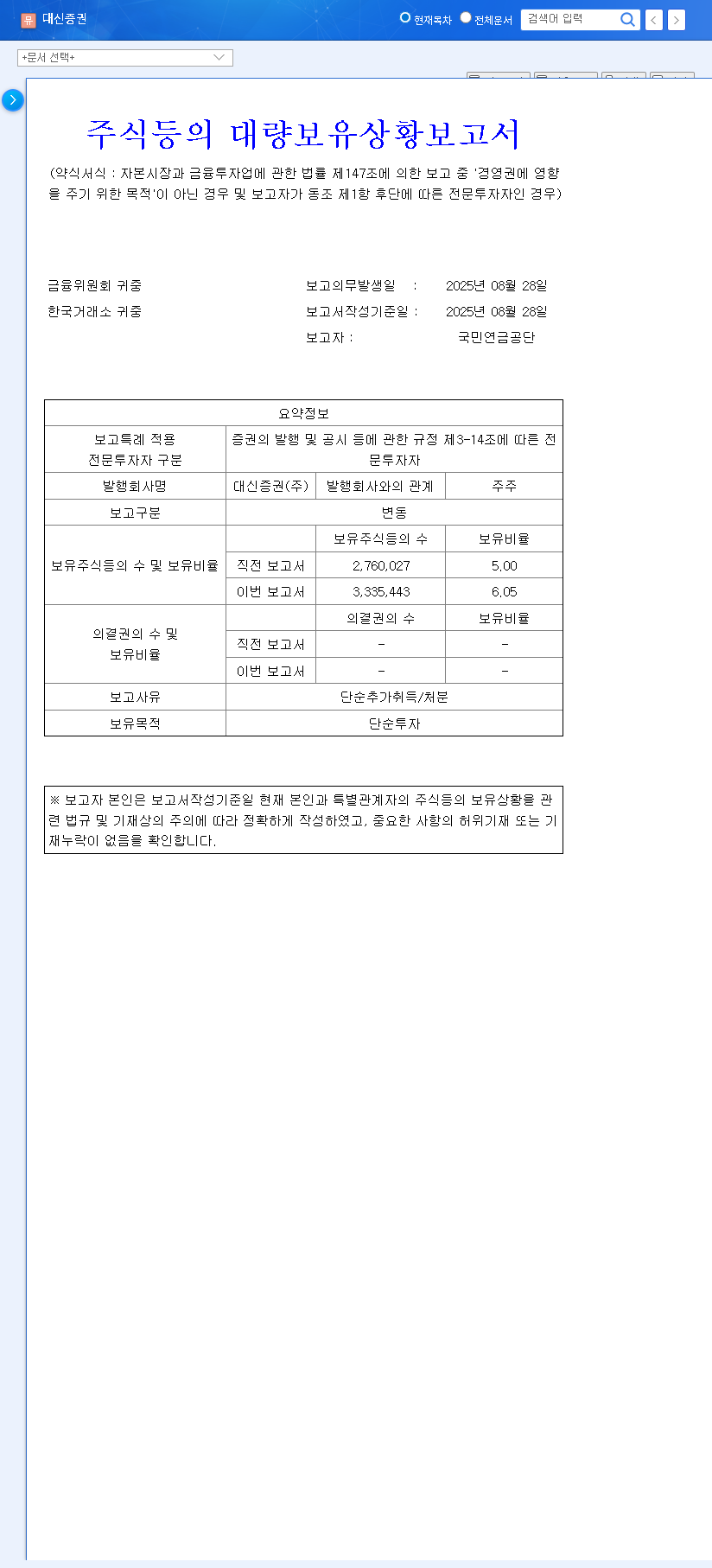
    According to the official filing on October 1, 2025, the National Pension Service reported an increase in its shareholding of Daishin Securities. The stake was raised by 0.05 percentage points, moving from 5.00% to a total of 6.05%. The purpose of the holding was explicitly stated as a ‘simple investment,’ implying no intent to participate in management. You can view the Official Disclosure (Source) for complete details. While seemingly minor, this consistent accumulation by the nation’s largest pension fund is a powerful non-verbal signal to the market about the company’s perceived value.

    Fundamental Analysis: Is Daishin Securities Built to Last?

    The NPS’s decision wasn’t made in a vacuum. A thorough review of Daishin Securities’ fundamentals reveals a company on a positive trajectory, making it an attractive target for long-term institutional capital.

    Profitability and Growth Turnaround

    Daishin Securities has demonstrated a remarkable financial recovery. After a challenging period in 2022, the company saw a significant turnaround in 2023, with both operating profit and net income showing strong positive growth. Projections for 2024 and 2025 continue this upward trend. Key profitability metrics tell a compelling story:

    • Return on Equity (ROE): Sharply improved from negative figures to a healthy 8.32% projected for 2024.
    • Earnings Per Share (EPS): Skyrocketed from negative in 2022 to a projected 2,049 KRW in 2024, signaling a robust recovery in earnings power.

    Financial Stability and Undervaluation

    Stability is paramount in the financial sector. Daishin’s debt-to-equity ratio remains at a very manageable level, even after a slight increase. Its current ratio and retention ratio further bolster its reputation for financial soundness. Critically, the market valuation appears highly attractive. With a projected 2024 Price-to-Earnings (PER) ratio of 6.27x and a Price-to-Book (PBR) ratio of 0.48x, the stock trades at a significant discount to both its intrinsic value and industry peers. This suggests a substantial margin of safety for investors, a key factor for a cautious institution like the NPS.

    The Macro Environment: Headwinds and Tailwinds

    No company operates in isolation. Several macroeconomic variables could influence Daishin Securities’ performance. While stable interest rates in the US (4.25%) and South Korea (3.50%) create a predictable environment, any future rate cuts could be a double-edged sword—potentially boosting trading volumes but squeezing interest-based income. For deeper insights, investors often follow commentary from leading global financial analysts to gauge central bank sentiment.

    Other factors, such as a rising USD/KRW exchange rate, falling oil prices, and rising gold prices, point to a complex global picture with increased market uncertainty. This environment can drive safe-haven demand while potentially dampening global trade, affecting overall investment sentiment which is crucial for a securities firm.

    The NPS’s increased stake is a long-term vote of confidence in Daishin Securities’ robust fundamentals and its potential to navigate the current macroeconomic climate successfully.

    Investment Thesis & Actionable Takeaways

    The increase in the NPS Daishin Securities stake, though small, reinforces a positive mid-to-long-term outlook. While the short-term stock price impact may be muted, the move enhances investor confidence and underscores the company’s fundamental strengths.

    For current and prospective investors, the path forward involves diligent monitoring:

    • Track Institutional Holdings: Continue to watch for changes in the NPS’s stake and other institutional movements as a key sentiment indicator.
    • Focus on Core Performance: Keep a close eye on Daishin’s quarterly earnings reports to ensure the positive trends in profitability and growth are sustained. Our internal guide to analyzing financial stocks can help you decipher these reports.
    • Assess Macro-Correlation: Understand how shifts in interest rates and global economic activity correlate with the performance of Daishin Securities stock to anticipate potential market shifts.

    In conclusion, the NPS’s ‘simple investment’ is a complex signal of underlying strength and long-term value in Daishin Securities. For investors with a long-term horizon, this development provides a compelling reason to consider the undervalued and fundamentally sound position of the company.

    (003540) NPS Increases Daishin Securities Stake: A Full Analysis for Investors 관련 이미지
  • Daishin Securities Announces ₩72.2 Billion Share Buyback and Cancellation: A Bullish Signal?

    Daishin Securities Announces ₩72.2 Billion Share Buyback and Cancellation: A Bullish Signal? 대표 차트 이미지

    What’s Happening?

    Daishin Securities plans to cancel 1,330,796 preferred shares through an off-market purchase on October 17, 2025. This represents approximately 5.52% of the company’s market capitalization, amounting to ₩72.2 billion.

    Why the Buyback?

    This share buyback is part of Daishin Securities’ proactive shareholder return policy aimed at enhancing shareholder value. Reducing the number of outstanding shares can lead to an increase in Earnings Per Share (EPS), positively impacting the stock price. It is also expected to improve Return on Equity (ROE) and simplify the capital structure, thereby increasing capital efficiency. Furthermore, this decision, based on Daishin Securities’ robust financial position, can be interpreted as a signal of the company’s commitment to transparent capital management to investors.

    So, What About the Stock Price?

    Given the significant size of the buyback relative to the market capitalization, it is highly likely to positively impact the stock price. The anticipated improvement in EPS and ROE, coupled with enhanced shareholder return, could bolster investor sentiment. Although no specific market expectations have been identified yet, there is potential for anticipation regarding further shareholder return policies, such as the possibility of common stock buybacks in the future. Macroeconomic indicators such as interest and exchange rates should be continuously monitored, as they can impact funding costs and foreign exchange gains/losses.

    What Should Investors Do?

    While Daishin Securities’ share buyback may act as a catalyst for stock price appreciation, investment decisions should be made with caution. It’s crucial to carefully monitor the financial impact of the buyback amount and future stock price movements to develop a sound investment strategy.

    What is a share buyback?

    A share buyback is when a company repurchases its own outstanding shares, reducing the number of shares available on the open market. This can increase the value of remaining shares.

    How does a share buyback affect stock price?

    Generally, a share buyback leads to an increase in earnings per share (EPS) due to a reduced number of outstanding shares, which can have a positive effect on the stock price.

    What is the scale of Daishin Securities’ share buyback?

    Daishin Securities plans to cancel 1,330,796 preferred shares, amounting to ₩72.2 billion.

    Daishin Securities Announces ₩72.2 Billion Share Buyback and Cancellation: A Bullish Signal? 관련 이미지
    Daishin Securities Announces ₩72.2 Billion Share Buyback and Cancellation: A Bullish Signal? 관련 이미지
  • Daishin Securities (003540) Q2 2025 Earnings: A Surprise Beat with a Catch?

    1. What Happened?

    Daishin Securities reported Q2 2025 earnings with revenue of KRW 13.221 billion, operating profit of KRW 1.357 billion, and net profit of KRW 739 billion. Operating profit significantly beat market expectations of KRW 489 billion, but net profit fell short of the projected KRW 829 billion. A correction to the financial statements was also announced, but it was a clerical error and doesn’t impact fundamentals.

    2. Why These Results?

    The surge in operating profit likely stems from strong performance in core business segments. However, the lower-than-expected net profit suggests potential factors like increased corporate taxes, one-time expenses, or non-operating losses. Further analysis is needed to pinpoint the exact cause.

    3. What Does it Mean?

    While the strong operating profit is encouraging, the net profit miss warrants careful consideration. Investors should monitor upcoming disclosures to understand the reasons behind the discrepancy and assess the company’s ability to sustain profitable growth. The current volatile macroeconomic environment also necessitates close attention to fluctuations in interest rates, exchange rates, and oil prices.

    4. Action Plan for Investors

    • Short-Term Perspective: The positive momentum from the operating profit beat could drive short-term gains. However, the uncertainty surrounding net profit should be factored in.
    • Long-Term Perspective: A thorough analysis of the net profit shortfall, along with an assessment of the company’s core competencies and future growth strategies, is crucial for making informed investment decisions.
    Q: What are the key takeaways from Daishin Securities’ Q2 earnings?

    A: Operating profit significantly beat expectations, but net profit fell short. Understanding this difference is crucial.

    Q: Why did net profit miss estimates?

    A: The exact reason is unclear, but potential factors include higher corporate taxes, one-time expenses, or non-operating losses. Future disclosures will provide more clarity.

    Q: What should investors consider?

    A: While the strong operating profit is positive, investors should analyze the net profit miss and monitor macroeconomic factors before making investment decisions.