Tag: 000300

  • (000300) DHAUTONEX Capital Reduction (2025): A Complete Investor’s Guide

    (000300) DHAUTONEX Capital Reduction (2025): A Complete Investor’s Guide

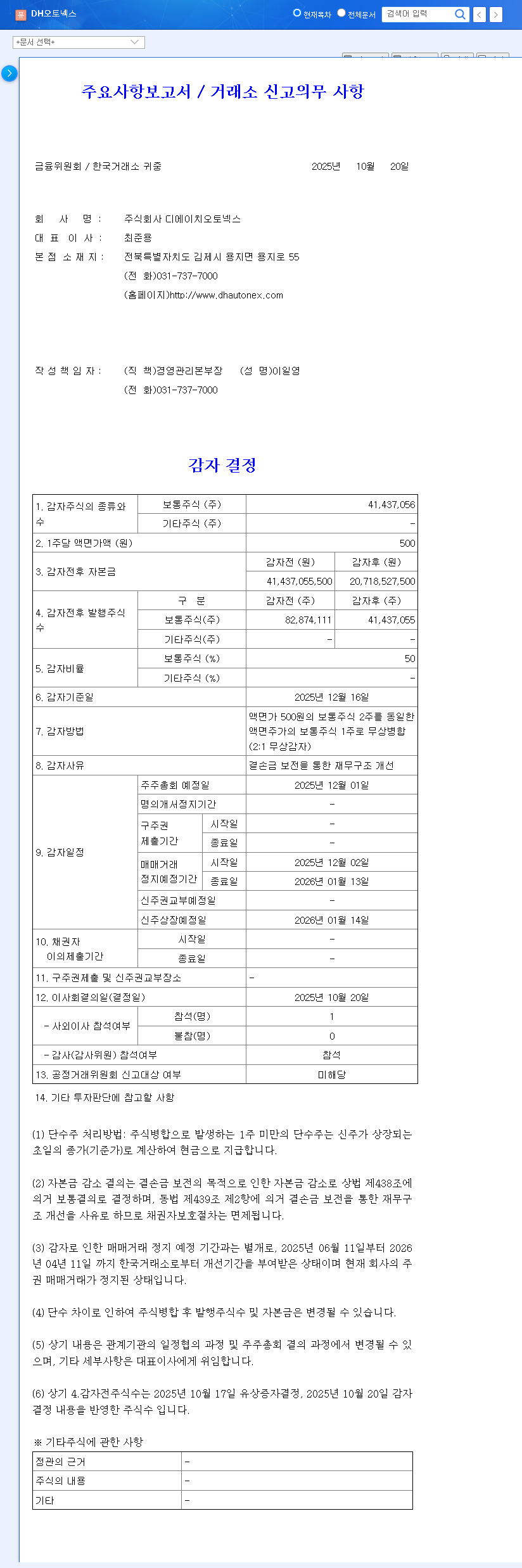
    The recent announcement of the DHAUTONEX capital reduction has raised significant questions among investors. On October 20, 2025, DHAUTONEX CO.,LTD (DH오토넥스) declared a 50% capital reduction via a reverse stock split, a strategic move aimed at improving its financial health. While this can be a positive step for the company’s balance sheet, it often introduces short-term stock price volatility and uncertainty for shareholders.

    This comprehensive guide provides a detailed analysis from a financial expert’s perspective. We will dissect the reasons behind this decision, break down the potential impact on the company’s stock price, and offer a clear action plan for investors. Our goal is to equip you with the knowledge to navigate this corporate event and make informed decisions about your portfolio.

    📈 Understanding the DHAUTONEX Capital Reduction

    DHAUTONEX officially announced a 50% capital reduction of its common shares. This is being executed as a 2-for-1 reverse stock split, which means every two existing shares will be consolidated into a single new share. This action will reduce the total number of outstanding shares from 82,874,112 to 41,437,056. The company has made this information public through its official channels.

    For complete details and verification, investors should always refer to the primary source. You can view the Official Disclosure on DART, South Korea’s electronic disclosure system.

    Key Schedule for the Reverse Stock Split

    • Announcement Date: October 20, 2025
    • Shareholder Meeting: December 1, 2025
    • Stock Trading Suspension: December 2, 2025
    • Record Date for New Shares: December 16, 2025
    • Stock Trading Resumption: January 14, 2026

    📉 The Core Reason: Improving Financial Structure

    The primary motivation behind any corporate capital reduction, including the DHAUTONEX capital reduction, is almost always related to the company’s financial health. In this case, the stated purpose is explicitly to address past financial difficulties.

    The official reason cited by DHAUTONEX is to ‘improve the financial structure by compensating for accumulated deficits.’ This indicates the company has carried significant losses on its books, which can lead to capital impairment and deter future investment.

    By reducing the capital account, the company can write off these accumulated deficits, effectively cleaning up its balance sheet. A cleaner financial statement can restore investor confidence, make it easier to raise new capital, and provide a more stable foundation for future operations. It’s a financial reset designed to pave the way for long-term recovery and growth.

    📊 Impact Analysis: Stock Price, Financials, and Investors

    A capital reduction creates ripple effects across the company. Here’s a breakdown of the key impacts investors need to understand.

    1. Financial Impact

    • Cleaner Balance Sheet: The primary goal—offsetting deficits—will be achieved, improving key financial ratios and overall soundness.
    • Potential for Higher EPS: With fewer shares outstanding, future profits will be divided among a smaller number of shares, which can lead to a higher Earnings Per Share (EPS), a key metric for investors.
    • No Change in Equity: Importantly, this is a ‘paper’ transaction. It shuffles numbers between capital and deficit accounts but does not change the company’s total shareholder equity or intrinsic value.

    2. Stock Price Impact

    • Price Readjustment: When trading resumes, the stock price will theoretically double to reflect the 2-for-1 consolidation. For example, two shares at 2,000 KRW each become one share at 4,000 KRW.
    • Short-Term Volatility: Markets often react with uncertainty. Expect increased price swings around the trading suspension and resumption dates as investors digest the news.
    • Long-Term Performance: The ultimate trajectory of the stock price depends entirely on the company’s future performance. A cleaner balance sheet is just the first step; DHAUTONEX must follow through with improved sales and profitability.

    3. Investor Impact

    • Reduced Share Count: Your number of shares will be halved. If you held 100 shares, you will own 50 post-split.
    • Constant Portfolio Value: Because the share price adjusts upwards, the total value of your holding should, in theory, remain the same at the moment of the split.
    • Need for Vigilance: Given the lack of detailed brokerage reports, investors must be proactive in monitoring company announcements and market sentiment.

    💡 Investor Action Plan & Key Monitoring Points

    This capital reduction is not a signal to buy or sell but a critical moment to re-evaluate. Prudent investors should focus on the company’s next steps. For more general guidance, you can read our article on How to Analyze a Company’s Financial Health.

    Here are the key points to monitor:

    • Shareholder Meeting Outcome: Confirm the final approval of the plan on December 1, 2025.
    • Post-Split Financial Reports: Scrutinize the first few quarterly reports after the reduction to see tangible improvements on the balance sheet and income statement.
    • Future Business Strategy: Look for clear communication from management about how they will leverage the improved financial structure to drive growth.
    • Market and Analyst Commentary: Follow expert analyses and market sentiment as they develop post-resumption of trading.

    ✅ Conclusion: A New Beginning, Not a Guaranteed Win

    The DHAUTONEX capital reduction is a significant and necessary step to repair its financial foundation. However, it is crucial for investors to understand that this action alone does not improve the company’s underlying business operations, competitiveness, or profitability. It simply provides a cleaner slate.

    The real test begins now. The focus should shift from this financial event to the company’s ability to execute a successful business strategy moving forward. Careful and continuous monitoring will be the key to making wise investment decisions regarding DHAUTONEX.

    Frequently Asked Questions (FAQ)

    Q1: What is a capital reduction and why is DHAUTONEX doing it?

    A capital reduction (specifically a gratuitous reduction or ‘무상감자’) is a corporate action to decrease a company’s shareholder equity. DHAUTONEX is doing this to offset its accumulated financial losses (deficits), thereby improving its financial statements and stability.

    Q2: How does this capital reduction affect the stock price?

    Theoretically, the total market value of the company doesn’t change. The stock price should double to compensate for the number of shares being halved. However, in practice, short-term stock price volatility is expected. The long-term price will depend on future business performance.

    Q3: What happens to my shares in DHAUTONEX?

    The number of shares you hold will be cut in half. If you own 100 shares, you will have 50 after the event. The price per share will adjust upwards, so the total value of your investment should remain the same at the time of the change.

    Q4: Is it safe to invest in DHAUTONEX now?

    This financial maneuver is just a starting point. It does not guarantee future success. Investment decisions should be made cautiously after monitoring the company’s post-reduction performance, business plans, and actual financial improvements. The uncertainty is high, so thorough due diligence is essential.
    (000300) DHAUTONEX Capital Reduction (2025): A Complete Investor's Guide 관련 이미지
  • (000300) DHAUTONEX Capital Reduction: A Deep Dive for Investors (2025 Plan)

    (000300) DHAUTONEX Capital Reduction: A Deep Dive for Investors (2025 Plan)

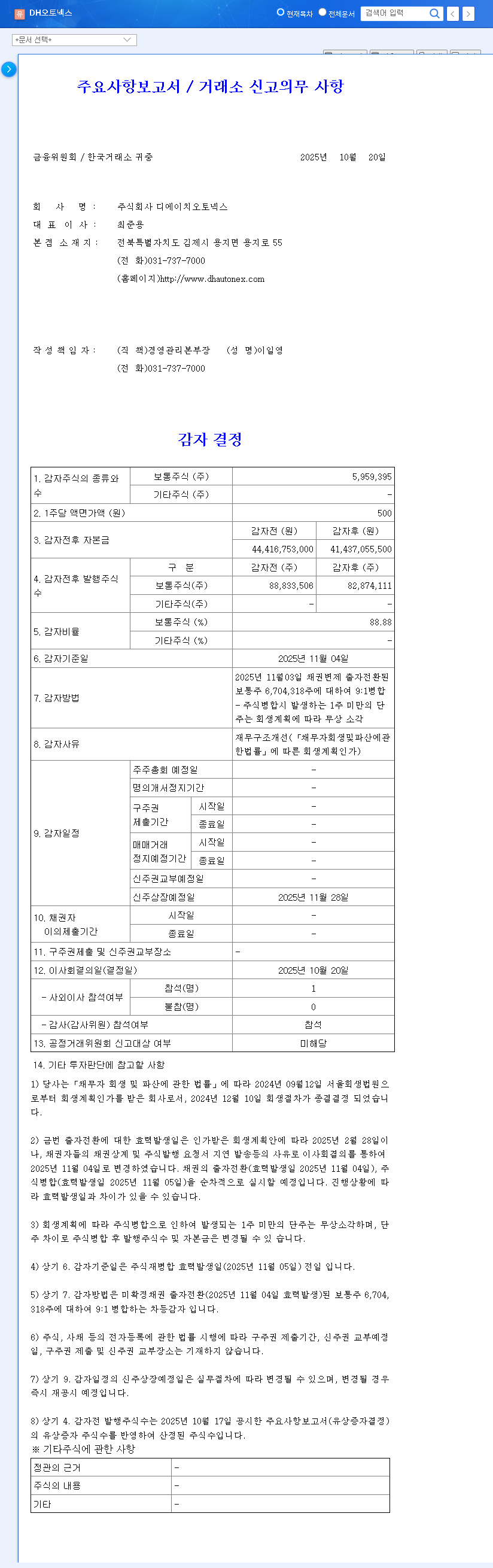
    The recent announcement of the DHAUTONEX capital reduction has sent ripples through the investment community. On October 20, 2025, DHAUTONEX CO.,LTD (Korean: DH오토넥스) revealed a drastic plan for an 88.9% stock merger as a cornerstone of its court-approved rehabilitation. This is not just a standard corporate action; it’s a critical maneuver aimed at financial survival and future recovery. For shareholders and potential investors, this event presents a complex mix of high risk and potential long-term opportunity. This comprehensive analysis will deconstruct the capital reduction, explore its immediate and future impacts, and outline a strategic approach for navigating this pivotal moment.

    A capital reduction of this magnitude is a clear signal of severe financial distress, but it is also a necessary step in a company’s journey back to stability. The key for investors is understanding the details of the accompanying rehabilitation plan.

    Deconstructing the 88.9% Stock Merger

    The core of the DHAUTONEX capital reduction is a significant stock merger designed to improve the company’s precarious financial structure. This action falls under the legal framework of the ‘Debtor Rehabilitation and Bankruptcy Act’, indicating it’s a court-sanctioned effort to restructure and stabilize the company. Here are the critical details every investor must know:

    • Reduction Method: A 9-for-1 stock merger. For every nine common shares an investor holds, they will be merged into a single share.
    • Shares Affected: 5,959,395 existing common shares, plus 6,704,318 common shares converted from debt repayment.
    • Fractional Shares: Any odd lot shares (less than one full share after the merger) will be retired without compensation, which can be a disadvantage for smaller retail investors.
    • Record Date: November 4, 2025.
    • Expected Trading Resumption: November 28, 2025.

    Immediate Fallout & Long-Term Outlook

    The impact of this financial restructuring will be felt in two distinct phases: the volatile short-term and the uncertain but potentially promising long-term.

    Short-Term: Navigating Market Volatility

    In the immediate aftermath, investors should brace for significant downward pressure on the stock price. The high reduction ratio of 88.9% drastically reduces the number of outstanding shares, which raises alarms about:

    • Share Dilution Concerns: Although the number of shares decreases, the context of a rehabilitation plan can spook the market.
    • Weakened Investor Sentiment: A capital reduction of this nature confirms the company’s severe financial difficulties, leading to a loss of confidence.
    • High Volatility: When trading resumes on November 28, 2025, the new share price will reflect the merger. Expect extreme price swings as the market digests the news and the company’s future prospects.

    Mid-to-Long-Term: The Path to Recovery

    The ultimate goal of the DHAUTONEX capital reduction is to lay a foundation for future viability. Success hinges entirely on the execution of the broader rehabilitation plan. If successful, the company could see a significant reduction in its debt-to-equity ratio and a healthier balance sheet. Key factors to monitor include the company’s ability to streamline operations, focus on core profitable business segments, and regain market trust through transparent management. A successful turnaround could lead to substantial value recovery, but the path is fraught with risk.

    Investor Strategy: A Cautious & Informed Approach

    Given the high degree of uncertainty, a prudent investment strategy is essential. Rushing into a decision is ill-advised. Instead, investors should adopt a wait-and-see approach while conducting thorough due diligence. Focus on continuous monitoring and deep research into the following areas:

    • The Official Disclosure: The most crucial first step is to analyze the primary source. The full details are available in the Official Disclosure (DART Report).
    • Rehabilitation Plan Specifics: Look for detailed documents outlining creditor agreements, debt-to-equity conversion ratios, and future business plans. This is the roadmap to recovery.
    • Financial Health: Scrutinize the latest financial statements and cash flow reports to understand the company’s liquidity and operational status post-restructuring. For more context, you can learn about analyzing companies in financial distress.
    • Industry Benchmarking: Compare DHAUTONEX’s position against healthy competitors to gauge its chances of regaining market share and competitiveness. For a general overview, resources like Investopedia provide excellent definitions of financial restructuring.

    Frequently Asked Questions

    What is the main reason for the DHAUTONEX capital reduction?

    The primary reason is to execute a critical financial restructuring as part of a court-approved rehabilitation plan. It aims to significantly reduce debt and repair the company’s balance sheet to ensure its survival and long-term viability.

    How will the 88.9% stock merger affect my shareholding?

    Your shares will be merged at a 9-to-1 ratio. For every nine shares you own, you will receive one new share. This will dramatically reduce the number of shares you hold, and the stock price will adjust upwards accordingly upon resumption of trading, though market sentiment will ultimately determine its value.

    When can I trade DHAUTONEX shares again?

    Trading is expected to resume on November 28, 2025. Be prepared for high volatility on and after this date as the market reacts to the newly structured company and its perceived future prospects.

    (000300) DHAUTONEX Capital Reduction: A Deep Dive for Investors (2025 Plan) 관련 이미지
  • (000300) DHAUTONEX CO.,LTD Rights Offering: A Deep Dive Analysis for Investors

    (000300) DHAUTONEX CO.,LTD Rights Offering: A Deep Dive Analysis for Investors

    The recent announcement of the DHAUTONEX CO.,LTD rights offering has sent ripples through the investment community. The company’s decision to raise KRW 3.35 billion in fresh capital presents a critical juncture. Will this move fortify its financial foundation and unlock new avenues for growth, or does it signal potential stock dilution that could harm existing shareholders? This expert analysis will dissect the official disclosure, explore the potential impacts, and provide a clear roadmap for investors considering their next move.

    Based on the ‘Report on Major Matters’ filed on October 17, 2025, we will delve into the nuances of this significant corporate action to help you understand the opportunities and risks involved in the DHAUTONEX capital increase.

    Deconstructing the DHAUTONEX Rights Offering

    On October 17, 2025, DHAUTONEX CO.,LTD (Market Cap: KRW 162.9 billion) formally announced its decision to proceed with a rights offering. Let’s break down the core components of this fundraising event.

    Key Details at a Glance

    • Total Capital Raised: Approximately KRW 3.35 billion
    • New Shares Issued: 6,704,318 common shares
    • Issue Price: KRW 500 per share
    • Issuance Ratio (Dilution): 8% of existing shares
    • Key Investors: Korea Eximbank, Chaghong Meiling, Winia Electronics Manufacturing, Winia
    • Payment & Listing Dates: Payment by Nov 3, 2025; Listing on Nov 24, 2025

    This KRW 3.35 billion fundraising effort represents about 2.06% of the company’s current market capitalization, a relatively modest figure that suggests a targeted, rather than transformative, use of funds.

    Potential Impacts: The Good, The Bad, and The Ambiguous

    A rights offering is a double-edged sword. For a comprehensive investor analysis of DHAUTONEX, we must weigh the potential upsides against the inherent risks.

    Positive Scenarios for Growth

    • Strengthened Financials: The capital injection can be used to pay down debt, improve liquidity, and lower interest expenses, leading to a healthier balance sheet. A strong financial base is crucial for weathering economic downturns, as noted by many leading financial analysts.
    • Fueling Future Engines: These funds could be earmarked for strategic R&D, facility upgrades, or small-scale acquisitions that enhance long-term growth potential and competitiveness.
    • Strategic Alliances: The participation of notable investors like Korea Eximbank and Winia Group affiliates could be a vote of confidence, potentially leading to valuable business synergies and partnerships down the road.

    Negative Risks to Consider

    • Share Value Dilution: The most immediate risk is stock dilution. By issuing 6.7 million new shares, the ownership stake of existing shareholders is reduced. While an 8% increase is not massive, the low issue price of KRW 500 could create downward pressure if it’s significantly below the market price.
    • Market Sentiment: Rights offerings can sometimes be perceived as a sign of financial distress, causing negative market sentiment and a short-term dip in the stock price as investors react to the news.

    The most critical factor for investors is the profound lack of clarity. The official report does not specify the exact use of the KRW 3.35 billion. This ambiguity makes it difficult to assess whether the capital will generate a return that outweighs the dilution effect.

    An Actionable Checklist for Investors

    Before making any decisions, a thorough due diligence process is essential. This is more than just a single event; it’s a piece of a larger puzzle. Here’s what to investigate next:

    • Scrutinize the Source: The first step is to review the primary document. The Official Disclosure on DART provides the unfiltered details directly from the company. Look for any fine print regarding the use of proceeds.
    • Analyze Financial Health: Go beyond this announcement. A deep dive into the company’s recent financial statements is non-negotiable. Our guide on how to analyze a balance sheet can help you assess if this capital raise is a strategic move or a necessity to cover operational shortfalls.
    • Evaluate the Issue Price: Compare the KRW 500 issue price to the stock’s trading price before the announcement and its current level. A large discount can exacerbate the dilution effect and may incentivize participants to sell immediately upon listing, creating price pressure.
    • Understand Investor Motives: Who are the key investors and why are they participating? Is Winia Group consolidating its influence? Is Korea Eximbank providing strategic financial backing for a specific project? Their motives will heavily influence the long-term outcome.

    Conclusion: Opportunity or Red Flag?

    The DHAUTONEX CO.,LTD rights offering presents a complex scenario. On one hand, the injection of KRW 3.35 billion and the backing of strategic investors could pave the way for enhanced financial stability and growth. On the other hand, the uncertainty surrounding the use of funds and the inherent risk of stock dilution demand caution.

    Ultimately, this event is neither definitively positive nor negative without more information. The decisive factor will be management’s ability to deploy this new capital effectively to generate value that exceeds the cost of dilution. For investors, the path forward requires diligent research and a clear-eyed assessment of the company’s fundamentals and strategic direction.

    Disclaimer: This article is for informational purposes only and is based on publicly available data. It does not constitute investment advice. All investment decisions should be made at the investor’s own discretion and responsibility.

    (000300) DHAUTONEX CO.,LTD Rights Offering: A Deep Dive Analysis for Investors 관련 이미지