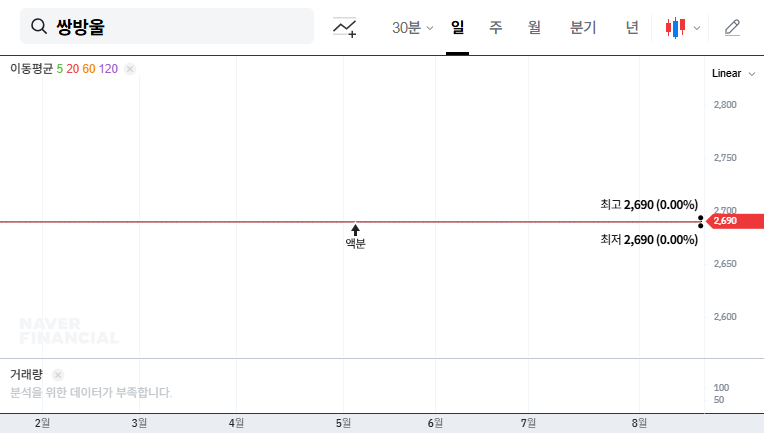
The final chapter for Ssangbangwool (SBW, 102280) on the public market is closing. The recent court decision has officially confirmed the SBW delisting, creating an urgent and high-stakes situation for all current shareholders. This is no longer a distant threat; it is an immediate reality that could result in the total loss of investment capital if not addressed with a clear and decisive strategy. This in-depth analysis breaks down the final verdict, the underlying causes, and provides a critical action plan for investors navigating this financial storm.
The Final Verdict: Liquidation Trading Begins
On November 12, 2025, the court delivered a critical blow by denying SBW’s request for an injunction to halt the delisting process. This ruling effectively sealed the company’s fate. As a direct consequence, the Korea Exchange announced that a final period of liquidation trading for SBW shares will take place from November 19, 2025, to November 27, 2025. After this brief window, trading will be permanently halted, rendering the shares illiquid and effectively worthless on the public market. For more details on the official proceedings, you can review the Official Disclosure.
Unraveling the Downfall: Why is Ssangbangwool Being Delisted?
A company’s delisting is rarely a sudden event. In SBW’s case, it’s the culmination of severe, long-standing issues that have systematically eroded investor trust and destroyed the company’s financial foundation. The primary reasons for the Ssangbangwool delisting can be traced back to three core areas of failure.
A Crisis of Integrity: Embezzlement and Breach of Trust
The most significant catalyst was the alleged embezzlement and breach of trust by former executives, amounting to over 13.4 billion KRW. Such massive internal corruption strikes at the very heart of a publicly-traded company’s credibility. It signals a complete breakdown in corporate governance and transparency, making it impossible for exchanges and investors to trust the company’s management and financial reporting.
The Bleeding Balance Sheet: Critical Financial Instability
The company’s financial health has been in a state of terminal decline. With consolidated deficits soaring past 173.2 billion KRW, SBW was suffering from severe capital impairment. Continuous operating losses and declining sales painted a picture of a business unable to sustain itself. This financial distress, exacerbated by the potential liabilities from the ongoing legal battles, left the company fundamentally nonviable in the eyes of regulators.
A Pattern of Deception: History of Dishonest Disclosures
Trust is the currency of the stock market. SBW’s history of being designated as a ‘dishonest disclosure corporation’ further damaged its reputation. Issues surrounding supply contract disclosures demonstrated a lack of transparency, making it impossible for investors to make informed decisions based on reliable information. This pattern of behavior is a major red flag that stock exchanges take extremely seriously.
The confirmed delisting signifies a final vote of no confidence from the market. For shareholders, this means the value of their SBW stock will almost certainly converge to zero, leading to irreversible capital losses.
Your Urgent Investor Action Plan
Given the finality of the SBW delisting, immediate and pragmatic action is required. Hope is not a strategy. Investors must consider the following steps to mitigate further damage. For a broader understanding of this process, you can read more about what delisting means for shareholders on high-authority financial sites.
- •Absolutely No New Investments: Under no circumstances should you invest new money into SBW. The delisting is confirmed, and any additional capital invested is highly likely to be lost completely.
- •Utilize the Liquidation Trading Window: For current shareholders, the period from Nov. 19 to Nov. 27 is the last chance to exit your position. We strongly advise selling your holdings to salvage any remaining value, however small. Be prepared for extremely low prices and high volatility.
- •Abandon ‘Wait and See’ Approaches: Holding on in the hope of a miraculous turnaround is unrealistic. Once delisted, shares become untradable on public exchanges, and recovering any investment becomes nearly impossible.
- •Consult a Financial Advisor: If your holdings are significant, consult with a professional financial advisor to discuss potential tax implications and strategies for managing investment losses within your portfolio.
In conclusion, the court’s decision has removed all uncertainty: the SBW delisting is happening. The priority for every investor must now shift from potential gains to immediate loss mitigation. The liquidation trading period is the final opportunity to act before the window closes for good.
Leave a Reply