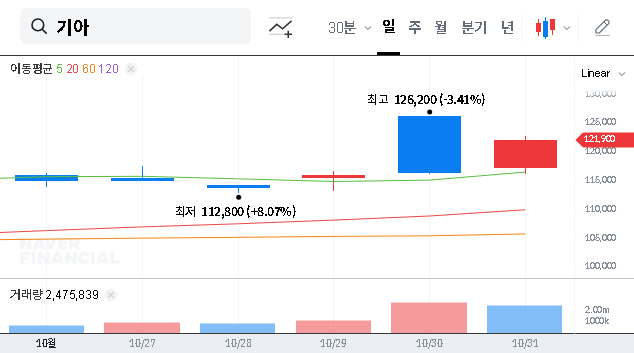
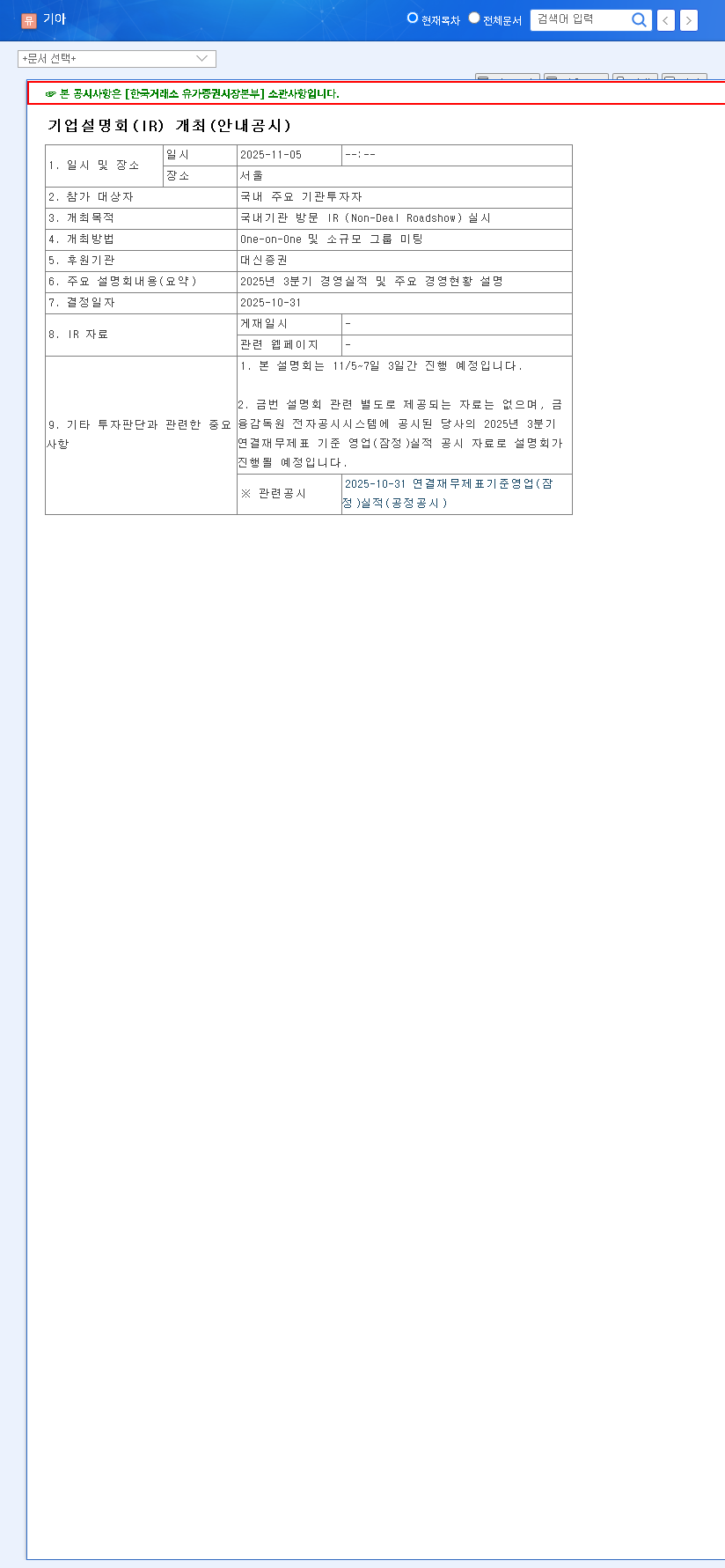
KIA CORPORATION is approaching a pivotal moment as it prepares to host its Q3 2025 Non-Deal Roadshow (IR) for domestic institutional investors on November 5, 2025. This event is far more than a routine financial report; it’s a critical platform for management to address pressing questions about its performance, navigate global economic headwinds, and articulate a compelling vision for the future. For current and prospective investors, this IR will provide crucial insights into the company’s trajectory in the fiercely competitive automotive landscape. The details of this event are based on the company’s official filing, which can be viewed in the Official Disclosure (DART).
This comprehensive analysis will deconstruct KIA CORPORATION’s recent financial health, explore the key topics expected at the IR, and outline a strategic framework for investors to evaluate the company’s stock potential.
Dissecting H1 2025 Performance: A Story of Growth and Pressure
The first half of 2025 painted a mixed picture for KIA CORPORATION. While top-line growth was evident, profitability faced significant pressures. Understanding this duality is key to interpreting the upcoming Q3 results and future outlook.
Key Financial Metrics (H1 2025)
- •Revenue Growth: Revenue reached KRW 57.3671 trillion, a 6.7% year-over-year increase. This was largely driven by a favorable product mix, with strong sales of higher-margin RVs and eco-friendly vehicles (HEV/EV), particularly in North America and other advanced markets.
- •Profitability Squeeze: Operating profit saw an 18.3% YoY decline to KRW 5.7733 trillion. This contraction was attributed to several factors, including tariff impacts in the United States, rising global logistics costs, and increased sales incentives needed to stay competitive. Despite the drop, the operating profit margin remained a healthy 10.1%.
- •Financial Stability: The company maintains a sound financial footing, with a debt-to-equity ratio of 64.58%, demonstrating prudent financial management amidst its aggressive investment cycle.
Investors will be keenly listening for management’s strategy to defend these strong profit margins. The core question is whether the revenue growth from high-value models can continue to outpace the rising costs and competitive pressures affecting the bottom line.
The Q3 2025 IR: Bullish Signals vs. Bearish Risks
The upcoming Kia investor relations event will be a battleground of narratives. The company’s stock performance will likely hinge on how effectively management can highlight its strengths while addressing tangible risks.
Potential Positive Catalysts (Bull Case)
- •Electrification Momentum: A confident presentation on the sales trajectory of models like the EV9 and the upcoming EV3/EV4, combined with updates on battery supply chains and software-defined vehicle (SDV) progress, could excite the market. Explore our deep-dive on Kia’s EV roadmap for more background.
- •Shareholder Return Commitment: Reaffirmation of Kia’s Total Shareholder Return (TSR) targets, through clear dividend policies and potential share buybacks, would signal a strong commitment to shareholder value.
- •Enhanced Transparency: Direct and transparent communication builds investor trust. A clear explanation of Q3 performance, even if it includes challenges, can be perceived positively if paired with a credible action plan.
Potential Headwinds & Risks (Bear Case)
- •Underwhelming Q3 Results: If Q3 earnings miss consensus estimates or if guidance for Q4 is weak, it could trigger a negative short-term reaction in the Kia stock price.
- •Macroeconomic Pressures: Ongoing concerns about high interest rates, slowing global demand, and geopolitical instability (as mentioned in various Reuters market reports) remain significant threats. A lack of a convincing mitigation strategy could worry investors.
- •Intensifying EV Competition: The electric vehicle market is becoming saturated with new entrants and aggressive pricing from competitors. If Kia cannot articulate a clear strategy for differentiation beyond design, investors may question its long-term market share.
Investor Strategy: Key Questions for the KIA CORPORATION IR
To make an informed decision, investors should focus on how management addresses the following critical areas during the presentation and Q&A session:
- Profitability Defense: What specific cost-control measures are being implemented to counter rising logistics and material costs? How will the company balance market share gains with margin protection?
- Regional Strategy: What is the updated plan for the challenging European and Chinese markets? How will Kia leverage its strength in North America, and what is the growth outlook for emerging markets like India?
- Future Mobility Execution: Beyond announcements, what are the tangible progress updates on the ‘Plan S’ strategy, including Purpose-Built Vehicles (PBVs) and the transition to a full software-defined architecture?
- Capital Allocation: With significant investments in R&D (KRW 1.7082 trillion) and facilities (KRW 14.1410 trillion), what is the expected return on invested capital (ROIC) and the timeline for these investments to generate significant revenue?
Ultimately, the success of the Q3 2025 IR event will depend not on presenting a flawless performance, but on demonstrating a masterful command of the company’s challenges and a credible, actionable plan to achieve long-term growth. Investors will be scrutinizing the details, and the market’s reaction will shape the trajectory of KIA CORPORATION’s stock for months to come.
Leave a Reply