Tag: WordPress

  • (049630) JAEYOUNG SOLUTEC Convertible Bond (049630): A 2025 Investor’s Guide

    (049630) JAEYOUNG SOLUTEC Convertible Bond (049630): A 2025 Investor’s Guide

    Investors in JAEYOUNG SOLUTEC CO.,LTD. (049630) are at a critical juncture. The company’s recent announcement regarding a large-scale JAEYOUNG SOLUTEC convertible bond exercise has sent ripples through the market. With millions of new shares on the horizon, stakeholders are asking crucial questions: Will this strengthen the company’s financial footing or lead to painful stock dilution? This comprehensive analysis will dissect the situation, providing a clear-eyed view of the company’s fundamentals, the market environment, and a prudent investment strategy to navigate the changes ahead.

    The Core Event: The 2025 Convertible Bond Conversion

    At the heart of the discussion is a major financial event. JAEYOUNG SOLUTEC has officially announced a significant exercise of its convertible bonds. For investors, understanding the precise details is the first step toward making an informed decision. This isn’t just a routine financial maneuver; it’s a move that will materially alter the company’s share structure.

    Event Snapshot: JAEYOUNG SOLUTEC’s CB Conversion
    New Shares to be Listed: 7,552,870
    Scheduled Listing Date: November 26, 2025
    Conversion Price: 662 Korean Won (KRW) per share
    Market Impact: Represents 6.90% of current market capitalization.
    Source: Official Disclosure (DART)

    Analyzing Financial Health: A Look at Q3 2025 Performance

    To understand the context of the JAEYOUNG SOLUTEC convertible bond exercise, we must examine the company’s recent financial performance. The cumulative Q3 2025 results paint a mixed picture of growth in one area and pressure in another.

    Revenue Growth vs. Profitability Decline

    On the surface, a 30% year-on-year revenue increase looks robust, driven primarily by strong sales from the nano-optics division. However, this top-line growth did not translate to the bottom line. Operating profit saw a significant decrease, squeezed by rising costs of sales, higher administrative expenses, and inventory valuation losses. This signals a critical deterioration in profitability that investors cannot ignore.

    Improved Financial Structure

    A bright spot is the company’s balance sheet. The conversion of previous bonds and an increase in capital surplus boosted total equity by about 16%. Coupled with an aggressive strategy of repaying borrowings, this has led to a healthier debt-to-equity ratio of 154.03%. This is a key reason companies utilize convertible bonds—to clean up their financial structure without taking on more traditional debt.

    Impact on JAEYOUNG SOLUTEC Stock (049630): A Double-Edged Sword

    The upcoming JAEYOUNG SOLUTEC convertible bond listing presents both opportunities and risks for the stock price. Navigating this requires a balanced perspective.

    The Upside: Potential Positives

    • Strengthened Balance Sheet: The conversion directly reduces debt and increases capital, enhancing financial stability and potentially making the company more attractive to long-term investors.
    • Increased Trading Liquidity: The influx of over 7.5 million new shares will increase the public float, which can lead to higher trading volumes and potentially more stable price action over time.
    • Short-Term Momentum: With the current stock price significantly higher than the 662 KRW conversion price, there is a strong incentive for bondholders to convert and sell for a profit, which can create complex but potentially positive trading dynamics.

    The Downside: Potential Risks

    • Share Dilution: This is the most significant risk. The new shares dilute the ownership stake of existing shareholders, meaning each share now represents a smaller piece of the company. You can learn more about the effects of stock dilution on high-authority financial sites.
    • Selling Pressure: Bondholders converting at 662 KRW will be highly motivated to sell their new shares to realize profits, especially if the market price remains high. This wave of selling could put significant downward pressure on the stock price around the listing date.
    • Valuation Concerns: Given the weak Q3 profitability, the current stock price may already be considered high by some analysts. The addition of new shares could amplify these valuation concerns.

    Investment Strategy & Outlook

    Given these competing factors, a nuanced strategy is required. Blind optimism or pessimism is ill-advised.

    Short-Term Approach (Pre- and Post-Listing)

    In the immediate term, caution is paramount. The period surrounding the November 26, 2025 listing date will likely see heightened volatility. Aggressive buying is risky due to the potential for significant selling pressure from converting bondholders. A prudent strategy is to observe the market’s reaction and wait for the supply/demand imbalance to stabilize.

    Mid- to Long-Term Approach

    The long-term case for JAEYOUNG SOLUTEC stock rests on its core business fundamentals, particularly the growth and technological edge of its nano-optics division. For further reading, you might be interested in our deep dive into the nano-optics industry. The key catalyst for a positive long-term outlook will be a demonstrated improvement in profitability. Investors should closely monitor future earnings reports for a return to robust operating profit. The improved financial structure post-conversion is a solid foundation, but it must be followed by operational success.

    In conclusion, the JAEYOUNG SOLUTEC convertible bond event is a defining moment. While it achieves the positive goal of deleveraging the company, the associated risks of dilution and short-term volatility demand a cautious and well-researched investment approach.

    (049630) JAEYOUNG SOLUTEC Convertible Bond (049630): A 2025 Investor's Guide 관련 이미지
  • (204270) JNTC Exchangeable Bond: A Deep Dive Analysis for Investors (204270)

    (204270) JNTC Exchangeable Bond: A Deep Dive Analysis for Investors (204270)

    On November 3, 2025, a significant financial maneuver by JNTC CO.,LTD. (204270) sent ripples through the market. The company announced the issuance of a KRW 12.4 billion JNTC exchangeable bond, a strategic decision packed with implications for the company’s future and its shareholders. With unusual terms, including a 0% interest rate and an exchange price dramatically higher than the current stock value, investors are right to ask: What does this mean for my investment? This in-depth JNTC stock analysis will dissect the bond’s details, evaluate the company’s fundamentals, and provide a clear outlook for potential investment strategies.

    This report leverages information from the company’s official public filing to explore the long-term significance of this financial event, viewing it not just as a capital raise, but as a critical indicator of JNTC’s growth trajectory and financial resilience.

    Deconstructing the JNTC Exchangeable Bond

    An exchangeable bond gives the holder the right to exchange the bond for shares of the issuing company’s stock at a predetermined price. It’s a hybrid security that combines features of both debt and equity. To understand this specific JNTC CO.,LTD. investment vehicle, let’s examine the key terms as outlined in the Official Disclosure.

    Key Bond Specifications

    • Total Issuance Size: KRW 12.4 billion
    • Issuance Method: Private Placement
    • Interest Rate: 0% coupon and 0% yield to maturity
    • Exchange Price: KRW 32,553
    • Current Stock Price (approx.): KRW 1,613
    • Exchange Period: November 18, 2025, to October 11, 2030

    The two most striking features are the 0% interest rate and the enormous gap between the current stock price and the exchange price. A 0% interest rate means JNTC is acquiring KRW 12.4 billion in capital without any immediate interest payment burden, a significant advantage for a company facing financial pressures. However, the high exchange price suggests that bondholders are betting on a massive, long-term appreciation of the 204270 stock price, a scenario that seems distant today.

    This bond issuance is a calculated gamble: JNTC secures interest-free capital to fuel a turnaround, while investors make a long-shot bet on the company’s future growth narrative paying off spectacularly.

    Why Now? A Fundamental Analysis of JNTC

    To understand the urgency behind this move, we must look at JNTC’s recent performance. The 2025 semi-annual report paints a picture of a company at a crossroads. Declining revenues in its core reinforced glass business, coupled with rising costs, have led to a sharp deterioration in profitability and mounting operating losses. This financial strain highlights the critical need for an injection of capital.

    Pivoting Towards Future Growth Engines

    Despite the challenges, JNTC is not standing still. The company is actively diversifying its portfolio to secure new revenue streams. The capital from the KRW 12.4 billion bond is likely earmarked for these strategic initiatives. Key areas of focus include:

    • Automotive Displays: Development of cover glass for the growing automotive display market.
    • Semiconductor Components: Investment in TGV (Through-Glass Via) glass substrates, a high-potential area linked to advanced semiconductor packaging. For more on this trend, see our latest analysis of the semiconductor industry.

    Success in these new ventures could dramatically reshape JNTC’s financial future and justify the optimistic exchange price set for the bond.

    Investor Implications: Risk and Reward

    For current and prospective shareholders, the JNTC exchangeable bond presents a complex picture. On one hand, it provides immediate financial relief and funds for potentially lucrative new projects. On the other, it introduces the long-term risk of shareholder dilution. If JNTC’s turnaround is successful and the stock price soars past KRW 32,553, bondholders will convert their bonds into new shares, diluting the ownership stake of existing shareholders. To learn more about this financial mechanism, you can read about how exchangeable bonds work on high-authority sites.

    The key for investors is to monitor the execution. How effectively will management deploy this new capital? Will the investments in TGV glass and automotive displays generate tangible returns? The answers to these questions will determine whether this bond is a bridge to recovery or simply a temporary stopgap.

    Comprehensive Outlook and Final Takeaways

    JNTC’s decision to issue this exchangeable bond is a bold strategic move to navigate current financial difficulties while seeding future growth. For investors, the focus should shift from short-term price volatility to long-term fundamentals. The primary determinant of success will be the company’s ability to translate this capital into improved profitability and market leadership in its new ventures. A cautious, fundamentals-driven approach is paramount.

    Frequently Asked Questions (FAQ)

    What is the JNTC exchangeable bond?

    It is a KRW 12.4 billion private placement bond that allows the holder to exchange it for JNTC shares in the future at a price of KRW 32,553. Notably, it carries a 0% interest rate, meaning JNTC doesn’t have to pay interest on the funds raised.

    How will this issuance affect JNTC’s stock price?

    In the short term, the impact may be muted due to the massive gap between the current stock price and the exchange price. The long-term impact depends entirely on the success of the investments made with the bond proceeds. If new ventures thrive, it could drive significant stock appreciation, though this also brings the risk of future share dilution.

    What is JNTC’s current financial situation?

    JNTC is facing profitability challenges with declining revenue and operating losses. However, it is strategically investing in new growth areas like automotive display glass and TGV glass substrates for semiconductors to diversify and improve its financial health.

    What should investors monitor moving forward?

    Investors should focus on three key areas: 1) The company’s progress in its new business ventures and any improvements in profitability. 2) Management’s clear communication and execution of their investment plan. 3) Macroeconomic factors like interest rates and raw material costs that could impact operations.

    (204270) JNTC Exchangeable Bond: A Deep Dive Analysis for Investors (204270) 관련 이미지
  • (117730) T-Robotics Convertible Bond: A Deep Dive on Share Dilution & Investment Strategy

    (117730) T-Robotics Convertible Bond: A Deep Dive on Share Dilution & Investment Strategy

    The upcoming T-Robotics convertible bond conversion is a pivotal event for investors in T-Robotics co., Ltd. (117730). With the company navigating sluggish performance, the exercise of conversion rights for nearly 470,000 shares presents a classic conflict: the immediate risk of share dilution versus the long-term potential for a healthier financial structure. This comprehensive analysis unpacks the event’s mechanics, examines the company’s current financial state, and provides a strategic roadmap for investors to navigate the potential volatility.

    Understanding the T-Robotics convertible bond event isn’t just about the numbers; it’s about weighing short-term market pressure against the company’s long-term strategic financial adjustments. Prudent investors will look beyond the immediate dilution.

    Deep Dive into the T-Robotics Convertible Bond Event

    On October 27, 2025, T-Robotics is set to issue approximately 470,000 new shares. This action stems from the exercise of conversion rights attached to its convertible bonds. For context, a convertible bond is a type of debt security that the holder can convert into a specified number of a company’s shares. While it allows companies to raise capital at a lower interest rate, the conversion can lead to an increased number of shares outstanding, a phenomenon known as share dilution.

    Key Details of the Conversion

    • Event Trigger Date: October 27, 2025
    • Shares to be Issued: 469,941 shares, representing a 2.36% share dilution effect.
    • Conversion Price: 8,767 KRW
    • Reference Stock Price: 14,710 KRW (as of October 27, 2024)
    • Actual Conversion Dates: November 6 and November 11, 2025

    The most critical factor here is the substantial discount. The conversion price of 8,767 KRW is significantly lower than the current market price. This creates a powerful incentive for bondholders to convert their debt into equity and potentially sell the newly acquired shares for an immediate profit, leading to increased selling pressure on the 117730 stock.

    A Company Under Pressure: T-Robotics Financial Analysis

    The timing of this conversion is crucial, as it coincides with a period of financial weakness for T-Robotics, as revealed in its H1 2025 report.

    1. Weak H1 2025 Performance

    The company’s performance has raised concerns. Consolidated revenue fell 14.2% year-over-year to 23.64 billion KRW, largely due to declining sales in its vacuum robot and autonomous logistics robot segments. More alarmingly, T-Robotics posted an operating loss of 0.73 billion KRW and a staggering net loss of 17.23 billion KRW. A significant portion of this net loss (15.77 billion KRW) was attributed to non-cash derivative liability valuation losses related to its convertible bonds, reflecting market volatility and the bonds’ terms.

    2. Deteriorating Financial Structure

    The balance sheet tells a similar story. Total liabilities have swelled by 9.9%, while total equity has plummeted by 33.5%. This has caused the debt-to-equity ratio to surge from a manageable 142.8% to a precarious 247.1%. Such a high ratio indicates significant financial risk and can make it harder for the company to secure future financing. For a deeper understanding of these metrics, you might want to review our guide on how to analyze a company’s financial health.

    Strategic Investor Playbook for the 117730 Stock

    Given the dual pressures of T-Robotics share dilution and underlying financial weakness, investors need a clear strategy.

    Short-Term Approach (High Risk)

    In the short term, the supply overhang from the newly converted shares will likely exert downward pressure on the stock price. Traders should be cautious. A phased buying strategy on significant dips could be considered, but only after the market shows signs of absorbing the new supply. Waiting until after the conversion dates of November 6 and 11, 2025, to assess the price action is a prudent move.

    Mid-to-Long-Term Perspective (Fundamental Focus)

    The long-term outlook for the T-Robotics investment strategy depends entirely on fundamental improvements. The conversion’s positive side effect is that debt is swapped for equity, which will automatically lower the high debt-to-equity ratio and improve the balance sheet. Long-term investors should focus on:

    • Revenue Recovery: Can the company reignite growth in its vacuum and autonomous robot segments?
    • Path to Profitability: Watch for improvements in operating margins and a reduction in net losses in subsequent quarterly reports.
    • Macroeconomic Tailwinds: Monitor factors like interest rates and currency exchange rates, which can impact manufacturing costs and export profitability.

    Conclusion: Navigating the T-Robotics Conversion

    The T-Robotics convertible bond conversion is a double-edged sword. It presents a clear short-term headwind due to share dilution, amplified by the company’s weak financial footing. However, it also offers a necessary step toward deleveraging and strengthening the financial structure for the long haul. Cautious, well-informed decision-making based on a thorough analysis of upcoming earnings reports and market conditions will be paramount for any investor considering the 117730 stock. For complete transparency, investors should review the Official Disclosure (Source: DART) regarding this event.

    (117730) T-Robotics Convertible Bond: A Deep Dive on Share Dilution & Investment Strategy 관련 이미지
  • (316140) Woori Financial Group Stock: 2025 Earnings & Dividend Deep Dive for Investors

    (316140) Woori Financial Group Stock: 2025 Earnings & Dividend Deep Dive for Investors

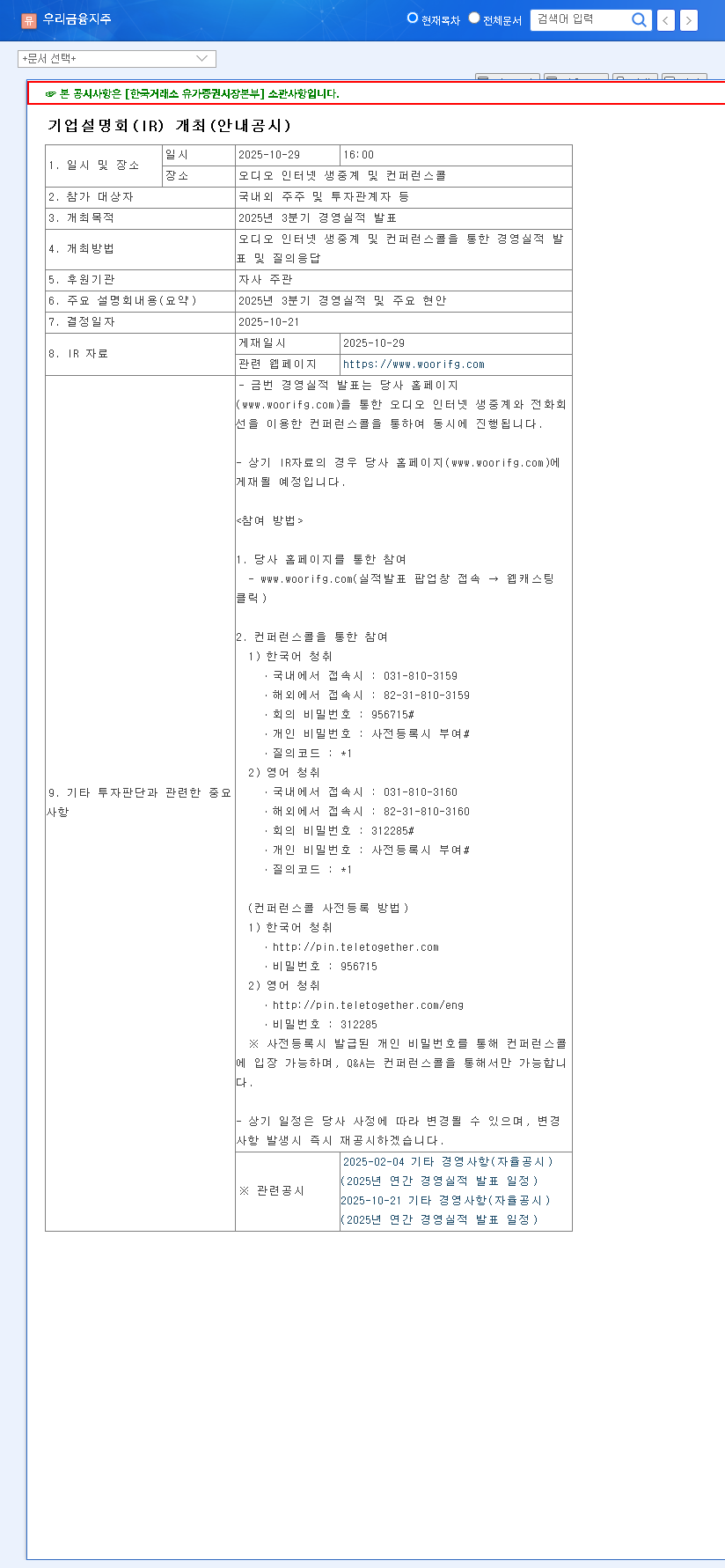
    The latest half-year report from Woori Financial Group Inc. has sent ripples through the South Korean financial market, offering investors a crucial look into the company’s health and strategic direction. With a significant H1 2025 net profit and a firm quarterly dividend decision, the announcement highlights a robust, diversified business model. But what do these numbers truly mean for the future of Woori Financial Group stock and your investment portfolio?

    This comprehensive investment analysis will unpack the key performance indicators, explore the foundational strengths driving growth, and critically examine the potential risks on the horizon. We’ll provide the insights you need to understand the opportunities and challenges facing Woori Financial Group Inc. in today’s dynamic financial landscape.

    H1 2025 Performance: A Snapshot of Strength

    Woori Financial Group Inc. reported a formidable net profit of KRW 1.552 trillion for the first half of 2025, a figure that underscores the group’s solid fundamentals amidst a complex economic climate. This performance is detailed in the company’s official filing (Source: Official Disclosure). Furthermore, the board’s decision to issue a quarterly cash dividend of KRW 200 per common share sends a powerful message of commitment to shareholder returns, enhancing the investment appeal of Woori Financial Group stock.

    This period also marked a strategic evolution for the group. The successful launch of Woori Investment & Securities and the integration of Dongyang Life Insurance and ABL Life Insurance have transformed the company into a truly comprehensive financial powerhouse, with strong pillars in banking, securities, and insurance.

    The diversification into non-banking sectors is not just about new revenue streams; it’s a strategic hedge against market volatility, providing greater stability and long-term growth potential for the Woori Financial Group.

    Analyzing the Pillars of Woori Financial Group Inc.’s Success

    Several core factors contributed to this strong performance, painting a picture of a well-managed and forward-thinking institution. For investors, understanding these pillars is key to evaluating the group’s long-term viability.

    Robust Financial Health & Risk Management

    Financial stability is the bedrock of any banking institution. Woori Financial Group boasts a healthy consolidated BIS capital ratio of 16.06%, well above regulatory requirements, indicating a strong capacity to absorb unexpected losses. Paired with a stable non-performing loan (NPL) ratio of 0.71%, it demonstrates prudent risk management and high-quality assets. You can learn more about understanding key financial ratios for bank stocks in our related guide.

    Commitment to ESG and Digital Transformation

    In today’s market, non-financial factors are increasingly critical. Woori Financial Group’s leadership in ESG (Environmental, Social, and Governance) is a significant differentiator. Achieving a top-tier MSCI ESG rating of ‘AAA’ for two consecutive years and its inclusion in the Dow Jones Sustainability World Index signal a deep commitment to sustainable, long-term value creation. This resonates strongly with a growing class of institutional and retail investors. Simultaneously, strategic investments in AI and digital platforms are modernizing customer experiences and creating efficiencies that will secure future competitiveness.

    Navigating Potential Headwinds: Risks and Challenges

    Despite the positive Woori Financial earnings report, no investment is without risk. Prudent investors must consider the external and internal challenges that could impact future performance.

    • Macroeconomic Volatility: Persistent high interest rates and the threat of a global economic slowdown could pressure profitability and asset quality. Geopolitical risks also add a layer of uncertainty that can affect international financial markets, as noted by sources like Reuters.
    • Intensifying Competition: The financial sector is no longer just traditional banks. Agile FinTech and BigTech companies are fiercely competing for market share, especially in digital payments and lending, which could erode margins.
    • Real Estate PF Exposure: The volatility in the real estate market, particularly concerning Project Financing (PF) loans, remains a monitored risk across the South Korean banking sector. Diligent management of this exposure is critical.

    Investor Outlook & Strategic Conclusion

    So, what is the key takeaway from this investment analysis? Woori Financial Group Inc. presents a compelling case built on a newly diversified business model, strong financial health, and a shareholder-friendly dividend policy. The Woori Financial dividend provides a stable income stream, making the stock attractive to income-focused investors.

    However, the path forward requires navigating significant external pressures. The group’s ability to continue growing its non-banking segments, manage credit risks effectively, and out-innovate digital competitors will be the ultimate determinant of its long-term corporate value. Investors should weigh the solid fundamentals and growth potential against the macroeconomic uncertainties. A long-term perspective, coupled with ongoing monitoring of these key risk factors, is the most prudent approach to investing in Woori Financial Group stock.

    (316140) Woori Financial Group Stock: 2025 Earnings & Dividend Deep Dive for Investors 관련 이미지