Tag: Tiger Asset Management

  • (156100) L&K Biomed Stock: Full Investment Analysis After Tiger Asset Management Sale

    (156100) L&K Biomed Stock: Full Investment Analysis After Tiger Asset Management Sale

    A significant institutional sell-off can send ripples of uncertainty through the market, leaving investors wondering if it’s a sign of trouble or a strategic shift. This is the exact situation facing L&K Biomed (156100), a prominent player in the spinal implant market. Recently, major investor Tiger Asset Management reduced its holdings, prompting a closer look at the company’s health. This comprehensive L&K Biomed investment analysis will dissect this event, evaluate the company’s core fundamentals, and provide a clear outlook for potential and current investors.

    We’ll move beyond the headlines to explore L&K Biomed’s robust sales growth, promising new ventures, and the financial headwinds that demand careful monitoring. Is the market overreacting, or are there genuine concerns investors should heed? Let’s find out.

    The Catalyst: Tiger Asset Management’s Stake Reduction

    On November 13, 2025, the market took note as Tiger Asset Management filed a mandatory disclosure revealing a change in its holdings of L&K Biomed stock. According to the Official Disclosure (DART Report), the investment firm’s position changed as follows:

    • Previous Holding: 5.82%
    • Current Holding: 4.41%
    • Change: A reduction of 1.41% (107,638 shares) through open market sales.

    Crucially, the filing stated the reason for holding was ‘simple investment purposes’. This suggests the sale is more likely part of a portfolio rebalancing strategy or profit-taking rather than a bearish verdict on L&K Biomed’s fundamental value. While such a sale can create short-term selling pressure on the L&K Biomed stock price, it doesn’t automatically signal a decline in the company’s long-term prospects. To understand the full picture, we must look at the company itself.

    Analyzing L&K Biomed’s Financial Health & Growth Prospects

    A balanced investment decision requires looking at both the strengths and weaknesses. L&K Biomed presents a compelling case with clear positive drivers, but also notable challenges that require strategic resolution.

    The Bull Case: Strong Fundamentals and New Ventures

    • Impressive Sales Growth: In the first half of 2025, sales surged to KRW 202,133 million, a 23.9% year-over-year increase. This growth is anchored by its core ‘Thoraco Lumbar’ spinal implant segment and a dominant international footprint, with 97% of sales originating overseas, primarily in the Americas.
    • New Growth Engine: The company is strategically expanding into the thoracic implant sector with its ‘Pectus Bar System’. Having already secured US FDA and Thailand FDA approvals, L&K Biomed is poised to generate new revenue streams from the lucrative US market starting in the second half of 2025.
    • Strengthened Financials: The company has made progress in improving its balance sheet. Total debt decreased by 8.1%, largely due to reductions in convertible bonds, which improved the overall debt ratio.

    The Bear Case: Areas Requiring Urgent Attention

    Despite the positive momentum, several financial metrics warrant caution:

    • Negative Operating Cash Flow: A critical indicator of financial health, operating cash flow turned to a net outflow in H1 2025. This means the core business operations are currently using more cash than they are generating, a situation that needs to be reversed. To learn more about this metric, you can review this guide to cash flow analysis.
    • Profitability Challenge: The company reported a net loss of KRW 3 billion in the first half of the year. Sustaining growth requires a clear path back to profitability.
    • Asset Management: Efficient management of inventory and accounts receivable is crucial to improving cash flow and overall operational efficiency.

    The central challenge for L&K Biomed is to translate its impressive top-line sales growth into bottom-line profitability and positive cash flow. Its future stock performance hinges on this execution.

    Macroeconomic Factors and Investment Outlook

    With 97% of its sales from overseas, L&K Biomed is highly sensitive to global economic trends, especially currency fluctuations. The strengthening of the US Dollar against the Korean Won (from 1,354.00 in June to 1,466.60 in November 2025) provides a significant tailwind, as it boosts the value of US-based revenue when converted back to KRW. The company estimates a 10% rise in the USD can increase its operating profit by KRW 574.26 million.

    Meanwhile, stable interest rates in the US and Korea, along with steady oil and shipping costs, suggest a relatively neutral external cost environment. For a broader view, consider our 2025 Medical Device Market Overview.

    Conclusion: A Smart Investment Strategy for L&K Biomed Stock

    L&K Biomed stands at a crossroads. It has undeniable long-term growth potential fueled by a strong market position and new product innovation. However, its short-term financial weaknesses, particularly in cash flow and profitability, cannot be ignored. The Tiger Asset Management sale appears to be market noise rather than a fundamental red flag.

    Investors should focus on the following key points going forward:

    • The successful rollout and revenue generation of the Pectus Bar System in the US.
    • Quarterly earnings reports showing a trend toward positive operating cash flow.
    • Management’s execution of specific strategies to improve profitability.

    Ultimately, investing in L&K Biomed requires a belief in its growth story while closely monitoring its ability to navigate current financial challenges. Prudent investors will weigh the long-term potential against these short-term risks.
    (156100) L&K Biomed Stock: Full Investment Analysis After Tiger Asset Management Sale 관련 이미지
  • (260970) S&D Co., Ltd Stock Analysis (260970): Tiger Asset Management Sale & Fundamentals

    (260970) S&D Co., Ltd Stock Analysis (260970): Tiger Asset Management Sale & Fundamentals

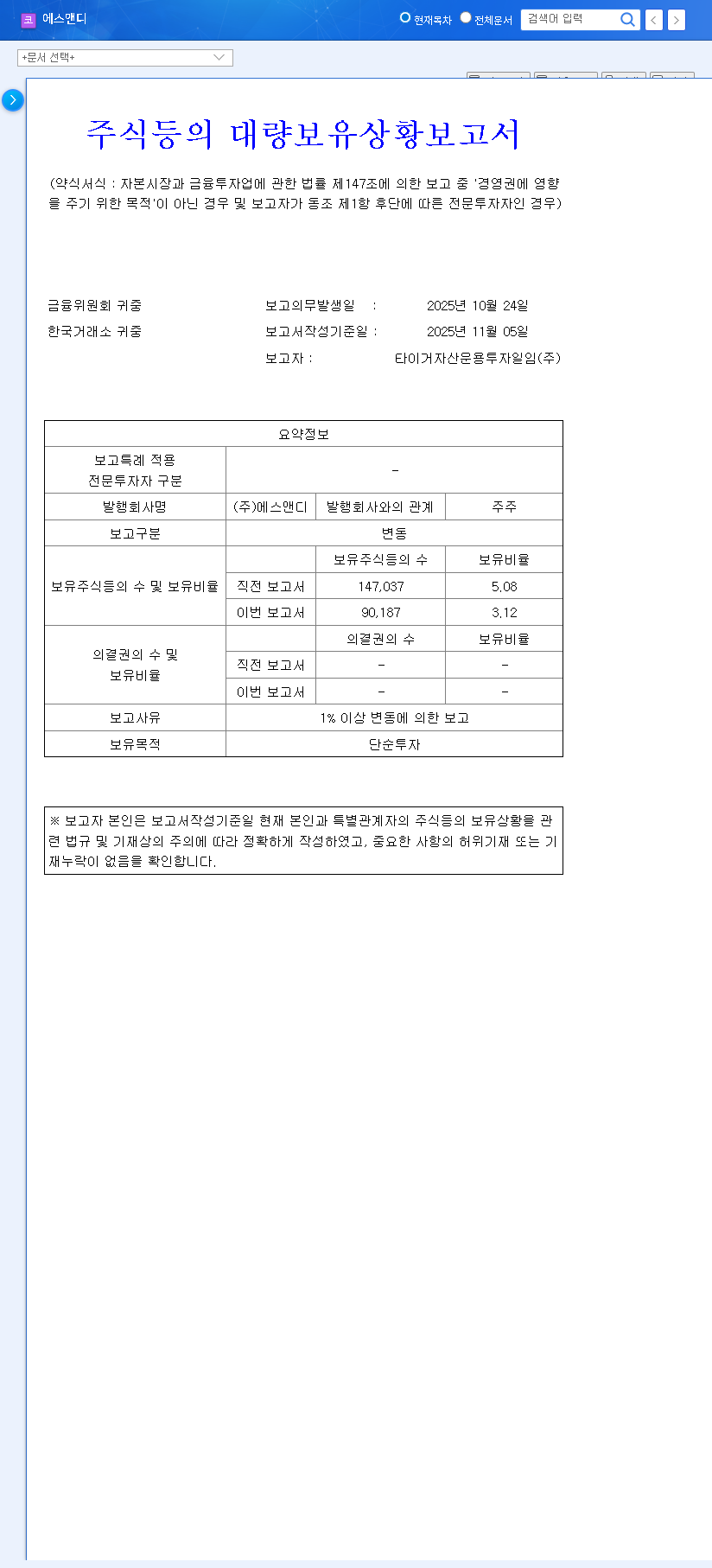
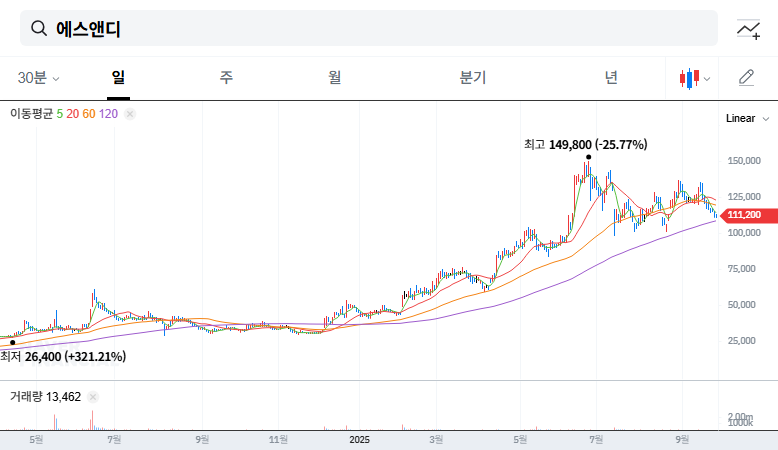
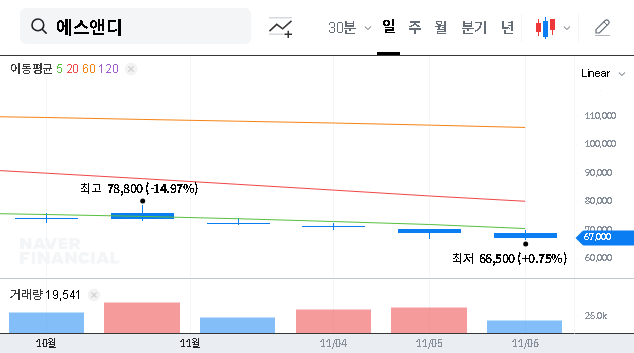
    This comprehensive S&D Co., Ltd stock analysis unpacks the recent news of Tiger Asset Management significantly reducing its stake in the company (ticker: 260970). The move, which saw their holdings drop from 5.08% to 3.12%, has understandably raised questions among investors about the potential impact on the S&D stock price and its underlying value. Is this institutional sell-off a red flag signaling deeper issues, or is it merely short-term market noise? We will explore the company’s fundamentals, growth prospects, and the potential fallout from this key event to provide investors with a clear, data-driven perspective.

    When a major institutional holder like Tiger Asset Management divests a significant portion of its shares, the market pays close attention. It often prompts a re-evaluation of a company’s financial health and future trajectory.

    This article provides an in-depth look at S&D Co., Ltd’s current situation, helping you understand the full context before making any investment decisions. We will cover the specifics of the sale, analyze the company’s financial health, and provide an actionable outlook for current and prospective shareholders.

    The Tiger Asset Management Divestment: A Closer Look

    The core event triggering this analysis is the stake sale by Tiger Asset Management. Understanding the details is the first step in assessing its impact. The sale was not a minor portfolio adjustment; it represents a substantial reduction in their position.

    Key Details of the Transaction

    • Previous Holding: 5.08%
    • Current Holding: 3.12%
    • Stated Purpose: Originally held for ‘simple investment’ purposes.
    • Transaction Period: Primarily executed via market sales between October 30 and November 5, 2025.
    • Disclosure Trigger: Mandatory reporting was required due to the change in shareholding exceeding 1%. You can view the Official Disclosure here.

    Such a sale can be interpreted as a bearish signal, suggesting that a well-informed institutional investor has lost confidence in the company’s short-to-medium term prospects. This action invariably influences broader market sentiment and requires a deeper look into the S&D fundamentals.

    In-Depth S&D Co., Ltd Stock Analysis: Fundamentals Under the Microscope

    To understand if Tiger Asset Management’s move is justified, we must analyze S&D’s core business and financial health. A company’s stock price may fluctuate on news, but its long-term value is rooted in its fundamentals. For more on this, consider reading a Guide to Analyzing Corporate Fundamentals.

    Financial Performance: A Mixed Picture

    S&D’s recent financial performance presents a conflicting narrative. While the first half of 2025 showed impressive growth, the longer-term trend raises significant concerns.

    • H1 2025 Positives: The company reported a 40% year-over-year revenue increase and a 37% rise in operating profit. Crucially, operating cash flow turned positive, indicating improved operational efficiency.
    • Long-Term Concerns: Despite this recent surge, both revenue and operating profit have been on a downward trajectory since late 2022. Full-year forecasts for 2025 predict an overall revenue decrease and a shift to an operating loss. This suggests the H1 performance may not be sustainable.

    Business Structure and Growth Initiatives

    S&D’s revenue is heavily concentrated, with over 92% coming from general functional food materials. While this specialization can be a strength, it also introduces risk. To counter this, the company is actively pursuing new growth drivers:

    • Health Functional Foods: Acquiring new certifications, such as for Ecklonia cava extract, signals a push into higher-margin health products.
    • Infrastructure Investment: The completion of a new factory, backed by a 17 billion KRW investment, significantly boosts production capacity and signals long-term confidence from management.

    Projected Impact on the S&D Stock Price

    The sale by Tiger Asset Management is likely to have immediate and lasting effects on the S&D stock price.

    Short-Term Outlook: Increased Volatility and Selling Pressure

    In the short term, the market’s reaction is often driven by sentiment. A large institutional sell-off creates a supply-demand imbalance, which typically pushes prices down. Retail investors may follow suit, fearing that Tiger Asset Management possesses negative information, thus amplifying the downward pressure. For more on market psychology, see analysis from authoritative sources like Bloomberg.

    Long-Term Outlook: A Return to Fundamentals

    Over the long term, the stock price will realign with the company’s actual performance. The critical question is whether the deteriorating profitability trend is a temporary blip or a systemic issue. The success of their new facility and expansion into health functional foods will be the ultimate determinant of long-term value. Tiger’s exit could be a preemptive move based on a negative assessment of this very turnaround potential.

    Conclusion: An Action Plan for Investors

    The S&D Co., Ltd stock analysis reveals a company at a crossroads. While H1 2025 results were positive, they are overshadowed by a concerning long-term financial decline and a significant vote of no-confidence from a major institutional investor. The S&D stock price will likely face short-term headwinds.

    Investors should exercise caution. Prudent decision-making requires careful monitoring of the following factors:

    • Monitor Q3 and Q4 Earnings: Upcoming financial reports are critical. Look for evidence that the revenue and profit decline is reversing and that the H1 2025 performance was not an anomaly.
    • Track New Business Performance: Pay close attention to announcements regarding the output of the new factory and the market reception of new health functional food products.
    • Watch for Further Institutional Moves: Keep an eye on any changes in holdings by other major investors, as this can indicate a broader shift in institutional sentiment.

    (260970) S&D Co., Ltd Stock Analysis (260970): Tiger Asset Management Sale & Fundamentals 관련 이미지
  • Tiger Asset Management Acquires 5% Stake in S&D (260970): Investment Signal Analysis and Future Outlook


    Tiger Asset Management Acquires 5% Stake in S&D (260970): Investment Signal Analysis and Future Outlook 대표 차트 이미지


    Tiger Asset Management Acquires 5% Stake in S&D: What Happened?

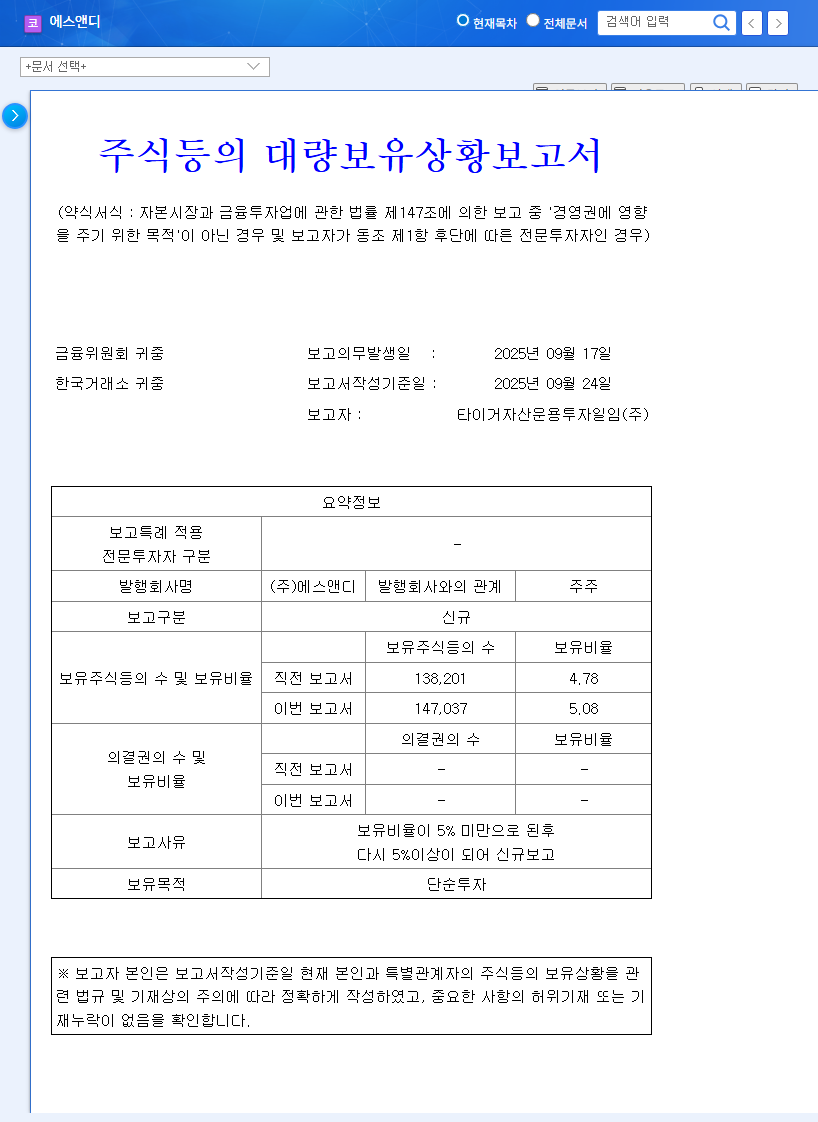
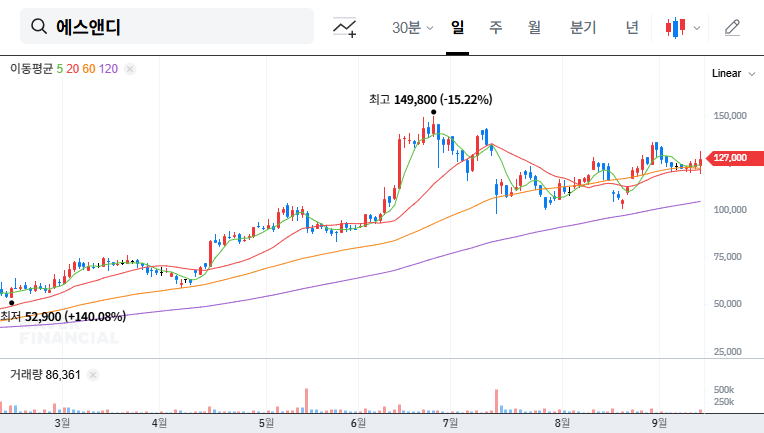
    On September 24, 2025, Tiger Asset Management announced that its stake in S&D had reached 5.08%. This is for simple investment purposes, up from the previous 4.78%.

    Why is S&D Attracting Attention?

    • Solid Performance: S&D’s sales and operating profit in the first half of 2025 grew significantly year-on-year. The growth of the general functional food ingredient sector is particularly notable.
    • Strong Technology: S&D has secured technological competitiveness with ISO22000 certification, individual recognition acquisition, and 31 patents.
    • Shareholder-Friendly Policies: S&D continues its efforts to enhance shareholder value, including share buybacks.
    • Securing Future Growth Engines: In addition to health functional food ingredients, S&D is pursuing business diversification through research and development of natural ingredients for household goods and cosmetics, and related articles of incorporation changes.
    • Sound Financial Structure: S&D maintains a healthy financial position with increased assets and capital, and a positive operating cash flow.

    Action Plan for Investors

    • Monitor Tiger Asset Management’s further stake changes: Investors should monitor future stake change trends to gauge market sentiment.
    • Check H2 earnings forecast: Confirm whether the strong performance in the first half of the year will continue in the second half, and the visibility of new business plans.
    • Monitor macroeconomic indicators: Pay attention to changes in the macroeconomic environment, such as exchange rates, interest rates, and raw material prices.

    Conclusion: A Cautious Investment Approach is Necessary

    While Tiger Asset Management’s stake acquisition can be interpreted as a positive signal, careful investment decisions are needed, considering both market conditions and internal corporate factors.


    Frequently Asked Questions

    What is the purpose of Tiger Asset Management’s investment?

    It is for simple investment purposes. They expect capital gains through stock price increases rather than management participation.

    What is S&D’s main business?

    S&D specializes in food additives and health functional food ingredients. Recently, they have been focusing on R&D of natural ingredients for household goods and cosmetics for business diversification.

    What should I be aware of when investing in S&D?

    It is necessary to consider various factors including fluctuations in macroeconomic indicators, future stake changes by Tiger Asset Management, and S&D’s second-half earnings outlook.


    Tiger Asset Management Acquires 5% Stake in S&D (260970): Investment Signal Analysis and Future Outlook 관련 이미지


  • SND Stock Forecast: Opportunity or Crisis After Tiger Asset Management’s Stake Sale?


    SND Stock Forecast: Opportunity or Crisis After Tiger Asset Management's Stake Sale? 대표 차트 이미지


    Tiger Asset Management Sells 1.1% Stake in SND: What Happened?

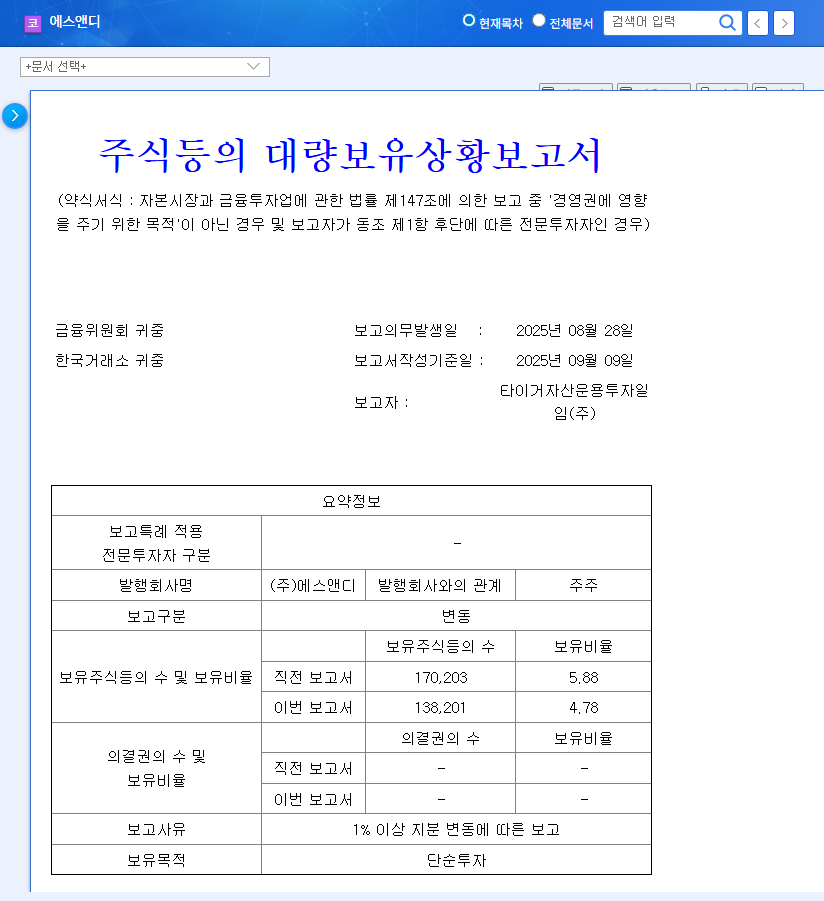
    On September 10, 2025, Tiger Asset Management announced a decrease in its SND stake from 5.88% to 4.78%, a 1.1% drop. This was due to a change in holdings exceeding 1% for ‘simple investment’ purposes, and appears to have been mainly through market sales.

    Background of the Sale and Hidden Meaning: Why Did They Sell?

    The official reason for the sale is a change in holdings for ‘simple investment’ purposes. However, there’s a record of them purchasing 6,025 shares on September 9th. This suggests the possibility of simple profit-taking or portfolio adjustments. The sale is more likely due to external factors rather than a deterioration of SND’s fundamentals.

    SND’s Solid Fundamentals: So What Happens Next?

    SND’s Q1 2025 earnings were very positive. Sales increased by 40.27% year-on-year, and operating profit surged by a whopping 120.70%. Financial soundness is also very stable. Considering these strong fundamentals, it seems unlikely that this stake sale will significantly impact the long-term stock price trend. Instead, a short-term price correction could be a buying opportunity.

    Action Plan for Investors: What Should You Do?

    • Mid- to long-term investors: A staggered purchase strategy during price corrections is recommended.
    • Short-term investors: Closely monitor market conditions and be wary of short-term volatility.

    It’s important to closely monitor future changes in Tiger Asset Management’s stake, SND’s Q2 earnings announcement, and new business development progress.


    Frequently Asked Questions (FAQ)

    Is Tiger Asset Management’s stake sale a negative signal for SND’s future?

    It could impact the stock price in the short term, but considering SND’s solid fundamentals, it’s unlikely to be a long-term negative factor.

    Is it okay to buy SND stock now?

    Investment decisions should be made at your own discretion and responsibility. Mid- to long-term investors might consider a staggered purchase strategy during price corrections.

    What is the outlook for SND’s stock price?

    It is difficult to make accurate predictions at this point without securities firm reports or market consensus data. We need to monitor Q2 earnings announcements and new business developments.


    SND Stock Forecast: Opportunity or Crisis After Tiger Asset Management's Stake Sale? 관련 이미지
    SND Stock Forecast: Opportunity or Crisis After Tiger Asset Management's Stake Sale? 관련 이미지


  • S&D Stock Forecast: Tiger Asset Management’s ₩10B Investment, a Bullish Signal?

    Tiger Asset Management Acquires 5.88% Stake in S&D

    Tiger Asset Management recently purchased 31,200 shares of S&D, approximately ₩10 billion, increasing its stake from 0% to 5.88%. The official purpose of the acquisition is ‘simple investment’.

    Why Did Tiger Asset Management Invest ₩10 Billion in S&D?

    Despite a decline in sales, S&D showed improved operating profit margins in Q1 2025 due to increased selling prices and cost reduction efforts. Maintaining a good credit rating of A and A+ is also a positive factor. This can be interpreted as a sign of a turnaround in sluggish performance and likely influenced Tiger Asset Management’s investment decision.

    How Will This Investment Affect the Stock Price?

    • Potential Stock Price Increase: A large purchase by a major investment firm sends a positive signal to the market and can drive stock price appreciation.
    • Improved Investor Sentiment: The investment could improve investor sentiment and attract further buying interest.

    What Should Investors Be Aware Of?

    • Simple Investment: Keep in mind that Tiger Asset Management could sell its stake at any time.
    • Macroeconomic Risks: Volatility in macroeconomic variables like raw material prices, exchange rates, and interest rates can impact S&D’s performance.
    • Intensifying Competition: Increased competition in the food industry could negatively affect S&D’s market share and profitability.

    Investor Action Plan

    If considering investing in S&D, carefully examine Tiger Asset Management’s investment strategy, S&D’s future earnings outlook, hedging strategies against raw material price fluctuations, overseas market entry plans, and new business plans.

    Frequently Asked Questions

    What is the size of Tiger Asset Management’s investment in S&D?

    Approximately ₩10 billion. They acquired 31,200 shares, representing a 5.88% stake.

    How did S&D perform in Q1 2025?

    While sales decreased, operating profit margins improved due to price increases and cost reductions.

    What are the key risks to consider when investing in S&D?

    Investors should be aware of Tiger Asset Management’s ‘simple investment’ objective, macroeconomic uncertainties, and the potential for increased competition.