Tag: Real Estate REITs

  • (448730) SamsungFN REIT (448730) Analysis: Stable Assets vs. High-Interest Headwinds

    (448730) SamsungFN REIT (448730) Analysis: Stable Assets vs. High-Interest Headwinds

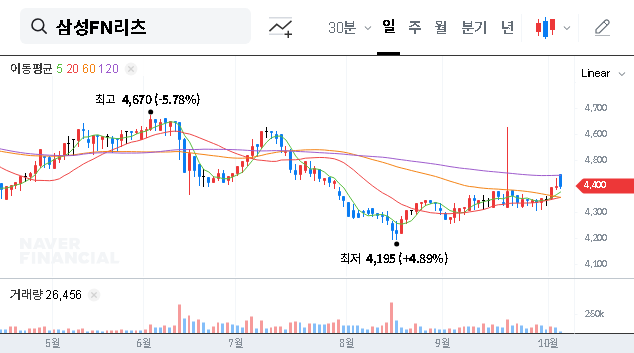
    For investors seeking steady dividend income from the property market, Real Estate Investment Trusts (REITs) are a cornerstone portfolio choice. A prime example is SamsungFN REIT Co., Ltd. (448730), a trust known for its portfolio of high-quality commercial assets. With the recent publication of its October 2025 monthly report, investors have a fresh opportunity to evaluate its performance. But what lies beneath the surface of this routine disclosure?

    This comprehensive SamsungFN REIT analysis will dissect the latest report, explore the company’s fundamental strengths and weaknesses, and place its performance within the challenging macroeconomic landscape. We will uncover the critical details that matter for your investment strategy, moving beyond the headlines to provide actionable insights.

    Deconstructing the October Monthly Report

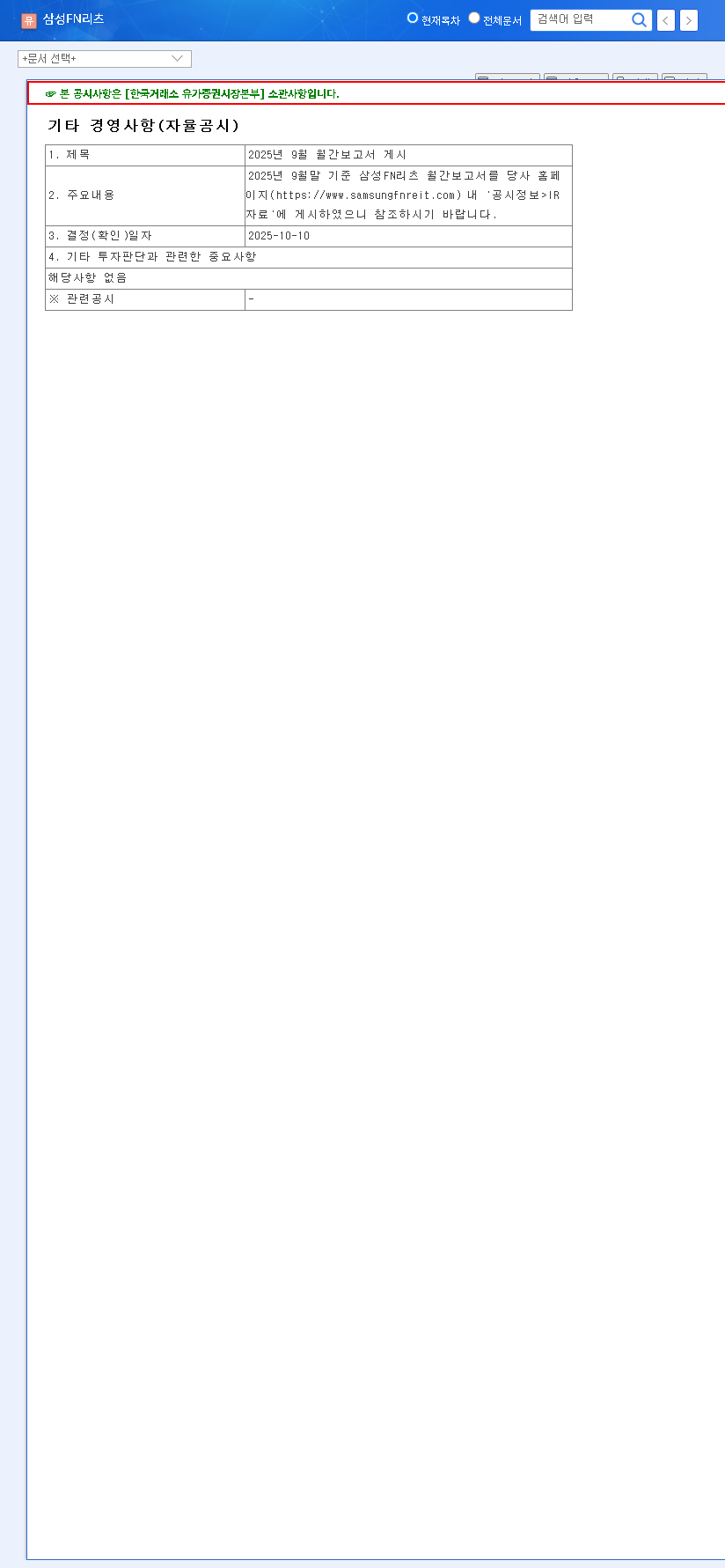
    On November 10, 2025, SamsungFN REIT released its October monthly report, a voluntary disclosure aimed at maintaining transparency with its investors. You can view the Official Disclosure on the DART system. While these reports rarely contain market-shaking news, they are vital for due diligence. They confirm operational continuity and provide the data points necessary to track the company’s health over time. The true value isn’t in the announcement itself, but in the details of rent collection, tenant stability, and financial shifts revealed within.

    The central challenge for SamsungFN REIT is a classic tug-of-war: the stability of its prime real estate assets versus the relentless pressure of a high-interest-rate environment.

    Fundamental Analysis: A Tale of Two Forces

    The financial health of SamsungFN REIT is a story of conflict between its rock-solid asset base and the harsh reality of rising financial costs. While its prime properties in Seoul—FNTower Daechi, FNTower Soonhwa, and FNTower Pangyo—boast a 100% occupancy rate with blue-chip tenants, the balance sheet reveals the strain.

    Key Financials (as of July 31, 2025)

    • Operating Revenue: KRW 12.15 billion (up 3.11% YoY), showing healthy rental income growth.
    • Operating & Net Income: Down 7.85% and 10.71% respectively. This is the red flag, directly caused by higher interest payments on its debt.
    • Debt-to-Equity Ratio: At 112.58%, this level warrants caution and demands a clear strategy for deleveraging or managing financial costs effectively.
    • Dividend Stability: Despite falling profits, the planned dividend of KRW 69 per share remains consistent, signaling a strong commitment to shareholder returns.

    The Power of a Premier Asset Portfolio

    The core strength of the SamsungFN REIT stock lies in its assets. Tenants like Samsung Life Insurance, Shinsegae International, and Hanwha Systems are not just names; they represent long-term, stable lease agreements that generate predictable cash flow. This 0% vacancy rate is the envy of the commercial real estate world and provides a significant buffer against economic downturns. For more on evaluating property portfolios, see our guide on How to Analyze a REIT’s Assets.

    Macroeconomic Headwinds: The Bigger Picture

    No company operates in a vacuum, and REIT investment is particularly sensitive to macroeconomic trends. The current environment presents several key challenges:

    • Persistent High-Interest Rates: Central banks in both the U.S. and Korea are maintaining a hawkish stance. As highlighted by market analysis from sources like Bloomberg, this directly increases the cost of borrowing for SamsungFN REIT, squeezing profit margins.
    • Bond Market Pressure: High yields on government bonds (like the U.S. 10-year Treasury) create a ‘risk-free’ alternative for income-seeking investors, making REIT dividends seem less attractive by comparison and potentially putting downward pressure on the stock price.
    • Inflation and Rent Negotiation: While inflation can justify future rent increases, this is not automatic. The ability to raise rents will depend heavily on the economic health of its tenants and the REIT’s negotiation power.

    Investor Strategy and Outlook

    For current and prospective investors in SamsungFN REIT (448730), the path forward requires careful monitoring of key performance indicators. The stability of its assets provides a strong foundation, but navigating the high-interest environment is paramount.

    What to Watch For:

    • Cost Management: Look for specific strategies from management on how they plan to reduce financial costs, whether through refinancing debt or other efficiency measures. This will be critical for restoring profit growth.
    • Debt Structure: Pay close attention to future financing plans. How the company manages its high debt-to-equity ratio will significantly impact its long-term financial health and risk profile.
    • Lease Renewals & Yields: While occupancy is perfect, the terms of future lease renewals are key. Investors should analyze upcoming reports for any changes in lease yields or tenant stability.

    In conclusion, the October report confirms that SamsungFN REIT is a high-quality operator facing significant external pressures. Its investment appeal hinges on its ability to leverage its premier asset base to weather the macroeconomic storm. Cautious optimism is warranted, but diligent monitoring of the factors outlined above is essential for making an informed investment decision.
    (448730) SamsungFN REIT (448730) Analysis: Stable Assets vs. High-Interest Headwinds 관련 이미지
  • (404990) Shinhan Seobu T&D REIT: In-Depth Analysis of the Q3 2025 Report for Investors

    (404990) Shinhan Seobu T&D REIT: In-Depth Analysis of the Q3 2025 Report for Investors

    For investors tracking the dynamic world of Real Estate Investment Trusts (REITs), the latest quarterly report from Shinhan Seobu T&D REIT Co., Ltd. is a critical piece of intelligence. Released on October 27, 2025, this report provides a transparent look into the company’s financial health, operational performance, and strategic direction amid a complex economic landscape. You can view the complete filing here: Official Disclosure (DART).

    This analysis will dissect the key findings from the Q3 report, balancing the promising indicators of growth against the significant financial headwinds. We’ll explore whether its stable rental income can outweigh the challenges of rising interest rates and a growing debt load, providing a clear, actionable outlook for both current and potential investors.

    Core Financials: A Tale of Two Tapes

    The Q3 2025 report for Shinhan Seobu T&D REIT paints a dual picture. On one hand, operational performance shows resilience and growth. On the other, macroeconomic pressures are clearly impacting the bottom line.

    The Bright Spots: Growth and Stability

    Several positive factors suggest a solid operational foundation and potential for long-term value creation.

    • Impressive Asset Growth: Total assets have swelled by 13.1% year-on-year, reaching 1.1 trillion KRW. This expansion, largely in core investment properties, enhances the REIT’s portfolio and potential for future revenue streams.
    • Robust Operating Revenue: The first half of the 10th fiscal year saw operating revenue climb to 27 billion KRW, a 49.2% increase YoY. Operating profit also rose by 32.4% to 15.78 billion KRW, driven by high occupancy rates and favorable rental adjustments.
    • Reliable Rental Income: The majority of the REIT’s properties maintain near-100% occupancy, ensuring a predictable and stable cash flow—the lifeblood of any successful real estate investment.
    • Supportive Market Environment: The broader Korean REIT market continues to expand, bolstered by supportive government policies and a growing investor appetite for alternative income-generating assets.

    The Headwinds: Debt and Financial Costs

    Despite strong operations, significant financial risks require careful monitoring.

    • Consolidated Net Loss: The company reported a net loss of 0.59 billion KRW. This was primarily caused by a sharp 16.82 billion KRW spike in financial costs (interest expenses) due to rate hikes and increased borrowing.
    • Rising Debt Levels: Total debt surged by 17.6% YoY to 753.25 billion KRW. Consequently, the debt-to-equity ratio has climbed to a significant 2.17 times, signaling increased financial leverage and risk.
    • Key Asset Occupancy Lag: The Gwanghwamun G-Tower, a key property, has a relatively low occupancy rate of 87.8%. Improving this figure is crucial for maximizing rental income and asset performance.
    • Tenant Risk: While not yet impacting financials, the corporate rehabilitation proceedings for Homeplus Co., Ltd., a master lease tenant, present a potential future risk to rent collection and contract stability.

    The core challenge for Shinhan Seobu T&D REIT is clear: can its strong operational revenue growth outpace the escalating burden of its financial costs in a high-interest-rate environment? The answer will define its trajectory for the coming year.

    Future Outlook & Investor Strategy

    The path forward for the Shinhan Seobu T&D REIT will be heavily influenced by its ability to navigate external market forces, particularly interest rate trends. Continued rate hikes would further pressure profitability, while a shift towards rate cuts could provide significant relief.

    Actionable Advice for Investors

    For Existing Investors: The focus should be on vigilance. Closely examine the REIT’s upcoming reports for progress on debt management and cost-control strategies. Sustained operational growth is positive, but any further deterioration of the bottom line due to interest expenses should be a red flag. Hold your position, but be prepared to reassess based on the next quarter’s financial health indicators.

    For New Investors: A cautious, wait-and-see approach is prudent. The current risk profile, dominated by a high debt ratio and interest rate sensitivity, suggests waiting for a clearer signal of financial stabilization. An attractive entry point may emerge when the company demonstrates a tangible plan to reduce its debt burden or when macroeconomic conditions (i.e., interest rate cuts) become more favorable.

    Key Monitoring Points Going Forward

    • Debt Ratio and Interest Expense Trends: Is the debt-to-equity ratio stabilizing or decreasing? Are interest costs being managed effectively?
    • Gwanghwamun G-Tower Occupancy: Watch for any improvement in leasing activity at this key asset, as it’s a direct path to increased revenue.
    • Dividend Policy Sustainability: How will the current net loss impact future dividend distributions, a key attraction for REIT investors?
    • Management’s Strategic Response: Look for clear communication from leadership regarding their strategy to navigate the current financial challenges.

    In conclusion, Shinhan Seobu T&D REIT stands at a crossroads. Its portfolio of quality assets generates strong operational results, but this strength is being tested by significant financial pressures. Informed investment decisions will depend on a careful analysis of the data provided in this Q3 report and a continuous monitoring of the key risk factors outlined above.

    (404990) Shinhan Seobu T&D REIT: In-Depth Analysis of the Q3 2025 Report for Investors 관련 이미지
  • (404990) Shinhan Seobu T&D REIT Asset Sale: A Deep Dive for Investors

    (404990) Shinhan Seobu T&D REIT Asset Sale: A Deep Dive for Investors

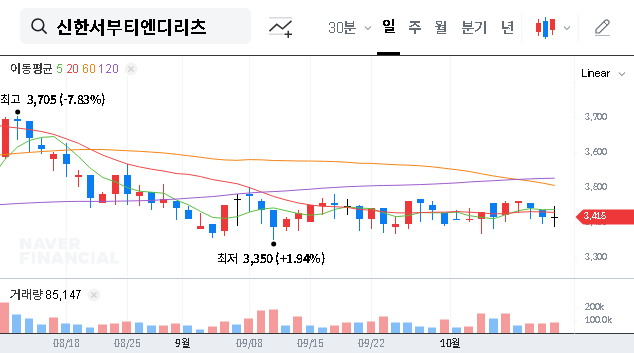
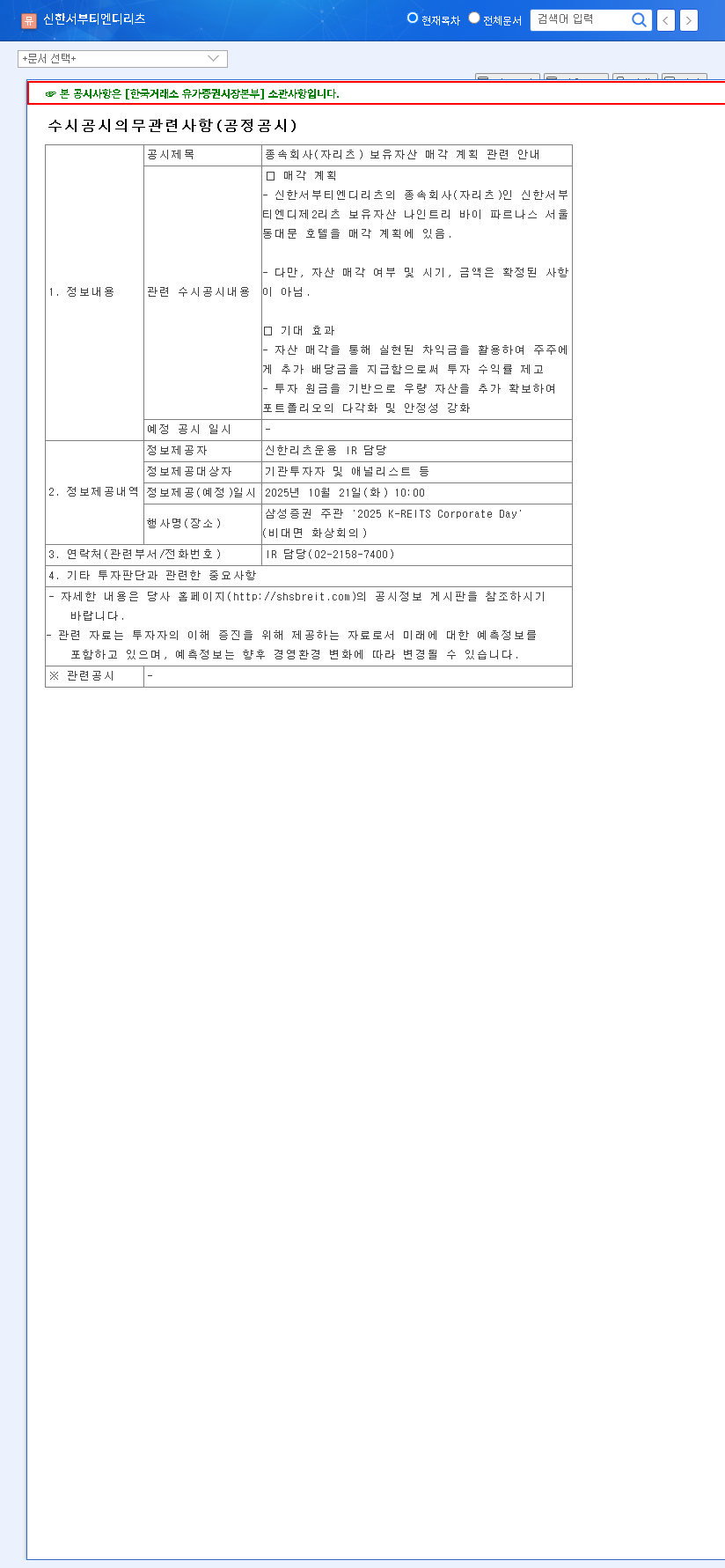
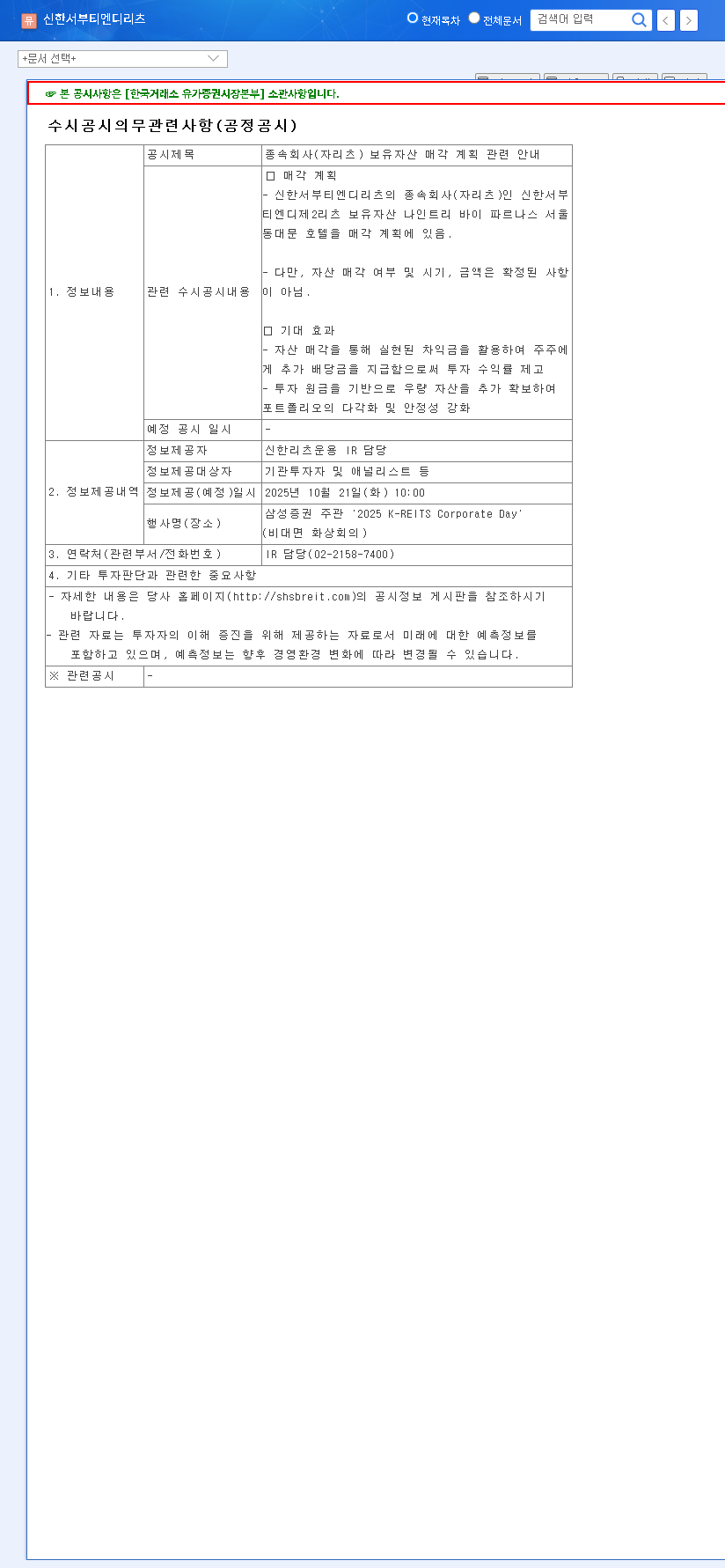
    The Korean real estate investment market is buzzing with a significant development: Shinhan Seobu T&D REIT has officially announced it is exploring the sale of a key asset, the ‘Nine Tree by Parnas Seoul Dongdaemun Hotel’. This move represents a potential turning point for the REIT, with major implications for its financial structure, portfolio strategy, and ultimately, shareholder returns. Is this a masterstroke to unlock value in a challenging market, or a defensive measure that hints at underlying risks?

    This in-depth analysis will dissect the Shinhan Seobu T&D REIT asset sale plan, examining the company’s recent fundamentals, the strategic rationale behind the sale, and the potential outcomes for investors. We provide the critical insights needed to navigate this pivotal event.

    The Core Proposal: Divesting the Nine Tree Hotel

    The proposal, as outlined in the company’s disclosure, involves Shinhan Seobu T&D REIT No. 2 (a subsidiary) divesting its entire stake in the ‘Nine Tree by Parnas Seoul Dongdaemun Hotel’. While the decision to sell is confirmed, critical details such as the final sale price, timing, and buyer remain under negotiation. You can view the Official Disclosure on DART for primary source information.

    On the surface, the company highlights two primary strategic benefits:

    • Enhanced Shareholder Returns: Profits realized from the sale could be distributed as a special dividend, providing a significant, immediate boost to investor yields.
    • Strategic Portfolio Rebalancing: The capital injection would allow Shinhan Seobu T&D REIT to pursue new acquisitions of prime assets, potentially in more resilient sectors, thereby strengthening and diversifying its long-term revenue streams.

    Why Now? A Look at the REIT’s Financial Health

    To understand the motivation behind this sale, a look at the Q2 2025 business report for Shinhan Seobu T&D REIT is essential. The financials paint a mixed picture of growth coupled with rising financial pressures.

    The Bright Spots

    • Growing Asset Base: Total assets climbed an impressive 13.6% to KRW 1.099 trillion by mid-2025, showing a solid growth trajectory.
    • Strong Operating Performance: Operating revenue and profit saw substantial gains (49% and 32% respectively) in H1 2025, driven by stable income from a portfolio with near-100% occupancy.

    Areas of Concern for Investors

    • Shift to Net Loss: Despite strong operations, the REIT swung to a net loss in H1 2025 from a net profit previously. This was caused by surging financial costs, primarily interest expenses on its debt.
    • High Debt Ratio: A consolidated debt ratio of 217.26% is a significant red flag. In a high-interest-rate environment, this level of leverage puts considerable strain on financial stability and profitability.

    This context suggests the asset sale is a proactive, strategic move to de-leverage the balance sheet, reduce interest burdens, and secure capital for future growth, turning a challenge into an opportunity.

    The Dual-Edged Sword: Opportunities and Risks

    A major asset sale like this presents both significant upsides and potential pitfalls. Investors in Shinhan Seobu T&D REIT should weigh both sides carefully.

    Potential Positive Impacts

    • Financial Fortification: The primary benefit would be using proceeds to pay down debt, immediately lowering the debt ratio and improving the REIT’s risk profile.
    • Capital for Growth: This is a classic capital recycling strategy. By selling a mature asset, the REIT can reinvest in properties with higher growth potential, such as modern logistics centers or prime office spaces.
    • Increased Shareholder Value: A special dividend is a direct return to shareholders, which could significantly boost the stock’s appeal in the short term.

    Potential Risks and Headwinds

    • Execution Uncertainty: The deal isn’t done. A lower-than-expected sale price or a significant delay could disappoint the market and limit the financial benefits.
    • Loss of Stable Income: The hotel, as a core asset, generates steady rental income. Its sale will create a revenue gap that must be filled by new acquisitions, which takes time.
    • Market Timing: The hotel sector’s value is tied to tourism and economic health. Selling in a soft market could mean leaving money on the table if the sector rebounds strongly in the coming years. For more context, see our Guide to Investing in Korean REITs.

    Investor Action Plan & Final Thoughts

    The Shinhan Seobu T&D REIT asset sale is a pivotal event that warrants close attention. While the strategy to improve the balance sheet is sound, success hinges on execution.

    Key Monitoring Points for Investors:

    • Sale Announcements: Watch for official news on the buyer, sale price, and expected closing date.
    • Use of Proceeds: Scrutinize the company’s plan for the capital. How much will go to debt repayment versus new acquisitions?
    • Market Conditions: Keep an eye on interest rate trends from the Bank of Korea and the performance of the broader real estate market. The value of the REIT is intrinsically linked to these factors.

    In conclusion, this asset sale could be the catalyst that propels Shinhan Seobu T&D REIT into a more stable and profitable future. However, the path is fraught with uncertainty. Diligent monitoring and a clear understanding of the risks involved will be crucial for making an informed investment decision.
    (404990) Shinhan Seobu T&D REIT Asset Sale: A Deep Dive for Investors 관련 이미지