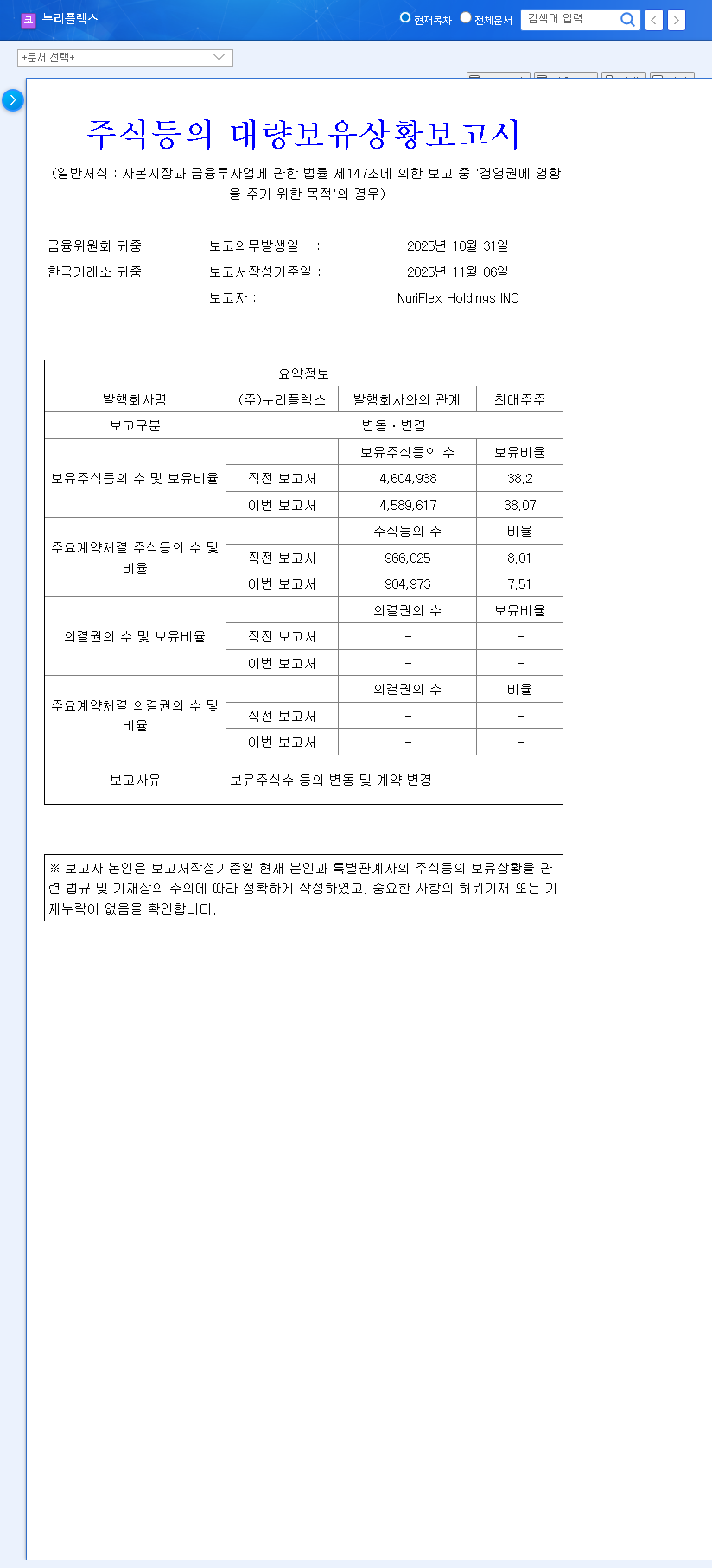
A recent disclosure has sent ripples through the investor community, focusing attention on a subtle but significant NuriFlex Co.,Ltd. ownership change. On November 6, 2025, a ‘Report on the Status of Large Shareholdings’ revealed that major shareholder NuriFlex Holdings I&C/Canada slightly decreased its stake. While a minor percentage shift might seem trivial, the declared purpose of ‘exercising influence over management rights’ signals potentially transformative events on the horizon. This analysis will dissect the implications of this development, examine NuriFlex’s current financial health, and provide a strategic outlook for investors navigating this period of uncertainty.
The official filing confirms that the shareholder’s ownership stake was reduced by a marginal 0.13 percentage points, moving from 38.2% to 38.07%. The transaction was attributed to a ‘change in number of shares held and contract amendment.’ For full transparency, you can view the Official Disclosure on the DART system. This event demands a closer look at the company’s internal and external pressures.
NuriFlex’s Current Financial Health: A Mixed Picture
To understand the context of the NuriFlex Co.,Ltd. ownership change, we must first assess the company’s fundamental performance. The semi-annual report from June 2025 paints a challenging picture. Despite continued success in its core power IoT/AMI solution business, the company is grappling with declining overall revenue and worsening profitability. This is a critical backdrop for any shareholder action.
The company’s debt-to-equity ratio has climbed to 114.82%, signaling rising financial risk and a potential need for careful liquidity management. This metric will be closely watched by the market.
Key Financial and Operational Headwinds
Several factors are contributing to NuriFlex’s current challenges:
- •Revenue & Profitability Issues: Consolidated revenue saw a significant year-on-year decrease, while the operating loss widened. Management attributes this to a global economic slowdown and inconsistent project delivery timelines.
- •Financial Soundness Concerns: A high proportion of short-term borrowings, coupled with the rising debt-to-equity ratio, raises questions about financial stability and requires prudent capital management.
- •Underperforming New Ventures: While the core power IoT/AMI business is a bright spot, newer segments like nano materials and healthcare have not yet delivered significant financial results, dragging on overall performance.
- •Treasury Stock Position: The company holds 6.28% of its common shares as treasury stock, a move often used to stabilize share prices and signal confidence to the market.
Analyzing the Impact of the Ownership Change
The stated goal to ‘influence management rights’ is the most critical piece of this disclosure. This phrase transforms a minor stock sale into a strategic signal. We can analyze its potential impact in both the short and long term.
Short-Term: Increased Volatility and Market Scrutiny
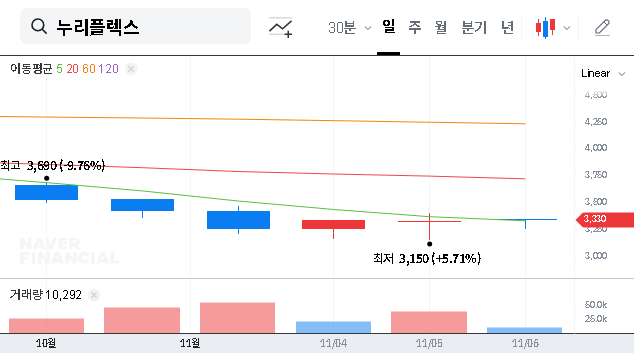
In the immediate future, this news is likely to increase market chatter and stock volatility. Any perceived shift in control can attract speculative traders, boosting trading volume. Conversely, the reduction in shareholding, however small, could be interpreted as a lack of confidence, creating selling pressure, especially given the company’s weak financial footing highlighted in our previous NuriFlex investor report. While a 0.13% reduction poses no immediate threat to management, it sets the stage for future moves.
Mid-to-Long-Term: Potential for Strategic Shifts
The long-term implications are far more profound. With a stake just over 38%, NuriFlex Holdings is in a strong position but does not have absolute control. The ‘influence management’ clause could foreshadow several scenarios: a future attempt to acquire more shares, a push for board seats, or a campaign to change the company’s strategic direction. This could lead to a reassessment of NuriFlex’s corporate value, where overcoming its current performance issues will be paramount. If synergies exist between the shareholder and NuriFlex’s operations, this influence could ultimately be a positive catalyst for growth.
Strategic Recommendations for NuriFlex Investors
For current and prospective investors, this is a time for heightened vigilance. The NuriFlex Co.,Ltd. ownership change is a significant event that warrants close monitoring. Here are key areas to focus on:
- •Track Shareholding Trends: Pay close attention to any subsequent filings. Further share acquisitions or disposals by NuriFlex Holdings I&C/Canada will be the clearest indicator of their next move.
- •Evaluate Performance Turnaround: Scrutinize NuriFlex’s upcoming financial reports. Look for concrete evidence of performance improvement, enhanced profitability in the core business, and progress in new ventures.
- •Monitor Macroeconomic Factors: Keep an eye on interest rates, currency exchange rates, and commodity prices, as these external pressures will continue to impact NuriFlex’s costs and profitability.
- •Demand Shareholder Communication: In times of potential management disputes, transparent and proactive communication from the company is essential to reduce market uncertainty and build investor trust.
In conclusion, the minor change in ownership at NuriFlex is more than just a number—it’s a statement of intent. Investors must weigh the potential for positive strategic change against the risks posed by the company’s current financial and operational weaknesses.