Tag: MRO

  • Dongil Steelux Designated as Investment Warning Stock: Crisis or Opportunity?


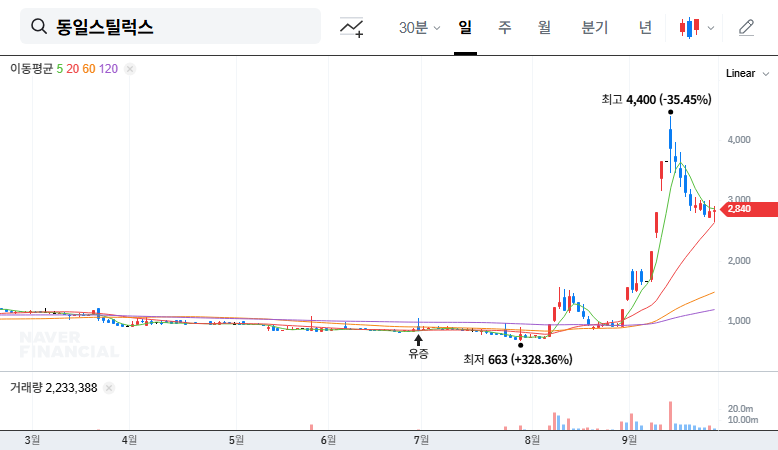
    Dongil Steelux Designated as Investment Warning Stock: Crisis or Opportunity? 대표 차트 이미지


    What Happened? Dongil Steelux Designated as Investment Warning Stock

    On September 24, 2025, Dongil Steelux was designated as an investment warning stock by the Korea Exchange. This signifies that the stock price has surged in the short term or trading volume has exceeded a certain threshold, indicating a potential market overheat.

    Why the Designation? Analyzing the Background and Causes

    The designation of Dongil Steelux as an investment warning stock is analyzed to be due to the recent expectations surrounding new business ventures (robots, MRO, etc.) and speculative buying by some investors. However, according to the company’s 2025 semi-annual report, the fundamentals, such as continuous operating losses and high debt ratio, remain weak.

    What’s Next? Future Stock Price Outlook and Investment Strategies

    In the short term, increased attention due to the investment warning designation may lead to greater stock price volatility. However, without fundamental improvements, sustained stock price increase is unlikely, and the possibility of designation as an overheated stock and trading suspension should be considered.

    • Positive aspects: Growth potential of new businesses (robots, MRO)
    • Negative aspects: Weak financial structure (high debt ratio, operating loss), uncertainty about going concern ability

    What Should Investors Do? Action Plan

    Investors should not be misled by short-term stock price fluctuations and should closely monitor the company’s fundamental improvements. It is important to continuously monitor improvements in financial structure, concrete results of new businesses, and changes in management strategies after the change of the largest shareholder, and to make prudent investment decisions.


    Frequently Asked Questions (FAQ)

    What is an investment warning stock?

    An investment warning stock refers to a stock whose price has rapidly increased or whose trading volume has surged, raising concerns about speculative trading.

    What are the sanctions for being designated as an investment warning stock?

    If the stock price continues to rise even after the designation, trading may be suspended.

    What is the future outlook for Dongil Steelux?

    The success of new businesses and improvements in the financial structure are expected to significantly impact future stock prices.


  • Kencoa Aerospace Q2 2025 Earnings: Unexpected Loss, What’s the Investment Strategy?

    1. Kencoa Aerospace Q2 Earnings: What Happened?

    Kencoa Aerospace reported revenue of ₩21.5 billion, an operating loss of ₩1.8 billion, and a net loss of ₩2.5 billion for Q2 2025. Revenue surpassed market expectations, but profitability significantly deteriorated.

    2. Reasons for Underperformance: Why These Results?

    The sluggish performance of the MRO (military aircraft, PTF Conversion) business segment is identified as the primary culprit. Increased competition and business volatility have led to continuous revenue decline. Furthermore, operating losses and other non-operating expenses contributed to the widening net loss.

    3. Future Outlook and Investment Strategy: What Now?

    In the short term, the negative earnings announcement is expected to put downward pressure on the stock price, requiring a cautious approach. However, positive factors such as growth in the US aircraft production/processing segment, securing global Tier 1 clients, and the potential of the UAM/drone business also exist.

    4. Investor Action Plan: What Should You Do?

    • Neutral Stance: Closely monitor MRO business improvement, new business performance, and financial soundness securing plans.
    • Risk Management: Managing risks related to exchange rate volatility, the continuing high-interest rate environment, and MRO business volatility is crucial.
    • Long-Term Perspective: Reassess the long-term investment value if the company successfully turns around and improves profitability.

    Frequently Asked Questions

    What are the main reasons for Kencoa Aerospace’s poor Q2 performance?

    The sluggish MRO business segment and increased operating losses are the primary reasons.

    What is the outlook for Kencoa Aerospace?

    While downward pressure on the stock price is expected in the short term, positive factors like growth in the US aircraft production/processing segment and the potential of the UAM/drone business also exist.

    What strategy should investors adopt?

    Investors should maintain a neutral stance in the short term, monitoring factors like MRO business improvement. A long-term perspective, considering the possibility of a turnaround, is also recommended.

  • SonoSquare’s Surprise Turnaround: Q2 2025 Earnings Analysis and Outlook

    1. SonoSquare Q2 Earnings: Key Highlights

    SonoSquare reported revenue of KRW 45.7 billion, operating profit of KRW 1.2 billion, and net income of KRW 0.9 billion in Q2 2025, marking a successful return to profitability. This represents a remarkable 30.6% year-over-year revenue increase and a 52.3% increase compared to the previous quarter.

    2. Drivers of the Turnaround: What Fueled the Growth?

    • Revenue Growth: A general business recovery, combined with the effects of new business ventures, drove the revenue increase.
    • Cost Efficiency: Consistent cost management efforts played a key role in achieving positive operating income.
    • Improved Financial Structure: The debt-to-equity ratio decreased to 57.93%, significantly enhancing financial health.

    3. Investment Considerations: What are the Potential Risks?

    • Struggling MRO Business: The past underperformance of the MRO business has not been fully resolved, and its high dependence on related companies poses a risk.
    • Continued Losses in the Rental Business: Improving profitability in the rental business is an urgent task.
    • Macroeconomic Uncertainty: Interest rate and exchange rate volatility are factors to consider when investing.

    4. Action Plan for Investors: How to Approach Investment?

    While SonoSquare’s return to profitability is encouraging, several risk factors remain. Before making investment decisions, carefully consider the MRO business recovery, new business performance, and macroeconomic variables. A long-term investment perspective is recommended, along with close monitoring of future earnings announcements and market conditions.

    Frequently Asked Questions

    What are SonoSquare’s main businesses?

    SonoSquare operates MRO (Maintenance, Repair, and Operations), rental, cosmetics/household goods businesses.

    What are the main reasons for the turnaround in Q2?

    Revenue growth, cost efficiency, and improved financial structure are the main reasons for the return to profitability.

    What should investors be aware of when considering SonoSquare?

    Investors should consider the continued underperformance of the MRO business, losses in the rental business, and macroeconomic uncertainty.

  • SonoSquare Invests ₩20B in T’way Air: Opportunity or Risk? (Feat. Synergy Analysis)

    1. What Happened? SonoSquare Invests ₩20 Billion in T’way Air

    SonoSquare is set to acquire a 11.71% stake in T’way Air through a ₩20 billion investment in a rights offering, aiming to improve T’way’s financial structure and facilitate further investments. This represents a significant investment, equivalent to 19.85% of SonoSquare’s capital.

    2. Why the Investment? Synergy and Growth Potential

    SonoSquare anticipates significant synergies with T’way Air, particularly linking air transportation with its rental business (SONOSEASON). Diversification and new growth opportunities are key objectives. Potential synergy strategies include joint promotions targeting travelers with rental services.

    3. What’s Next? Analyzing Opportunities and Risks

    • Potential Benefits: Improved financial health for T’way Air, positive impact on SonoSquare’s consolidated financials, business diversification, and potential stock price momentum.
    • Potential Risks: Increased financial burden on SonoSquare, volatility in the airline industry impacting investment returns, uncertainty in synergy realization, and increased stock price volatility.

    SonoSquare is currently facing challenges with its struggling MRO business and declining profitability in its rental segment. This large investment could exacerbate its financial burden. Furthermore, the airline industry’s sensitivity to external factors like oil prices, exchange rates, and economic downturns poses risks to T’way’s performance, potentially impacting SonoSquare.

    4. What Should Investors Do? Action Plan

    • Short-term Strategy: Monitor stock price volatility following the announcement and await T’way Air’s detailed business plans.
    • Long-term Strategy: Focus on SonoSquare’s fundamental improvements, synergy realization, and maintenance of financial health.

    In conclusion, this investment presents both opportunities and risks. Investors should avoid being swayed by short-term price fluctuations and focus on a thorough analysis of the company’s fundamentals, synergy potential, and financial stability before making investment decisions.

    What is the purpose of SonoSquare’s investment in T’way Air?

    The investment aims to maximize synergy by improving T’way Air’s financial structure and facilitating further investment, as well as diversifying SonoSquare’s business portfolio and securing new growth engines.

    What are the potential risks of this investment?

    Potential risks include increased financial burden on SonoSquare, volatility of the airline industry, uncertainty in synergy realization, and increased stock price volatility.

    What should investors be aware of?

    Investors should focus on analyzing SonoSquare’s fundamental improvements, the feasibility of synergy realization, and the company’s ability to maintain financial health, rather than reacting to short-term stock price fluctuations.