Tag: Lee Kyung-ha

  • (096760) JW HOLDINGS CORPORATION: Major Shareholder Stake Increase Analysis (2025)

    (096760) JW HOLDINGS CORPORATION: Major Shareholder Stake Increase Analysis (2025)

    For investors in JW HOLDINGS CORPORATION, recent developments have stirred a mix of optimism and caution. A significant disclosure on November 4, 2025, revealed that a major shareholder, Lee Kyung-Ha, has increased his stake with the explicit purpose of ‘influencing management.’ This action can be a powerful signal, but it’s clouded by the mention of a ‘Significant Contract Change’ and the company’s underlying financial headwinds. This comprehensive analysis will unpack the event, examine the fundamentals, and provide a clear roadmap for investors navigating this pivotal moment for JW HOLDINGS CORPORATION.

    Dissecting the Disclosure: What Happened?

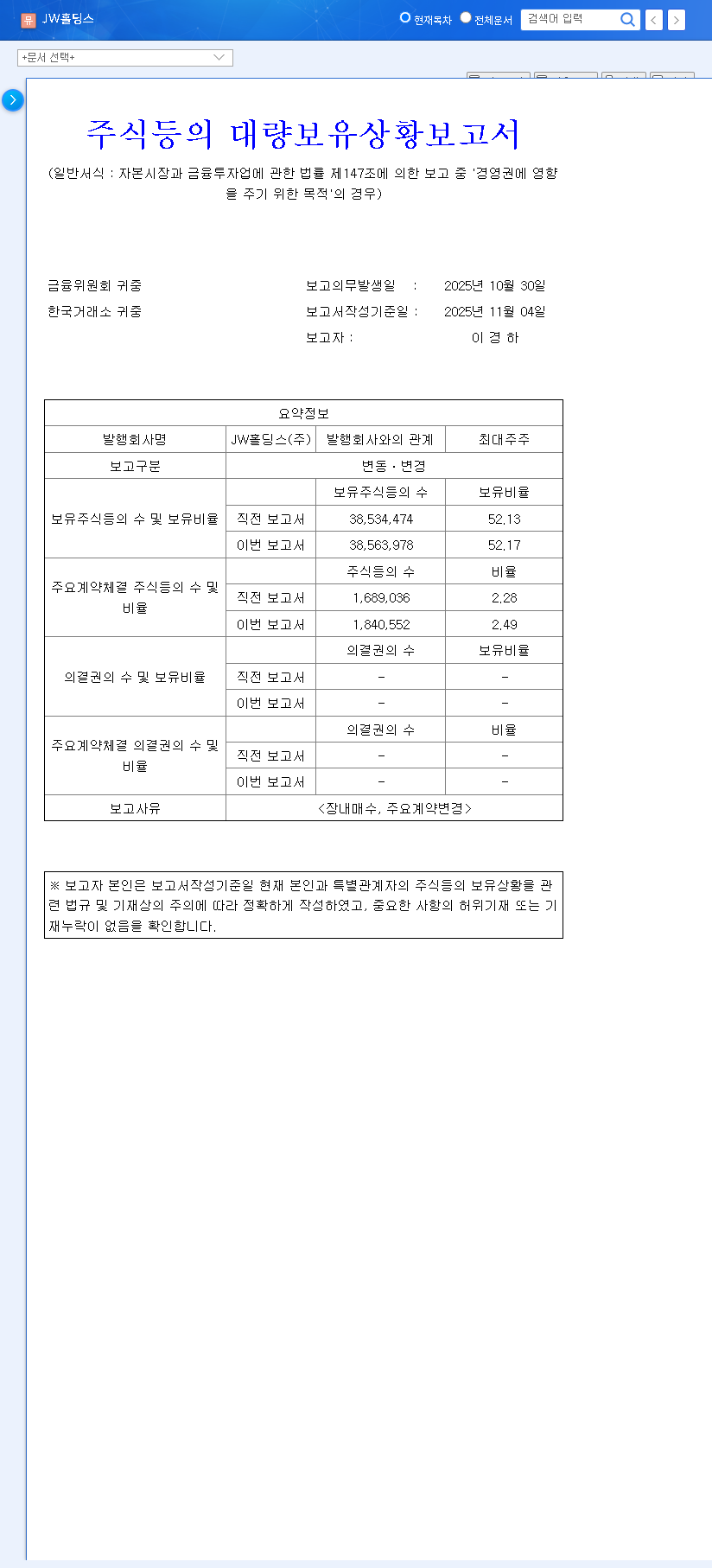
    On November 4, 2025, JW HOLDINGS CORPORATION filed a mandatory ‘Report on the Status of Large-scale Shareholding.’ The core of the report, confirmed by the Official Disclosure on DART, detailed two key points. First, major shareholder Lee Kyung-Ha increased his ownership by 0.04 percentage points, moving from 52.13% to a controlling 52.17% stake. This was achieved through an on-market purchase. Second, and perhaps more ambiguously, the filing cited a ‘<Significant Contract Change>’ as a concurrent reason for the report. This combination of a deliberate stake increase and a mysterious contractual event creates a complex picture for anyone conducting a JW HOLDINGS stock analysis.

    The central question for investors: Is this a vote of confidence from a key insider aimed at steering the company toward growth, or a prelude to a disruptive event masked by the vague ‘Significant Contract Change’ disclosure?

    Weighing the Pros and Cons for Investors

    The Bull Case: Stability and Confidence

    On the surface, a major shareholder stake increase is often interpreted positively by the market. Here’s why:

    • Enhanced Management Stability: A larger stake solidifies the shareholder’s control and demonstrates a long-term commitment. This can reduce the risk of hostile takeovers and ensure a consistent strategic direction.
    • Signal of Undervaluation: When an insider buys shares on the open market, it suggests they believe the company’s stock is undervalued. This can boost market sentiment and attract new investors, as detailed in many guides to analyzing insider trading.
    • Accountable Leadership: By explicitly stating the purpose is to ‘influence management,’ Lee Kyung-Ha is signaling an intent to be actively involved in steering JW HOLDINGS CORPORATION towards growth and enhanced shareholder value.

    The Bear Case: Uncertainty and Fundamental Weakness

    However, several underlying risks temper this optimism:

    • The ‘Significant Contract Change’ Mystery: This is the biggest red flag. Without details, investors are left to speculate. Could it be a major asset sale, a dilutive merger, or a disadvantageous partnership? This uncertainty can suppress stock prices until clarity is provided.
    • Deteriorating Fundamentals: The 2025 semi-annual report paints a concerning picture. A 20.72% year-on-year revenue decline points to significant operational challenges. This isn’t just a minor dip; it’s a substantial slowdown that the shareholder action alone cannot fix.
    • Macroeconomic Pressures: Global interest rate hikes, volatile currency exchange rates (KRW/USD, KRW/EUR), and fluctuating raw material costs are external pressures that affect profitability, especially for a holding company with diverse subsidiaries. For more on this, financial news outlets like Bloomberg offer extensive market analysis.

    Investor Action Plan for JW HOLDINGS CORPORATION

    Given the conflicting signals, a prudent investment analysis requires a multi-faceted approach. Passive observation is not enough; active monitoring is key.

    Priority 1: Seek Clarity on the Contract

    The single most important task is to monitor all future company announcements for details regarding the ‘Significant Contract Change.’ The nature of this contract will likely be the primary driver of the stock’s medium-term performance. Will it unlock value or introduce new liabilities?

    Priority 2: Monitor for Fundamental Turnaround

    Look for tangible evidence that management is addressing the revenue decline. Key performance indicators to watch include subsidiary performance, progress in the R&D pipeline (especially for JW Pharmaceutical), and strategies to mitigate the impact of exchange rate volatility. Quarterly earnings reports will be critical.

    Priority 3: Observe Further Shareholder Actions

    Is this a one-time purchase, or the beginning of a larger accumulation of shares? Continued buying by Lee Kyung-Ha could further strengthen the bull case, while any selling would be a major red flag. Monitor trading volume and foreign ownership trends for shifts in market sentiment.

    In conclusion, while the major shareholder’s move injects a dose of confidence into the narrative for JW HOLDINGS CORPORATION, it is overshadowed by real fundamental weaknesses and significant uncertainties. A cautious, evidence-based approach is essential. The positive signal from the stake increase should be viewed as a potential catalyst, but one that requires confirmation through improved financial performance and transparent communication from management before it can be considered a definitive buy signal.
    (096760) JW HOLDINGS CORPORATION: Major Shareholder Stake Increase Analysis (2025) 관련 이미지
  • JW Holdings: CEO Increases Stake, What’s Next for the Stock?

    CEO Lee Kyung-ha Secures 52.13% Stake in JW Holdings

    CEO Lee Kyung-ha increased his stake in JW Holdings from 51.99% to 52.13% through market purchases. This move is interpreted as a strong commitment to strengthening management control and pursuing future growth strategies.

    Stake Increase: Good News?

    This stake increase is likely to have a positive impact on the stock price in the short term. Expectations for management stability tend to boost investor sentiment. However, sustained stock price growth depends on subsidiary performance improvements, effective responses to market changes, and transparent management.

    Key Variables: Subsidiary Performance and New Drug Development

    • JW Pharmaceutical’s URC102
    • JW CreaGen’s CAR-NK cell therapy

    The success of these two new drug developments is a key variable that will determine the future of JW Holdings. It is also crucial to reduce dependence on dividend income from the holding company business and drive stable growth of subsidiaries.

    Market Environment Changes and Transparent Management

    Effective response strategies are needed for external factors such as raw material price and exchange rate fluctuations, and interest rate hikes. Transparent management and information disclosure are also crucial for securing investor confidence.

    Action Plan for Investors

    Don’t be fooled by the possibility of short-term stock price increases. It’s important to coldly analyze JW Holdings’ fundamentals and growth potential from a long-term perspective. Continuous monitoring of relevant information, such as subsidiary earnings announcements and new drug development progress, is essential.

    Frequently Asked Questions

    How will CEO Lee’s stake increase affect JW Holdings’ stock price?

    While it’s likely to have a positive impact in the short term, the long-term stock price will depend on various factors like subsidiary performance, market conditions, and management transparency.

    What are the future growth drivers for JW Holdings?

    Key growth drivers include new drug developments like JW Pharmaceutical’s URC102 and JW CreaGen’s CAR-NK cell therapy, along with improvements in subsidiary performance.

    What precautions should investors take when investing in JW Holdings?

    Investors should not be swayed by short-term stock fluctuations and should thoroughly analyze the company’s fundamentals and long-term growth potential. Continuous monitoring of relevant information is also crucial.

  • JW Holdings: Stakeholder Buyout to Strengthen Management Rights? In-Depth Analysis of July 16th Event

    JW Holdings: Analysis of CEO Lee Kyung-ha’s 20,000 Share Purchase Event

    JW Holdings (market capitalization: 276.8 billion KRW) announced that its largest shareholder, CEO Lee Kyung-ha, purchased 20,000 shares on the stock market on July 14, 2025. Following this report, his stake increased slightly from 51.97% to 51.99%. The reported reasons for the purchase are ‘On-market purchase, major contract change,’ indicating an intent to maintain or strengthen his control over the company’s management.

    JW Holdings’ Solid First-Quarter Performance and Growth Drivers

    According to the Q1 2025 report, JW Holdings achieved a sound performance with sales revenue increasing by 9.76% year-over-year to 27.5 billion KRW. This growth was driven by steady performance in its holding company business (up 61.7%) and pharmaceutical import/export business (up 38.3%). Notably, the increase in sales of nutritional solutions (5.6 billion KRW) and penem antibiotics (2.8 billion KRW) was particularly strong, reflecting the growth momentum of its subsidiaries, JW Pharmaceutical and JW Life Science.

    JW Holdings’ Resilience in a Volatile Macroeconomic Environment

    JW Holdings has demonstrated a degree of resilience amidst recent macroeconomic shifts:

    • Exchange Rate Fluctuations: Despite the potential for USD/KRW exchange rate increases in Q1 2025, a rise in overseas sales denominated in USD offset this, leading to increased profits. However, given the recent slight upward trend in the EUR/KRW exchange rate (currently 1,610.19 KRW), close monitoring of profitability changes due to future exchange rate volatility is necessary.
    • Interest Rate Hikes: The rising trend in benchmark interest rates and 10-year Treasury yields in both the US and Korea could increase corporate borrowing costs. While JW Holdings managed to offset this with its Q1 profit growth, sustained high interest rates could pose a long-term financial burden. (US benchmark rate: 4.5%, 10-year Treasury yield: 4.489%; Korea benchmark rate: 2.5%, 10-year Treasury yield: 2.875%)
    • Logistics and Commodity Prices: While crude oil prices showed volatility, the Baltic Dirty Tanker Index is on an upward trend. This could lead to increased logistics costs negatively impacting profitability, though the impact is likely not significant given the Q1 sales growth. Crude oil prices recently showed a slight downward trend, settling at $66.84.
    • Chinese Economy: The Container Freight Index (China) has shown volatility, reflecting the correlation with China’s economic conditions. Information regarding JW Holdings’ market presence and impact in China was insufficient in the Q1 report. (Container Freight Index (China): 1,313.70)

    Potential Impact of the Event: Management Stabilization vs. Hidden Risks

    CEO Lee Kyung-ha’s substantial share purchase can be interpreted as a positive signal of management stabilization and reinforced commitment to the company’s current direction, potentially boosting investor confidence. However, the true significance of this purchase hinges on the details of the ‘major contract change.’

    • Positive Scenario: If this purchase is a measure to preempt potential management disputes or alleviate concerns about a decline in corporate value, it is likely to have a positive impact on the stock price.
    • Negative Scenario: Conversely, if further management-related issues arise post-purchase or if the ‘major contract change’ has negative implications for the company’s value, it could exert downward pressure on the stock price.

    Future Outlook and Recommendations for Investors

    While JW Holdings’ Q1 performance is positive, potential risk factors such as exchange rate volatility, prolonged high interest rates, and fluctuations in commodity prices must not be overlooked.

    Investors should acquire and analyze the following additional information for more accurate investment decisions:

    • Confirmation of the specific details of the ‘major contract change.’
    • An assessment of JW Holdings’ presence and future plans in the Chinese market.
    • A detailed evaluation of each subsidiary’s performance and growth strategies.
    • An analysis of the effectiveness of strategies for securing long-term growth drivers and managing risks.

    In conclusion, the large share purchase by CEO Lee Kyung-ha may provide a positive short-term momentum for JW Holdings’ stock. However, the long-term stock performance will be determined by the details of the ‘major contract change,’ the impact of macroeconomic variables, and JW Holdings’ business strategy and risk management capabilities. We recommend a cautious investment approach, with a thorough understanding of potential risks and careful analysis of the additional information mentioned above.

    Why did JW Holdings’ largest shareholder purchase shares?

    JW Holdings’ largest shareholder, CEO Lee Kyung-ha, cited ‘On-market purchase, major contract change’ as the reason for his purchase, signaling an intent to maintain and strengthen his influence over the company’s management. This can be interpreted as a signal for management stabilization and enhancing shareholder value.

    What is JW Holdings’ recent financial performance?

    As of Q1 2025, JW Holdings showed solid performance, with sales revenue increasing by 9.76% year-over-year to 27.5 billion KRW. This growth is attributed to the robust performance of its holding company and pharmaceutical import/export businesses, reflecting the sales growth of its subsidiaries.

    What are the potential risks for JW Holdings in the current macroeconomic environment?

    Potential risks include increased exchange rate volatility, rising borrowing costs due to higher benchmark and Treasury yields, and potential increases in logistics costs. Changes in the Chinese economy could also have an impact.

    How might this event affect JW Holdings’ stock price?

    The share purchase by CEO Lee Kyung-ha could positively impact the stock price in the short term due to expectations of management stabilization. However, the long-term stock performance may vary depending on whether the ‘major contract change’ is positive and whether any further management-related issues arise.

    What additional factors should investors consider when looking at JW Holdings?

    Investors should verify the specific details of the ‘major contract change,’ assess JW Holdings’ presence and future plans in the Chinese market, and analyze the performance and growth strategies of its subsidiaries. Evaluating the effectiveness of its strategies for securing long-term growth drivers and managing risks is also crucial.