Tag: Korean Stock Market

  • (282330) BGF Retail Q3 2025 Earnings Analysis (282330): A Strong Rebound or Temporary Relief?

    (282330) BGF Retail Q3 2025 Earnings Analysis (282330): A Strong Rebound or Temporary Relief?

    The initial analysis of the BGF retail Q3 2025 earnings report reveals a significant outperformance of market expectations, sparking conversations about a potential turnaround for the operator of South Korea’s largest convenience store chain, CU. After a challenging first half of the year, BGF Retail (KRX: 282330) has posted robust growth in revenue, operating profit, and net income, suggesting a recovery in its core business fundamentals. This detailed BGF retail analysis will dissect the quarterly results, explore the underlying drivers, evaluate the persistent risks, and offer a strategic outlook for investors monitoring BGF retail stock.

    BGF Retail Q3 2025 Earnings: The Key Numbers

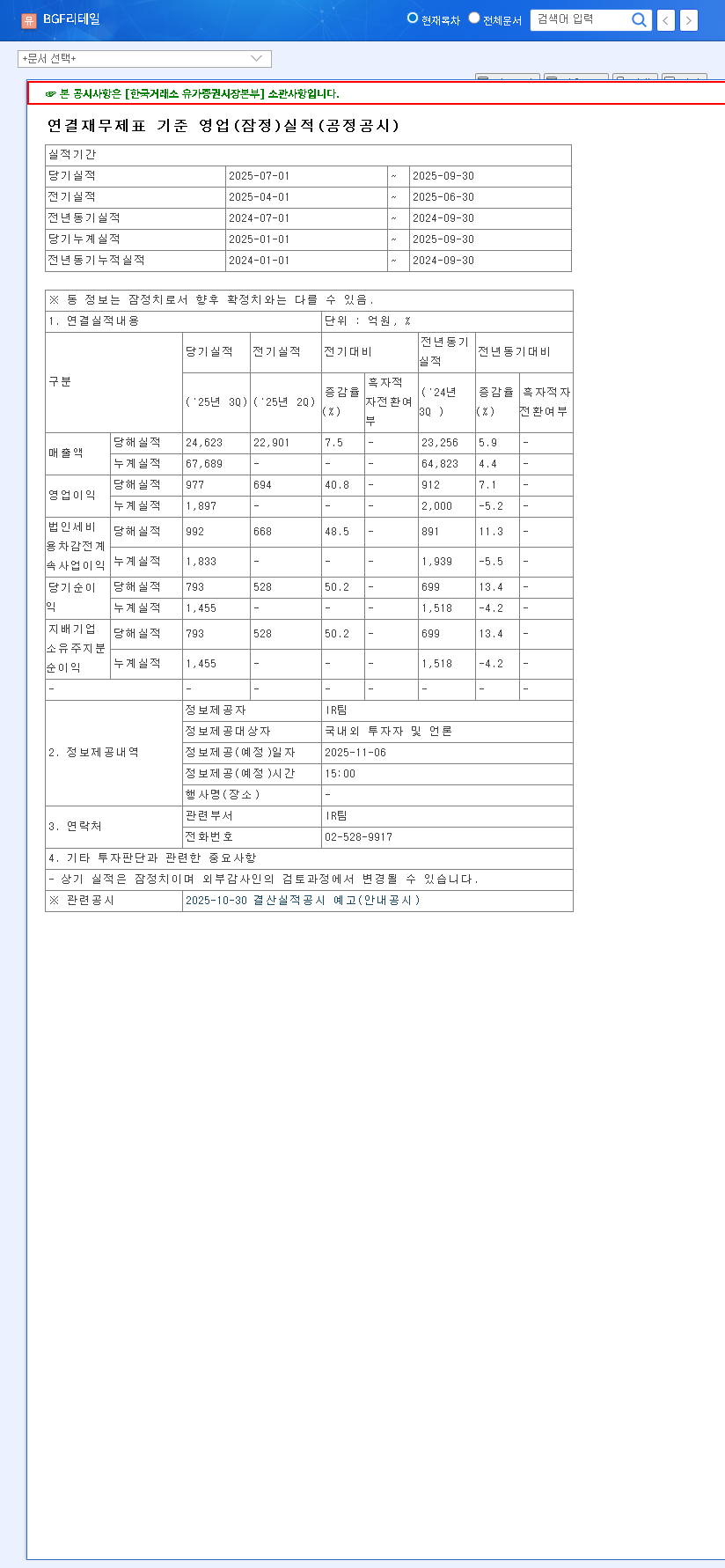
    On November 6, 2025, BGF retail CO., LTD. released its preliminary consolidated financials, delivering a pleasant surprise to the market. The results not only showed growth but also confidently surpassed consensus forecasts across the board. You can view the full report directly from the source: Official Disclosure.

    Here’s a breakdown of the performance against market expectations:

    • Revenue: KRW 2.4623 trillion, which is 1.0% above the market expectation of KRW 2.4375 trillion.
    • Operating Profit: KRW 97.7 billion, standing 2.2% above the market expectation of KRW 95.6 billion.
    • Net Income: KRW 79.3 billion, a significant 6.2% above the market expectation of KRW 74.7 billion.

    The impressive beat in net income is particularly noteworthy, as it suggests stronger-than-anticipated operational efficiency and profitability management during the quarter.

    The Q3 2025 results serve as a crucial data point, potentially marking an inflection point for BGF Retail. The strong bottom-line performance indicates that the company’s strategic initiatives may be starting to bear fruit, alleviating earlier concerns about margin compression.

    Analysis: Why This Earnings Beat Matters

    A Clear Reversal from H1 Weakness

    The first half of 2025 was a period of concern for BGF Retail investors. A sequential comparison highlights the magnitude of the Q3 recovery:

    • Q3 2025 Operating Profit: KRW 97.7 billion
    • Q2 2025 Operating Profit: KRW 69.4 billion
    • Q1 2025 Operating Profit: KRW 22.6 billion

    This sharp upward trend in profitability demonstrates a powerful recovery, moving the company past the operational hurdles seen earlier in the year. This provides a strong foundation for a potential re-rating of the CU convenience store earnings power and, by extension, BGF retail stock.

    Strengthening Fundamentals and Core Business Health

    Delivering results beyond market predictions in a competitive environment validates BGF Retail’s strong business foundation and adaptability. While specific segment results were not detailed in the preliminary report, the overall profit jump suggests encouraging signs. This likely includes improved performance in the high-margin food manufacturing and distribution segment, a key area that had previously faced profitability challenges. A healthier food sector is vital for long-term growth.

    Navigating the Headwinds: Key Risks for Investors

    Despite the positive BGF retail Q3 2025 earnings, a prudent investor must remain aware of the potential risks that could impact future performance.

    Internal Financial Health and Governance

    The company’s balance sheet requires continued monitoring. The debt-to-equity ratio saw an increase to 113.53% in late 2023 from 92.27% the prior year. While manageable, a high debt load can become a significant burden in a high-interest-rate environment, constraining flexibility and pressuring profits. Furthermore, while recent audits have been clean, any history of audit-related issues can make some institutional investors cautious.

    External Macroeconomic Pressures

    The broader economic climate poses several challenges. The sustained high benchmark interest rates from central banks like the U.S. Federal Reserve and the Bank of Korea increase borrowing costs. Moreover, a volatile currency exchange rate, particularly a weak Korean Won against the US Dollar, can inflate the cost of imported raw materials essential for many in-store products. These factors are critical to watch, as they directly impact the company’s cost structure. For more on this, you can read about the global economic outlook on Reuters. Understanding the broader South Korean retail market is also essential context.

    Investment Outlook: Strategic Path Forward

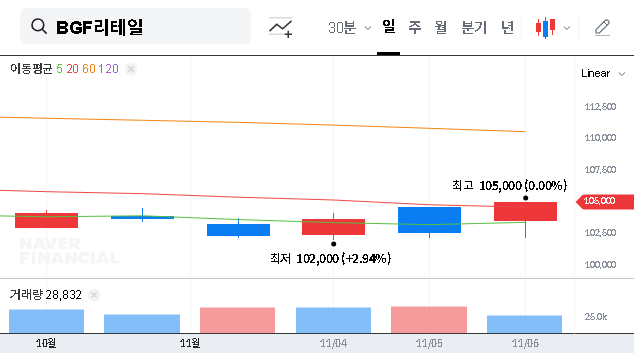
    The strong Q3 results are a bullish signal that could provide a short-term boost to the BGF retail stock price. It effectively counters the narrative of decline from the first half of the year. However, a long-term investment decision requires a more nuanced view.

    Investors should look for confirmation of this recovery in the upcoming Q4 2025 and Q1 2026 reports. Key factors to monitor will be the sustainability of profit margin improvements, management’s strategy for debt reduction, and tangible progress in new growth areas, such as overseas expansion and digital initiatives. A long-term perspective, combined with diligent monitoring of these key performance indicators, will be the most effective strategy for making sound investment decisions regarding BGF Retail.
    (282330) BGF Retail Q3 2025 Earnings Analysis (282330): A Strong Rebound or Temporary Relief? 관련 이미지
  • Saramin Stock (143240) Rocked by Major Foreign Investor Sell-Off: Crisis or Buying Opportunity? (2025 Deep Dive)

    What Happened? A Large-Scale Stake Sale by Foreign Funds

    The core of this event, revealed through a ‘Report on Mass Holdings of Shares,’ is a significant divestment by foreign funds. Here’s a summary of the details:

    • – Sellers: Kayne Anderson Rudnick Investment Management, LLC & Virtus KAR Emerging Markets Small Cap Fund
    • – Period: July 7 to July 11, 2025
    • – Volume: Over 30,000 shares sold on the open market
    • – Ownership Change: Stake reduced from 5.20% to 3.90%

    The fact that a major shareholder with over 5% ownership has sold off its stake can be interpreted as a negative signal to the market, and is a significant event that could dampen investor sentiment in the short term.

    Why the Exit? 3 Potential Reasons Behind the Sell-Off

    So, why did they decide to sell Saramin shares now? The analysis report suggests a combination of factors.

    • 1. Short-Term Performance Dip: As of Q3 2025, Saramin experienced a temporary decline in revenue and operating profit. Investors may have decided to cash out due to concerns about short-term profitability.
    • 2. Financial Health Concerns: The report notes Saramin’s high debt-to-equity ratio. While this could be a result of financing for new business expansion and R&D, it can be a red flag for investors who prioritize financial stability.
    • 3. External Macroeconomic Factors: While the US benchmark interest rate remains at 4.5%, Korea’s has fallen to 2.5%. A general trend of rising interest rates can slow down corporate hiring, indirectly pressuring Saramin’s performance. This macroeconomic outlook may have influenced the decision to sell.

    So What? Finding Opportunity Amidst the Crisis

    However, it’s not all bad news. There’s a strong possibility that this sell-off is a short-term market reaction, and Saramin’s long-term growth potential remains intact.

    • – Long-Term Growth Engine, AI: Saramin is actively investing in R&D to advance its AI-based services and enter new business areas. This is a positive sign of its ambition to evolve beyond a simple recruitment platform into a future-facing tech company.
    • – Limited Exposure to External Risks: Saramin’s business is predominantly domestic, making it less vulnerable to direct impacts from recent volatility in foreign exchange rates.

    Ultimately, this major sell-off can be seen as the result of investors choosing short-term risk management in the face of Saramin’s immediate challenges (performance, debt) versus its long-term vision (AI, new ventures).

    Investor’s Playbook: What to Monitor Now

    At this juncture, investors should rely on cool-headed analysis rather than emotional reactions. We recommend continuously monitoring the following three points:

    1. Performance of New Ventures: Check quarterly earnings reports to see if the AI-based services and new businesses are translating into tangible revenue.
    2. Improvements in Financial Health: Watch for signs of a stabilizing financial structure, such as better debt ratio management and improved cash flow.
    3. Stock Price and Trading Volume Trends: Analyze the stock’s movement and volume after the sell-off disclosure to understand how the market is digesting the event.

    In conclusion, while short-term uncertainty exists, Saramin’s long-term growth story has not been derailed. Concrete performance indicators to be released in the future will be the key to its stock’s direction.

    Q1. What’s the real reason foreign investors sold a large stake in Saramin?

    A. The official reason cited is ‘capital recovery.’ However, the analysis suggests it’s a combination of factors: Saramin’s short-term earnings dip, its relatively high debt-to-equity ratio, and concerns about the macroeconomic environment like interest rate hikes. The decision was likely driven by a desire to avoid short-term uncertainty.

    Q2. Is Saramin’s high debt ratio a serious risk?

    A. A high debt ratio can be a concern for financial stability. However, it may be a consequence of aggressive investments for future growth, such as advancing AI technology and launching new businesses. If these investments lead to successful outcomes and improved cash flow, the debt could be reassessed positively. It’s crucial to look at the ‘quality’ of the debt in conjunction with the company’s growth strategy.

    Q3. Is Saramin a good stock to invest in right now?

    A. The current stock price may have already priced in the short-term negative news. Therefore, for investors who believe in Saramin’s long-term growth potential—namely the success of its AI services and new ventures—this could be an opportunity. However, volatility may remain high until the success of new businesses and improved financial health are confirmed. A cautious approach, such as dollar-cost averaging (DCA), while closely monitoring upcoming earnings reports, would be a prudent strategy.

  • Manho Steel in Crisis: Management Dispute Lawsuit Shakes Stock – 2025 Analysis & Outlook

    1. The Opening Salvo: What’s Behind Manho Steel’s Management Dispute?

    The core of the event is the ‘lawsuit to nullify a general shareholders’ meeting resolution’ filed by shareholder MK Asset. This legally challenges the validity of the company’s key decisions, effectively questioning the legitimacy of the current management and signaling the start of a management dispute. This lawsuit creates severe uncertainties:

    • – Potential Management Change: Depending on the outcome, the current leadership could be replaced, leading to abrupt changes in corporate strategy.
    • – Prolonged Litigation Risk: A lengthy legal battle extends the management vacuum and uncertainty, eroding corporate value.
    • – Financial Burden: Legal fees associated with the lawsuit will be a direct financial drain on the company.

    2. Fundamental Health Check: Can Manho Steel Withstand the Storm?

    To weather an internal crisis, a company needs a strong constitution—solid fundamentals. However, Manho Steel’s Q3 2025 performance is less than reassuring.

    • – Persistent Operating Loss: The company reported an operating loss of 11.4 billion KRW on sales of 113.4 billion KRW. While the loss narrowed from the previous quarter, it remains firmly in the red.
    • – Concerning Revenue Decline: Although lower raw material costs and increased exports helped reduce the loss, the fundamental decline in revenue itself is a major concern.

    A management dispute arising from such a weak fundamental position could divert energy and resources away from crucial business recovery efforts, further delaying a turnaround.

    3. Compounding Crises: Navigating Macroeconomic Headwinds

    Manho Steel faces not only internal problems but also several external threats.

    • – Weakening Demand: The Baltic Clean Tanker Index and the China Containerized Freight Index, both barometers for the shipbuilding industry, are trending downwards. This signals a potential decrease in demand from Manho Steel’s key forward industries.
    • – High-Interest Rate Pressure: The high-interest rate environment in both the U.S. and South Korea increases borrowing costs for the company and dampens overall investor sentiment.
    • – FX Volatility: For Manho Steel, with its significant export volume, foreign exchange is a double-edged sword. A stronger Korean Won hurts price competitiveness but eases the cost of imported raw materials. For now, the volatility itself is a risk.

    4. Investor Action Plan: What Should We Do Now?

    In conclusion, Manho Steel is exposed to a dual threat: the internal risk of a ‘management dispute’ and the external risks of ‘weak fundamentals and an unfavorable macro environment.’

    Therefore, investors should adopt a cautious approach:

    • 1. Monitor the Lawsuit Closely: Uncertainty is the biggest risk at present. The company’s fate could hinge on the progress and outcome of the lawsuit, so paying close attention to related disclosures and news is crucial.
    • 2. Maintain a Conservative Stance: Until earnings show clear signs of improvement and the management uncertainty is resolved, it is wise to observe from the sidelines rather than actively buying.
    • 3. Assess Quantitative Risks: It is essential to check future reports for specific details on how factors like raw material prices and FX rates are impacting performance, and how the company quantifies the lawsuit risk.

    The Bottom Line: Manho Steel is at a critical crossroads. It is difficult to see it as an attractive investment at this time, and risk management should be the top priority.

    Q. What is the major issue currently facing Manho Steel?

    A. Manho Steel is being sued by a major shareholder to nullify a resolution from its general shareholders’ meeting. This is a serious issue that could escalate into a full-blown management dispute, creating significant uncertainty for the company’s management and stock price.

    Q. How does a management dispute lawsuit typically affect a company’s stock price?

    A. Generally, a management dispute heightens risks such as a management vacuum, potential strategy shifts, and litigation costs, which in turn harms investor sentiment. This is highly likely to exert downward pressure on the stock price.

    Q. What is Manho Steel’s recent financial performance?

    A. As of Q3 2025, the company is still unprofitable, posting an operating loss of 11.4 billion KRW. Although the loss has decreased, its revenue has also declined, indicating that its fundamentals remain weak.

    Q. Should I consider investing in Manho Steel at this moment?

    A. The combination of internal management dispute risks and external macroeconomic headwinds creates a very high level of investment uncertainty. A cautious and conservative approach is recommended until there is a clear earnings recovery and the management uncertainties are resolved.

  • Seohan’s Stock Disposal: A Bullish Signal or a Red Flag? 2025 Investor Guide

    What Happened? Seohan Announces ₩2.6 Billion Treasury Stock Disposal

    On July 17, 2025, Seohan made a key announcement regarding the disposal of a portion of its treasury shares. Here are the core details:

    • ✔️ Shares Disposed: 2,700,000 shares (2.68% of total outstanding shares)
    • ✔️ Transaction Value: Approximately ₩2.6 billion
    • ✔️ Purpose: To grant shares to employees and contribute to the in-house welfare fund.
    • ✔️ Method: Off-market disposal (Underwriter: Samsung Securities)

    On the surface, this appears to be a positive move, with the company utilizing its assets to boost employee morale and invest in long-term growth.

    Why? Securing Future Growth vs. Facing Weak Fundamentals

    Seohan’s stated purpose of ’employee welfare’ and ‘long-term growth’ is a positive signal, as securing talented personnel is crucial for any company’s future. However, this decision must be viewed in the context of the company’s current financial situation.

    The Q1 2025 performance was rather sluggish:

    • – Decline in Revenue and Net Income: Impacted by the housing market slump and a slowdown in the construction sector, both revenue (₩749.3B → ₩153.1B) and net income (₩19.2B → ₩8.1B) decreased.
    • – High Debt Ratio: The debt-to-equity ratio remains high at 156.85%, making long-term financial health management a critical task.

    Therefore, this stock disposal should be interpreted as a complex event, balancing a positive ‘investment in the future’ against the challenging reality of the ‘difficult present.’

    So What? In-Depth Analysis of the Impact on Stock Price

    How will this decision affect Seohan’s stock price? We can break down the impact from short-term and long-term perspectives.

    • 📈 Short-Term View: Potential for Improved Investor Sentiment
      While a disposal of shares can increase the number of shares in circulation, this specific transaction is an off-market transfer to a designated group (employees, welfare fund) and does not create direct selling pressure on the market. Instead, the market may positively interpret the company’s commitment to long-term growth, potentially leading to a short-term improvement in investor sentiment.
    • 🤔 Long-Term View: Fundamentals are Key
      Ultimately, a stock’s price converges with its intrinsic value. Fundamental earnings improvement is far more critical than a one-time event. Without a clear recovery in the housing market, new project orders, and effective debt management, a sustained stock price rally is unlikely.

    Investor Action Plan: What to Watch Now

    Making a hasty investment decision based solely on this announcement is risky. A prudent investor should continuously monitor the following factors:

    • 1. Housing Market & Government Policies: Closely watch for signs of recovery in the real estate market, the biggest variable for the construction industry, and any related government policy changes.
    • 2. Future Orders and Business Plans: Scrutinize the company’s new order pipeline, which drives future revenue, and assess the feasibility of its stated business plans.
    • 3. Financial Health Management: Check quarterly reports to see how the company plans to manage its high debt ratio and track its execution.

    In conclusion, Seohan’s treasury stock disposal is a positive signal, but its translation into a tangible stock price increase is contingent upon strengthening the company’s core fundamentals.

    Q. Is Seohan’s treasury stock disposal unequivocally good news?

    A. In the short term, it can be seen as a positive signal of the company’s commitment to growth. However, it’s best viewed as a ‘conditional positive,’ as a long-term stock price increase depends on improving fundamentals like weak Q1 earnings and a high debt ratio.

    Q. What are the biggest factors currently affecting Seohan’s stock price?

    A. The primary external variables are the housing market conditions, interest rate trends, and raw material prices. Given the nature of the construction industry, the recovery of the housing market is the most critical factor for its future stock performance.

    Q. Is Seohan’s financial position stable?

    A. As of Q1 2025, its debt-to-equity ratio is somewhat high at 156.85%. While revenue and net income declined, the operating margin improved due to cost-cutting measures. Continuous debt management and efforts to improve profitability are crucial at this stage.