Tag: KCC

  • KCC’s Treasury Stock Plan: Impact on Stock Price and Investment Strategy


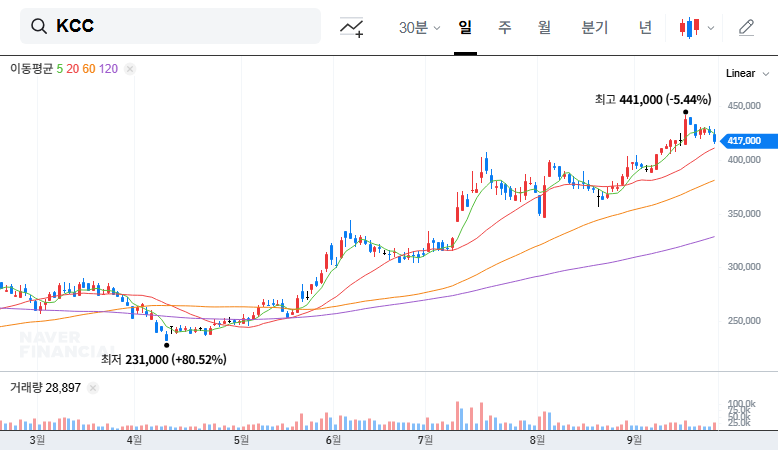
    KCC's Treasury Stock Plan: Impact on Stock Price and Investment Strategy 대표 차트 이미지


    KCC’s Treasury Stock Plan: What Was Announced?

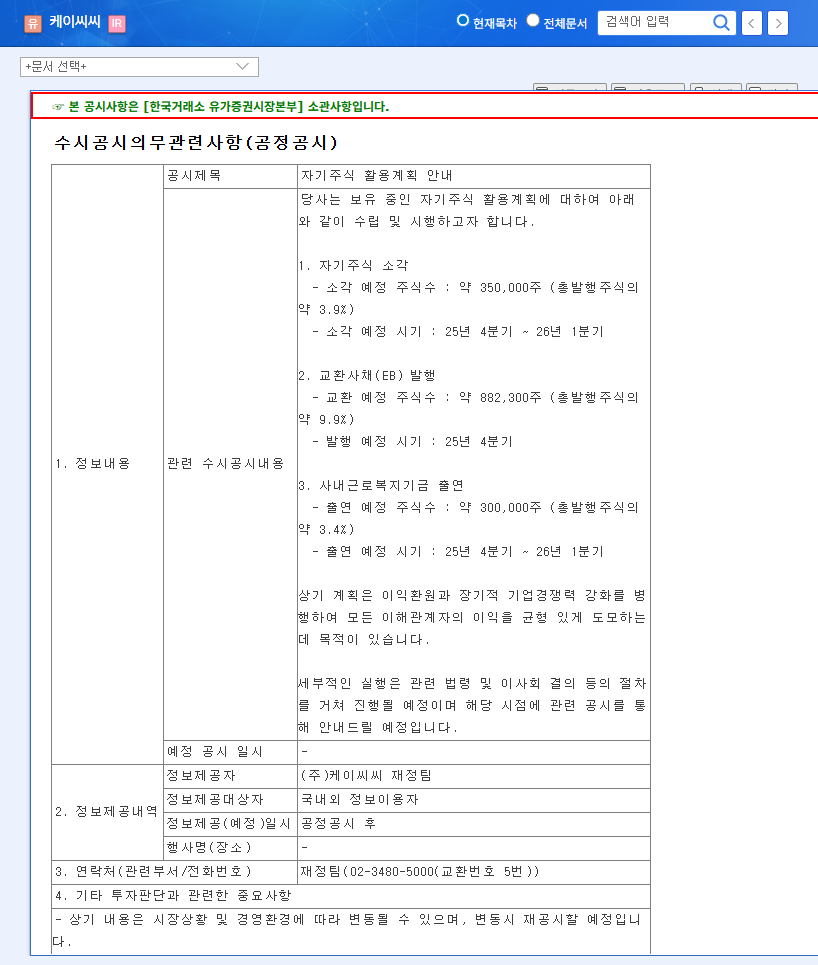
    • Treasury Stock Retirement: Approximately 3.9% of total outstanding shares (350,000 shares) will be retired.
    • Exchangeable Bond (EB) Issuance: Approximately 9.9% of total outstanding shares (882,300 shares) will be used for EB issuance.
    • Employee Welfare Fund Contribution: Approximately 3.4% of total outstanding shares (300,000 shares) will be contributed.

    Why Does This Matter?

    This decision can significantly impact KCC’s future, affecting shareholder value, financial structure, and employee morale. Share retirement can boost Earnings Per Share (EPS), increasing shareholder value. The EB issuance provides financial flexibility while also introducing the potential for share dilution. The employee welfare fund contribution aims to improve morale and potentially drive long-term performance gains.

    Impact on Investors

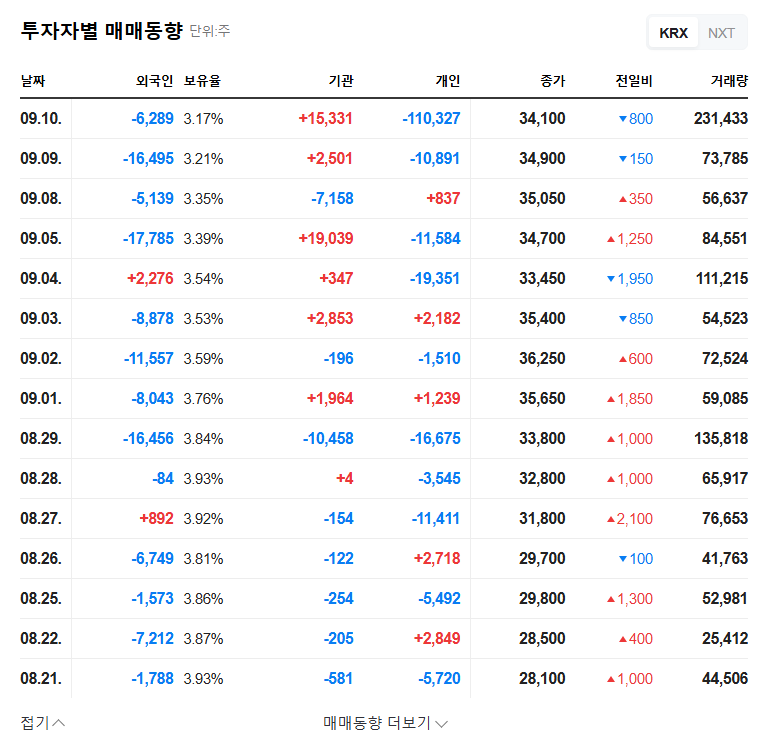
    In the short term, share retirement can positively influence the stock price, but the potential dilution from the EB issuance can introduce volatility. Investors should closely monitor the terms of the EB issuance and overall market conditions.

    Investor Action Plan

    KCC’s treasury stock plan has both short-term and long-term implications. Investors should consider the following when developing their investment strategies:

    • Review the terms of the exchangeable bond issuance.
    • Analyze market conditions and competitor activities.
    • Assess KCC’s financial health and business outlook.
    • Consider your investment goals and risk tolerance.


    FAQ

    What is treasury stock retirement?

    Treasury stock retirement is when a company repurchases its own shares and removes them from circulation. This reduces the number of outstanding shares, potentially increasing earnings per share (EPS) and shareholder value.

    What are exchangeable bonds (EBs)?

    Exchangeable bonds are bonds that give the bondholder the option to exchange them for shares of a company other than the issuer.

    How will KCC’s treasury stock plan affect its share price?

    Stock retirement generally has a positive impact on share price, while the issuance of exchangeable bonds can introduce volatility due to potential dilution.
    KCC's Treasury Stock Plan: Impact on Stock Price and Investment Strategy 관련 이미지


  • KCC Acquires 9.9% Stake in Noroo Holdings: Simply Investment or a Power Play?

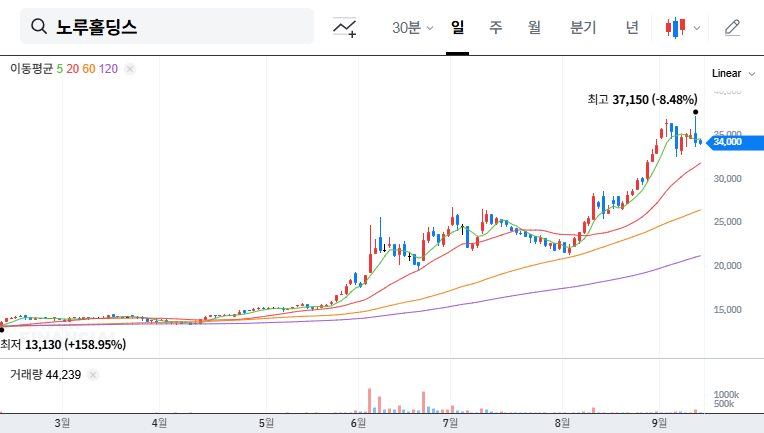
    KCC Acquires 9.9% Stake in Noroo Holdings: Simply Investment or a Power Play? 대표 차트 이미지

    1. What Happened?

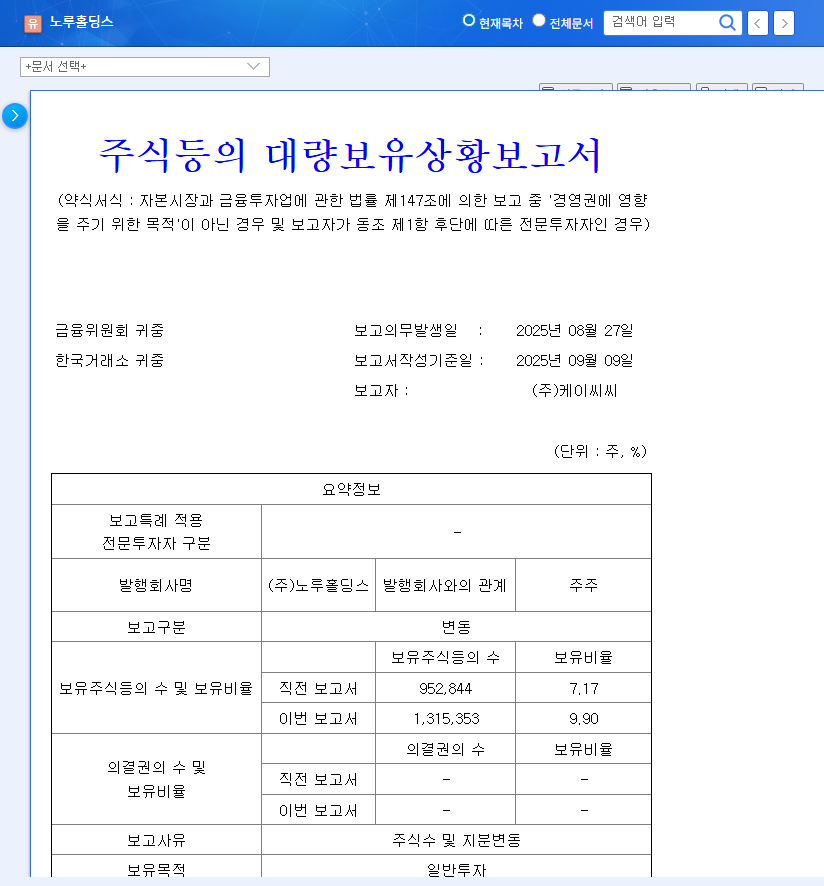
    On September 10, 2025, KCC announced an increase in its stake in Noroo Holdings from 7.17% to 9.90%, a 2.73%p increase. The acquisition was made through on-market purchases, with the stated purpose being ‘general investment.’

    2. Why Did KCC Increase Its Stake?

    While KCC officially stated ‘general investment’ as the purpose, various interpretations are circulating in the market. It could be a simple investment, but the possibility of future management participation or strengthened business cooperation cannot be dismissed. Considering Noroo Holdings’ stable financial structure and growth potential, KCC may be taking a long-term investment perspective. According to Noroo Holdings’ 2024 business report amendment, the company’s fundamentals are solid, and its financial outlook is positive, with steady growth expected in both sales and operating profit, and healthy financial soundness indicators.

    3. What’s Next?

    Short-Term Impact

    • Increased stock price volatility and trading volume.
    • Potential improvement in investor sentiment and inflow of buying power.

    Long-Term Impact

    • Possibility of KCC’s management participation and subsequent changes in corporate governance.
    • Potential for enhanced business cooperation and synergy between the two companies.

    4. What Should Investors Do?

    Investors should pay close attention to KCC’s future stake changes and the potential for business cooperation between the two companies. Continuous monitoring of Noroo Holdings’ performance improvements and changes in business strategy is also crucial.

    Is KCC’s increased stake in Noroo Holdings just a simple investment?

    While KCC stated ‘general investment,’ the possibility of future management participation or strengthened business cooperation should also be considered.

    How will this stake change affect Noroo Holdings’ stock price?

    In the short term, increased stock price volatility and trading volume are expected. The long-term impact will depend on KCC’s future actions.

    What should investors watch for?

    Investors should monitor KCC’s future stake changes, potential cooperation between the two companies, and changes in Noroo Holdings’ performance and business strategy.

    KCC Acquires 9.9% Stake in Noroo Holdings: Simply Investment or a Power Play? 관련 이미지
    KCC Acquires 9.9% Stake in Noroo Holdings: Simply Investment or a Power Play? 관련 이미지
  • KCC Q2 2025 Earnings Analysis: Silicon Growth and Investment Strategy

    KCC Q2 Earnings: Key Highlights

    KCC’s Q2 2025 earnings presentation provided insights into its business segments, financial health, and the current market and macroeconomic environment. The silicon segment emerged as a key growth driver, fueled by expansion in electric vehicle and medical markets. Paint and building materials maintained stable market share, while the ‘other’ segment saw growth driven by materials supply for the fourth industrial revolution.

    Impact on Investors: Opportunities and Risks

    KCC’s Q2 earnings present both opportunities and risks for investors. Continued growth in the silicon business and efforts to secure future growth drivers are positive factors that could boost investor confidence. However, volatility in raw material prices, potential slowdown in the domestic economy, and high debt-to-equity ratio are risk factors to consider. Investors are particularly interested in KCC’s strategy for navigating external economic uncertainties and its plans for improving financial health.

    Investment Strategy: Should You Invest in KCC?

    • Positive Factors: Continued silicon business growth, efforts to secure new growth drivers
    • Negative Factors: High debt-to-equity ratio, external economic uncertainties

    Before making any investment decisions, carefully review KCC’s future earnings outlook, risk management plans, and strategies for improving financial health. Ongoing competitor analysis and monitoring of market conditions are also crucial.

    KCC Q2 Earnings FAQ

    What are KCC’s main business segments?

    KCC’s main business segments are silicon, paints, building materials, and other.

    What is the growth outlook for KCC’s silicon business?

    The outlook is positive, driven by growth in high-value-added markets like electric vehicles and medical.

    What are the key risks to consider when investing in KCC?

    Key risks include raw material price volatility, potential domestic economic slowdown, and a high debt-to-equity ratio.

  • KCC Acquires 7.17% Stake in Noroo Holdings: Investment Opportunity?

    KCC’s Stake Acquisition: What Happened?

    KCC acquired 239,712 shares of Noroo Holdings through open market purchases between August 6th and 12th, 2025, securing a 7.17% stake. While KCC stated the purpose as ‘general investment,’ various interpretations are circulating in the market.

    Why Does KCC’s Investment Matter?

    This acquisition could signify more than just a passive investment. The potential synergy between the two companies and the possibility of KCC’s involvement in Noroo Holdings’ management are key considerations. Particularly given Noroo Holdings’ weak Q1 2025 performance, KCC’s entry adds a new dynamic.

    • Potential Upside: KCC’s investment could signal confidence in Noroo Holdings’ growth potential and suggests possible business collaborations.
    • Concerns: Noroo Holdings’ current fundamentals are weak. Despite a 3% YoY increase in Q1 sales, operating profit declined due to rising raw material prices and fixed cost burdens.

    What Should Investors Do?

    While KCC’s investment could positively impact Noroo Holdings in the short term, the long-term value hinges on fundamental improvements. Investors should closely monitor:

    • Announcements of specific collaboration plans between KCC and Noroo Holdings
    • Noroo Holdings’ future earnings releases (focus on operating profit margin recovery)
    • Fluctuations in raw material prices and exchange rates

    Key Takeaways for Investors

    Currently, a neutral stance is recommended. Careful observation of the factors mentioned above is crucial. A thorough analysis of market conditions and the company’s fundamental changes is essential for successful investment decisions.

    Frequently Asked Questions

    What is the purpose of KCC’s investment?

    KCC officially stated the purpose as ‘general investment.’ However, market speculation includes potential business synergy and strategic partnerships.

    What is Noroo Holdings’ current financial status?

    As of Q1 2025, sales slightly increased YoY, but operating profit declined due to rising raw material costs and fixed expenses.

    What should investors be cautious about?

    While KCC’s investment may positively influence the stock price in the short term, long-term value depends on improvements in Noroo Holdings’ fundamentals. Closely monitor future earnings releases and collaboration plans with KCC.

  • KCC Q2 Earnings Surprise: Unpacking the Results and Investment Strategies

    KCC Q2 Earnings Breakdown: What Happened?

    KCC reported revenue of KRW 1.7053 trillion, operating profit of KRW 140.4 billion, and net profit of KRW 893.3 billion for Q2 2025. Notably, net profit soared by approximately 20 times compared to Q1, far exceeding market forecasts.

    Behind the Surge: Why These Results?

    The increase in operating profit seems to be driven by both revenue growth and cost-cutting efforts. However, the reason for the surge in net profit remains unclear. Several possibilities need to be considered, such as one-off gains, gains on the valuation of investment assets, or gains related to financial assets. Further analysis is required to determine the exact cause.

    Investment Strategies: What Now?

    While the strong Q2 performance is positive, uncertainties persist, including the ongoing economic downturn, PTC-related risks, and raw material price volatility. Making investment decisions without a clear understanding of the net profit surge is challenging.

    • Short-Term Investment: Potential for short-term stock price gains exists but proceed with caution due to volatility.
    • Long-Term Investment: Carefully evaluate the sustainability of earnings and the resolution of risk factors.

    Investor Action Plan: What to Watch?

    • Look for KCC’s official explanation of the surge in net profit.
    • Review future earnings forecasts and growth strategies.
    • Continuously monitor risk factors, such as the economic downturn and the PTC lawsuit.

    Frequently Asked Questions

    What is the key takeaway from KCC’s Q2 earnings?

    While the growth in sales and operating profit is important, the most significant aspect is the dramatic increase in net profit. Understanding the drivers behind this surge is crucial.

    Should I invest in KCC stock?

    While there is potential for short-term gains, a cautious approach is recommended for long-term investment. Consider the reasons for the net profit surge, the economic downturn, and PTC-related risks.

    What is the outlook for KCC?

    Growth in the silicone segment is promising, but uncertainties remain due to the economic downturn and raw material price volatility. Continuously monitor KCC’s growth strategies and risk management capabilities.