Tag: Hana Financial Group

  • Hana Financial Group’s Amended Report: Key Analysis for Investors


    What Happened?

    Hana Financial Group amended its semi-annual report (June 2025) on August 14, 2025, with revisions primarily concerning the presentation format of various financial items, including fair value measurement of financial assets and liabilities, risk management disclosures, and derivative instruments. These changes were prompted by inconsistencies and minor errors discovered during the audit and review process.

    Why the Amendment?

    The primary reason for the amendment is to enhance the accuracy and transparency of disclosed information. The corrections do not reflect any fundamental change in Hana Financial Group’s financial position or business operations. Rather, they represent the company’s commitment to presenting consistent and accurate financial data to investors, fostering greater trust and reliability.

    What Does This Mean for Investors?

    This amendment does not directly impact Hana Financial Group’s fundamental value. Investment decisions should not be solely based on this amendment but rather on a comprehensive analysis of the company’s core business competitiveness, financial soundness, and profitability. However, continued occurrences of similar amendments might raise concerns regarding the efficacy of internal control systems and should be monitored.

    Investor Action Plan

    • Analyze Fundamentals: Evaluate the company’s core business competitiveness, financial strength, and earnings potential.
    • Monitor for Recurrences: Track any future amendments and analyze their potential impact. Analyze the influence of macroeconomic factors on Hana Financial Group’s performance.
    • Stay Informed: Keep up-to-date with Hana Financial Group’s earnings releases, business news, and other relevant information.


    FAQ

    Will this amendment affect the stock price?

    The amendment is not expected to directly impact the stock price as it relates to presentational consistency rather than fundamental changes. However, market sentiment and overall market conditions can still influence stock price fluctuations.

    Why are amendments frequently filed?

    Amendments are sometimes necessary due to the complexity of accounting standards, the vast amount of information being reported, or occasional oversights in internal control processes. Companies strive for accurate reporting, and investors should consider a company’s amendment history as part of their investment analysis.

    What precautions should investors take?

    Investment decisions should be based on a thorough understanding of the company’s financial reports, business operations, and market context. Avoid relying solely on individual disclosures and always diversify investments.

  • Hana Financial Group’s After-Hours Block Trade: 2025 Fundamentals and Investment Strategy

    1. What Happened? Analysis of the After-Hours Block Trade

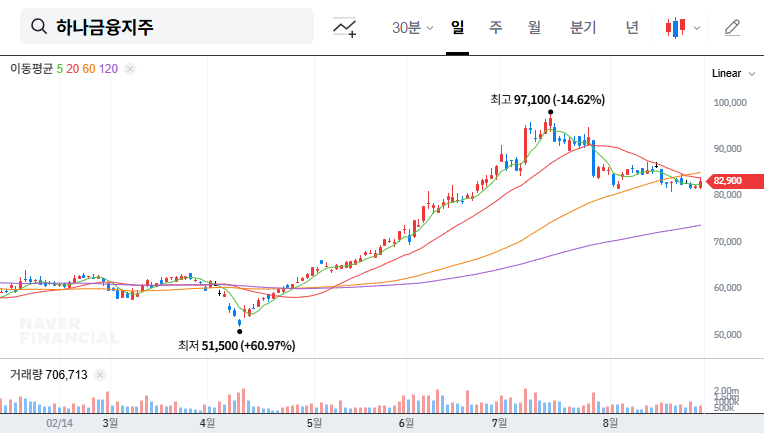
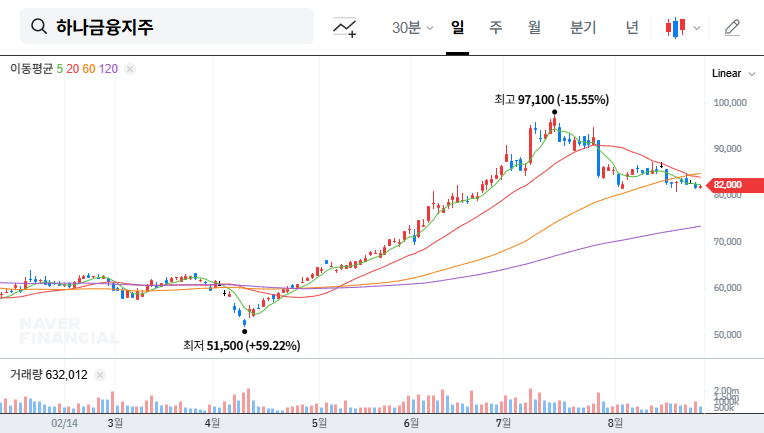
    After the market closed on September 15, 2025, 125,801 shares (approximately KRW 11.4 billion) of Hana Financial Group’s stock were traded in a block trade. This represents approximately 0.005% of the market capitalization. Foreign investors showed volatility on that day, net buying KRW 78 billion and then net selling KRW 85.6 billion.

    2. Why is it Important? Fundamentals and Market Expectations

    Hana Financial Group is expected to see a significant improvement in its earnings in 2025. Sales are steadily increasing, and operating profit and net profit are projected to grow significantly to KRW 333.5 billion and KRW 261 billion, respectively, in 2025. The low P/E ratio (5.18) enhances its investment appeal. However, concrete information regarding current market expectations is lacking.

    3. So, What Should We Do? Analysis of Investment Impact

    The impact of this after-hours block trade on the fundamentals is limited. In the short term, foreign selling pressure could put downward pressure on the stock price, but the impact is expected to be minimal due to the small transaction size. Investors should focus on the positive outlook for 2025 earnings and the low P/E ratio. However, continuous monitoring of macroeconomic variables such as falling interest rates and exchange rate fluctuations, as well as foreign investment trends, is necessary.

    4. Action Plan for Investors

    • Consider Buy: Gradual increase in position size is possible, considering the expected improvement in 2025 earnings and low valuation.
    • Sell/Hold: Observe short-term volatility and monitor fundamental changes.

    It is essential to keep an eye on foreign investment trends, the 2025 earnings announcement, and interest rate and exchange rate fluctuations.

    How will this after-hours block trade impact Hana Financial Group’s stock price?

    In the short term, there may be downward pressure due to foreign selling, but the impact is expected to be minimal due to the small transaction size.

    Should I invest in Hana Financial Group?

    The positive outlook for 2025 earnings and the low P/E ratio are attractive investment points. However, investment decisions should be made by monitoring macroeconomic variables and foreign investment trends.

    What are the key factors to watch when investing in Hana Financial Group?

    Investors should monitor foreign investment trends, the 2025 earnings announcement, and interest rate and exchange rate fluctuations.

  • Hana Financial Group’s After-Hours Block Trade (2025.09.11): In-Depth Analysis & Investor Implications


    What Happened?

    On September 11, 2025, after the market closed, a large block trade of 645,079 Hana Financial Group shares, totaling ₩56.6 billion, was executed. Notably, foreign investors were net buyers on the same day.

    Why Did This Happen?

    The precise reason behind this block trade remains unclear based on currently available information. Several possibilities exist, including institutional portfolio adjustments or fund rebalancing. Further investigation is needed to determine the specific cause. The amendment to the semi-annual report released the same day appears to be a procedural adjustment for accounting clarity and doesn’t directly impact the company’s fundamentals.

    What Does This Mean for Investors?

    Investment Opinion: Neutral (Caution advised due to short-term volatility)

    The direct impact of this after-hours block trade on Hana Financial Group’s long-term fundamentals is expected to be limited. However, large trades can increase short-term price volatility, warranting investor caution. Investors should pay close attention to the following:

    • • Understanding the context of the trade: Analyzing the specific reasons for the block trade.
    • • Monitoring market reactions: Observing subsequent stock price movements and trading volume.
    • • Analyzing fundamental changes: Assessing the impact of macroeconomic indicators such as interest rate fluctuations.


    FAQ

    What is an after-hours block trade?

    An after-hours block trade refers to a large quantity of shares traded outside of regular trading hours. This can reflect the intentions of specific investors and may have various impacts on the market.

    How will this block trade affect Hana Financial Group’s stock price?

    It may increase short-term price volatility, but the impact on long-term fundamentals is expected to be limited.

    What should investors keep in mind?

    Investors should carefully consider the background of the trade, market reaction, and potential fundamental changes before making investment decisions.


  • Hana Financial Group IR: Analyzing 2025 Growth Strategies and Investment Opportunities


    Hana Financial Group IR: Analyzing 2025 Growth Strategies and Investment Opportunities 대표 차트 이미지


    What’s Happening? Hana Financial Group’s IR Announcement

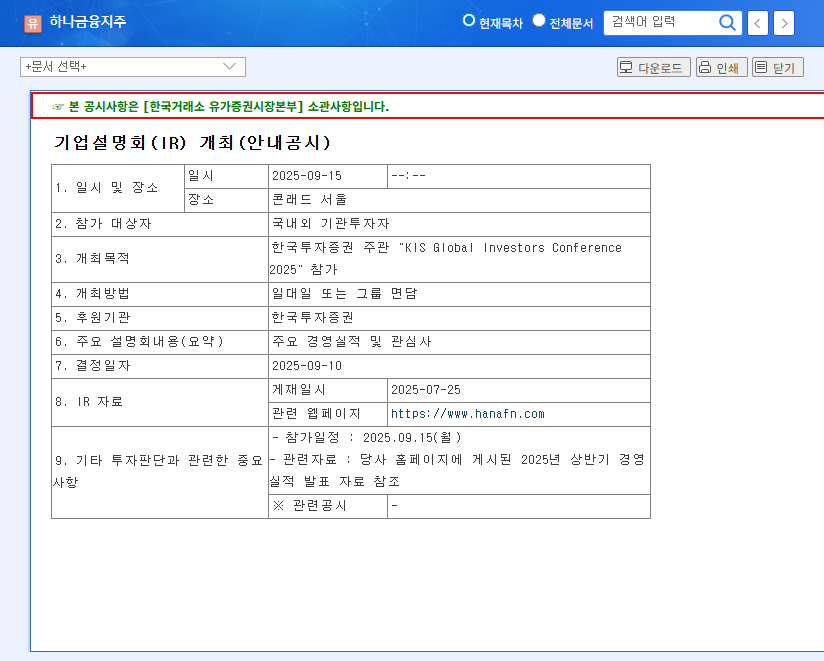
    Hana Financial Group will hold an IR session on September 15, 2025, participating in the “KIS Global Investors Conference 2025” hosted by Korea Investment & Securities. The presentation will cover key management performance results and address market concerns.

    Why is this IR Important? Market Expectations and Fundamental Analysis

    The market is focusing on Hana’s overall management performance, future growth strategies, capital soundness, and shareholder return policies. As the recent financial statement correction disclosure doesn’t directly impact fundamentals, the IR’s focus will likely be on explaining the company’s intrinsic value creation capabilities.

    • Projected Performance Improvement from 2024: Expected recovery in sales and profit indicators, improvement in operating and net profit margins, and stable ROE.
    • Macroeconomic Factors: US interest rate freeze, KRW/USD exchange rate increase, fluctuations in oil and gold prices, and rising bond yields could all impact Hana Financial Group.

    What’s the Impact? Analyzing the IR’s Influence and Investor Strategies

    The IR can positively impact information transparency and investor sentiment but may also lead to disappointment if expectations are unmet. Investors should consider macroeconomic variables such as interest and exchange rate fluctuations, changes in oil and gold prices, and rising bond yields.

    • Positive Impacts: Enhanced information transparency, improved investor sentiment, increased interest from participating institutions.
    • Potential Negative Impacts: Disappointment if expectations are unmet, highlighting sensitive issues.

    What Should Investors Do? Key Investment Points

    • KPI-based Performance Presentation: Focus on key KPI achievements compared to past performance and concrete execution plans for future growth strategies.
    • Strategies for Macroeconomic Uncertainty: Examine risk management and stable profitability strategies in response to interest rate and exchange rate fluctuations, geopolitical risks, etc.
    • ESG Management and Social Responsibility Activities: Assess long-term sustainability and social value creation capabilities.
    • Shareholder Return Policy: Check dividend payout ratio, treasury stock buyback/retirement plans, etc.


    FAQ

    What are the key takeaways to watch for in this IR?

    Along with the announcement of key management performance results, information regarding future growth strategies, capital soundness, and shareholder return policies will be important.

    What is the outlook for Hana Financial Group’s future performance?

    Sales and profit indicators are expected to recover and grow from 2024, and operating and net profit margins are also projected to improve.

    How will macroeconomic factors affect Hana Financial Group?

    Interest and exchange rate fluctuations, changes in oil and gold prices, and rising bond yields can all impact Hana Financial Group’s profitability and investment portfolio.


    Hana Financial Group IR: Analyzing 2025 Growth Strategies and Investment Opportunities 관련 이미지


  • Hana Financial Group IR Analysis: September 2025, A Turning Point?

    Hana Financial Group IR Analysis: September 2025, A Turning Point? 대표 차트 이미지

    1. Hana Financial Group IR: What’s it about?

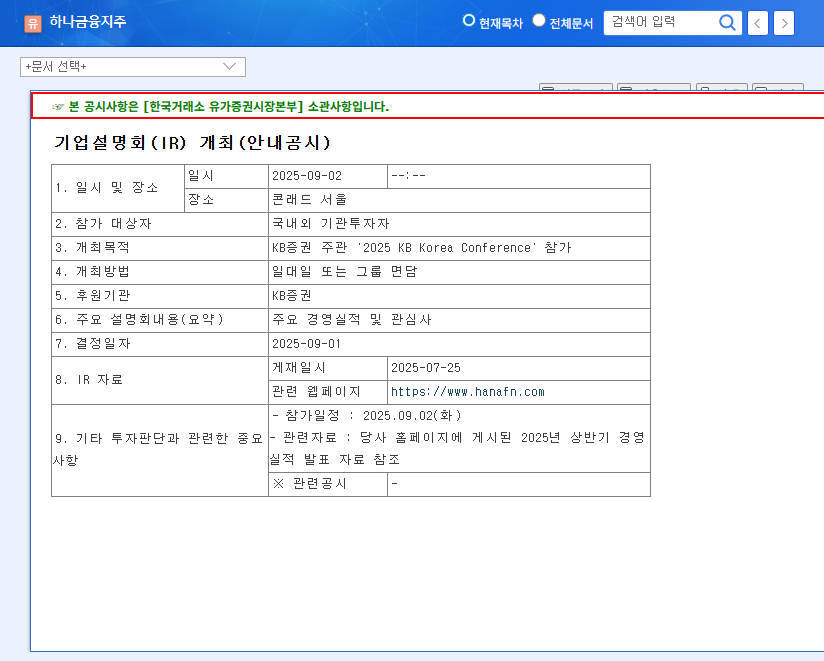
    On September 2nd, 2025, Hana Financial Group will participate in the ‘2025 KB Korea Conference’ to present its business performance and future plans. Addressing the recent slump and presenting future growth strategies are key tasks.

    2. Why is it important?

    Hana Financial Group has been struggling with losses for the past two years. Increasing debt ratio and deteriorating profitability are raising concerns among investors. This IR is a crucial opportunity to alleviate these concerns and restore investor confidence.

    3. Hana Financial Group’s Current Status and Outlook

    • Financial Status: Continued losses in 2024 with revenue of KRW 928 billion, operating loss of KRW 131 billion, and net loss of KRW 125 billion. Worsening debt ratio and declining profitability.
    • Market Environment: Continuing volatility in interest rates and exchange rates, and increasing global economic uncertainty are expected to create a challenging business environment.
    • Key IR Objectives: Needs to clearly present strategies for improving performance, strengthening financial soundness, and shareholder return policy.

    4. What should investors do?

    Investors should carefully analyze the IR presentation to assess the company’s future growth potential. In particular, they should focus on the concreteness of the performance improvement strategy, the effectiveness of the financial soundness strengthening plan, and the sustainability of the shareholder return policy.

    Frequently Asked Questions

    When is Hana Financial Group’s IR scheduled?

    It is scheduled for September 2nd, 2025.

    How has Hana Financial Group’s recent performance been?

    The company has been recording losses since 2023, and the losses widened in 2024.

    What should investors pay attention to during the IR?

    Investors should closely examine the strategies for performance improvement, strengthening financial soundness, and shareholder return policy.

    Hana Financial Group IR Analysis: September 2025, A Turning Point? 관련 이미지
  • Hana Financial Group Announces KRW 400 Billion Share Buyback: Impact on Stock Price?

    Hana Financial Group Announces KRW 400 Billion Share Buyback: Impact on Stock Price? 대표 차트 이미지

    1. What is the Share Buyback?

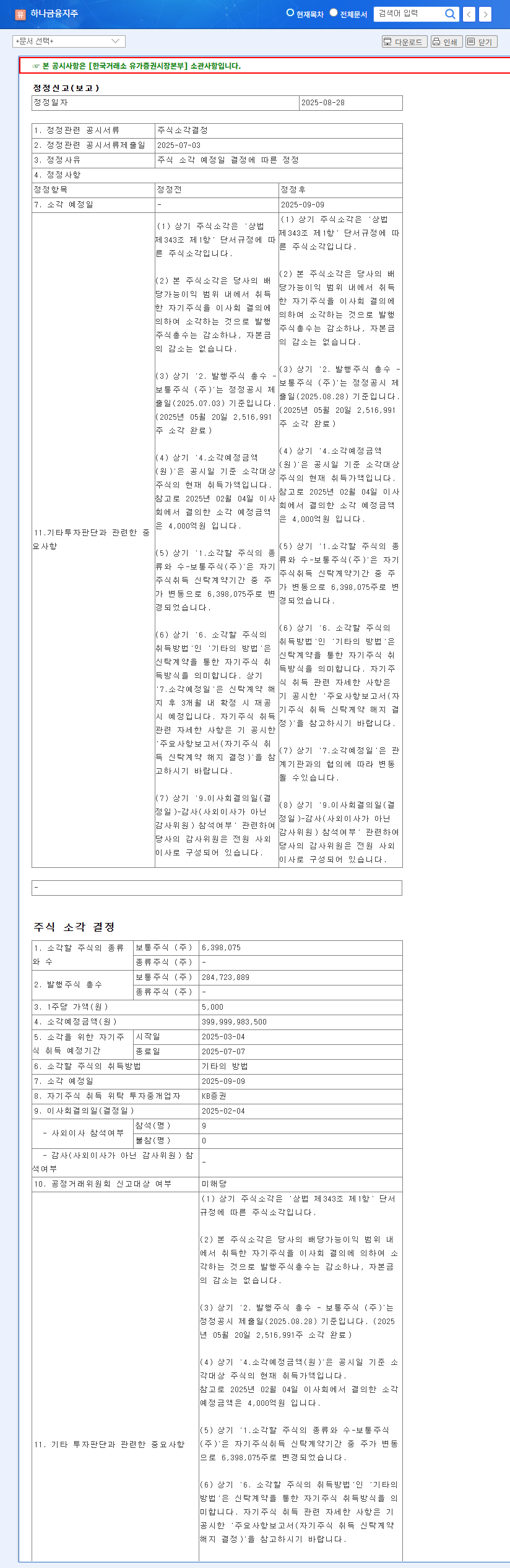
    On August 28, 2025, Hana Financial Group announced its decision to repurchase and cancel KRW 400 billion worth of common stock, equivalent to 6,398,075 shares. The cancellation is scheduled for September 9, 2025. A share buyback reduces the number of outstanding shares, effectively increasing the value per share.

    2. Why the Buyback?

    The share buyback is part of Hana Financial Group’s shareholder return policy. Reducing the number of shares increases both Book Value Per Share (BPS) and Earnings Per Share (EPS), improving capital efficiency. This directly translates to enhanced shareholder value. The buyback also signals confidence in the company’s financial health and future growth prospects.

    3. How Will the Buyback Affect the Stock Price?

    • Positive Impacts: Increased BPS and EPS, enhanced capital efficiency, strengthened shareholder return policy, positive market signal
    • Negative Impacts: Potential decrease in short-term liquidity, possible reduction in growth investment capacity (though not a major concern considering the company’s financial strength)
    • Neutral Impacts: Limited direct impact on fundamental business model or revenue generation, low correlation with macroeconomic variables

    In the short term, the buyback is likely to have a positive impact on the stock price. However, the overall market conditions and the company’s future plans will also play a role.

    4. What Should Investors Do?

    This share buyback is a positive sign for shareholder value. However, before making any investment decisions, investors should carefully consider the company’s financial health, business outlook, and the overall macroeconomic environment.

    Frequently Asked Questions

    When will the share buyback take place?

    It is scheduled for September 9, 2025.

    Will the stock price definitely go up after the buyback?

    While share buybacks generally have a positive effect on stock prices, various factors, including market conditions, can influence the outcome.

    Why is the company doing a share buyback?

    It’s a part of their shareholder return policy, aiming to enhance shareholder value by reducing the number of outstanding shares and increasing the value per share.

    Hana Financial Group Announces KRW 400 Billion Share Buyback: Impact on Stock Price? 관련 이미지
  • Hana Financial Group’s IR: Key Takeaways for Investors (September 2025 Analysis)

    Hana Financial Group's IR: Key Takeaways for Investors (September 2025 Analysis) 대표 차트 이미지

    1. Hana Financial Group’s IR: What Happened?

    Hana Financial Group presented its key management performance and future outlook at the “Korea Days 2025” IR hosted by Daiwa Securities on September 1, 2025. This IR garnered significant attention, especially following the recent correction disclosure of their semi-annual report.

    2. Why is it Important?

    This IR goes beyond a simple earnings announcement; it serves as a crucial platform for ensuring transparency regarding the company’s financial status and management activities, and for communicating with market participants, including international investors. Particularly in the current market environment characterized by increasing interest rate and exchange rate volatility, this event provides a valuable opportunity to understand Hana Financial Group’s response strategies and future growth plans.

    3. Hana Financial Group’s Fundamentals: Strengths and Weaknesses

    3.1 Strengths

    • Solid Profitability: Stable profit generation based on a diversified business portfolio.
    • Strong Financial Soundness: High resilience against market volatility due to excellent BIS ratio.
    • Future Growth Drivers: Pursuit of sustainable growth through digital transformation and new business investments.
    • Shareholder-Friendly Policy: 50% shareholder return target, quarterly dividends, share buybacks/cancellations.

    3.2 Weaknesses (Risks)

    • Sensitivity to Macroeconomic Variables: Impact from external factors such as interest rate and exchange rate fluctuations, and real estate PF risks.
    • Intensifying Competition: Increasing competition with internet banks and fintech companies, and changes in the regulatory environment.

    4. Action Plan for Investors: What to Do?

    Investors should carefully review the IR materials and subsequent disclosures, continuously monitoring Hana Financial Group’s response strategies to changes in macroeconomic indicators and its growth potential. It is crucial to pay close attention to its sensitivity to interest rate and exchange rate fluctuations, its credit risk management capabilities related to specific industries, and the performance of its digital transformation and new businesses.

    FAQ

    What were the key takeaways from Hana Financial Group’s IR?

    The key takeaways include the announcement of the 2025 first-half business performance, the future management outlook, and information regarding the recent correction disclosure of the semi-annual report.

    What are the key considerations for investment?

    Investors should consider the influence of macroeconomic variables such as interest rate and exchange rate fluctuations, intensifying competition, and credit risks related to specific industries.

    What are the future growth drivers for Hana Financial Group?

    The main growth drivers are accelerating digital transformation, AI asset management, strengthening non-face-to-face services, and investments in new businesses like Fintech.

    Hana Financial Group's IR: Key Takeaways for Investors (September 2025 Analysis) 관련 이미지
  • Hana Financial Group at UBS Korea Summit 2025: Investment Strategies and Future Outlook

    1. UBS Korea Summit 2025: Hana Financial Group Unveils Future Strategies

    Hana Financial Group is expected to share key business performance figures, future outlook, and address market concerns at the UBS Korea Summit 2025. The presentation will likely include explanations for recent performance declines and outline strategies for securing future growth engines, such as digital transformation and new business development. Clear answers regarding capital adequacy, shareholder return policies, and other key investor concerns are also anticipated.

    2. Fundamental Analysis: Balancing Risks and Growth Potential

    2023 was a challenging year for Hana Financial Group, marked by declining sales and net income, negative net profit, low ROE, and increasing debt-to-equity ratio. Although 2024 showed signs of improvement, performance remained below 2022 levels, and concerns about financial soundness persist. However, there’s optimism about potential future growth driven by proactive digital transformation efforts and new business initiatives.

    3. Macroeconomic Analysis: Navigating Volatility and Uncertainty

    The current macroeconomic environment presents challenges for financial companies, including a weak Korean Won, interest rate volatility, and concerns about a global economic slowdown. However, stable domestic interest rates and relatively stable oil prices could offer some positive support. Hana Financial Group needs to develop appropriate response strategies based on a thorough analysis of these macroeconomic changes.

    4. Action Plan for Investors: Thorough Post-IR Analysis is Crucial

    • Carefully analyze the information presented at the UBS Korea Summit 2025 to assess actual fundamental improvements and future growth potential.
    • Pay close attention to changes in the interest rate environment, exchange rate volatility, and digital competitiveness enhancement efforts.
    • Develop a long-term investment strategy without being swayed by short-term stock price fluctuations.

    Frequently Asked Questions

    How did Hana Financial Group perform in 2023?

    Hana Financial Group experienced a decline in sales and net income, recording a negative net profit in 2023.

    What are the key takeaways from the UBS Korea Summit 2025?

    Key takeaways include strategies for securing future growth engines, capital adequacy and shareholder return policies, and strategies for responding to changes in the macroeconomic environment.

    What should investors consider when investing in Hana Financial Group?

    Investors should consider fundamental improvements, interest rate and exchange rate volatility, and digital competitiveness. Maintaining a long-term investment perspective despite short-term stock price fluctuations is also crucial.

  • Hana Financial Group’s After-Hours Block Trade: Impact Analysis for Investors

    1. What Happened?

    On August 14th, during after-hours trading, 89,833 shares of Hana Financial Group were traded for approximately ₩7.7 billion KRW. This transaction was categorized as an intraday block trade.

    2. Why Does it Matter?

    Block trades often attract market attention and can influence stock price volatility. Although this trade represents a small percentage of the total outstanding shares, it’s crucial to understand how it might impact market sentiment.

    Hana Financial Group recently amended its semi-annual report, but these changes were purely technical and do not impact fundamentals. In fact, the increased transparency of information is considered a positive development.

    3. What Should Investors Do?

    This block trade itself doesn’t directly impact Hana Financial Group’s fundamentals. Considering the net buying trend from foreign investors, we don’t anticipate significant short-term fluctuations in investor sentiment.

    • Short-Term Impact: Limited. No major stock price fluctuations expected.
    • Long-Term Impact: Continued monitoring of fundamentals and macroeconomic indicators is advised.

    Investors should prioritize analyzing the company’s fundamentals, including interest rates and exchange rates, rather than focusing on short-term price movements. It’s also important to consider the financial performance of Hana Financial Group’s subsidiaries.

    4. Investor Action Plan

    • Analyze Hana Financial Group’s core business competitiveness, asset soundness, and profitability.
    • Monitor macroeconomic variables such as interest rates, exchange rates, and oil prices.
    • Review disclosed information and corporate transparency.
    • Assess the financial status and business performance of subsidiaries.

    Frequently Asked Questions

    Will this block trade affect the stock price?

    The impact on the stock price is expected to be minimal due to the small size of the trade.

    What is the outlook for Hana Financial Group?

    As with any financial institution, Hana Financial Group is susceptible to macroeconomic factors such as interest and exchange rates, requiring ongoing monitoring.

    What should investors be aware of?

    It’s important to adopt a long-term perspective, focusing on fundamental analysis rather than short-term market fluctuations.

  • Hana Financial Group’s Report Correction: Impact Analysis for Investors

    What Happened?

    On August 14, 2025, Hana Financial Group submitted a correction disclosure for its semi-annual report for the first half of 2025 (June). The corrections primarily involve unifying ratio notation, correcting year notation errors, and do not signify any material changes to the company’s performance or financial status.

    Why the Correction?

    This correction is an administrative procedure to ensure consistency in formatting and notation, often identified during audits. This is unrelated to changes in the company’s financial soundness or management activities.

    So, What’s the Impact on Investments?

    The correction itself is not expected to significantly impact investment decisions. However, investors should carefully consider the simultaneously announced Q2 2025 earnings, which showed a 95% decrease in net income compared to expectations. While operating profit increased significantly, further analysis is needed on the causes of the decline in net income.

    • Key takeaway: Focus on earnings, not just the correction.
    • Positive factor: 140% increase in operating profit.
    • Negative factor: 95% decrease in net income.

    What Should Investors Do?

    Investors should carefully review the company’s explanation for the decline in net income and its future outlook. It’s also crucial to continuously monitor the correlation between macroeconomic variables such as interest rates and exchange rates, and Hana Financial Group’s performance.

    Q: What does this report correction mean?

    A: The correction is an administrative procedure involving unifying notations and correcting errors, with no impact on the company’s fundamentals.

    Q: What should investors be aware of?

    A: Understanding the reasons for the sharp decline in net income and analyzing the company’s future outlook is crucial.