Tag: Fuel Cell

  • (058730) DASCO Hydrogen Power Contract: A ₩317B Lifeline for Development Advance Solution Co., Ltd.?

    (058730) DASCO Hydrogen Power Contract: A ₩317B Lifeline for Development Advance Solution Co., Ltd.?

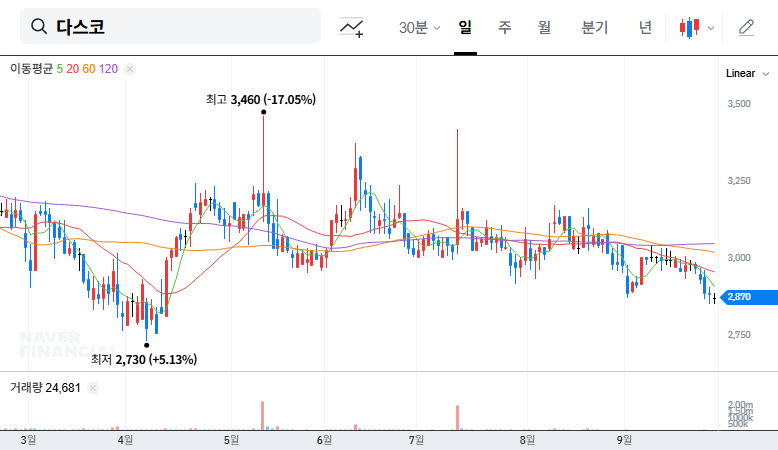
    In a landmark move for the renewable energy sector, Development Advance Solution Co., Ltd. (DASCO) has announced a staggering new DASCO hydrogen power contract that has sent ripples through the market. For a company recently battling deteriorating fundamentals and a sluggish construction market, this ₩317.1 billion deal with Korea Electric Power Corporation (KEPCO) represents more than just revenue—it’s a potential turning point. This massive, long-term commitment raises a critical question for investors: Is this the catalyst that will redefine DASCO’s future? This article provides a comprehensive analysis of the contract, DASCO’s financial health, and the strategic implications for your investment portfolio.

    The Landmark ₩317.1 Billion Hydrogen Power Deal Explained

    On November 14, 2025, Development Advance Solution Co., Ltd. (KOSDAQ: 058730) formally announced the signing of the ‘2025 General Hydrogen Power Electricity Trading Contract.’ This agreement, made with KEPCO and other key energy players, is a monumental step for the company. The core details, as outlined in the Official Disclosure on DART, are as follows:

    • Contract Value: A colossal ₩317.1 billion, which remarkably represents 101% of DASCO’s entire annual revenue from the previous year.
    • Project Scope: The contract covers electricity trading for the 9.68MW Busan Myeongji 3rd Phase Fuel Cell Power Plant, a significant project in the nation’s push for clean energy.
    • Contract Duration: An extensive long-term agreement spanning approximately 22 years and 3 months, from November 14, 2025, to January 31, 2048.

    The sheer scale and long-term nature of this agreement provide a predictable and substantial revenue stream, something that has been desperately needed to stabilize the company’s financial outlook.

    Context: Why This Deal is a Game-Changer for DASCO

    To fully grasp the importance of this contract, one must understand the challenging environment DASCO was navigating. The period leading up to this deal was marked by significant financial headwinds and market uncertainty.

    Deteriorating Financial Performance

    The company’s Q3 2025 report painted a grim picture. Revenue had fallen by 19.3% year-over-year to ₩177.48 billion, while the operating loss widened to ₩47.08 billion. This slump was not isolated to one division; it was a systemic issue affecting their core businesses in building materials, SOC, steel, and even energy. The energy sector, in particular, was squeezed by shifting renewable energy policies and soaring raw material costs, while the construction downturn hammered the building materials segment.

    Mounting Financial Health Concerns

    These operational struggles directly impacted DASCO’s balance sheet. The debt-to-equity ratio climbed from 76.88% to 94.89%, a worrying trend driven by an increase in short-term borrowings. This, combined with macroeconomic pressures like global interest rate hikes and exchange rate volatility, put the company in a precarious position. The new DASCO hydrogen power contract, therefore, arrived at a pivotal moment, offering a powerful antidote to these financial ailments.

    This isn’t just another contract; it’s a strategic pivot. A 22-year revenue stream equivalent to an entire year’s sales can fundamentally reshape a company’s financial foundation and long-term growth narrative.

    Potential Impacts & Investor Outlook

    This KEPCO deal has the potential to dramatically alter DASCO’s trajectory. However, prudent investors must weigh the significant opportunities against the inherent risks.

    The Bull Case: A New Era of Growth

    • Stable Revenue Foundation: The most immediate benefit is a secure, long-term revenue base, drastically reducing earnings volatility and improving financial planning capabilities.
    • Energy Sector Leadership: This contract solidifies DASCO’s position in the high-growth hydrogen power market. The global push for clean energy, detailed by sources like the International Energy Agency (IEA), supports a strong long-term outlook for this sector.
    • Improved Financial Health: Consistent cash flow from the contract can be used to pay down debt, lower the debt-to-equity ratio, and strengthen the balance sheet over time.
    • Positive Market Sentiment: A deal of this magnitude acts as a powerful signal to the market, boosting investor confidence and potentially driving the DASCO stock price upward.

    Risks and Considerations to Monitor

    While the outlook is promising, success is not guaranteed. Investors should keep a close eye on several factors:

    • Execution and Profitability: A long-term project is subject to unforeseen variables like inflation in raw material costs and operational challenges. DASCO’s ability to manage costs and maintain profitability margins will be critical.
    • Recovery of Core Businesses: The hydrogen deal is a massive boost, but the health of DASCO’s other divisions, especially building materials, remains crucial for overall corporate value. A full turnaround requires broad-based recovery.
    • Hydrogen Market Volatility: As an emerging industry, the hydrogen energy sector’s long-term trajectory depends on government policy, technological breakthroughs, and competitive dynamics.

    Conclusion: A Prudent Investment Strategy

    The ₩317.1 billion DASCO hydrogen power contract is unequivocally a positive and transformative event. It provides a powerful growth engine and a stable foundation to counteract the company’s recent struggles. For investors, this creates a compelling narrative that balances short-term momentum with long-term potential. While continued monitoring of operational execution and the recovery of legacy businesses is essential, this deal marks a new chapter for Development Advance Solution Co., Ltd. For those interested in understanding renewable energy investments, DASCO has just become a key case study to watch.

    (058730) DASCO Hydrogen Power Contract: A ₩317B Lifeline for Development Advance Solution Co., Ltd.? 관련 이미지
    (058730) DASCO Hydrogen Power Contract: A ₩317B Lifeline for Development Advance Solution Co., Ltd.? 관련 이미지
  • (336260) Doosan Fuel Cell Stock: 2025 IR Event Analysis & SOFC Outlook

    (336260) Doosan Fuel Cell Stock: 2025 IR Event Analysis & SOFC Outlook

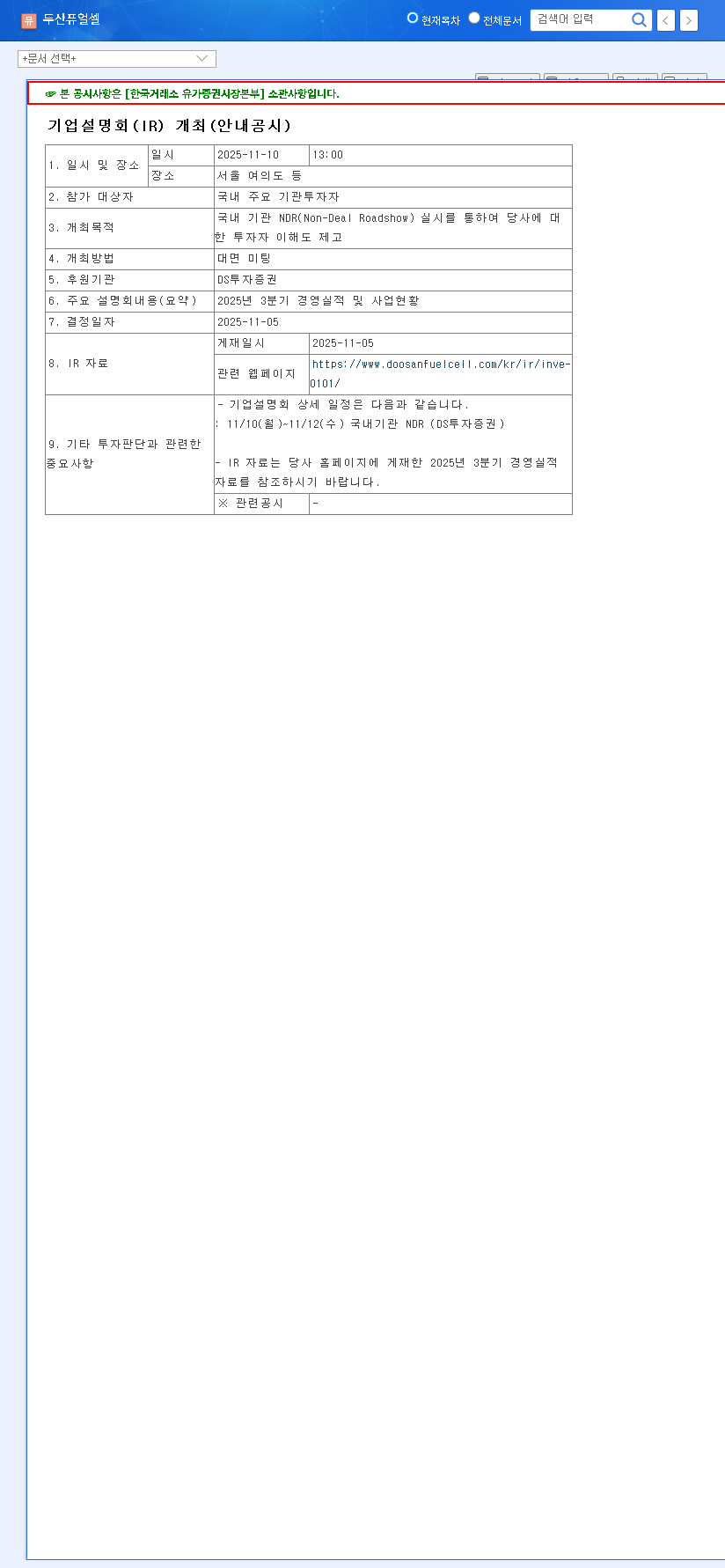
    The future of Doosan Fuel Cell hangs in the balance as it prepares for its critical Q3 2025 Investor Relations (IR) event. For investors and market analysts, this event is more than a routine earnings call; it’s a pivotal moment that will reveal the company’s strategy for navigating recent financial headwinds and its roadmap for capitalizing on next-generation SOFC technology. This comprehensive analysis unpacks the company’s current state, the opportunities and risks tied to the IR, and the key metrics every stakeholder should be watching.

    Amid declining revenues and operational losses, Doosan Fuel Cell is betting on future growth engines, including Solid Oxide Fuel Cell (SOFC) development and a strategic entry into the eco-friendly vehicle market. The question remains: can the company’s leadership present a convincing case for a turnaround and sustainable growth, thereby restoring market confidence in the Doosan Fuel Cell stock?

    The Upcoming Doosan Fuel Cell IR Event: What to Expect

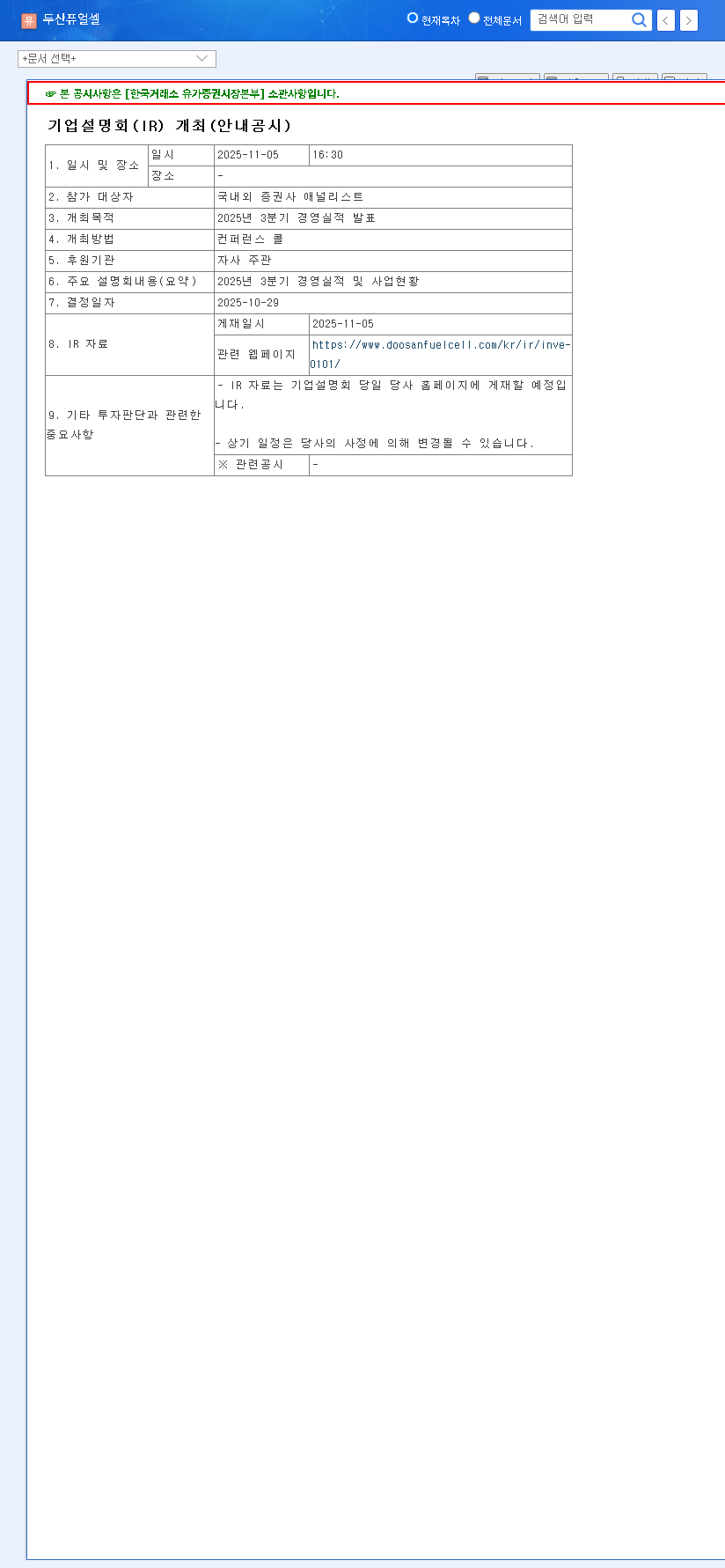
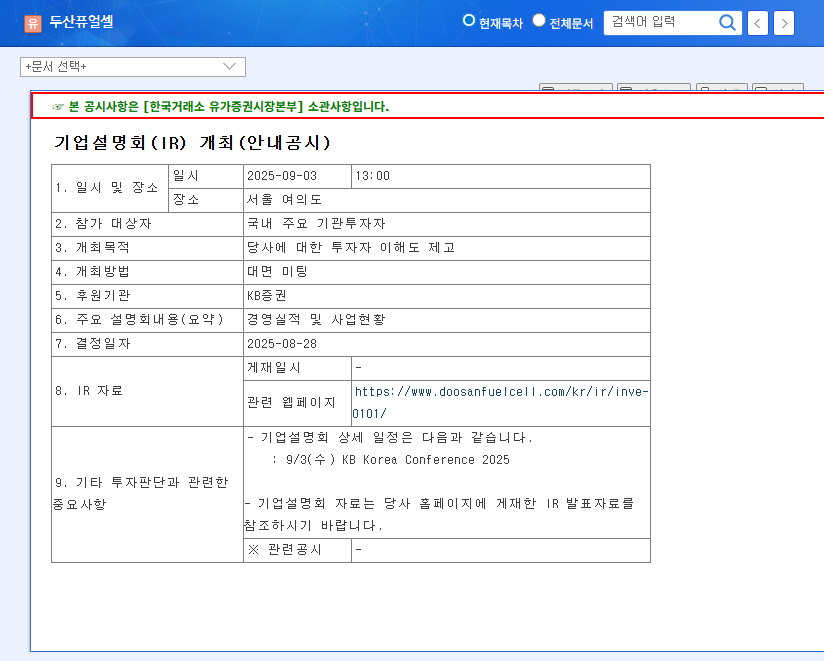
    Doosan Fuel Cell Co., Ltd. has officially scheduled its Doosan Fuel Cell IR event for domestic institutional investors on November 10, 2025, at 1:00 PM. The primary agenda is to present the Q3 2025 management performance and provide a detailed business status update. This event is a crucial platform for the company to address the underperformance seen in the first half of the year and to articulate a clear, actionable plan for recovery and future expansion. The official announcement can be reviewed in the company’s disclosure. (Source: Official Disclosure).

    A Deep Dive into Doosan Fuel Cell’s Current State

    Business Model & Competitive Edge

    Doosan Fuel Cell has long been a leader in the Korean power generation hydrogen fuel cell market, specializing in Phosphoric Acid Fuel Cell (PAFC) technology. This established technology provides stability and versatile fuel utilization, giving the company a strong foothold. However, recognizing the market’s evolution, the company is making strategic pivots:

    • Portfolio Diversification: An equity investment in HyAxios Motors signals a serious commitment to entering the burgeoning eco-friendly commercial vehicle market, reducing reliance on stationary power generation.
    • Future-Proofing with SOFC Technology: The acquisition of next-generation Solid Oxide Fuel Cell (SOFC) technology and the construction of a 50MW production facility are critical for long-term growth and competing on a global scale. You can learn more about this technology in our guide, A Deep Dive into SOFC vs. PAFC Technology.

    Financial Health Under Scrutiny

    The H1 2025 financial report painted a challenging picture. Revenue plummeted to 228.2 billion KRW (a 44.7% decrease YoY), while the operating loss widened to -13.5 billion KRW. This performance raises significant questions about inventory management (358.7 billion KRW in assets) and debt, with the debt-to-equity ratio climbing to 153.8%. A clear strategy to improve financial discipline will be non-negotiable for investors at the IR event.

    Investors will be looking past the promises of future technology and scrutinizing the balance sheet. A credible plan to manage debt and improve operational efficiency is just as important as the roadmap for SOFC technology.

    Macro-Environment and Policy Tailwinds

    It’s not all headwinds. The broader market offers several opportunities. Government policies like the Clean Hydrogen Portfolio Standard (CHPS) are creating a favorable domestic market. Globally, the push towards a hydrogen economy, as outlined by organizations like the International Energy Agency (IEA), provides a long-term tailwind. Furthermore, stabilizing interest rates could ease borrowing costs, providing some financial relief.

    Potential IR Impact on Doosan Fuel Cell Stock

    The upcoming Doosan Fuel Cell IR event is a double-edged sword, presenting both significant opportunities and risks.

    Opportunities (Potential Upside)

    • Restoring Investor Confidence: A transparent explanation for recent struggles coupled with a robust improvement plan could significantly boost sentiment.
    • Highlighting Future Value: A detailed roadmap for the commercialization of SOFC technology and the new vehicle venture can shift the narrative from current losses to future potential.
    • Synergy with Policy: Demonstrating alignment with national and global hydrogen policies can unlock perceived value and de-risk the business model.

    Risks (Potential Downside)

    • Magnifying Poor Performance: If Q3 results show a continuation of the negative trend without a clear path to profitability, investor concerns will intensify.
    • Vague Strategic Vision: A lack of concrete details on financial management or competitive strategy could be interpreted as a lack of direction, further damaging the stock.

    Investor Checklist: Key Watch Points

    Investors should meticulously evaluate the information presented at the IR, focusing on these five critical areas:

    1. 1.Q3 Performance & Outlook: Are there tangible signs of a turnaround in the core business?
    2. 2.Financial Improvement Plan: What are the specific steps and timelines for reducing inventory and improving the debt ratio?
    3. 3.SOFC Commercialization Roadmap: What is the realistic timeline for revenue generation from the new SOFC technology?
    4. 4.Competitive Strategy: How will Doosan differentiate itself as global competition in the hydrogen fuel cell space heats up?
    5. 5.Capital Allocation: How will the company balance investment in future growth with the need for current financial stability?

    In conclusion, the Doosan Fuel Cell IR event is a watershed moment. The company’s ability to deliver a clear, credible, and convincing message that addresses its current challenges while painting a compelling vision for the future will be paramount in determining the trajectory of its stock and its place in the rapidly evolving energy landscape.

    (336260) Doosan Fuel Cell Stock: 2025 IR Event Analysis & SOFC Outlook 관련 이미지
  • (336260) Doosan Fuel Cell Q3 2025 Earnings Shock: Stock Analysis & Future Outlook

    (336260) Doosan Fuel Cell Q3 2025 Earnings Shock: Stock Analysis & Future Outlook

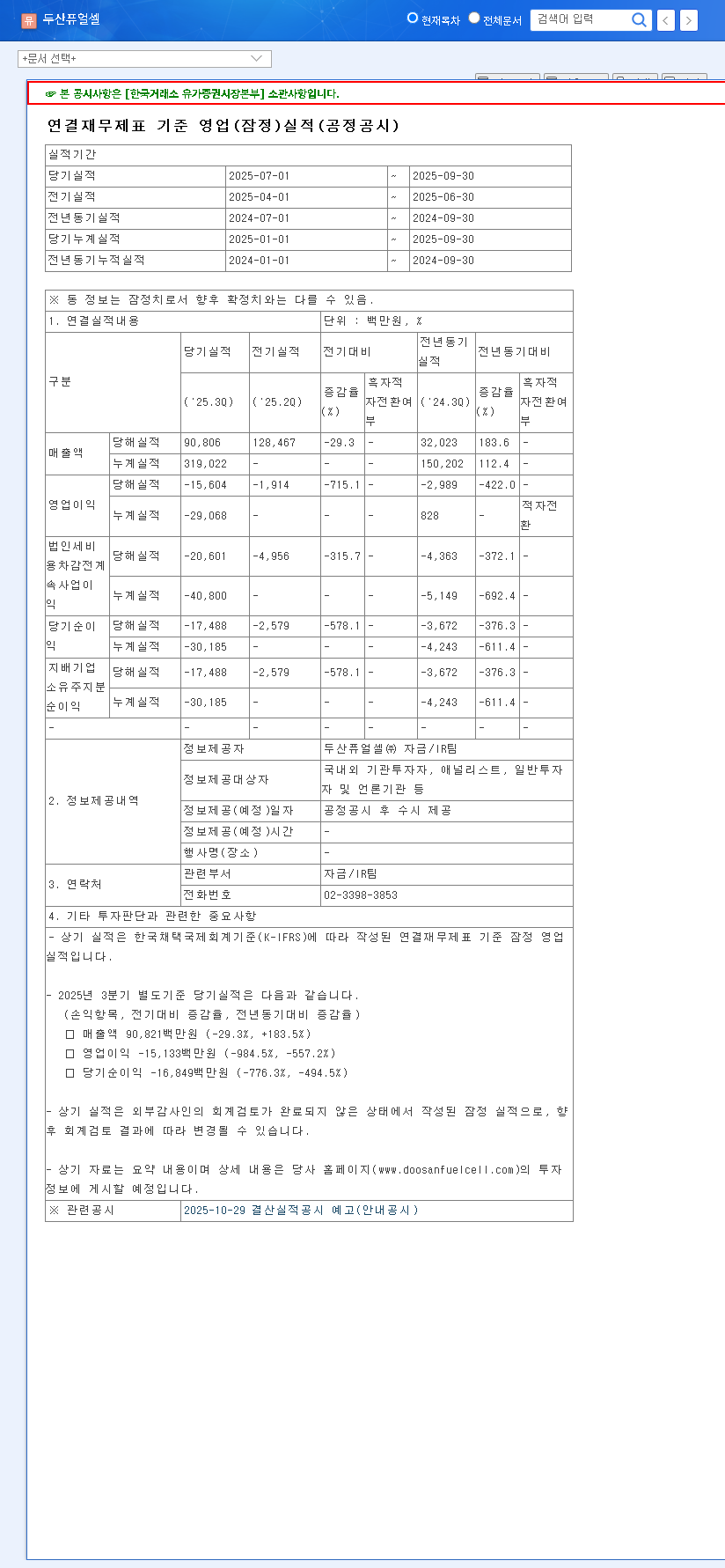
    The latest Q3 2025 preliminary report from Doosan Fuel Cell has sent a clear message to the market: the path to a hydrogen-powered future is fraught with financial turbulence. Once a beacon for the burgeoning hydrogen economy, the company’s performance fell drastically short of expectations, raising critical questions for current and potential investors. The report, officially filed on November 5, 2025 (see the Official Disclosure), reveals widening losses and plummeting revenue, casting a shadow over its short-term prospects. This comprehensive analysis will dissect the Doosan Fuel Cell earnings report, explore the underlying causes, and provide a strategic outlook on what this means for the company’s stock and the broader hydrogen fuel cell investment landscape.

    The Numbers Don’t Lie: A Breakdown of the Q3 Earnings Shock

    The gap between market consensus and reality was stark. Doosan Fuel Cell’s preliminary Q3 2025 results revealed a significant deterioration in its financial health, missing targets across all key metrics. This performance continues a troubling trend of financial decline observed throughout 2025.

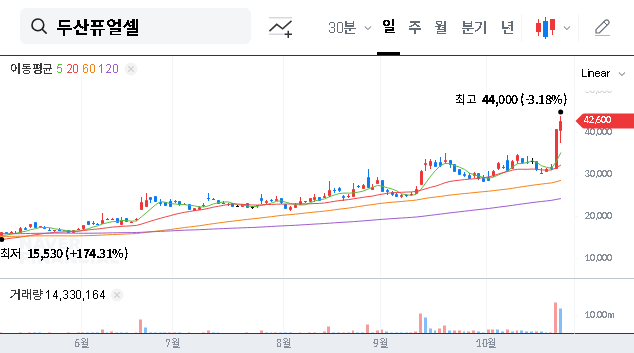
    • Revenue: Clocked in at KRW 90.8 billion, a staggering 31.0% below the projected KRW 131.1 billion.
    • Operating Loss: Widened to KRW -15.6 billion, a full 100% worse than the anticipated loss of KRW -7.8 billion.
    • Net Loss: Ballooned to KRW -17.5 billion, a shocking 298% deviation from the estimated loss of KRW -4.4 billion.

    This isn’t an isolated incident. The financial trajectory from late 2024 through 2025 shows a pattern of revenue contraction and persistent unprofitability, creating significant headwinds for the Doosan Fuel Cell stock price.

    Unpacking the Underperformance: Key Factors at Play

    Several internal and external factors converged to create this perfect storm of poor performance. Understanding these is key to assessing the company’s ability to execute a turnaround.

    Internal Headwinds and Financial Burdens

    The company’s balance sheet reveals significant stress. A high debt-to-equity ratio of 153.8% and a net debt-to-equity ratio of 78.0% signal a heavy reliance on borrowing. This is compounded by an inventory balance of KRW 358.7 billion, which accounts for nearly 30% of total assets and suggests potential issues with sales velocity or production management. These persistent losses, coupled with necessary investments in R&D and new business lines like SOFC technology, are straining financial resources.

    External Macroeconomic Pressures

    The global economic climate has been unforgiving. Volatility in EUR/KRW and USD/KRW exchange rates directly impacts the profitability of overseas operations and component sourcing. Furthermore, aggressive interest rate hikes by central banks in the US, Europe, and Korea have significantly increased the cost of capital, making Doosan’s high debt levels even more perilous. Fluctuating prices for key raw materials add another layer of uncertainty to production costs and profit margins.

    While the short-term outlook is challenging, Doosan Fuel Cell’s long-term thesis remains tied to the undeniable global shift towards clean energy. The key is separating temporary financial strain from permanent structural flaws.

    The Long-Term Vision: Growth Catalysts on the Horizon

    Despite the bleak quarterly report, it would be shortsighted to dismiss the company’s future potential. Several powerful tailwinds could propel Doosan Fuel Cell forward in the coming years.

    • Government Support & Market Growth: Pro-hydrogen policies and the establishment of a hydrogen power bidding market in Korea provide a stable demand foundation. This regulatory support is crucial for the entire industry.
    • Technological Advancement (SOFC): The completion of new Solid Oxide Fuel Cell (SOFC) production facilities is a major milestone. SOFC technology offers higher efficiency and is a key next-generation growth engine for power generation and marine applications. For more on this technology, you can consult authoritative resources like the U.S. Department of Energy.
    • Robust Order Backlog: A substantial order backlog of over KRW 2 trillion, primarily in long-term maintenance contracts, offers a degree of revenue stability and visibility.
    • Market Diversification: Strategic expansion into new markets like China and ventures into eco-friendly commercial vehicles represent promising new revenue streams.

    Investor Outlook: A Cautious Approach to Doosan Fuel Cell Stock

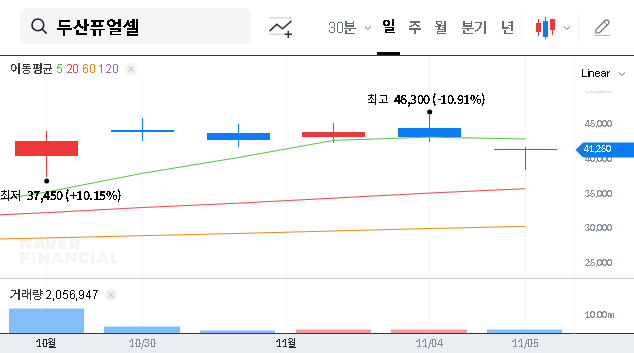
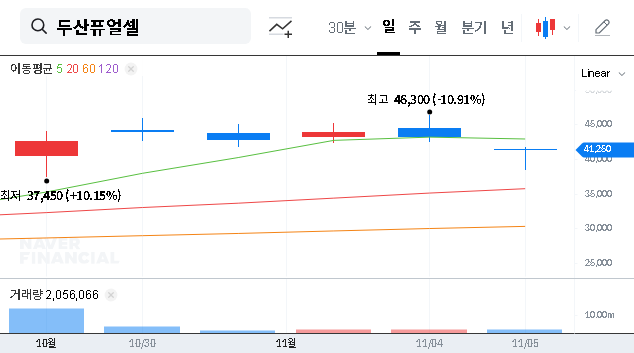
    In the immediate aftermath of such disappointing Doosan Fuel Cell earnings, investors should brace for downward pressure on the stock price. Market sentiment will likely be negative until the company can demonstrate a clear path to profitability and financial stability. A long-term hydrogen fuel cell investment requires patience, but also a critical eye on execution.

    Key Metrics to Monitor Moving Forward

    Investors should adopt a cautious but watchful stance. Keep a close eye on the following indicators in upcoming quarters to gauge whether a turnaround is materializing. For a broader perspective, you might also read our guide on How to Analyze Green Energy Stocks.

    • Profitability Trajectory: Can the company stem the tide of losses and show a clear path to positive operating income?
    • Financial Health: Are there concrete plans and actions to reduce the debt-to-equity ratio and improve liquidity?
    • New Business Performance: Are new ventures, particularly SOFC production and sales, beginning to contribute meaningfully to the top line?
    • Order Intake: Is the company winning new orders at a healthy rate to replenish its backlog and fuel future growth?

    Disclaimer: This analysis is for informational purposes only and is based on publicly available information. All investment decisions are the sole responsibility of the investor.

    (336260) Doosan Fuel Cell Q3 2025 Earnings Shock: Stock Analysis & Future Outlook 관련 이미지
  • (336260) Doosan Fuel Cell Q3 2025 IR: A Deep Dive for Investors & Future Outlook

    (336260) Doosan Fuel Cell Q3 2025 IR: A Deep Dive for Investors & Future Outlook

    As the global energy landscape shifts, investors are closely watching leaders in the hydrogen economy. The upcoming Doosan Fuel Cell IR (Investor Relations) conference, scheduled for November 5, 2025, is a pivotal event. This briefing will not only reveal the company’s Q3 2025 earnings but also offer a critical window into its strategic direction, future growth engines, and resilience in a challenging market. For anyone considering a Doosan Fuel Cell investment, this analysis will break down what to expect, the key metrics to watch, and how to interpret the company’s vision for the future.

    This IR event is more than just numbers; it’s a test of Doosan Fuel Cell’s ability to navigate economic headwinds while executing its ambitious long-term growth strategy centered on next-generation fuel cell technology.

    The High Stakes of the Q3 2025 Doosan Fuel Cell IR

    Following a mixed semi-annual report that showed revenue growth but a notable operating loss, the market’s spotlight is firmly on profitability. The primary question on every investor’s mind is whether Doosan Fuel Cell can turn the corner in Q3. This IR must address the root causes of the previous loss—such as rising raw material costs and heavy R&D spending—and provide a clear, convincing path back to profitability. The company’s credibility hinges on its ability to demonstrate effective cost management and operational efficiency. You can view the company’s latest financial statements via their Official Disclosure on DART.

    Core Business Analysis: Strengths vs. Risks

    A sound Doosan Fuel Cell investment decision requires a balanced view of its fundamental factors. The company boasts significant strengths but also faces undeniable market risks that must be managed proactively.

    Key Strengths to Consider

    • Robust Order Backlog: A massive KRW 2.0456 trillion backlog, with the majority in long-term maintenance contracts, provides exceptional revenue visibility and stability.
    • Future Growth Engines: Aggressive investment in high-potential areas, particularly Solid Oxide Fuel Cell (SOFC) production and the eco-friendly commercial vehicle market, positions the company for the next wave of the hydrogen economy.
    • Market Dominance: As the established leader in South Korea’s power generation fuel cell market, Doosan leverages deep technological expertise and a proven track record. The growth of the global hydrogen economy is a major tailwind.

    Headwinds and Potential Risks

    • Profitability Concerns: The H1 2025 operating loss of KRW 13.5 billion is a major red flag. The IR must provide a clear strategy for mitigating raw material costs and controlling R&D expenditures without stifling innovation.
    • Macroeconomic Volatility: With significant foreign currency transactions and debt, the company is exposed to exchange rate fluctuations and rising global interest rates, which could further squeeze margins.

    Potential Stock Impact: Bull vs. Bear Scenarios

    The IR announcement will likely act as a major catalyst for the stock. A bullish outcome would involve a surprise return to profitability, concrete timelines for SOFC mass production, and a strong outlook that exceeds analyst expectations. Conversely, a bearish scenario would be characterized by continued losses, vague updates on new ventures, and a cautious or negative outlook on the macroeconomic environment. Investors should be prepared for volatility following the event, as detailed in our guide to investing in renewable energy stocks.

    Investor Action Plan: Key Questions for the IR

    To make an informed decision, focus your analysis of the Doosan Fuel Cell IR on these critical questions:

    • Path to Profitability: What specific cost-saving measures have been implemented? Is the Doosan Fuel Cell Q3 earnings report showing a positive trend in operating margin?
    • Growth Engine Progress: Are there firm dates for the SOFC factory launch? What is the go-to-market strategy for commercial vehicle fuel cells? Are there any new partnerships or contracts to announce?
    • Risk Management: How is the company hedging against currency and interest rate risks? What is management’s outlook on supply chain stability for key materials?

    Ultimately, this IR is a crucial moment for Doosan Fuel Cell to reassure the market. By carefully analyzing their presentation and financials, you can better position your portfolio and make a strategic investment decision aligned with your long-term goals. We wish you success in your analysis and investment journey.

    (336260) Doosan Fuel Cell Q3 2025 IR: A Deep Dive for Investors & Future Outlook 관련 이미지
  • (336260) Doosan Fuel Cell Stock Analysis: NPS Increases Stake – Buy Signal or Trap?

    (336260) Doosan Fuel Cell Stock Analysis: NPS Increases Stake – Buy Signal or Trap?

    The recent news of South Korea’s National Pension Service (NPS) increasing its stake in Doosan Fuel Cell has sent ripples through the investment community. When a financial behemoth like the NPS makes a move, the market pays close attention. The central question for every investor is clear: Is this a vote of confidence and a compelling buy signal, or a potential value trap masked by institutional buying? This analysis will dissect the NPS’s decision, evaluate the underlying financial health of Doosan Fuel Cell, and provide a strategic outlook for potential investors.

    The NPS Move: A Closer Look at the Numbers

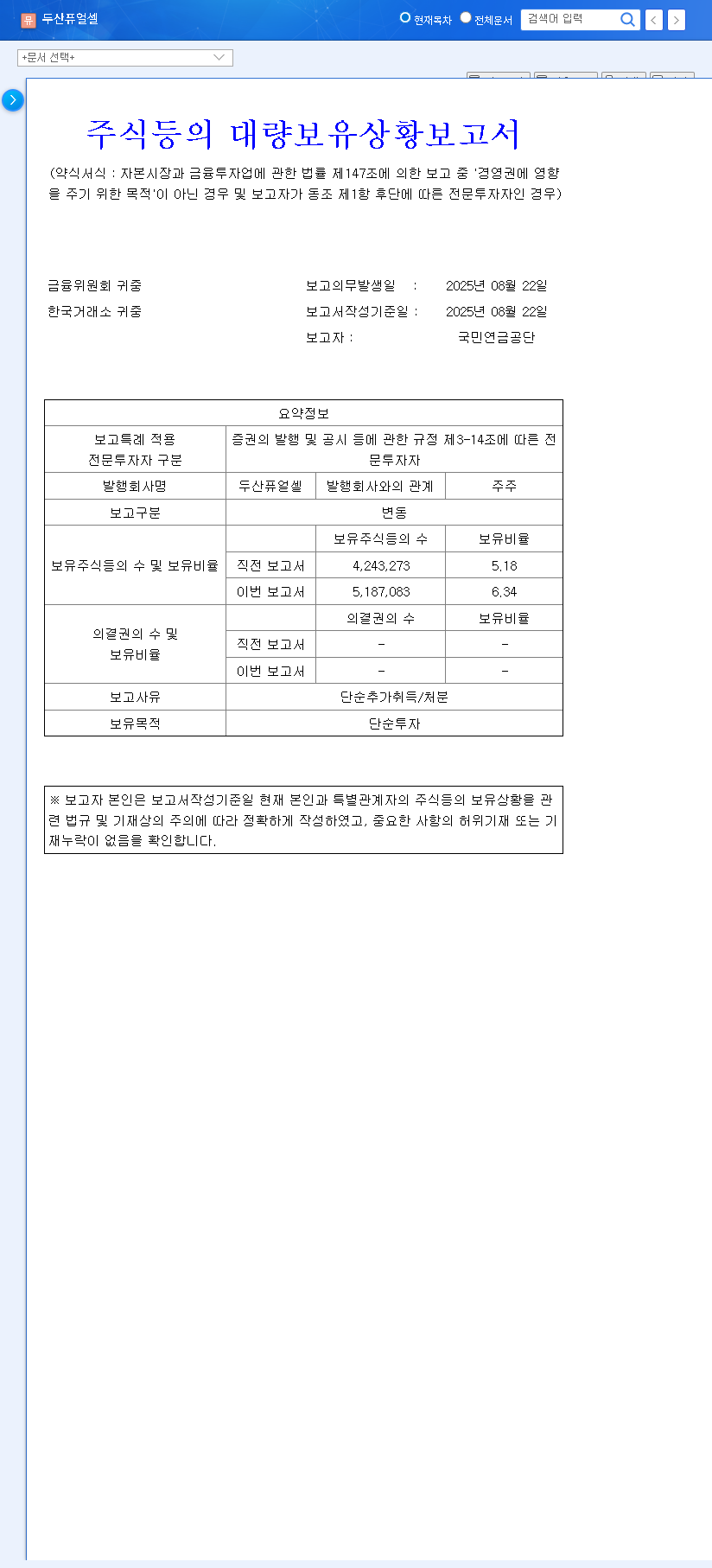
    On October 1, 2025, the National Pension Service officially reported an increase in its shareholding of Doosan Fuel Cell. The stake grew from 5.18% to 6.34%. This transaction, executed via a simple market acquisition, is significant. As one of the world’s largest pension funds, the NPS’s investment decisions are typically based on rigorous long-term analysis. This increased stake can be interpreted as a positive signal, suggesting that the fund sees significant long-term growth potential in the fuel cell giant, despite some clear short-term hurdles. The official filing provides transparency on this move.

    Official Disclosure: Click to view DART report

    Analyzing Doosan Fuel Cell’s Financial Health

    While the NPS investment is a major headline, prudent investors must look past it and into the company’s fundamentals. Doosan Fuel Cell’s 2025 first-half performance presents a mixed, complex picture that warrants careful consideration.

    The Good: Impressive Revenue Growth

    The company reported revenue of 228.2 billion KRW, a substantial jump from 118.2 billion KRW in the same period last year. This external growth is primarily driven by strong sales of its core power generation fuel cell units, indicating robust market demand and successful expansion of its business operations. This top-line growth is a critical indicator of the company’s market position and relevance.

    The Bad: A Shift to Operating Loss

    Despite surging revenues, profitability faltered. Doosan Fuel Cell recorded an operating loss of 13.5 billion KRW, a stark reversal from the 3.8 billion KRW operating profit a year prior. This dip into the red is attributed to several factors:

    • High Cost of Goods Sold: Increased production costs have squeezed margins.
    • Aggressive Investment: Significant capital is being deployed into future growth engines, such as Solid Oxide Fuel Cell (SOFC) technology and the eco-friendly commercial vehicle sector.
    • Increased Expenses: Rising selling, general, and administrative (SG&A) expenses are also weighing on the bottom line.

    The Ugly: Escalating Financial Leverage

    The balance sheet reveals growing risks. With total liabilities at 747 billion KRW, the company’s debt-to-equity ratio stands at a high 153.8%. In an era of rising interest rates, this significant financial leverage could increase interest expenses and put pressure on cash flow. For a deeper understanding of these metrics, it’s helpful to learn how to analyze a company’s balance sheet effectively.

    The core dilemma for investors: Weigh the National Pension Service’s long-term confidence against Doosan Fuel Cell’s immediate challenges of unprofitability and high debt. It’s a classic case of growth potential versus present-day risk.

    Macro Factors: Tailwinds and Headwinds

    No company operates in a vacuum. The global push toward clean energy creates a powerful tailwind for Doosan Fuel Cell. Government policies supporting the hydrogen economy, both in South Korea and abroad, provide a favorable long-term landscape. According to the International Energy Agency, hydrogen is a key pillar for achieving a net-zero future. However, the company also faces macroeconomic headwinds, including KRW depreciation and rising global interest rates, which can increase the cost of foreign debt and imported materials.

    Investor Action Plan: Navigating Your Decision

    Given this complex scenario, a short-term positive boost from the NPS investment is possible. However, sustainable stock price growth will hinge on fundamental improvements. Here are key factors to monitor:

    • Path to Profitability: Watch upcoming earnings reports for improvements in operating margin. Can the company translate its revenue growth into actual profit?
    • New Business Milestones: Track the progress of the SOFC technology and commercial vehicle ventures. Successful execution in these areas is key to the long-term growth story.
    • Debt Management: Look for signs of deleveraging or effective management of financial liabilities in the company’s financial statements.
    • Institutional Flow: Continue to monitor the NPS and other institutional investors. Are they continuing to buy, hold, or sell their positions?

    Disclaimer: This report is based on publicly available information and data and does not constitute investment advice. All investment decisions should be made based on the investor’s own judgment and responsibility.

    (336260) Doosan Fuel Cell Stock Analysis: NPS Increases Stake - Buy Signal or Trap? 관련 이미지
  • Doosan Fuel Cell’s 21-Year Maintenance Contract: Good News or a Trap? Key Analysis and Investment Strategy

    Doosan Fuel Cell's 21-Year Maintenance Contract: Good News or a Trap? Key Analysis and Investment Strategy 대표 차트 이미지

    1. What Happened?

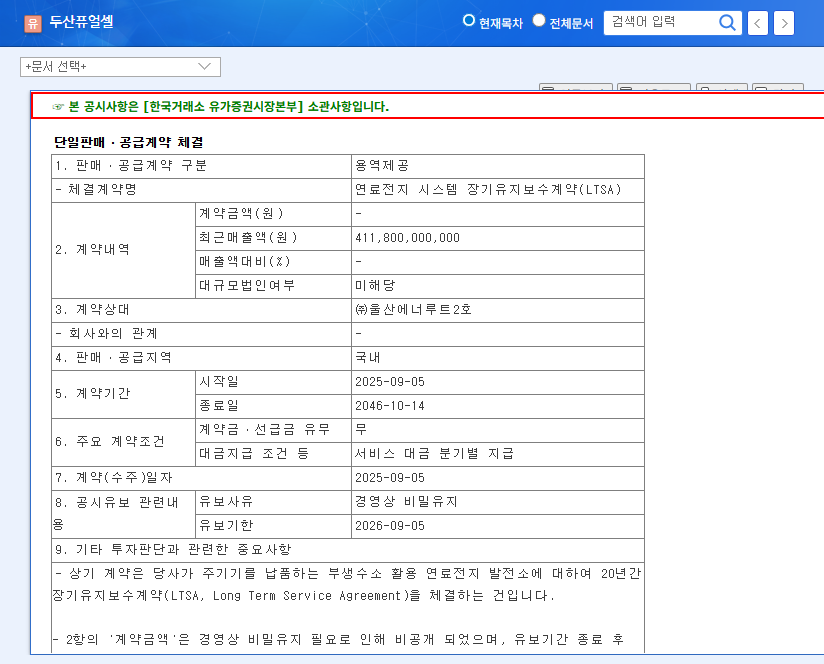
    Doosan Fuel Cell signed a 21-year LTSA with Ulsan Enerute No. 2, commencing September 5, 2025, and ending October 14, 2046. The financial details of the contract were not disclosed.

    2. Why Does It Matter?

    This contract is positive for Doosan Fuel Cell, securing long-term revenue and strengthening customer relationships. Predictable revenue streams contribute to the company’s stability. However, the lack of disclosed financial details makes it difficult to assess the immediate financial impact.

    3. So, What Should You Do?

    A cautious approach is recommended in the short term. While the long-term contract is a positive sign, the company’s deteriorating profitability, increasing inventory, and financial burdens revealed in the 2025 semi-annual report remain key challenges. A long-term perspective requires close monitoring of Doosan’s efforts to improve profitability, inventory management, new business performance, and financial health.

    4. Investor Action Plan

    • Short-term: Monitor stock performance and macroeconomic factors while remaining cautious.
    • Long-term: Base investment decisions on the company’s ability to demonstrate fundamental improvements, financial stabilization, and successful new business ventures. Consider both the growth potential of the hydrogen industry and potential increased competition.

    Frequently Asked Questions

    Will this contract positively impact Doosan Fuel Cell’s stock price?

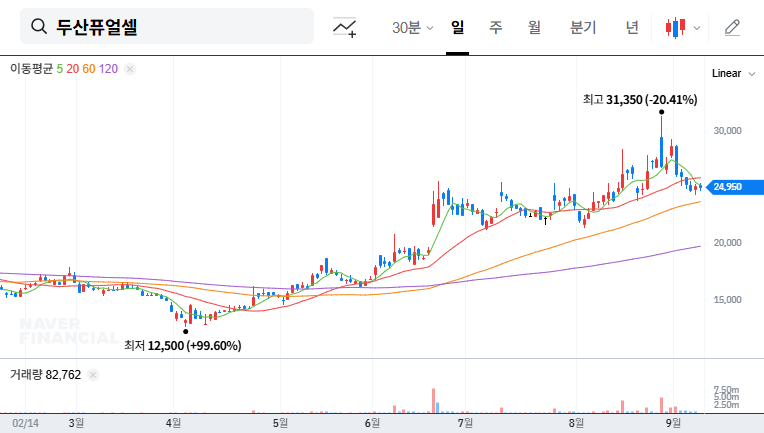
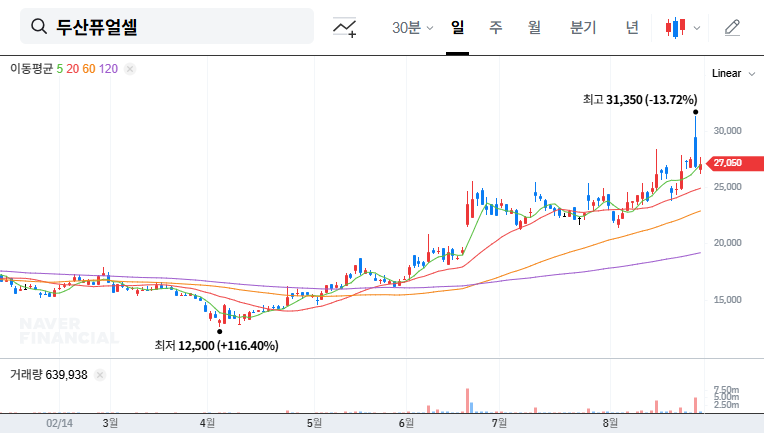
    It could have a positive short-term impact, but significant gains are unlikely without fundamental improvements. Long-term stock performance hinges on the company’s ability to address underlying issues.

    What are Doosan Fuel Cell’s biggest challenges currently?

    Declining profitability, high inventory levels, and a weakened financial structure are key concerns. The deterioration of operating cash flow requires immediate attention.

    Should I invest in Doosan Fuel Cell?

    A wait-and-see approach is currently recommended. It’s prudent to assess the company’s progress in improving fundamentals and restoring financial health before making any investment decisions.

    Doosan Fuel Cell's 21-Year Maintenance Contract: Good News or a Trap? Key Analysis and Investment Strategy 관련 이미지
  • Doosan Fuel Cell Secures 20-Year Maintenance Contract: Investment Implications

    Doosan Fuel Cell Secures 20-Year Maintenance Contract: Investment Implications 대표 차트 이미지

    1. What Happened?

    Doosan Fuel Cell signed a 20-year and 7-month LTSA with Ulsan Enerute No. 2, extending until March 2046, for the maintenance of its fuel cell systems.

    2. Why Does It Matter?

    This agreement signifies more than just a contract; it holds significant weight for Doosan Fuel Cell’s future.

    • Stable Revenue Stream: The long-term contract ensures a predictable and stable service revenue stream. Service revenue typically carries higher margins than product sales, potentially boosting profitability.
    • Strengthened Customer Relationships: A long-term partnership fosters trust with clients, increasing the likelihood of future contracts.
    • Enhanced Cash Flow Predictability: The extended contract duration improves cash flow predictability, aiding in financial planning.

    3. What’s Next?

    While positive, the contract comes with considerations:

    • Undisclosed Contract Value: The exact financial details remain undisclosed, making it difficult to fully assess the impact on profitability.
    • Long-Term Maintenance Costs: The 20+ year timeframe necessitates careful consideration of potential technological advancements and fluctuations in maintenance costs.

    4. What Should Investors Do?

    Investors should focus on the long-term impact on the company’s fundamentals rather than short-term stock fluctuations. A comprehensive investment decision requires considering Doosan Fuel Cell’s financial health, the hydrogen economy’s growth prospects, and government policies. Monitoring the release of the contract’s details and future earnings reports will be crucial for informed investment strategies.

    Frequently Asked Questions

    Will this contract help Doosan Fuel Cell improve its losses?

    While the long-term service revenue is expected to contribute to improved profitability, the undisclosed contract value makes it challenging to determine the precise impact.

    What is the outlook for Doosan Fuel Cell’s stock price?

    Short-term stock price predictions are difficult. However, this contract can be viewed as a positive factor in the long run. Overall market conditions and company fundamentals should be considered.

    What should investors be cautious about?

    Investors should closely monitor details of the contract, future earnings reports, and changes in hydrogen economy-related policies. Caution and thorough research are advised before making investment decisions.

    Doosan Fuel Cell Secures 20-Year Maintenance Contract: Investment Implications 관련 이미지
  • Doosan Fuel Cell IR Analysis: Overcoming Challenges and Investment Strategies

    Doosan Fuel Cell IR Analysis: Overcoming Challenges and Investment Strategies 대표 차트 이미지

    1. What Happened? H1 2025 Performance Review

    Doosan Fuel Cell reported a decline in revenue for the first half of 2025, down 44.6% year-on-year to 228.2 billion KRW, with an operating loss of 13.5 billion KRW. This is attributed to a combination of factors, including rising raw material prices and increased production costs. Concerns about financial stability are also rising, as the debt-to-equity ratio increased to 153.8%.

    2. Why Did This Happen? Reasons for Underperformance

    The decline in revenue is primarily due to sluggish sales of fuel cell main units and long-term maintenance services. The operating loss is a result of decreased revenue coupled with rising raw material prices and increased production costs. Furthermore, the company’s high dependence on its top four clients (64.9% of total sales) makes it vulnerable to changes in demand from specific customers.

    3. What’s the Plan? Key IR Focus and Expected Outcomes

    Doosan Fuel Cell intends to use this IR to provide a clear explanation of its recent underperformance, highlighting its new business initiatives and future vision, including its entry into the eco-friendly commercial vehicle market (HyAxiom Motors acquisition) and securing SOFC technology. They are also expected to announce financial restructuring plans and risk management strategies. A successful IR could lead to stabilized investor sentiment, create momentum for a stock rebound, and attract potential investors.

    4. What Should Investors Do? Investment Strategies

    Investors should carefully review the information presented at the IR and assess the company’s future growth potential based on management’s explanations and responses during the Q&A session. Pay close attention to the progress of new businesses, profitability projections, and the feasibility of financial restructuring plans. It’s crucial to make investment decisions based on a comprehensive evaluation of both positive external factors, such as the growth potential of the hydrogen industry and government policy support, and the company’s fundamentals and future strategies.

    What is Doosan Fuel Cell’s main business?

    Doosan Fuel Cell manufactures and sells power generation fuel cell systems based on PAFC (Phosphoric Acid Fuel Cell) technology. They hold the largest market share in the domestic power generation fuel cell market. Recently, they have been diversifying their business by investing in eco-friendly commercial vehicles and SOFC (Solid Oxide Fuel Cell) technology development.

    How did Doosan Fuel Cell perform in the first half of 2025?

    Doosan Fuel Cell recorded revenue of 228.2 billion KRW (down 44.6% year-on-year) and an operating loss of 13.5 billion KRW in the first half of 2025.

    What are the key things to watch for in this IR?

    Key points of interest include the analysis of the reasons for underperformance, the presentation of new business initiatives and future vision, and the proposed financial restructuring plan. It’s especially important to look for information regarding the specific roadmap and profitability outlook for new businesses, such as the eco-friendly commercial vehicle venture and SOFC technology development.

    Doosan Fuel Cell IR Analysis: Overcoming Challenges and Investment Strategies 관련 이미지
  • Doosan Fuel Cell’s ₩26 Billion Contract: A True Turning Point or a Glimmer of Hope?

    1. Decoding the ₩26 Billion Contract

    On August 22, 2025, Doosan Fuel Cell secured a ₩26 billion fuel cell system supply contract. This represents 6.31% of the company’s annual revenue in 2024, with the contract period extending until November 15, 2026. This equates to approximately 11.39% of the first-half 2025 revenue, raising expectations for improved second-half performance.

    2. Significance: A Key to Recovery from a Weak First Half?

    Doosan Fuel Cell reported losses in both operating income and net income in the first half of 2025. Increased investment in new businesses and R&D expenses were cited as primary causes, along with concerns over declining equity and rising debt ratios. This contract is expected to contribute to improved profitability and restore market confidence through increased sales.

    3. The Path Forward: Balancing Opportunities and Risks

    • Positive Aspects: Increased sales, potential for profit improvement, strengthened market confidence
    • Risks: May not fundamentally reverse the declining profitability trend, vulnerability to exchange rate and interest rate fluctuations, increased cost burden due to rising oil prices and shipping costs

    While a short-term stock rebound is possible, the improvement in fundamentals remains uncertain. Therefore, careful analysis is crucial before making investment decisions.

    4. Action Plan for Investors

    • Continuously monitor profit improvement trends.
    • Examine the company’s strategies for managing exchange rate and interest rate volatility.
    • Check the progress of new businesses and efforts to secure future growth engines.

    Frequently Asked Questions

    Does this contract guarantee Doosan Fuel Cell’s return to profitability?

    While this contract is expected to positively impact sales and profitability, it doesn’t guarantee a return to profitability. Various factors such as improvement in cost structure and the success of new businesses need to be considered.

    What is the most important factor to consider when investing?

    The high debt ratio and vulnerability to fluctuations in exchange rates, interest rates, and raw material prices are key concerns. Investors should carefully evaluate the company’s risk management capabilities.

  • Doosan Fuel Cell’s ₩26 Billion Contract: Short-Term Boost or Long-Term Opportunity?

    1. What Happened? – The ₩26 Billion Deal

    Doosan Fuel Cell signed a ₩26 billion contract with Samchully ES on August 21, 2025, to supply fuel cell systems. This deal represents a significant 6.31% of Doosan Fuel Cell’s revenue.

    2. Why Does It Matter? – Opportunities and Risks

    Positive Aspects:

    • Short-Term Revenue Growth: The ₩26 billion contract will directly contribute to short-term revenue growth.
    • Confirmed Business Stability: Consistent order intake demonstrates the stability of Doosan Fuel Cell’s business foundation.
    • Hydrogen Economy Growth Expectations: Aligning with the government’s hydrogen economy promotion policies, this deal increases the likelihood of future orders.

    Negative Aspects:

    • Limited Profitability Improvement: The contract size alone is unlikely to significantly improve profitability.
    • Exchange Rate and Interest Rate Fluctuation Risks: Rising exchange rates and interest rates could increase financial burden.
    • Macroeconomic Uncertainty: Fluctuations in international oil and raw material prices, among other macroeconomic factors, could influence investor sentiment.

    3. Investment Strategies

    While this contract is a positive sign, investors should consider the following before making a decision:

    • Profitability Improvement Strategy: Cost reduction and securing profitability in new businesses are crucial.
    • Future Growth Drivers: Carefully assess the growth potential of new businesses.
    • Managing Macroeconomic Variables: Establish a strategy for navigating exchange rate and interest rate fluctuations.

    Avoid being swayed by the potential for short-term stock price increases. Investment decisions should be based on a thorough analysis of the company’s fundamentals and long-term growth potential.

    Frequently Asked Questions

    How will this contract affect Doosan Fuel Cell’s stock price?

    It’s likely to have a positive short-term impact. However, the long-term stock price depends on the company’s fundamentals and the success of its new businesses.

    What is the outlook for Doosan Fuel Cell?

    Driven by hydrogen economy promotion policies, there’s high growth potential, but profitability improvement and the success of new businesses are key variables.

    What precautions should investors take?

    Don’t be swayed by short-term stock fluctuations; analyze the company’s fundamentals and long-term growth potential. Also, be mindful of macroeconomic factors like exchange rates and interest rates.