Tag: EB

  • Korea Land Trust’s ₩50B EB Issuance: What Investors Need to Know

    Korea Land Trust's ₩50B EB Issuance: What Investors Need to Know 대표 차트 이미지

    1. What Happened?

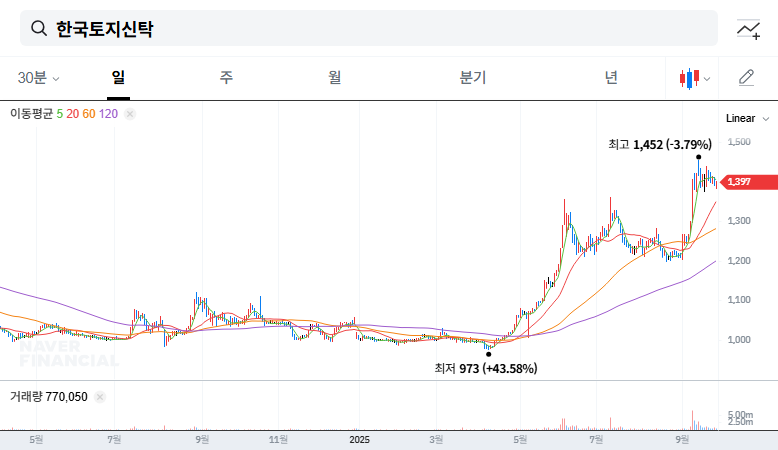
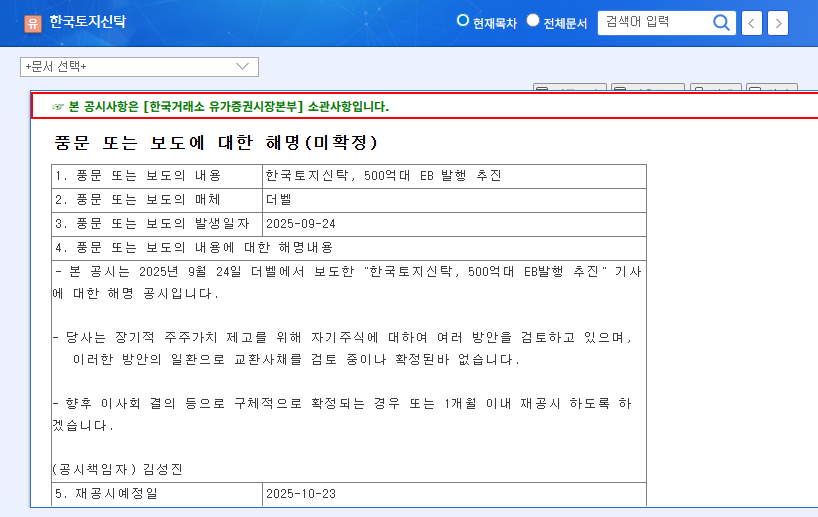
    On September 24, 2025, news broke that Korea Land Trust is exploring the issuance of ₩50 billion in EBs. The company stated that this is being considered as part of a broader strategy to enhance shareholder value, potentially involving treasury stock, but that nothing has been finalized.

    2. Why Issue EBs?

    Korea Land Trust operates a diverse portfolio of businesses, including real estate trust, urban redevelopment, and REITs. The funds raised through the EB issuance are expected to be used for improving the company’s financial structure and securing investment resources for future growth. The link to potential treasury stock strategies also signals a commitment to enhancing shareholder value.

    3. Opportunities and Risks of the EB Issuance

    • Opportunities: Improved financial structure, secured investment resources, potential for increased shareholder value.
    • Risks: Potential for share dilution (upon conversion), increased interest expense burden.

    4. Macroeconomic Considerations

    Current market conditions show increased volatility in interest rates, exchange rates, and the real estate market. This volatility could impact Korea Land Trust’s business and financial performance, and also influence the interest rate on the EBs.

    5. What Should Investors Do?

    • Confirm finalization and terms of the EB issuance (amount, interest rate, maturity, conversion terms, etc.).
    • Analyze the impact of the EB issuance on the company’s financial structure and shareholder value.
    • Monitor changes in macroeconomic indicators, such as interest rates, exchange rates, and real estate market trends.
    • Continuously observe Korea Land Trust’s financial soundness and earnings performance.

    FAQ

    Has Korea Land Trust confirmed the EB issuance?

    No, the issuance is currently under review and will be publicly announced upon confirmation.

    How will the funds from the EB issuance be used?

    The funds will be utilized to strengthen the company’s financial structure and secure investment resources for future growth. Treasury stock strategies are also under consideration.

    How will the EB issuance affect the stock price?

    While it could positively impact the company’s financials and shareholder value, there are risks, including potential share dilution and increased interest expenses.
    Korea Land Trust's ₩50B EB Issuance: What Investors Need to Know 관련 이미지
  • KCC’s Treasury Stock Plan: Impact on Stock Price and Investment Strategy


    KCC's Treasury Stock Plan: Impact on Stock Price and Investment Strategy 대표 차트 이미지


    KCC’s Treasury Stock Plan: What Was Announced?

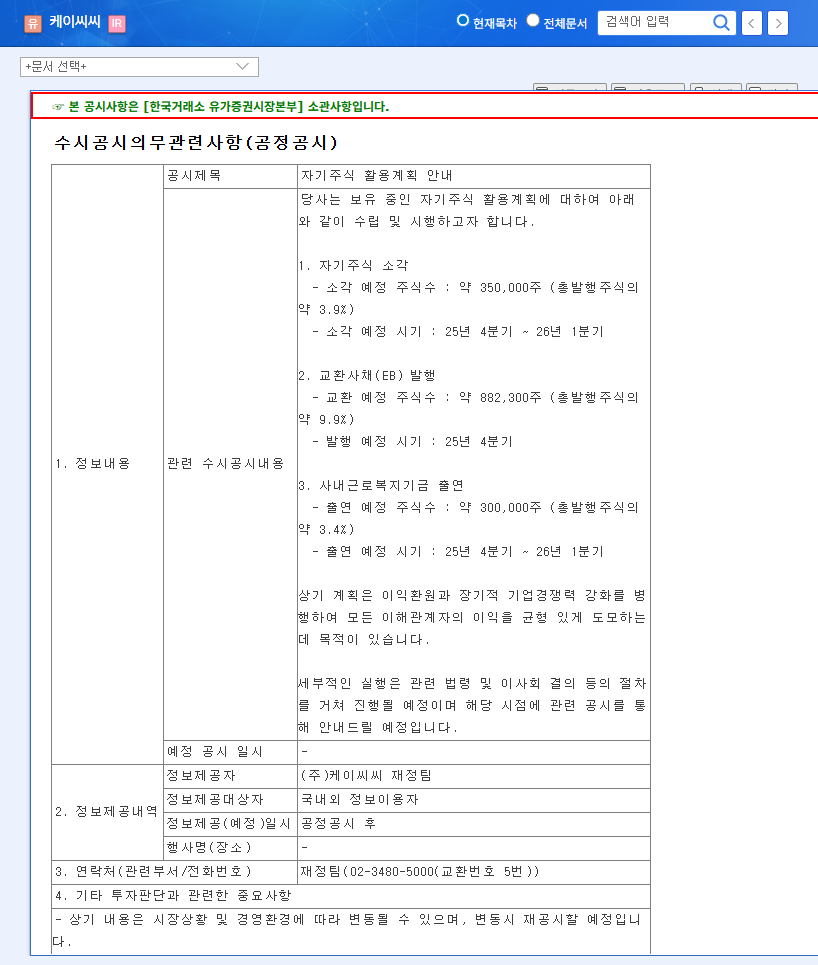
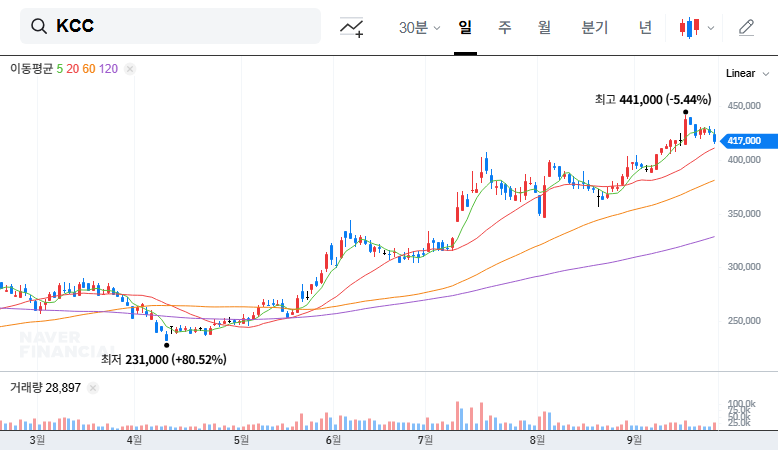
    • Treasury Stock Retirement: Approximately 3.9% of total outstanding shares (350,000 shares) will be retired.
    • Exchangeable Bond (EB) Issuance: Approximately 9.9% of total outstanding shares (882,300 shares) will be used for EB issuance.
    • Employee Welfare Fund Contribution: Approximately 3.4% of total outstanding shares (300,000 shares) will be contributed.

    Why Does This Matter?

    This decision can significantly impact KCC’s future, affecting shareholder value, financial structure, and employee morale. Share retirement can boost Earnings Per Share (EPS), increasing shareholder value. The EB issuance provides financial flexibility while also introducing the potential for share dilution. The employee welfare fund contribution aims to improve morale and potentially drive long-term performance gains.

    Impact on Investors

    In the short term, share retirement can positively influence the stock price, but the potential dilution from the EB issuance can introduce volatility. Investors should closely monitor the terms of the EB issuance and overall market conditions.

    Investor Action Plan

    KCC’s treasury stock plan has both short-term and long-term implications. Investors should consider the following when developing their investment strategies:

    • Review the terms of the exchangeable bond issuance.
    • Analyze market conditions and competitor activities.
    • Assess KCC’s financial health and business outlook.
    • Consider your investment goals and risk tolerance.


    FAQ

    What is treasury stock retirement?

    Treasury stock retirement is when a company repurchases its own shares and removes them from circulation. This reduces the number of outstanding shares, potentially increasing earnings per share (EPS) and shareholder value.

    What are exchangeable bonds (EBs)?

    Exchangeable bonds are bonds that give the bondholder the option to exchange them for shares of a company other than the issuer.

    How will KCC’s treasury stock plan affect its share price?

    Stock retirement generally has a positive impact on share price, while the issuance of exchangeable bonds can introduce volatility due to potential dilution.


    KCC's Treasury Stock Plan: Impact on Stock Price and Investment Strategy 관련 이미지


  • SK Chemical Plans ₩240 Billion EB Issuance: Investment Strategy & Outlook


    SK Chemical Plans ₩240 Billion EB Issuance: Investment Strategy & Outlook 대표 차트 이미지


    1. SK Chemical’s EB Issuance: What’s Happening?

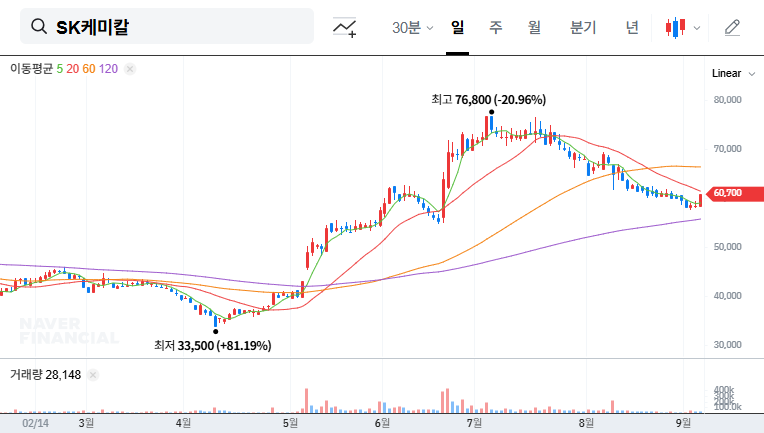
    According to a report by Korea Economic Daily on September 4, 2025, SK Chemical is planning to issue ₩240 billion worth of Exchangeable Bonds (EBs) using its subsidiary stakes. While still unconfirmed, this move is expected to significantly impact SK Chemical’s business strategy.

    2. Why Issue EBs?

    SK Chemical is focused on securing growth momentum by investing heavily in its Green Chemicals and Life Science businesses. The funds raised through the EB issuance are expected to be utilized for expansion and R&D in these core business areas. It is also anticipated to improve the company’s financial structure and increase investment capacity.

    3. Impact on Investors

    • Positive Impacts: Business expansion, improved financial structure, re-evaluation of subsidiary value, increased market interest.
    • Negative Impacts: Potential dilution of shareholder value, interest burden, market volatility, subsidiary stake value fluctuations.

    4. SK Chemical’s Current Business Performance

    SK Chemical has shown stable growth in both its Green Chemicals and Life Science businesses. The Green Chemicals business is strengthening its eco-friendly materials portfolio, while the Life Science business is focusing on expanding its vaccine and CDMO businesses. Despite a decrease in sales, the company’s H1 2025 results showed a positive turnaround with operating profit, indicating a positive trend.

    5. Investment Action Plan

    • Confirm Re-disclosure Details: Carefully review the terms of the EB issuance, including size, interest rates, etc.
    • Monitor Subsidiary Performance and Investment Efficiency: Observe how the funds are utilized and the impact on subsidiary value.
    • Watch Macroeconomic Conditions: Pay attention to external factors such as fluctuations in exchange rates, oil prices, and interest rates.
    • Consider Potential Share Dilution: Factor in the potential dilution of shareholder value upon EB conversion when making investment decisions.


    FAQ

    What are Exchangeable Bonds (EBs)?

    EBs are bonds that grant the holder the right to exchange them for shares of a company other than the issuer at maturity.

    How will the EB issuance affect SK Chemical’s stock price?

    In the short term, it could attract investor interest and drive up the stock price. However, in the long term, the increased number of shares from EB conversion could dilute shareholder value.

    What are SK Chemical’s core businesses?

    SK Chemical operates two core businesses: Green Chemicals (eco-friendly materials) and Life Science (bio/vaccines).


    SK Chemical Plans ₩240 Billion EB Issuance: Investment Strategy & Outlook 관련 이미지
    SK Chemical Plans ₩240 Billion EB Issuance: Investment Strategy & Outlook 관련 이미지


  • KUKDO Chemical Stock Forecast: NH Investment & Securities Stake Acquisition Analysis


    KUKDO Chemical Stock Forecast: NH Investment & Securities Stake Acquisition Analysis 대표 차트 이미지


    NH Investment & Securities Acquires 1.55% Stake in KUKDO Chemical (September 3, 2025)

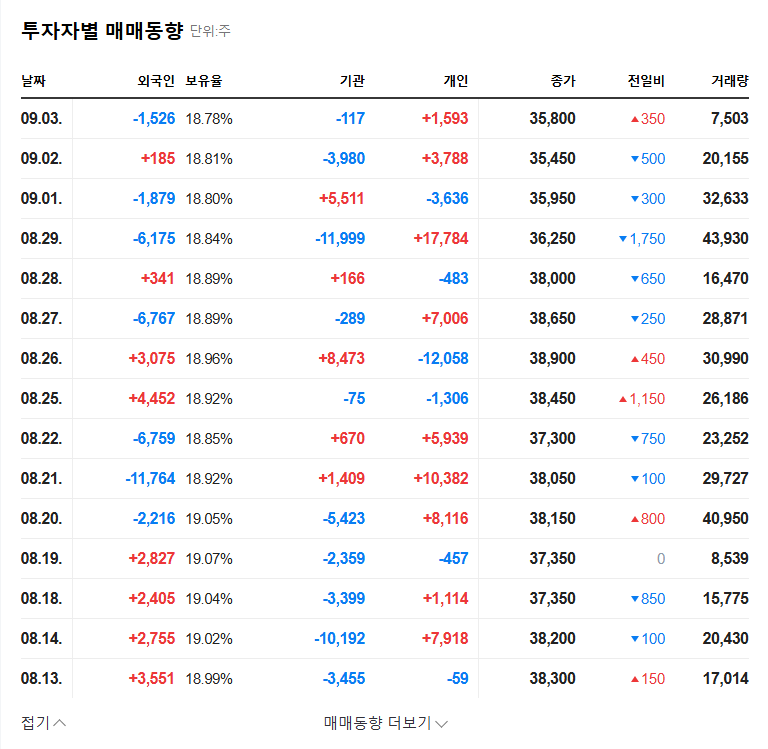
    NH Investment & Securities announced on September 3, 2025, the acquisition of a 1.55% stake in KUKDO Chemical. This acquisition resulted from EB (Convertible Bond) acquisition and transfer activities, with the stated purpose being ‘simple investment.’

    Impact of the Stake Acquisition on KUKDO Chemical

    • Positive Aspects: Increased market attention and potential influx of buying power. Heightened interest in EB issuance and potential future stock conversion.
    • Neutral/Limited Aspects: ‘Simple investment’ purpose suggests no intention of management participation. The small stake (1.55%) limits direct impact on stock price. Limited direct connection to KUKDO Chemical’s fundamentals.
    • Potential Negative/Cautionary Aspects: Possibility of overhang issues upon future conversion of EB to shares. Potential short-term price volatility due to supply and demand imbalances.

    KUKDO Chemical Fundamentals and Future Outlook

    KUKDO Chemical recorded solid performance in the first half of 2025, driven by strong epoxy resin performance and reduced losses in the polyol segment. However, potential global economic slowdown and raw material price volatility remain risk factors.

    Action Plan for Investors

    • Monitor Short-term Price Volatility: Observe NH’s further stake changes and market reactions.
    • Assess EB Conversion Potential and Overhang Risk: Continuously monitor the potential conversion of EB to shares and the resulting overhang risk.
    • Focus on Fundamental Analysis: Analyze KUKDO’s earnings, new business performance, and macroeconomic factors.


    Frequently Asked Questions (FAQ)

    Will NH’s stake acquisition positively impact KUKDO Chemical’s stock price?

    Short-term market attention may drive price increases, but long-term impact depends on KUKDO’s fundamentals.

    What are Convertible Bonds (EB)?

    Convertible bonds are bonds that can be converted into the issuing company’s shares after a certain period.

    What is an overhang, and why is it important?

    An overhang represents a large number of shares that could potentially be sold. This potential for increased supply can negatively impact stock prices.


    KUKDO Chemical Stock Forecast: NH Investment & Securities Stake Acquisition Analysis 관련 이미지
    KUKDO Chemical Stock Forecast: NH Investment & Securities Stake Acquisition Analysis 관련 이미지


  • DB Hitek Announces Potential 100 Billion KRW EB Issuance: Investment Analysis and Outlook

    DB Hitek Announces Potential 100 Billion KRW EB Issuance: Investment Analysis and Outlook 대표 차트 이미지

    1. What’s Happening? DB Hitek Explores EB Issuance

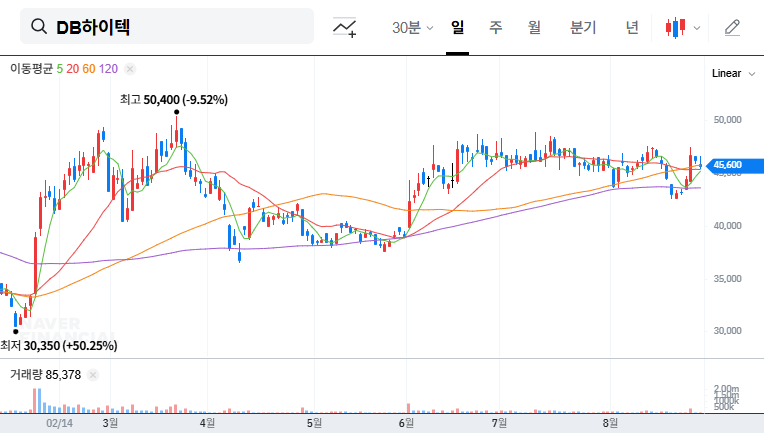
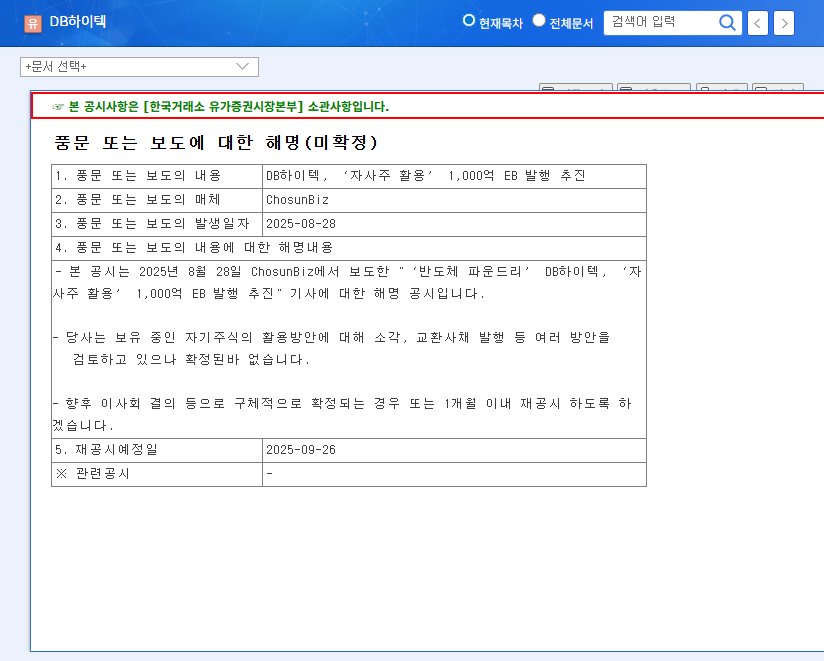
    On August 28, 2025, news broke that DB Hitek is considering issuing exchangeable bonds (EBs) worth 100 billion KRW using its treasury stock. While not yet finalized, the potential move has investors on alert.

    2. Why the EB Issuance? Understanding the Rationale

    DB Hitek is evaluating various options for utilizing its treasury stock, including cancellation and EB issuance. The funds raised through the EB issuance are expected to be used for improving financial structure, investing in new businesses, and strengthening R&D. This is interpreted as a strategic move to secure funding for new growth engines amidst intensifying competition in the 8-inch foundry industry.

    3. What’s the Potential Impact? Analyzing the Implications

    • Positive Aspects: Improved capital structure, enhanced financial flexibility, securing investment funds for new businesses.
    • Negative Aspects: Redemption burden at maturity, increased interest expenses, uncertainty stemming from the undetermined outcome of treasury stock utilization.

    Macroeconomic factors such as the global economic slowdown, semiconductor market uncertainty, and fluctuations in interest rates and exchange rates should also be considered.

    4. What Should Investors Do? Investment Strategies

    As the EB issuance is currently under review, it is advisable to await the company’s official announcement rather than making hasty investments. Carefully analyze DB Hitek’s fundamentals, the terms of the EB issuance, the planned use of funds, and manage risks associated with changes in macroeconomic conditions. With a re-disclosure expected within a month, prudent investors should thoroughly review the disclosed information before making any investment decisions.

    Frequently Asked Questions (FAQ)

    What are Exchangeable Bonds (EBs)?

    Exchangeable bonds (EBs) are bonds with an embedded option to exchange them for a predetermined number of shares of a company’s common stock or other assets. Investors can receive interest payments until maturity or opt to exchange the bonds for shares, potentially profiting from stock price appreciation.

    Will DB Hitek’s EB Issuance Positively Impact its Stock Price?

    The impact of the EB issuance on DB Hitek’s stock price is uncertain. Various factors, including the terms of the issuance, the purpose of the funds raised, and market conditions, can influence stock price movements. Favorable terms and efficient use of funds could boost the stock price, while the opposite could negatively impact it.

    What are the Key Investment Considerations?

    Before investing, thoroughly analyze DB Hitek’s financial status, business outlook, and competitive landscape. Managing risks related to macroeconomic volatility, interest rate changes, and currency fluctuations is also crucial. Regularly monitor the company’s disclosures and consider seeking advice from financial professionals.

    DB Hitek Announces Potential 100 Billion KRW EB Issuance: Investment Analysis and Outlook 관련 이미지
  • Kostecxis Issues 6.4 Billion Won Convertible Bonds: Opportunity or Risk?

    1. Kostecxis’ Convertible Bond Issuance: What’s Happening?

    Kostecxis is issuing convertible bonds worth 6.4 billion won through a private placement. The conversion price is set at 14,351 won, higher than the current stock price. This can be interpreted as reflecting investors’ expectations for future stock price increases.

    2. Why Issue Convertible Bonds?

    Kostecxis’ Q1 2025 report shows a decline in sales and a net loss. This EB issuance aims to secure funds for financial restructuring and future growth. The funds are expected to be used for R&D investment, facility expansion, and new customer acquisition, particularly in preparation for growth in the 5G and electric vehicle markets.

    3. What Does This Mean for Investors?

    This EB issuance presents both opportunities and risks for investors.

    • Positive Impacts: Potential for long-term shareholder value enhancement through financial restructuring and securing growth momentum.
    • Negative Impacts: Stock dilution due to EB conversion, short-term downward pressure on stock price.

    Investment decisions should consider both positive and negative factors, along with the current stock price level, future growth potential, and market conditions.

    4. What Should Investors Do?

    Kostecxis’ EB issuance requires careful analysis from both short-term and long-term perspectives. Continuous monitoring of macroeconomic factors such as raw material prices, exchange rates, and interest rate fluctuations, as well as the potential for increased competition in the 5G and electric vehicle markets, is crucial. Closely observing the company’s earnings improvement is also essential. Predicting the EB conversion rate and the stock price at the time of conversion will be key variables in investment decisions.

    Frequently Asked Questions

    What are convertible bonds (EB)?

    Convertible bonds (EB) are financial instruments that combine the stability of bonds with the potential returns of stocks. Investors receive bond interest payments until maturity and have the right to convert the bonds into the issuer’s stock within a specified period. If the stock price rises, they can convert to shares to profit from the price appreciation. If the stock price falls, they can hold the bonds to maturity to receive the principal and interest.

    How will Kostecxis’ EB issuance affect its stock price?

    In the short term, there may be downward pressure on the stock price due to concerns about dilution. However, in the long term, securing growth momentum through fundraising could lead to a stock price increase. The stock’s direction will depend on the company’s earnings improvement and market conditions.

    What should investors consider when investing?

    Investors should consider the EB conversion price, the conversion period, the company’s financial condition and growth potential, and the competitive landscape. It is particularly important to continuously monitor macroeconomic factors such as raw material prices, exchange rates, and interest rate fluctuations, as well as the possibility of increased competition in the 5G and electric vehicle markets.