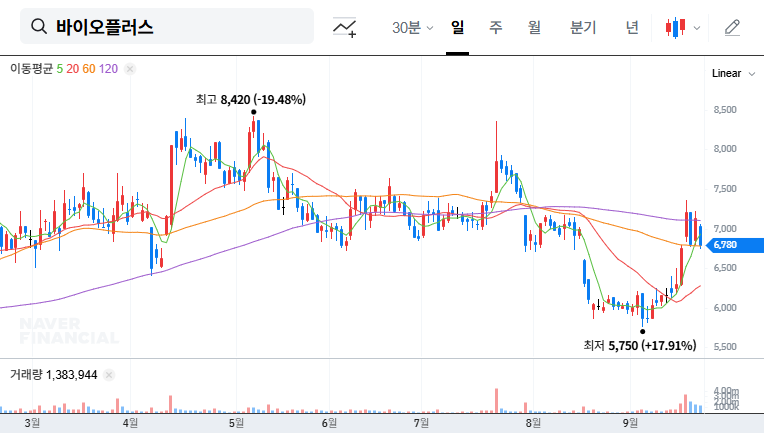
Tag: Bioplus

  • Bioplus IR Analysis: Growth Drivers Amidst Declining Performance?


    Bioplus IR Analysis: Growth Drivers Amidst Declining Performance? 대표 차트 이미지


    Bioplus IR Key Takeaways

    On September 22, 2025, Bioplus held an IR meeting for investors. The main topics discussed were the half-year financial results and future growth strategies. Addressing concerns over the decline in HA filler sales and profitability, the company emphasized its commitment to securing growth momentum through new pipeline development and overseas market expansion.

    Reasons for the Performance Decline and Recovery Strategies

    • Intensifying competition in the HA filler market
    • Sluggish sales of specific products

    The company attributed its sluggish performance to intensifying competition in the HA filler market and declining sales of specific products. As countermeasures, Bioplus outlined plans for new product launches, strengthened marketing efforts, and price policy adjustments.

    Future Growth Drivers: New Pipeline

    • Obesity/Diabetes Treatment
    • Next-Generation Botulinum Toxin

    Bioplus is focusing on the development of treatments for obesity and diabetes, as well as a next-generation botulinum toxin. The IR meeting detailed the development stages, clinical trial results, and market entry strategies for each pipeline, raising investor expectations.

    Action Plan for Investors

    Investors should review their investment strategies based on the information disclosed during the IR meeting. While a short-term performance decline is inevitable, investment decisions should be made after carefully analyzing the potential success of the new pipeline and the company’s overseas market expansion strategy.


    FAQ

    What is Bioplus’s main business?

    Bioplus manufactures HA fillers and medical devices based on its core technology, MDM Technology. They are also focusing on developing a new pipeline, including treatments for obesity and diabetes, and a next-generation botulinum toxin.

    Why has Bioplus’s recent performance been sluggish?

    The main reasons are intensifying competition in the HA filler market and sluggish sales of specific products.

    What are Bioplus’s future growth drivers?

    The future growth drivers are the development of new pipelines, such as treatments for obesity and diabetes and a next-generation botulinum toxin, and expansion into overseas markets.
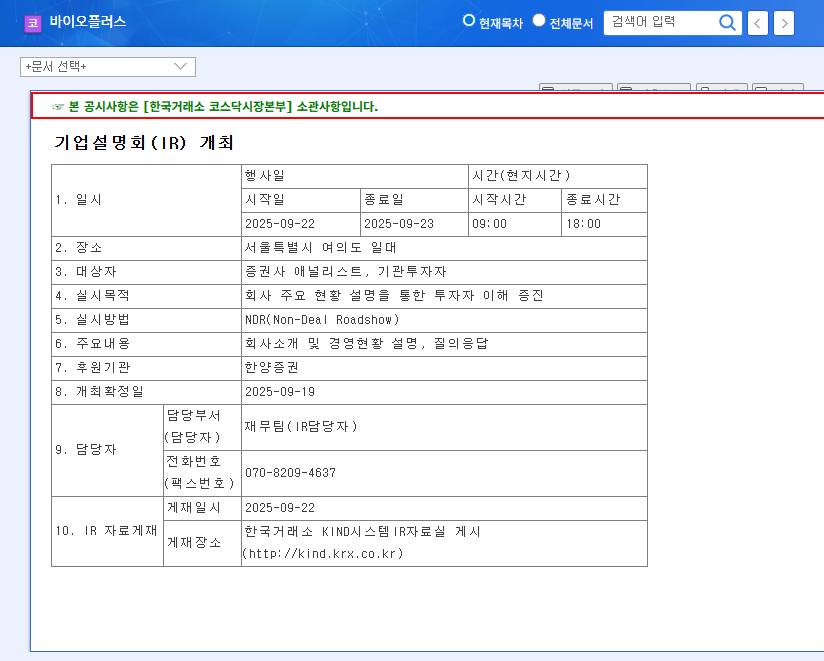
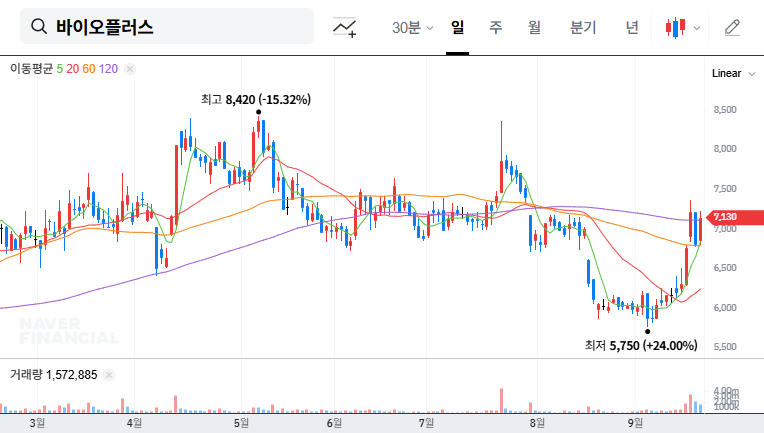


    Bioplus IR Analysis: Growth Drivers Amidst Declining Performance? 관련 이미지
    Bioplus IR Analysis: Growth Drivers Amidst Declining Performance? 관련 이미지


  • Bioplus Stock Repurchase: Short-term Pain, Long-term Gain?

    Bioplus Stock Repurchase: Short-term Pain, Long-term Gain? 대표 차트 이미지

    1. What Happened?

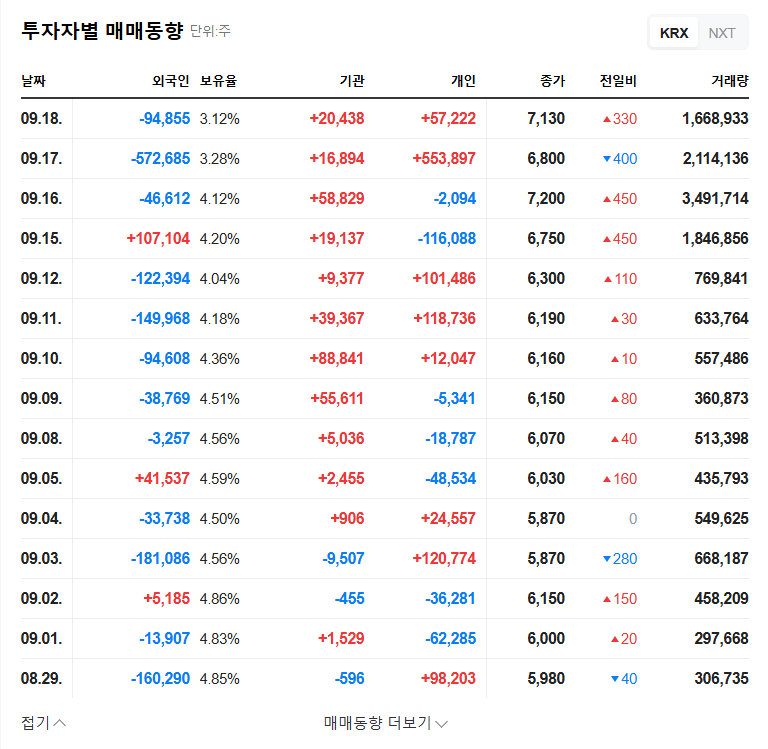
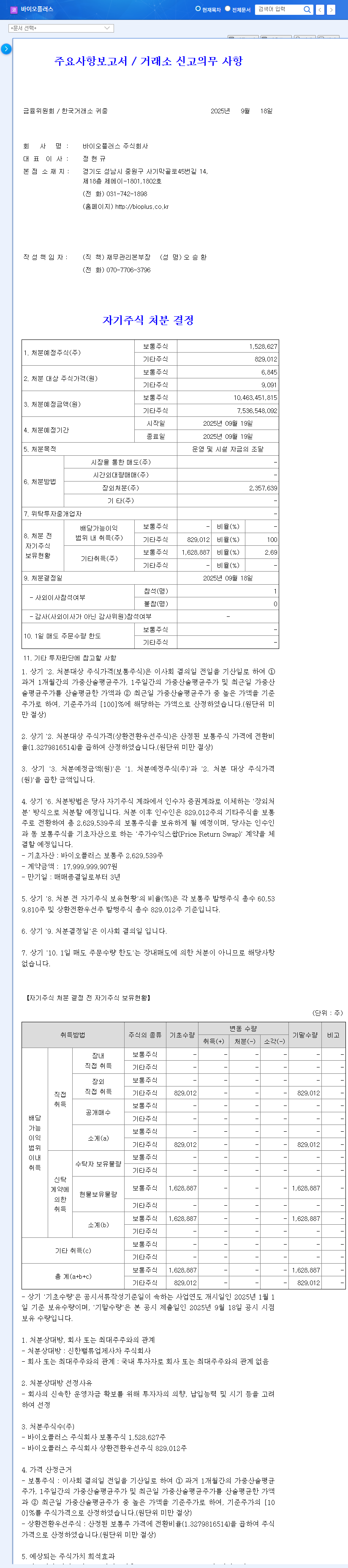
    On September 18, 2025, Bioplus announced its decision to repurchase ₩10.5 billion worth of common stock and ₩7.5 billion worth of preferred stock to secure operating and facility funds.

    2. Why the Repurchase?

    The official reason is to secure ‘operating and facility funds.’ Bioplus is investing in medical devices like anti-adhesion agents and joint tissue repair materials, as well as new pharmaceuticals such as next-generation botulinum toxin and obesity/diabetes treatments. The repurchase likely aims to finance these new ventures and expand into overseas markets.

    3. How Will This Affect the Stock Price?

    Short-Term Impact:

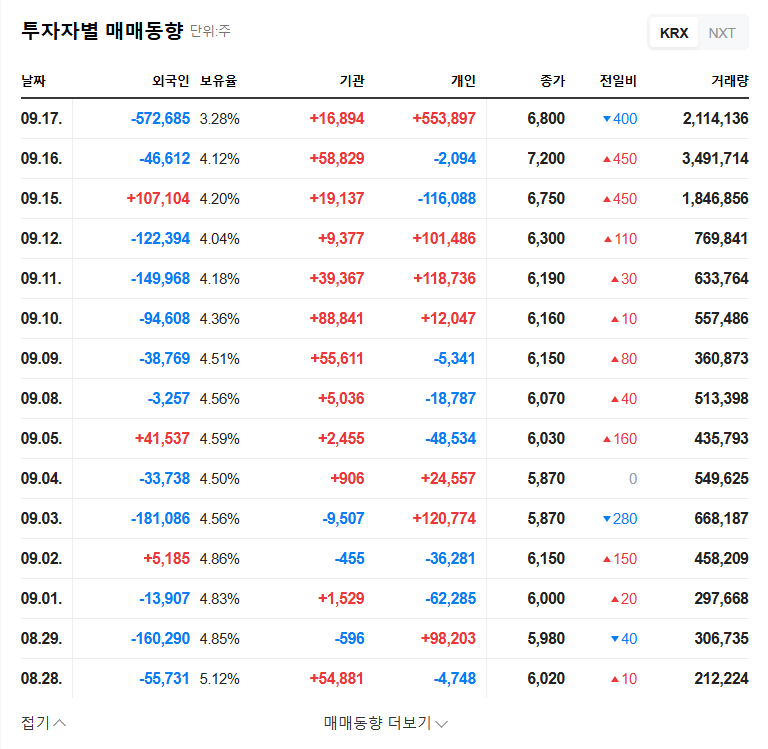
    • Potential Price Drop: The increased supply of shares could put downward pressure on the stock price in the short term.
    • Investor Sentiment: Raising funds for ‘operating expenses’ might raise concerns about the company’s financial health.

    Long-Term Impact:

    • Positive Scenario: If the funds are successfully invested in new businesses, it could lead to enhanced future growth, improved performance, and ultimately, a higher stock price.
    • Negative Scenario: If performance doesn’t improve after the repurchase, or if investments in new businesses falter, the stock price could be negatively impacted.

    4. What Should Investors Do?

    Rather than focusing solely on the repurchase itself, investors should closely monitor Bioplus’s specific plans for the funds and the subsequent results. Consider the company’s growth strategy, global competitiveness, and short-term profitability when making investment decisions. Pay particular attention to the performance of new business investments.

    What is the size of Bioplus’s stock repurchase?

    ₩10.5 billion in common stock and ₩7.5 billion in preferred stock.

    What is the purpose of the stock repurchase?

    To secure operating and facility funds.

    How will the stock repurchase affect the share price?

    While there may be downward pressure on the stock price in the short term, the long-term impact will depend on the success of investments in new businesses.

    Bioplus Stock Repurchase: Short-term Pain, Long-term Gain? 관련 이미지
    Bioplus Stock Repurchase: Short-term Pain, Long-term Gain? 관련 이미지
  • Bioplus: Jeong Hyeon-gyu Reduces Stake by 1.05% – What Investors Need to Know


    Bioplus: Jeong Hyeon-gyu Reduces Stake by 1.05% - What Investors Need to Know 대표 차트 이미지


    What Happened?

    On September 2, 2025, Jeong Hyeon-gyu, a major shareholder of Bioplus, sold 1.05% of his stake. This sale, conducted for ‘management influence’ purposes, was facilitated by J One Global Co., Ltd.’s over-the-counter purchase. This decreased Jeong’s stake from 30.47% to 29.42%.

    Why Does This Matter?

    Changes in major shareholder stakes can be interpreted as important signals about a company’s management and future direction. A stake sale for ‘management influence’ purposes, in particular, can create uncertainty for investors. However, the fact that J One Global Co., Ltd. made the purchase suggests there may be more to this than a simple sale.

    So, What’s Next for Bioplus?

    • Short-term Impact: Jeong Hyeon-gyu’s stake sale could put downward pressure on the stock price in the short term. The possibility of investor sentiment weakening should also be considered.
    • Long-term Impact: While the projected return to operating profit in 2025 is positive, the continued net loss and increasing debt ratio are concerns. The success of Bioplus’s next-generation new business pipeline will be crucial for long-term growth.

    What Should Investors Do?

    • Short-term Investment Strategy: A conservative investment strategy is recommended, keeping in mind the possibility of a stock price decline. It’s wise to stay on the sidelines and observe the trend.
    • Long-term Investment Strategy: Investors should carefully monitor the progress of the new business pipeline, improvements in earnings, and any further changes in major shareholder stakes before making investment decisions.

    This analysis is for investment reference only, and the responsibility for investment decisions lies with the individual investor.


    FAQ

    Why did Jeong Hyeon-gyu sell his stake?

    According to the public disclosure, the stake change was for ‘management influence’ purposes. The detailed background has not yet been revealed.

    What is Bioplus’s financial status?

    Bioplus recorded losses in both 2023 and 2024, but is expected to return to operating profit in 2025. However, the company is still projected to record a net loss, and the increasing debt ratio is a concern.

    What should investors be cautious about?

    In the short term, investors should be wary of the possibility of a stock price decline due to the stake sale. In the long term, they should continuously monitor the progress of the new business pipeline, earnings improvement, and any further changes in major shareholder stakes.


    Bioplus: Jeong Hyeon-gyu Reduces Stake by 1.05% - What Investors Need to Know 관련 이미지
    Bioplus: Jeong Hyeon-gyu Reduces Stake by 1.05% - What Investors Need to Know 관련 이미지


  • Bioplus (099430) Q2 2025 Earnings Analysis: Below Expectations, What’s Next?

    1. Bioplus Q2 Earnings: Key Highlights

    Bioplus’s Q2 2025 earnings significantly missed market expectations. Revenue came in at ₩20.6 billion, 10.43% lower than anticipated. Operating profit was particularly weak at ₩2 billion, a staggering 70.15% below expectations. Net income also underperformed, reaching ₩3.4 billion, or 39.29% below estimates. Increased R&D and marketing expenses are identified as key factors contributing to the profit decline.

    2. Reasons for Underperformance: Why Did Bioplus Miss Expectations?

    While the HA filler segment maintained decent growth, it wasn’t enough to offset the overall underperformance. The medical device and cosmetics segments showed growth potential, but their revenue contributions remain limited. Increased R&D investment and marketing expenses weighed on profitability. Global economic volatility and intensifying competition also played a role.

    3. Future Outlook and Investment Strategies: How Should Investors Respond?

    Downward pressure on the stock price is expected in the short term, necessitating a conservative investment approach. For the mid-to-long term, investors should monitor the success of new pipelines, cost efficiency measures, and the performance of business diversification efforts. The second half earnings performance and the progress of R&D pipelines will be crucial factors in investment decisions. Managing exchange rate volatility and monitoring the growth of new business segments are also essential.

    4. Key Checkpoints for Investors

    • H2 2025 Earnings Performance
    • R&D Pipeline Progress
    • Exchange Rate Volatility Management
    • New Business Segment Growth
    Why did Bioplus’s Q2 earnings fall short of expectations?

    Increased R&D investment, higher marketing expenses, global economic volatility, and intensifying competition are the main factors.

    What are Bioplus’s future investment strategies?

    A conservative approach is recommended in the short term. Mid-to-long term, focus on new pipelines, cost efficiency, and business diversification.

    What should investors consider when investing in Bioplus?

    Monitor H2 2025 earnings, R&D pipeline progress, exchange rate volatility, and the growth of new business segments.