Tag: 323410

  • (323410) KakaoBank Corp. NDR: A Deep Dive into its Global Growth Strategy & Stock Potential

    (323410) KakaoBank Corp. NDR: A Deep Dive into its Global Growth Strategy & Stock Potential

    The recent KakaoBank Corp. NDR (Non-Deal Roadshow) for international institutional investors marks a pivotal moment for South Korea’s leading digital finance powerhouse. This strategic event, held on November 17, 2025, is more than a simple presentation; it’s a calculated move to showcase the company’s robust value proposition and ambitious future growth strategy to a global audience. For investors, understanding the nuances of this roadshow is key to unlocking insights into KakaoBank’s stock potential and its long-term trajectory in the competitive fintech landscape. This event was formally announced in an Official Disclosure, underscoring its significance.

    In this comprehensive analysis, we will deconstruct the core pillars of KakaoBank’s appeal, from its formidable fundamentals and AI-driven innovations to its platform expansion strategies. We’ll also explore the potential impacts of the NDR on corporate value and provide a strategic outlook for prudent investors.

    Deconstructing KakaoBank’s Core Strengths

    To captivate global investors, KakaoBank is highlighting a trifecta of strengths: a massive user base, technological leadership, and impeccable financial health. These are not just talking points; they are the foundational columns supporting its entire growth narrative.

    1. Unparalleled Customer Base & Platform Dominance

    KakaoBank’s growth is fundamentally anchored by its vast and highly engaged user base. With over 20 million Monthly Active Users (MAU) and total deposits soaring to KRW 65.7 trillion, the bank has achieved a scale that traditional institutions envy. This success is a direct result of its hyper-focus on a seamless user experience (UX/UI) and innovative product development. The platform’s expansion into brokerage services (7.07 million accounts) and loan comparison platforms further solidifies its ecosystem, creating multiple revenue streams and increasing customer lifetime value. For a deeper look at market trends, see this fintech industry analysis.

    2. Pioneering AI in Digital Finance

    A key focus of the KakaoBank Corp. NDR is its leadership in Artificial Intelligence. The bank is embedding AI across its services to enhance both security and customer convenience. Innovations like ‘AI Smishing Message Verification’ protect users from fraud, while ‘AI Search’ and ‘AI Financial Calculators’ provide personalized and intuitive experiences. This commitment to technology is not just about improving existing services; it’s about building a future-proof banking platform that can adapt and lead in the fast-evolving world of digital finance.

    “The future of banking isn’t in physical branches; it’s in the palm of your hand, powered by intelligent, data-driven platforms that anticipate your needs. This is the competitive edge that tech-first institutions like KakaoBank are building.”

    3. A Fortress of Financial Stability

    Despite its rapid growth, KakaoBank maintains exceptional financial health. Its BIS total capital ratio of 23.85% significantly exceeds regulatory requirements, signaling a stable and well-managed financial position. Furthermore, its ability to attract low-cost demand deposits (83.96% of total) provides a substantial competitive advantage, lowering its cost of funding and boosting profitability. This financial prudence is a critical message for risk-averse international investors.

    Navigating the Headwinds: Risks and Challenges

    While the outlook is promising, investors must consider potential risks. The South Korean market is facing intensifying competition, with the potential entry of new internet-only banks and the aggressive expansion of other big tech players. Additionally, macroeconomic uncertainties, including rising household debt and currency volatility, could impact loan quality and overall profitability. Careful management of its corporate loan portfolio will be crucial in navigating these challenges.

    Impact of the NDR on KakaoBank Stock

    A successful NDR can serve as a powerful catalyst for KakaoBank stock. By clearly communicating its KakaoBank growth strategy and building trust, the company can attract significant foreign investment, leading to positive stock price momentum. However, there are potential downsides. If the presentation fails to meet lofty market expectations, it could trigger a sell-off. As with any investment, a prudent approach is necessary, and further research can be found in our detailed market overview.

    Investment Outlook: Key Considerations

    For those considering an investment in KakaoBank, the post-NDR period will be critical for observation. We recommend focusing on the following areas:

    • International Investor Reaction: Monitor reports and analyst ratings from global institutions following the KakaoBank Corp. NDR to gauge sentiment.
    • AI Service Monetization: Track the actual revenue contribution and performance metrics of new AI-based financial products.
    • Platform Growth Metrics: Continue to assess the expansion and monetization of its platform businesses, such as brokerage and loan comparisons.
    • Macroeconomic Indicators: Stay informed about changes in interest rates and exchange rates that could impact KakaoBank’s fundamentals.

    In conclusion, the KakaoBank Corp. NDR is a crucial step in its journey to become a global fintech leader. By effectively showcasing its strengths and future vision, the company has the potential to unlock significant corporate value and deliver long-term returns for discerning investors.

    (323410) KakaoBank Corp. NDR: A Deep Dive into its Global Growth Strategy & Stock Potential 관련 이미지
  • (323410) KakaoBank Corp. IR Event 2025: A Complete Investor’s Guide to Growth & Strategy

    (323410) KakaoBank Corp. IR Event 2025: A Complete Investor’s Guide to Growth & Strategy

    On November 11, 2025, a significant event for the fintech sector is set to unfold: the KakaoBank Corp. IR (Investor Relations) event. As South Korea’s preeminent online-only bank, this Non-Deal Roadshow (NDR) for institutional investors is more than a standard update; it’s a critical look into the engine room of a digital banking giant. For current and prospective investors, this event presents a pivotal opportunity to assess KakaoBank’s performance, understand its future trajectory, and gain clarity on its strategy amidst a dynamic economic landscape. This comprehensive guide will analyze the bank’s fundamentals, explore the potential impacts of the IR, and outline the key observation points every investor needs to watch.

    The Significance of the KakaoBank Corp. IR Event

    KakaoBank has consistently disrupted traditional banking with its user-centric platform and massive customer base. With a market capitalization already exceeding 10 trillion KRW, the upcoming KakaoBank Corp. IR event is drawing intense market attention. This session provides a direct line of communication, allowing management to articulate their vision and address investor concerns head-on. The official announcement, available on Korea’s DART system, sets the stage for a deep dive into the company’s strategic roadmap. You can view the Official Disclosure here. For investors, this isn’t just about numbers; it’s about understanding the narrative and the leadership’s confidence in navigating future challenges and opportunities.

    This IR event is a crucial test of transparency and forward-thinking strategy. The market will be listening for concrete plans, not just optimistic projections, particularly regarding AI monetization and capital adequacy.

    Analyzing KakaoBank’s Financials & Growth Engines

    Before the IR event, a firm grasp of KakaoBank financials is essential. The bank’s performance in the first half of 2025 demonstrates a foundation of solid, continued growth. Total assets swelled to 71.9 trillion KRW, a 14.5% increase, fueled by a robust 15.8% rise in deposit liabilities. This indicates strong customer trust and an expanding user base. More importantly, net profit climbed by 13.9% to 263.7 billion KRW, proving that its model is not just popular but also profitable.

    Key Performance Indicators to Watch

    While the headline numbers are strong, savvy investors will look deeper. Here are the core metrics that paint a detailed picture of the bank’s health:

    • Capital Adequacy: A BIS Total Capital Ratio of 25.45% is well above regulatory requirements, signifying stability. However, investors will be keen to hear about strategies to manage its slight declining trend. For more on this, you can read about understanding bank capital ratios.
    • Asset Quality: With a Non-performing Loan (NPL) ratio of just 0.54% and a robust Loan Loss Reserve Ratio of 219.07%, KakaoBank demonstrates excellent risk management.
    • Profitability Diversification: While the Net Interest Margin (NIM) saw a slight dip, Non-interest Income grew by 8.3%. This is a critical sign of a successful platform strategy, reducing reliance on traditional lending.

    The Competitive Edge: Technology and User Base

    KakaoBank’s true moat lies in its unparalleled user engagement. With nearly 20 million Monthly Active Users (MAU) and an industry-leading UX/UI, its platform is sticky and efficient. The bank’s forward-looking adoption of AI for services like phishing detection and enhanced search is a key part of its KakaoBank growth strategy, promising to secure future revenue streams and operational efficiencies.

    Investor Action Plan: Critical Questions for the IR

    The success of a KakaoBank investment hinges on the answers to tough questions. The IR event’s impact—whether positive or negative—will depend on how effectively management addresses the market’s key concerns. A clear, convincing presentation could boost investor sentiment, while ambiguity could lead to short-term pressure on the stock.

    Here are the pivotal questions investors hope to have answered:

    • AI Monetization: What are the specific, actionable business models that will turn AI capabilities into tangible revenue?
    • Macroeconomic Resilience: What are the bank’s defensive strategies against interest rate volatility and a potential economic slowdown?
    • Competitive Landscape: How will KakaoBank maintain its edge against intensifying competition, including the potential entry of a fourth South Korean online bank?
    • Shareholder Returns: What are the long-term plans for dividends and other shareholder return policies?

    Ultimately, the market’s reaction will hinge on the credibility and detail of the vision presented. A strong performance at the IR could reinforce KakaoBank’s position as a premier fintech investment, while a lackluster one could invite skepticism. For more on market analysis, high-authority sources like Bloomberg offer valuable global perspectives.

    Frequently Asked Questions

    When is the KakaoBank Corp. IR event?

    The Investor Relations (IR) event for KakaoBank Corp. is scheduled for November 11, 2025.

    What is the primary objective of this IR event?

    The main goal is to communicate directly with domestic institutional investors, sharing detailed information on KakaoBank’s business status, financial results, and strategic plans for future growth.

    What are KakaoBank’s key future growth drivers?

    KakaoBank’s future growth hinges on leveraging its massive customer base to expand platform partnership services and integrating advanced AI technology to enhance service offerings and operational efficiency.

    (323410) KakaoBank Corp. IR Event 2025: A Complete Investor's Guide to Growth & Strategy 관련 이미지
  • (323410) KakaoBank Corp. Value-Up Plan: A 2025 Deep Dive for Investors

    (323410) KakaoBank Corp. Value-Up Plan: A 2025 Deep Dive for Investors

    KakaoBank Corp., a trailblazer in South Korea’s digital finance sector, has unveiled its comprehensive KakaoBank Corp. Value-Up Plan, a strategic roadmap designed to bolster corporate value and enhance shareholder returns. This pivotal announcement offers investors a clear window into the company’s future ambitions, from pioneering AI-native banking to aggressive platform expansion. In this detailed analysis, we will unpack the core components of this plan, evaluate its potential market impact, and outline key considerations for anyone looking at a KakaoBank investment.

    KakaoBank’s latest disclosure signals a clear commitment to not just maintaining its market leadership but actively redefining the future of digital banking through technology and a robust shareholder-focused strategy.

    Deconstructing the KakaoBank Corp. Value-Up Plan

    On November 5, 2025, KakaoBank Corp. provided a voluntary disclosure detailing the execution status of its enterprise value enhancement initiatives. This wasn’t merely a financial update; it was a foundational statement on the company’s long-term vision. The full report can be viewed via the official Official Disclosure. The plan is built on three core pillars:

    • Value-Up Growth Framework: A comprehensive review of key performance indicators, including customer acquisition, Monthly Active Users (MAU), asset growth, and profitability metrics like ROE.
    • Strategic Business Directions: Detailing the performance and future plans for its core loan and deposit businesses, Fee & Platform revenue streams, and the ambitious transition towards an ‘AI Native Bank’.
    • Enhanced Shareholder Returns: A clear commitment to strengthening shareholder value through transparent communication and a progressive dividend policy.

    Why This Plan Matters: Growth Drivers & Financial Health

    This disclosure reaffirms the solid fundamentals underpinning KakaoBank’s success and provides a blueprint for its next evolutionary phase. The KakaoBank growth strategy is multi-faceted and aggressive.

    1. Unstoppable Platform Growth

    With 25.86 million customers and 19.64 million MAU, KakaoBank’s reach is formidable. Its success is rooted in a best-in-class, mobile-first user experience that continues to attract new users. Beyond core banking, its platform business is thriving, with 7.02 million stock accounts opened and 12.8 trillion KRW in facilitated loan comparisons. This diversification is crucial for building sustainable, high-margin revenue streams independent of interest income.

    2. The ‘AI Native Bank’ Transition

    KakaoBank is not just adopting AI; it’s embedding it into its DNA. The transition to an ‘AI Native Bank’ involves leveraging artificial intelligence across all operations. This includes AI-powered smishing detection services, intelligent search functions, and AI-driven financial calculators for users. Internally, AI will optimize credit scoring models, personalize product recommendations, and enhance fraud detection, securing a significant technological edge over traditional competitors and other internet-only bank players.

    3. Fortified Financial Soundness

    Beneath the innovative surface lies a remarkably stable financial core. KakaoBank boasts a BIS capital ratio of 25.45% (well above regulatory requirements) and an exceptional Liquidity Coverage Ratio (LCR) of 806.66%. Profitability is on an upward trend, with a Return on Equity (ROE) of 8.09%. This financial stability provides the foundation needed to pursue its ambitious growth plans while simultaneously expanding its shareholder return program, which aims for a 50% payout ratio upon further BIS ratio improvement.

    Market Impact and Potential Risks

    The KakaoBank Corp. Value-Up Plan is expected to bolster investor confidence. However, a balanced KakaoBank stock analysis requires acknowledging potential headwinds.

    Positive Catalysts

    • Enhanced Trust: Transparency around growth strategies and shareholder returns fosters investor confidence.
    • Competitive Moat: Deepening its AI capabilities strengthens its competitive advantage and creates a higher barrier to entry.
    • Value-Up Program Alignment: The plan aligns with the government-led ‘Corporate Value-up Program,’ potentially attracting institutional investment.

    Risk Factors to Monitor

    • Execution Risk: The company’s value will ultimately depend on its ability to execute its ambitious plans and meet its stated targets.
    • Macroeconomic Headwinds: As noted by financial analysts at leading institutions like Bloomberg, global interest rate volatility and currency fluctuations (USD/KRW at 1,444.00) pose a risk to net interest margins and asset quality across the banking sector.
    • Intensifying Competition: The potential entry of new internet-only banks could pressure market share and profitability.

    Investor Action Plan & Conclusion

    This disclosure is a significant positive for KakaoBank, confirming its long-term potential. Investors should focus on monitoring the tangible outcomes of the KakaoBank Corp. Value-Up Plan. Keep a close watch on quarterly reports to track progress against core objectives, observe how management navigates the macroeconomic landscape, and assess the real-world implementation of its shareholder return policies. While risks exist, KakaoBank’s innovative vision, dominant market position, and clear strategic direction make it a compelling entity in the evolving world of finance.

    (323410) KakaoBank Corp. Value-Up Plan: A 2025 Deep Dive for Investors 관련 이미지
  • (323410) KakaoBank Q3 2025 Earnings: A Deep Dive Analysis & Stock Forecast

    (323410) KakaoBank Q3 2025 Earnings: A Deep Dive Analysis & Stock Forecast

    The initial report on the KakaoBank Q3 2025 earnings sent a wave of concern through the market. With key profitability metrics falling short of analyst consensus, investors are questioning whether this is a minor hiccup or a sign of more significant headwinds for the digital banking giant. This comprehensive KakaoBank stock analysis examines the performance drivers, underlying risks, and long-term growth prospects to provide a clear roadmap for what’s next.

    KakaoBank Q3 2025 Earnings Report: The Numbers

    According to its preliminary earnings announcement, KakaoBank Corp. posted a Q3 2025 revenue of KRW 764.7 billion. However, the figures that caught investors’ attention were the operating profit of KRW 151.1 billion and a net profit of KRW 111.4 billion. These results were both approximately 7% below market expectations, signaling a continued downward trend in profitability from previous quarters. The slight quarter-on-quarter revenue decrease further fuels concerns about the bank’s near-term growth trajectory. For a detailed breakdown, investors can consult the Official Disclosure filed with DART.

    Why the Miss? Analyzing the Headwinds

    The disappointing results weren’t caused by a single issue but rather a combination of internal fundamental pressures and a challenging macroeconomic landscape.

    Fundamental and Risk Factors

    • Declining Profitability Metrics: A key area of concern is the compression of the Net Interest Margin (NIM), which measures the difference between interest income and interest paid out. This downward trend, a crucial indicator of a bank’s core profitability, suggests increasing pressure on margins. You can learn more about how to analyze banking metrics in our guide to financial stock analysis.
    • Rising Corporate Loan Delinquency: The year-on-year increase in the delinquency rate for corporate loans is a red flag. It highlights the growing need for stringent risk management to maintain the health of KakaoBank’s expanding corporate loan portfolio.
    • Decreasing Capital Adequacy: While attributable to business expansion, the year-on-year drop in the BIS Total Capital Ratio requires close monitoring. Future capital injection plans will be critical to support growth without compromising financial stability.

    Macroeconomic and Market Pressures

    External factors have created a difficult operating environment for the entire banking sector:

    • Interest Rate Volatility: Rising global benchmark rates and unpredictable government bond yields are directly squeezing bank margins like KakaoBank’s NIM.
    • Household Debt & Consumption: Growing concerns over high levels of household debt in Korea and a corresponding slowdown in consumer spending could negatively impact loan quality and growth across the industry.

    While the Q3 2025 earnings report presents short-term challenges, it’s crucial for investors to look beyond the immediate numbers and evaluate the long-term strategic initiatives that could redefine KakaoBank’s future.

    The Bull Case: KakaoBank’s Long-Term Growth Engines

    Despite the current headwinds, KakaoBank Corp. holds several powerful strategic advantages that form a strong foundation for future growth and improved KakaoBank profitability.

    • AI-Powered Innovation: The company’s focus on leveraging AI for everything from credit scoring to personalized financial products is a key differentiator that can enhance efficiency and customer experience.
    • Platform Expansion: Diversifying its service portfolio with offerings like the MMF Box investment service strengthens the app’s ecosystem, increasing customer engagement and creating a powerful lock-in effect.
    • Robust Financial Health: Despite recent decreases, the bank’s overall BIS capital ratio and Liquidity Coverage Ratio (LCR) remain stable, providing a solid buffer against potential market shocks.
    • Global Expansion: Securing a virtual bank license in Thailand is a significant first step into overseas markets, opening up new, high-growth revenue streams beyond Korea. For more information on market trends, see the latest from authoritative financial news sources.

    Investment Outlook & Action Plan

    The KakaoBank Q3 2025 earnings miss has understandably created short-term negative sentiment. The current investment recommendation is to maintain a ‘Neutral’ stance. The key is to avoid overreacting to one quarter’s results and instead focus on monitoring key performance indicators that will shape the company’s long-term value.

    Key Factors for Investors to Monitor:

    • Profitability Initiatives: Watch for tangible results from efforts to improve NIM, manage the corporate loan portfolio, and successfully monetize new AI-driven services.
    • Macroeconomic Shifts: Keep an eye on central bank policies regarding interest rates, inflation trends, and the overall pace of economic recovery.
    • Competitive Landscape: Observe KakaoBank’s strategic responses to intensifying competition, including from potential new digital banking entrants.
    • Overseas Performance: Track the progress and success of the new venture in Thailand, as this will be a major indicator of its global scalability.

    (323410) KakaoBank Q3 2025 Earnings: A Deep Dive Analysis & Stock Forecast 관련 이미지
  • (323410) KakaoBank Q3 2025 Earnings: A Deep Dive for Investors | AI & Global Growth Analysis

    (323410) KakaoBank Q3 2025 Earnings: A Deep Dive for Investors | AI & Global Growth Analysis

    The upcoming KakaoBank Q3 2025 earnings announcement, scheduled for November 5, 2025, is more than just a financial report; it’s a critical inflection point for investors. This event will provide a crucial glimpse into the company’s trajectory as it navigates a dynamic financial landscape, doubling down on its identity as an ‘AI Native Bank’ and accelerating its global expansion. This comprehensive KakaoBank investment analysis will dissect the fundamentals, explore potential outcomes, and offer a clear action plan for investors looking to make informed decisions.

    Understanding the Stakes: Why This Earnings Call Matters

    Following a robust performance in the first half of 2025, the market is keenly watching to see if KakaoBank can sustain its growth momentum. The KakaoBank Q3 2025 earnings call is pivotal for two key reasons: it will be the first major progress report on its ambitious AI strategy, and it will offer concrete details on its foray into international markets. The results will not only impact KakaoBank stock but also set the tone for the competitive South Korean neobank sector, where rivals like Toss Bank and K-Bank are also vying for market share.

    Will KakaoBank’s investments in technology and global reach translate into sustainable, long-term shareholder value? This Q3 report will provide the first substantial clues.

    A Look Under the Hood: KakaoBank’s Core Fundamentals

    Before looking ahead, it’s essential to understand the solid foundation KakaoBank has built. As of its H1 2025 report, the company’s strength lies in several key areas:

    Unmatched Platform Power & AI Innovation

    KakaoBank’s primary advantage is its massive user base, with nearly 20 million Monthly Active Users (MAU). This is not just a number; it represents a deep moat built on the network effects of the Kakao ecosystem. The company is now leveraging this advantage to execute its KakaoBank AI Native Bank transformation, aiming to integrate artificial intelligence into every facet of its operations—from AI-powered financial calculators and smishing detection to hyper-personalized loan offers and predictive wealth management advice. This strategy is central to its future competitiveness.

    Robust Financial Health & Profitability

    Financial stability is paramount. KakaoBank maintains an exceptionally high level of financial health, evidenced by a BIS total capital ratio of 25.45% and a Liquidity Coverage Ratio (LCR) of 806.66%. These figures, which significantly exceed regulatory requirements, showcase prudent management and a strong capacity to absorb economic shocks. For detailed figures, investors can refer to the Official Disclosure (DART). Despite slight pressure on its Net Interest Margin (NIM), which stands at a competitive 2.00%, the bank continues to deliver solid profitability.

    Analyzing the Q3 Impact: Bull vs. Bear Scenarios

    The KakaoBank Q3 2025 earnings report will likely push the stock in one of two directions based on the following potential catalysts and headwinds.

    The Bull Case: Positive Catalysts

    • Exceeding Earnings Expectations: If Q3 profits beat analyst consensus, driven by strong loan growth and successful NIM management, it will reaffirm the bank’s core earning power and boost investor confidence significantly.
    • Clear Global Strategy Roadmap: Concrete details on market entry into regions like Southeast Asia, including partnerships or license acquisitions, would validate the KakaoBank growth strategy and provide a tangible long-term growth narrative.
    • Enhanced Shareholder Returns: Any announcement of an increased dividend or share buyback program would be a strong signal of management’s confidence and could make the stock more attractive to value-oriented investors.

    The Bear Case: Potential Headwinds

    • Growth Slowdown or Margin Compression: An unexpected miss on earnings or signs of a significant slowdown could trigger concerns about market saturation. Greater-than-expected NIM pressure due to macroeconomic factors, as often reported by sources like Reuters, would also be a major concern.
    • Uncertainty in New Ventures: If the monetization of AI services appears slow or if global expansion faces unforeseen hurdles, doubts could arise about the long-term growth engines, potentially leading to a re-evaluation of the company’s premium valuation.
    • Regulatory Changes: Increased scrutiny from financial authorities or the introduction of new regulations targeting fintech platforms could create operational uncertainty and weigh on investor sentiment.

    Investor Action Plan & Final Take

    For those conducting a KakaoBank investment analysis, the key is to look beyond the headline numbers. During the earnings call, focus on management’s commentary on key performance indicators. To dive deeper, consider our guide on how to evaluate modern fintech stocks.

    Ultimately, KakaoBank’s powerful brand, massive user base, and innovative spirit position it well for the future. The KakaoBank Q3 2025 earnings will be a crucial test of its ability to execute on its ambitious vision. While we maintain a long-term positive outlook, investors should carefully scrutinize the report for confirmation that the growth story remains firmly on track before making any new investment decisions.

    Disclaimer: This analysis is based on publicly available information, and investment decisions should be made at the investor’s own discretion and responsibility. The content is for informational purposes only and does not constitute financial advice.

    (323410) KakaoBank Q3 2025 Earnings: A Deep Dive for Investors | AI & Global Growth Analysis 관련 이미지
  • KakaoBank Targets Global Investors: An Analysis of its Recent IR and Future Prospects


    KakaoBank Targets Global Investors: An Analysis of its Recent IR and Future Prospects 대표 차트 이미지


    KakaoBank’s IR: What was discussed?

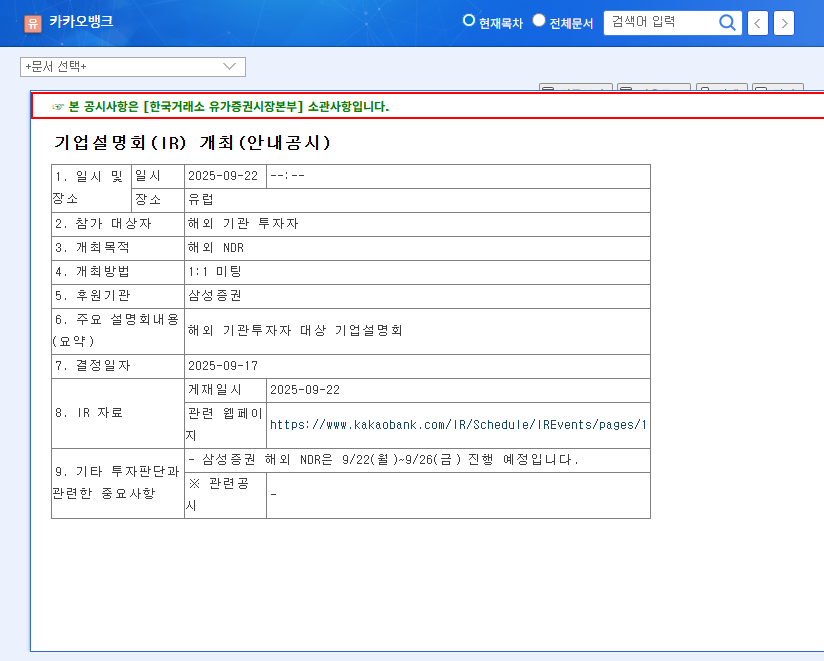
    KakaoBank conducted a Non-Deal Roadshow (NDR) on September 22, 2025, targeting international institutional investors. The primary goal was to showcase the company’s vision, growth potential, and attract investment.

    Strengths and Opportunities for KakaoBank

    • Strong Fundamentals: KakaoBank boasts a robust financial structure with an AA+ credit rating, high capital adequacy ratio, and consistent profitability (ROA 0.78%, ROE 8.09%).
    • Continuous Growth: With 25.86 million customers, KRW 63.7 trillion in deposits, and KRW 44.8 trillion in loans, KakaoBank continues its impressive growth trajectory. The expansion of its platform business also deserves attention.
    • AI-Driven Innovation: Its ‘AI Native Bank’ strategy focuses on expanding AI-powered services to enhance customer experience and lead the future of finance.
    • Competitive Edge: Superior UX/UI, customer-centric product development, and effective IT utilization provide KakaoBank with a distinct competitive advantage.

    Investment Considerations

    • Interest Rate and Economic Volatility: Potential interest rate fluctuations and economic slowdown pose risks to the banking sector as a whole.
    • Intensifying Competition: The internet banking market is becoming increasingly competitive, necessitating continuous innovation.
    • Market Reaction to IR: The stock price may experience volatility if the IR outcomes fail to meet market expectations.

    Action Plan for Investors

    • Carefully analyze the IR presentation and Q&A session.
    • Monitor stock price and trading volume trends following the IR.
    • Consider KakaoBank’s long-term growth potential and potential risks comprehensively.


    Frequently Asked Questions

    What was the purpose of KakaoBank’s IR?

    The IR aimed to present KakaoBank’s current business status and growth strategies to international institutional investors and explore investment opportunities.

    What are KakaoBank’s key competitive advantages?

    KakaoBank’s key strengths include its user-friendly UX/UI, innovative financial products, and AI-powered services.

    What factors should investors consider when evaluating KakaoBank?

    Investors should consider potential interest rate volatility, increasing competition, and the possibility of an economic slowdown.


    KakaoBank Targets Global Investors: An Analysis of its Recent IR and Future Prospects 관련 이미지


  • KakaoBank’s $450 Billion Real Estate Investment: Opportunity or Risk? (Pangyo Tech One Analysis)

    KakaoBank's $450 Billion Real Estate Investment: Opportunity or Risk? (Pangyo Tech One Analysis) 대표 차트 이미지

    1. Why is KakaoBank Investing in Real Estate?

    KakaoBank has decided to invest $450 billion in a real estate fund to acquire the Pangyo Tech One building, aiming to diversify its portfolio and enhance operational returns. This investment represents 6.88% of its equity capital and 0.72% of its total assets.

    2. Opportunity Analysis: Stable Income and Portfolio Diversification

    Pangyo Tech One, located in a prime business district, is expected to generate stable rental income. This investment will also diversify KakaoBank’s asset portfolio, reducing its dependence on specific assets and mitigating risks. In the long term, securing its own office building could enhance operational stability.

    3. Risk Analysis: Market Volatility and Investment Size

    The substantial investment size of $450 billion carries the risk of principal loss if the real estate market declines. Current market uncertainties, high interest rates, and the possibility of an economic slowdown could negatively impact the investment. The large capital outlay might also affect short-term liquidity, and the investment’s classification as non-core business raises questions about resource allocation efficiency.

    4. Market Context and KakaoBank’s Track Record

    Considering the current interest rate environment and real estate market outlook, the Pangyo Tech One investment is expected to have relatively stable demand, but a general market correction cannot be ruled out. Examining KakaoBank’s past asset management performance and declining BIS capital adequacy ratio suggests the need for ongoing monitoring of its capital soundness.

    5. Action Plan for Investors

    While this investment is a strategic decision for long-term portfolio diversification and return enhancement, it requires a cautious approach given the investment size and market conditions. Investors should carefully monitor the fund’s performance, real estate market trends, KakaoBank’s capital adequacy indicators, and its efforts to strengthen its core business competitiveness before making investment decisions.

    What is the purpose of KakaoBank’s investment in Pangyo Tech One?

    To diversify its portfolio and enhance operational returns.

    What is the investment amount and its proportion to equity capital?

    $450 billion, representing approximately 6.88% of its equity capital.

    What are the main risks associated with this investment?

    Real estate market volatility, significant investment size, liquidity impact, and non-core business investment.

    KakaoBank's $450 Billion Real Estate Investment: Opportunity or Risk? (Pangyo Tech One Analysis) 관련 이미지