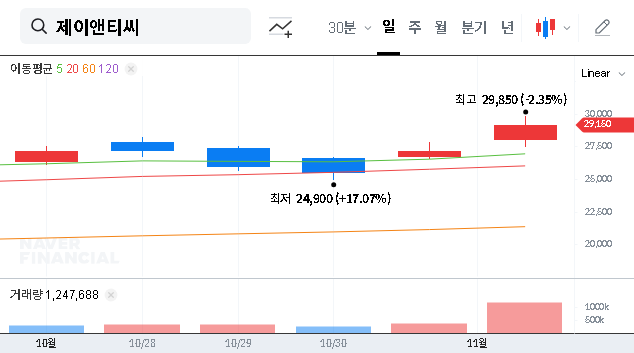
On November 3, 2025, a significant financial maneuver by JNTC CO.,LTD. (204270) sent ripples through the market. The company announced the issuance of a KRW 12.4 billion JNTC exchangeable bond, a strategic decision packed with implications for the company’s future and its shareholders. With unusual terms, including a 0% interest rate and an exchange price dramatically higher than the current stock value, investors are right to ask: What does this mean for my investment? This in-depth JNTC stock analysis will dissect the bond’s details, evaluate the company’s fundamentals, and provide a clear outlook for potential investment strategies.
This report leverages information from the company’s official public filing to explore the long-term significance of this financial event, viewing it not just as a capital raise, but as a critical indicator of JNTC’s growth trajectory and financial resilience.
Deconstructing the JNTC Exchangeable Bond
An exchangeable bond gives the holder the right to exchange the bond for shares of the issuing company’s stock at a predetermined price. It’s a hybrid security that combines features of both debt and equity. To understand this specific JNTC CO.,LTD. investment vehicle, let’s examine the key terms as outlined in the Official Disclosure.
Key Bond Specifications
- •Total Issuance Size: KRW 12.4 billion
- •Issuance Method: Private Placement
- •Interest Rate: 0% coupon and 0% yield to maturity
- •Exchange Price: KRW 32,553
- •Current Stock Price (approx.): KRW 1,613
- •Exchange Period: November 18, 2025, to October 11, 2030
The two most striking features are the 0% interest rate and the enormous gap between the current stock price and the exchange price. A 0% interest rate means JNTC is acquiring KRW 12.4 billion in capital without any immediate interest payment burden, a significant advantage for a company facing financial pressures. However, the high exchange price suggests that bondholders are betting on a massive, long-term appreciation of the 204270 stock price, a scenario that seems distant today.
This bond issuance is a calculated gamble: JNTC secures interest-free capital to fuel a turnaround, while investors make a long-shot bet on the company’s future growth narrative paying off spectacularly.
Why Now? A Fundamental Analysis of JNTC
To understand the urgency behind this move, we must look at JNTC’s recent performance. The 2025 semi-annual report paints a picture of a company at a crossroads. Declining revenues in its core reinforced glass business, coupled with rising costs, have led to a sharp deterioration in profitability and mounting operating losses. This financial strain highlights the critical need for an injection of capital.
Pivoting Towards Future Growth Engines
Despite the challenges, JNTC is not standing still. The company is actively diversifying its portfolio to secure new revenue streams. The capital from the KRW 12.4 billion bond is likely earmarked for these strategic initiatives. Key areas of focus include:
- •Automotive Displays: Development of cover glass for the growing automotive display market.
- •Semiconductor Components: Investment in TGV (Through-Glass Via) glass substrates, a high-potential area linked to advanced semiconductor packaging. For more on this trend, see our latest analysis of the semiconductor industry.
Success in these new ventures could dramatically reshape JNTC’s financial future and justify the optimistic exchange price set for the bond.
Investor Implications: Risk and Reward
For current and prospective shareholders, the JNTC exchangeable bond presents a complex picture. On one hand, it provides immediate financial relief and funds for potentially lucrative new projects. On the other, it introduces the long-term risk of shareholder dilution. If JNTC’s turnaround is successful and the stock price soars past KRW 32,553, bondholders will convert their bonds into new shares, diluting the ownership stake of existing shareholders. To learn more about this financial mechanism, you can read about how exchangeable bonds work on high-authority sites.
The key for investors is to monitor the execution. How effectively will management deploy this new capital? Will the investments in TGV glass and automotive displays generate tangible returns? The answers to these questions will determine whether this bond is a bridge to recovery or simply a temporary stopgap.
Comprehensive Outlook and Final Takeaways
JNTC’s decision to issue this exchangeable bond is a bold strategic move to navigate current financial difficulties while seeding future growth. For investors, the focus should shift from short-term price volatility to long-term fundamentals. The primary determinant of success will be the company’s ability to translate this capital into improved profitability and market leadership in its new ventures. A cautious, fundamentals-driven approach is paramount.
Frequently Asked Questions (FAQ)
What is the JNTC exchangeable bond?
It is a KRW 12.4 billion private placement bond that allows the holder to exchange it for JNTC shares in the future at a price of KRW 32,553. Notably, it carries a 0% interest rate, meaning JNTC doesn’t have to pay interest on the funds raised.
How will this issuance affect JNTC’s stock price?
In the short term, the impact may be muted due to the massive gap between the current stock price and the exchange price. The long-term impact depends entirely on the success of the investments made with the bond proceeds. If new ventures thrive, it could drive significant stock appreciation, though this also brings the risk of future share dilution.
What is JNTC’s current financial situation?
JNTC is facing profitability challenges with declining revenue and operating losses. However, it is strategically investing in new growth areas like automotive display glass and TGV glass substrates for semiconductors to diversify and improve its financial health.
What should investors monitor moving forward?
Investors should focus on three key areas: 1) The company’s progress in its new business ventures and any improvements in profitability. 2) Management’s clear communication and execution of their investment plan. 3) Macroeconomic factors like interest rates and raw material costs that could impact operations.

Leave a Reply