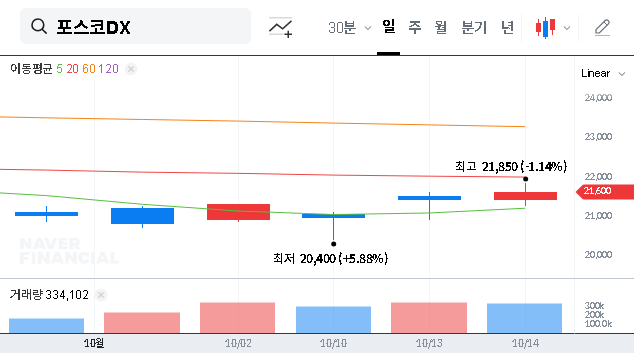
The latest POSCO DX Q3 earnings report for 2025 has sent a mixed but intriguing signal to the market. While revenue saw a slight contraction, a resilient rebound in operating profit highlights the company’s robust operational efficiency and leadership in the Digital Transformation (DX) space. For investors, these figures raise critical questions: Is this a temporary dip or a sign of a slowing growth trajectory? What does this mean for the POSCO DX stock valuation moving forward?
This comprehensive POSCO DX investment analysis meticulously unpacks the Q3 2025 preliminary earnings, examines the core fundamentals driving the company, and assesses the external market challenges. We will provide deep insights into the company’s strategic direction to help you make informed investment decisions.
A Deep Dive into the POSCO DX Q3 Earnings Report
On October 27, 2025, POSCO DX released its preliminary consolidated POSCO DX financial results, providing a crucial snapshot of its performance. These figures are the foundation of our analysis and are sourced directly from the company’s public filing.
Key Q3 2025 Financial Highlights (Consolidated):
- •Revenue: KRW 244.7 billion
- •Operating Profit: KRW 21.7 billion
- •Net Income: KRW 17.4 billion
While revenue declined compared to Q2, the rise in operating profit suggests successful cost management and a focus on higher-margin projects. However, a comparison with Q1 results (Revenue KRW 296.8 billion, Operating Profit KRW 22.9 billion) shows a broader downward trend in top-line growth, a point of concern for investors focused on expansion. These numbers can be verified via the company’s Official Disclosure (DART Source).
Fundamental Analysis: Strengths and Challenges
Core Strengths Fueling Long-Term Growth
Despite short-term revenue fluctuations, POSCO DX is built on a solid foundation of powerful growth engines and excellent financial health.
- •Diversified DX Portfolio: The company benefits from a stable IT service business and is rapidly expanding its high-growth Digital Transformation (DX) offerings. This includes building AI and robot-powered ‘Intelligent Factories’ for the secondary battery sector and enhancing its logistics automation business for major clients like Incheon International Airport.
- •Robust Financial Stability: With a significant order backlog of ~KRW 757.1 billion and cash equivalents of ~KRW 223.3 billion, the company is well-capitalized to navigate market volatility and invest in future growth. Its A2+ corporate bond rating further underscores this financial strength.
- •Technological Edge: Continuous R&D investment, such as the KRW 4.9 billion spent in H1 2025, powers proprietary platforms like the ‘PosFrame’ AI system. This commitment to innovation ensures a competitive advantage in a rapidly evolving tech landscape.
External Headwinds and Potential Risks
No POSCO DX investment analysis would be complete without acknowledging the external risks that could impact future performance.
- •Industry Cyclicality: POSCO DX’s fate is tied to the health of its primary clients in the steel and secondary battery industries. A global economic slowdown or a cooling EV market, as noted in reports from major outlets like Bloomberg, could reduce capital expenditures and thus impact DX project pipelines.
- •Intensifying Competition: The IT service and automation markets are highly competitive. New and existing players could exert downward pressure on pricing, potentially squeezing profit margins if POSCO DX cannot maintain its technological and value-added differentiation.
- •Currency Volatility: Fluctuations in the KRW/USD and KRW/EUR exchange rates pose a tangible risk, particularly for projects with international components, potentially leading to foreign exchange losses as seen in Q1 2025.
Strategic Investment Outlook: Navigating the Future
The immediate market reaction to the POSCO DX Q3 earnings may be muted due to the mixed results. However, savvy investors should look beyond the headline numbers and focus on the strategic drivers that will shape the company’s long-term value.
The key determinant of POSCO DX’s future stock performance will be its ability to translate its new growth initiatives—like 5G private networks and Intelligent Factories—into tangible, revenue-generating successes.
The long-term growth story, heavily intertwined with the POSCO Group’s broader digital transformation strategy, remains compelling. The critical test will be execution. Investors should monitor the progress of new business ventures and the company’s ability to secure large-scale projects that can reignite top-line growth. For a deeper understanding of the sector, consider our guide on evaluating industrial technology stocks.
Conclusion: A Prudent Approach to POSCO DX Stock
POSCO DX stands at a crossroads. Its Q3 2025 earnings demonstrate admirable profitability and operational control but also flag a potential deceleration in revenue growth. The company possesses strong fundamentals, a clear technological vision, and the financial stability to pursue its ambitions.
Investors should adopt a balanced view, weighing the immense long-term potential of the DX market against the immediate macroeconomic and competitive pressures. Success will depend on converting innovative projects into consistent revenue streams and effectively managing external financial risks. Watching for clear signs of new business traction will be paramount in determining the future trajectory of the POSCO DX stock.
Frequently Asked Questions (FAQ)
What were the key takeaways from the POSCO DX Q3 earnings?
POSCO DX reported Q3 revenue of KRW 244.7 billion (a decrease) and an operating profit of KRW 21.7 billion (an increase). This indicates strong profitability management despite a slowdown in sales growth for the quarter.
What are POSCO DX’s primary growth drivers?
The company’s growth is powered by its core IT and automation services, supplemented by high-potential new ventures in AI-driven ‘Intelligent Factories,’ advanced logistics automation, and the rollout of 5G private networks for industrial use.
What are the main risks for investors in POSCO DX stock?
Key risks include dependence on cyclical industries like steel and EVs, intense competition in the tech services market, and financial exposure to currency exchange rate volatility.

Leave a Reply